
Thanksgiving and Turkey The First Thanksgiving Benjamin Franklin

Thanksgiving and Turkey:
The First Thanksgiving § Benjamin Franklin, an admirer of the wild turkey, was disappointed when the bald eagle was chosen as a symbol of the United States of America. § He felt the wild turkey should have been the chosen bird. Franklin called the wild turkey a ". . . more respectable Bird. . . " and ". . . a true original native of North America. "
The First Thanksgiving § Turkeys are large birds, related to pheasants. § Wild turkeys are native to wooded areas of North America. § Turkeys were not mentioned by name in original accounts of the December 1621 Plymouth Thanksgiving celebration. § Wild turkeys would have lived in the surrounding area and may have been included in the fowl eaten at the meal however.
The First Thanksgiving § Thanksgiving did not become a national holiday until 1863 when President Abraham Lincoln proclaimed the last Thursday of November as a national day of thanksgiving. § Later, President Franklin Roosevelt clarified that Thanksgiving should always be celebrated on the fourth Thursday of the month to encourage earlier holiday shopping.
General Turkey Facts § Male turkeys are called toms. Female turkeys are called hens. § Only male turkeys make gobbling sounds. § Wild turkeys eat seeds, acorns, and insects. § Wild turkeys can run and are good fliers. Domesticated turkeys cannot fly. (55 MPH) § Wild turkeys are not as fat as domesticated turkeys.
Domestic Turkeys § Domesticated turkeys are related to Mexican turkeys. § Spanish Conquistadors took Mexican turkeys to Europe in the 16 th century. Turkeys were raised in Europe before the Pilgrims left there. § In this country, the average person in the United States eats almost 19 pounds of turkey each year.
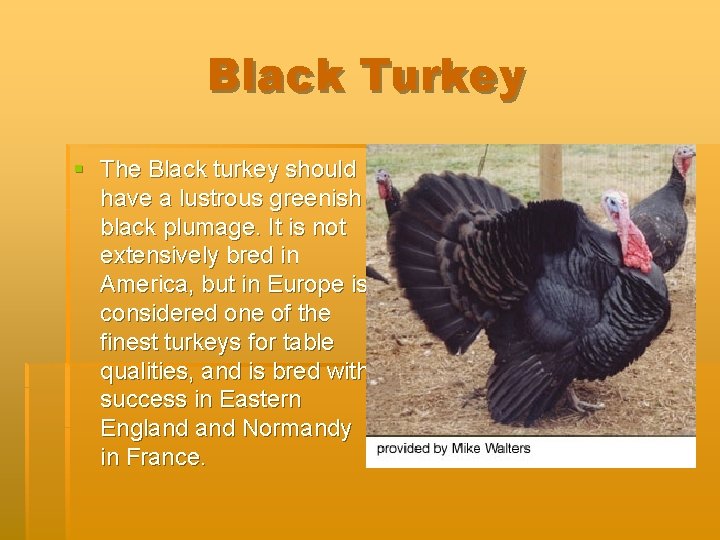
Black Turkey § The Black turkey should have a lustrous greenish black plumage. It is not extensively bred in America, but in Europe is considered one of the finest turkeys for table qualities, and is bred with success in Eastern England Normandy in France.
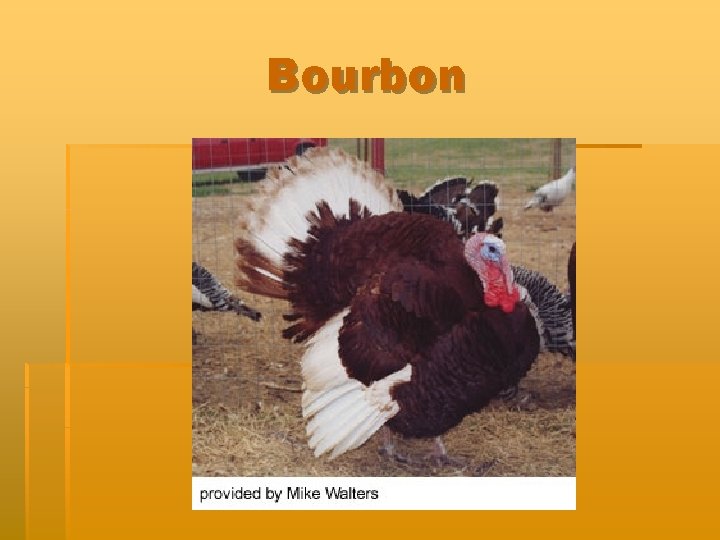
Bourbon
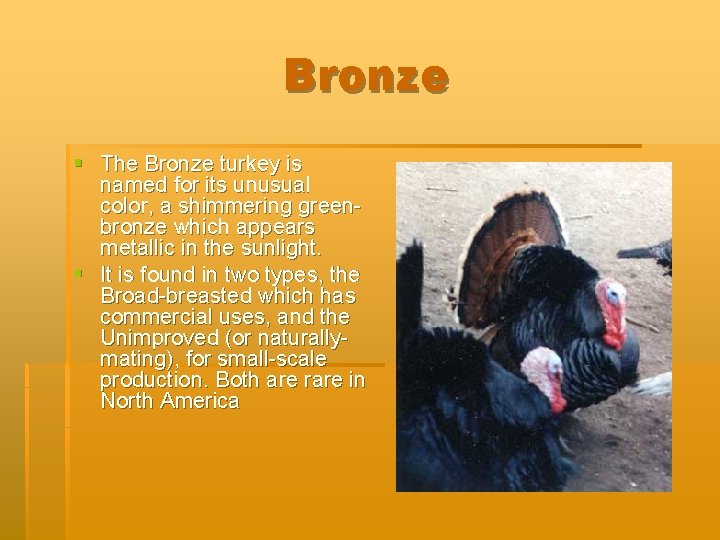
Bronze § The Bronze turkey is named for its unusual color, a shimmering greenbronze which appears metallic in the sunlight. § It is found in two types, the Broad-breasted which has commercial uses, and the Unimproved (or naturallymating), for small-scale production. Both are rare in North America
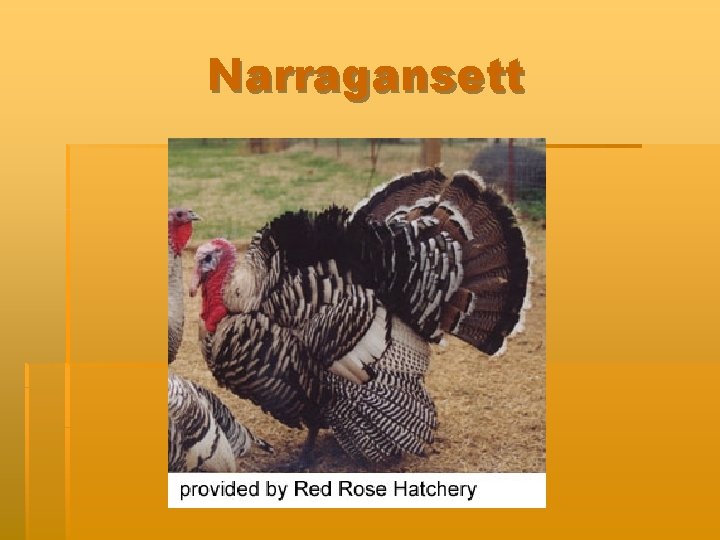
Narragansett
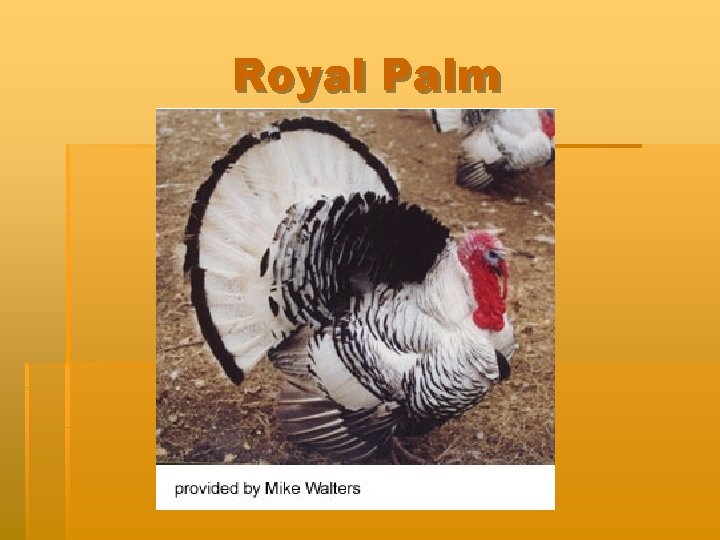
Royal Palm
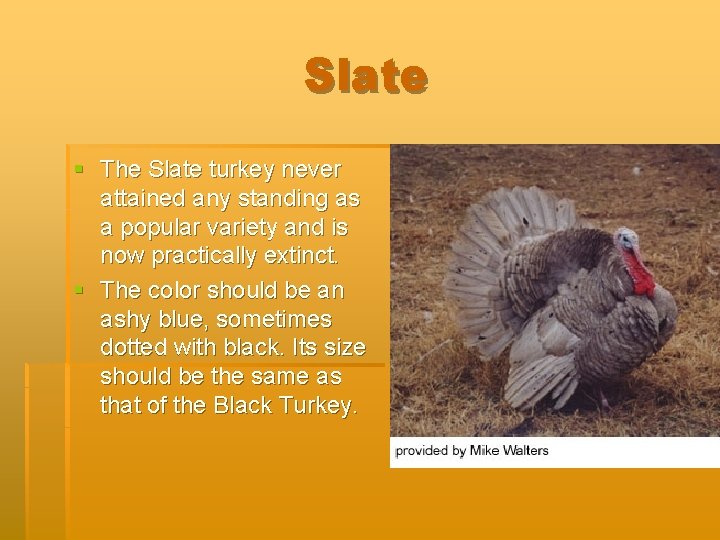
Slate § The Slate turkey never attained any standing as a popular variety and is now practically extinct. § The color should be an ashy blue, sometimes dotted with black. Its size should be the same as that of the Black Turkey.
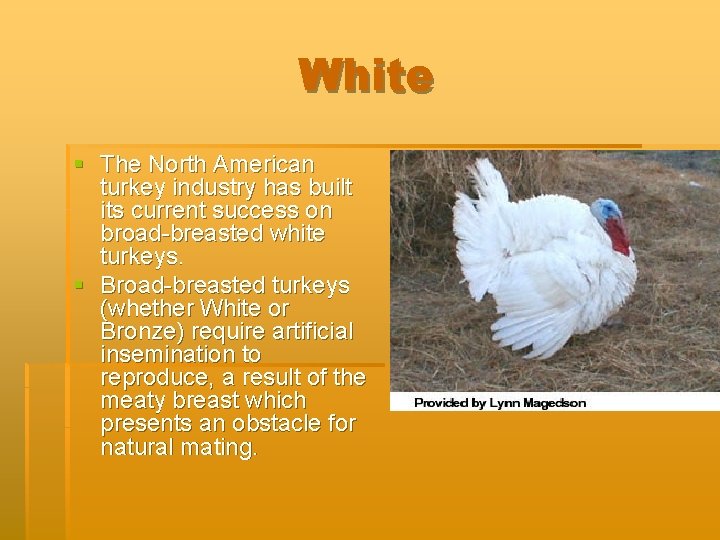
White § The North American turkey industry has built its current success on broad-breasted white turkeys. § Broad-breasted turkeys (whether White or Bronze) require artificial insemination to reproduce, a result of the meaty breast which presents an obstacle for natural mating.
Turkeys Today § 271 million is the preliminary estimate of the number of turkeys raised in the United States in 2007. § The turkeys produced in 2007 weighed 7. 9 billion pounds altogether and were valued at $3. 7 billion.
Turkeys Today § 44. 5 million is the preliminary estimate of the number of turkeys Minnesota expects to raise in 2005. § The Gopher State is tops in turkey production. It is followed by North Carolina, Arkansas, Virginia, Missouri and California. § These six states together will probably account for about 175 million of trhe 271 million turkeys raised in 2007

Turkeys Today § Utah somewhere in the top 20 -30
Turkeys Today § $5. 2 million is the value of U. S. imports of live turkeys during the first half of 2005 — all from Canada. § Our northern neighbors also accounted for all of the cranberries the United States imported. § The Price is Right $1. 00. Cost per pound of a frozen whole turkey in December 2004.
Cranberries § 649 million pounds is the forecast for U. S. cranberry production in 2005, up 5 percent from 2004. § Wisconsin is expected to lead all states in the production of cranberries, with 367 million pounds, followed by Massachusetts, Oregon, New Jersey and Washington.
Pumpkins § 998 million pounds in total pumpkin production of major pumpkin-producing states in 2004. § Illinois, with a production of 457 million pounds, led the country. Pumpkin patches in California, Ohio, Michigan, Pennsylvania and New York also produced a lot of pumpkins.
Sweet Potatoes § 1. 6 billion pounds is the total weight of sweet potatoes — another popular Thanksgiving side dish — produced in the United States in 2004. § North Carolina produced more sweet potatoes than any other state. It was followed by California, Mississippi and Louisiana.
Other Fun Turkey Facts § Wild Turkeys can run 20 MPH § Turkeys’ heads change colors when they become excited. § Turkeys can see in color § Turekys have heart attacks. The United States Air Force was doing test runs and breaking the sound barrier. Nearby turkeys dropped dead with heart attacks.
Other Fun Turkey Facts § There are wild turkeys in every state except Alaska. § Turkey breeding has caused turkey breasts to grow so large that the turkeys fall over. § June is National Turkey Lover’s Month. § Turkeys have over 3500 feathers at maturity.
Turkey Parts § Caruncle: red-pink fleshy growth on the head and upper neck of the turkey § Snood: long, red, fleshy area that grows from the forehead over the bill § Wattle: fleshy growth under a turkey’s throat § Turkey eggs hatch in 28 days.
- Slides: 23