
Thank you for your growth mindset Teacher Planning

- Slides: 21
Thank you for your growth mindset.
Teacher Planning & Collaboration Day Thursday, August 22, 2013
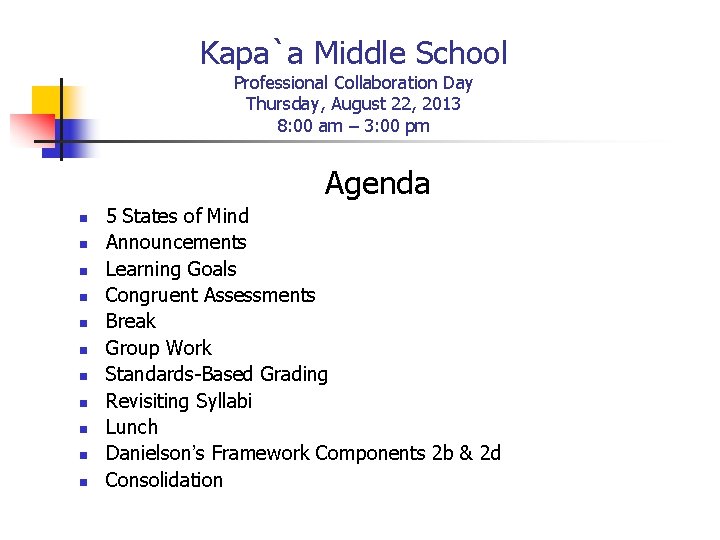
Kapa`a Middle School Professional Collaboration Day Thursday, August 22, 2013 8: 00 am – 3: 00 pm Agenda n n n 5 States of Mind Announcements Learning Goals Congruent Assessments Break Group Work Standards-Based Grading Revisiting Syllabi Lunch Danielson’s Framework Components 2 b & 2 d Consolidation
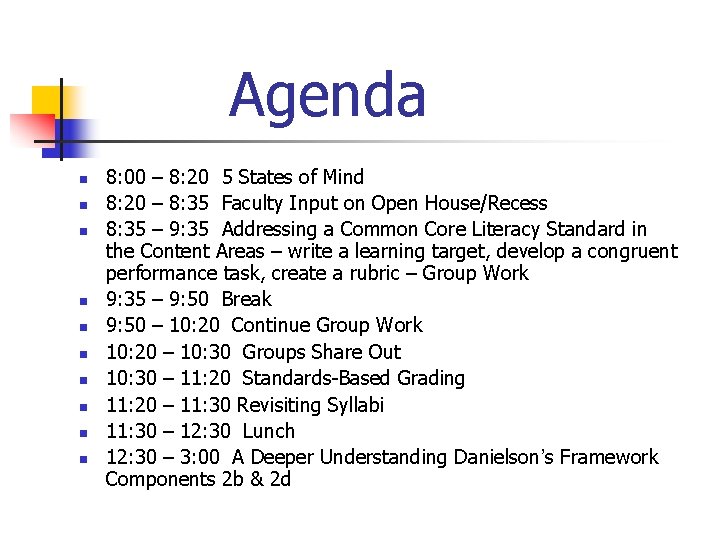
Agenda n n n n n 8: 00 – 8: 20 5 States of Mind 8: 20 – 8: 35 Faculty Input on Open House/Recess 8: 35 – 9: 35 Addressing a Common Core Literacy Standard in the Content Areas – write a learning target, develop a congruent performance task, create a rubric – Group Work 9: 35 – 9: 50 Break 9: 50 – 10: 20 Continue Group Work 10: 20 – 10: 30 Groups Share Out 10: 30 – 11: 20 Standards-Based Grading 11: 20 – 11: 30 Revisiting Syllabi 11: 30 – 12: 30 Lunch 12: 30 – 3: 00 A Deeper Understanding Danielson’s Framework Components 2 b & 2 d
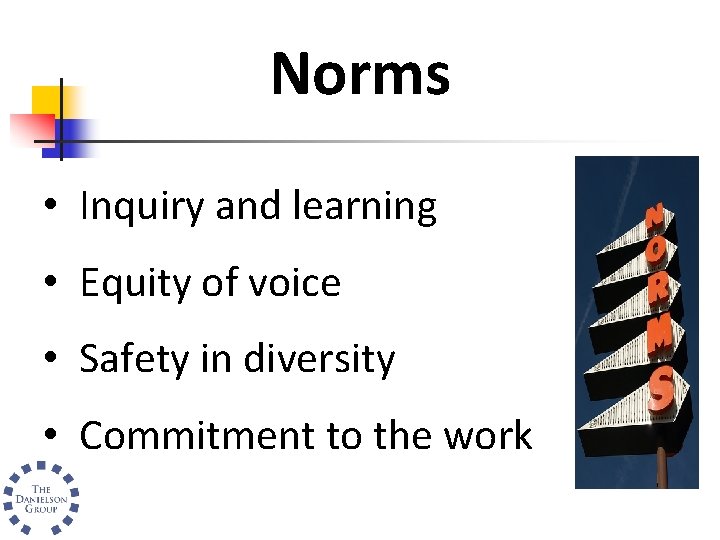
Norms • Inquiry and learning • Equity of voice • Safety in diversity • Commitment to the work
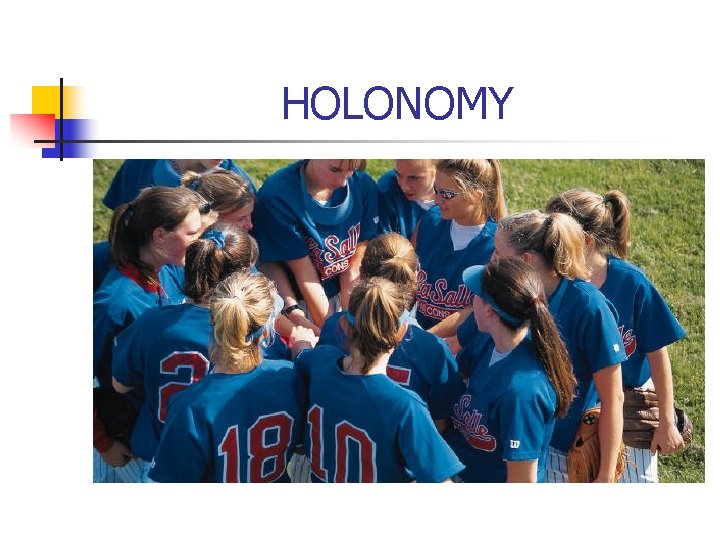
HOLONOMY
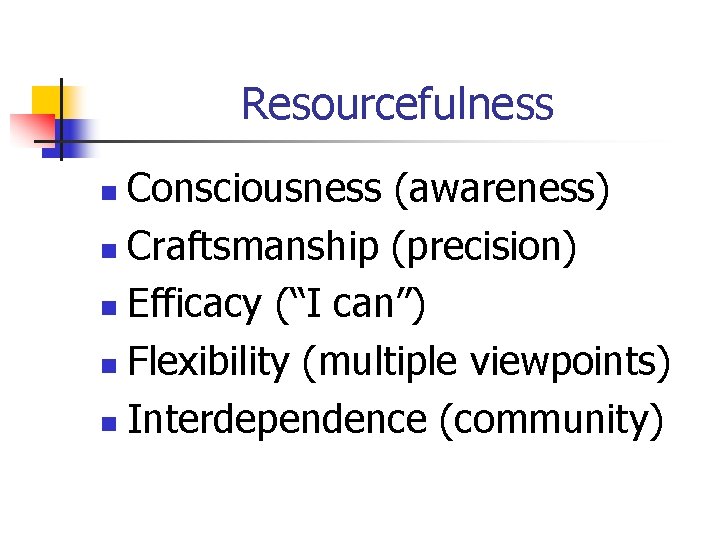
Resourcefulness Consciousness (awareness) n Craftsmanship (precision) n Efficacy (“I can”) n Flexibility (multiple viewpoints) n Interdependence (community) n
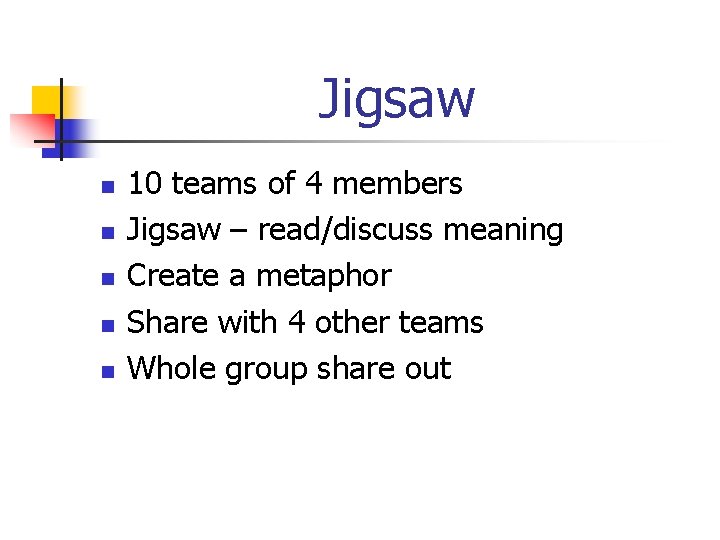
Jigsaw n n n 10 teams of 4 members Jigsaw – read/discuss meaning Create a metaphor Share with 4 other teams Whole group share out
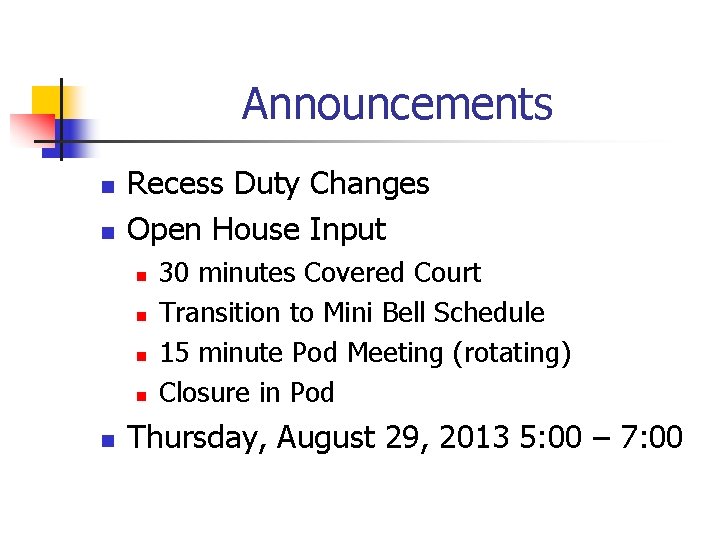
Announcements n n Recess Duty Changes Open House Input n n n 30 minutes Covered Court Transition to Mini Bell Schedule 15 minute Pod Meeting (rotating) Closure in Pod Thursday, August 29, 2013 5: 00 – 7: 00
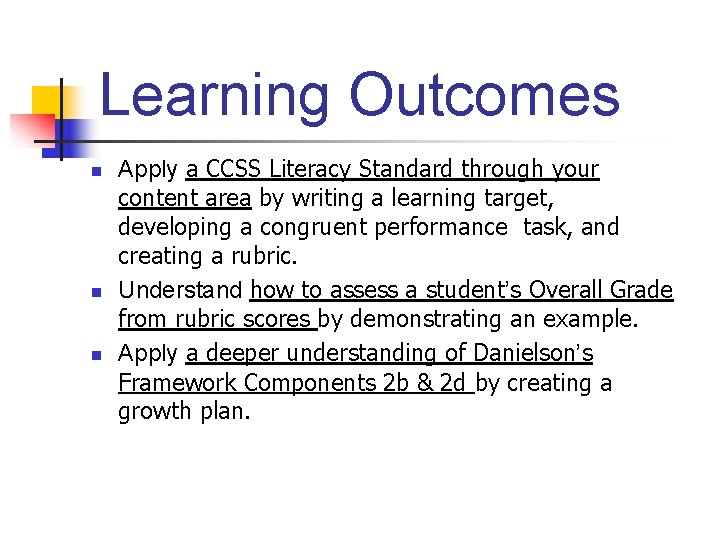
Learning Outcomes n n n Apply a CCSS Literacy Standard through your content area by writing a learning target, developing a congruent performance task, and creating a rubric. Understand how to assess a student’s Overall Grade from rubric scores by demonstrating an example. Apply a deeper understanding of Danielson’s Framework Components 2 b & 2 d by creating a growth plan.
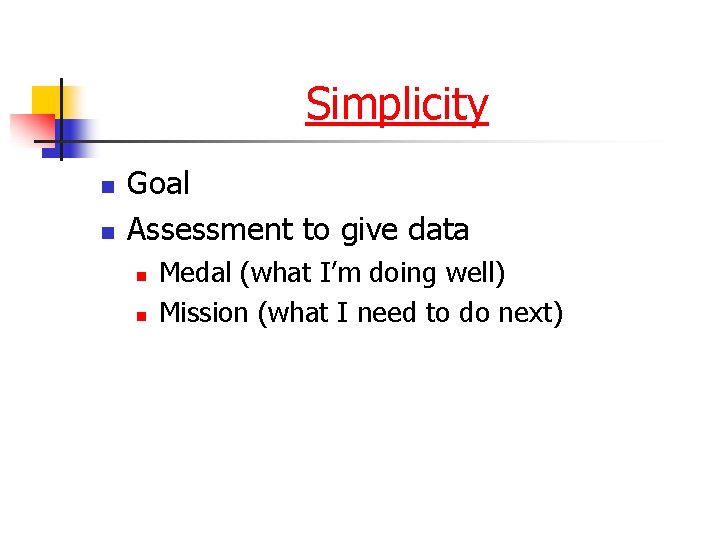
Simplicity n n Goal Assessment to give data n n Medal (what I’m doing well) Mission (what I need to do next)
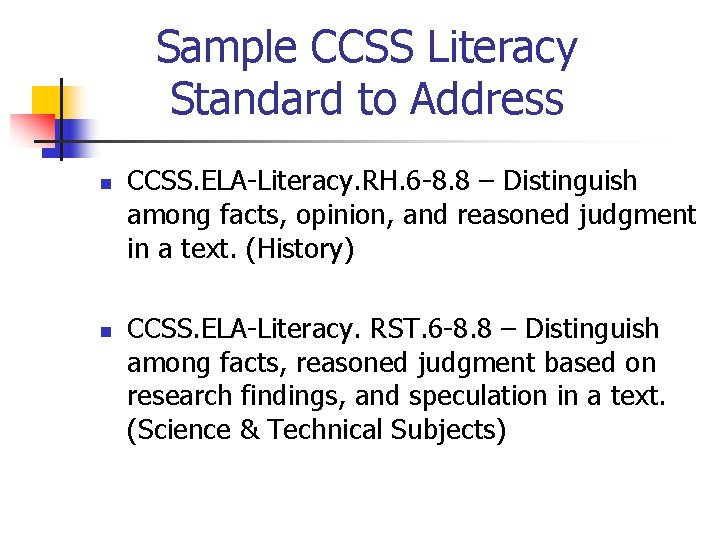
Sample CCSS Literacy Standard to Address n n CCSS. ELA-Literacy. RH. 6 -8. 8 – Distinguish among facts, opinion, and reasoned judgment in a text. (History) CCSS. ELA-Literacy. RST. 6 -8. 8 – Distinguish among facts, reasoned judgment based on research findings, and speculation in a text. (Science & Technical Subjects)
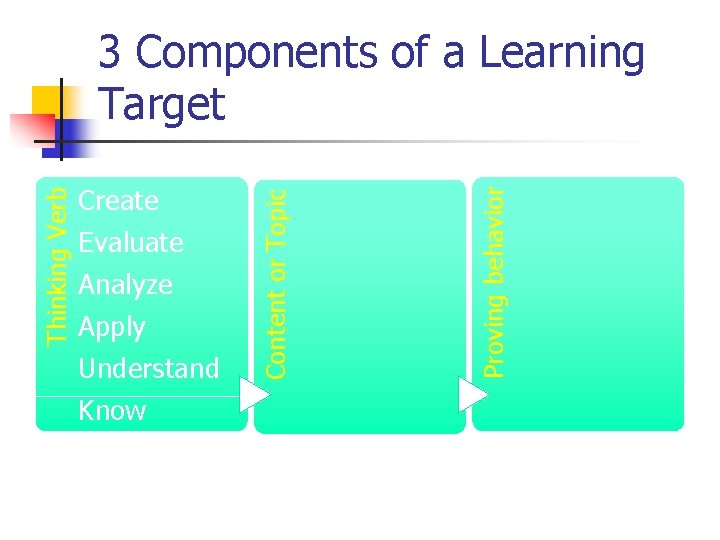
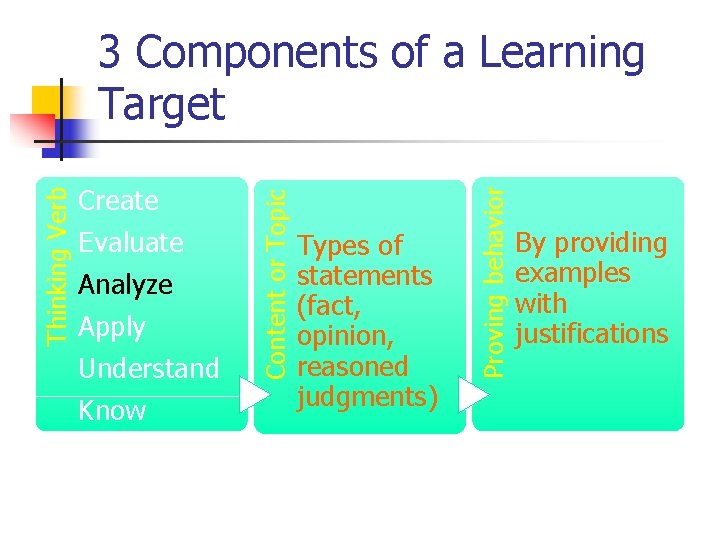
Proving behavior Create Evaluate Analyze Apply Understand Know Content or Topic Thinking Verb 3 Components of a Learning Target
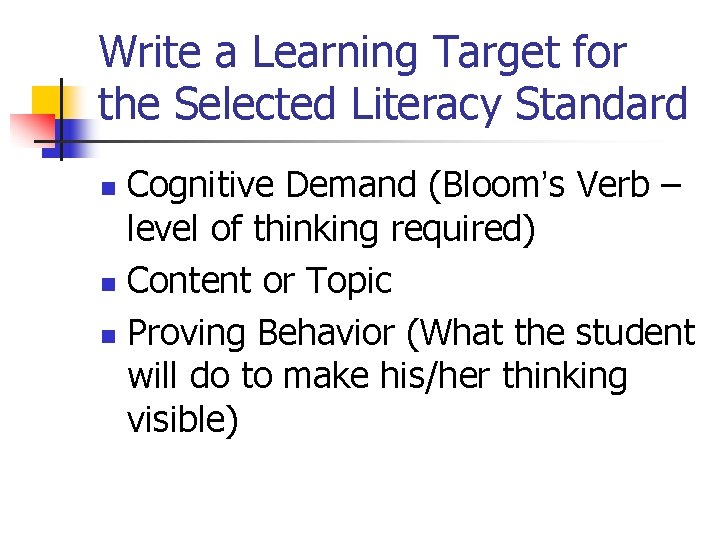
Write a Learning Target for the Selected Literacy Standard Cognitive Demand (Bloom’s Verb – level of thinking required) n Content or Topic n Proving Behavior (What the student will do to make his/her thinking visible) n
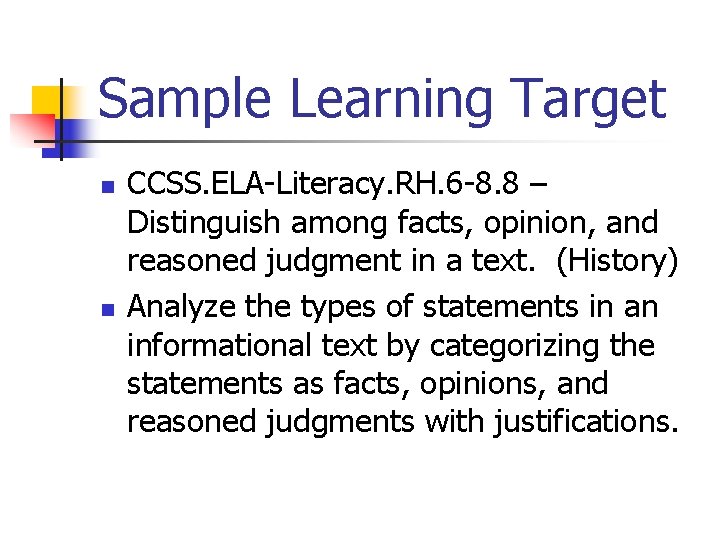
Sample Learning Target n n CCSS. ELA-Literacy. RH. 6 -8. 8 – Distinguish among facts, opinion, and reasoned judgment in a text. (History) Analyze the types of statements in an informational text by categorizing the statements as facts, opinions, and reasoned judgments with justifications.
Types of statements (fact, opinion, reasoned judgments) Proving behavior Create Evaluate Analyze Apply Understand Know Content or Topic Thinking Verb 3 Components of a Learning Target By providing examples with justifications
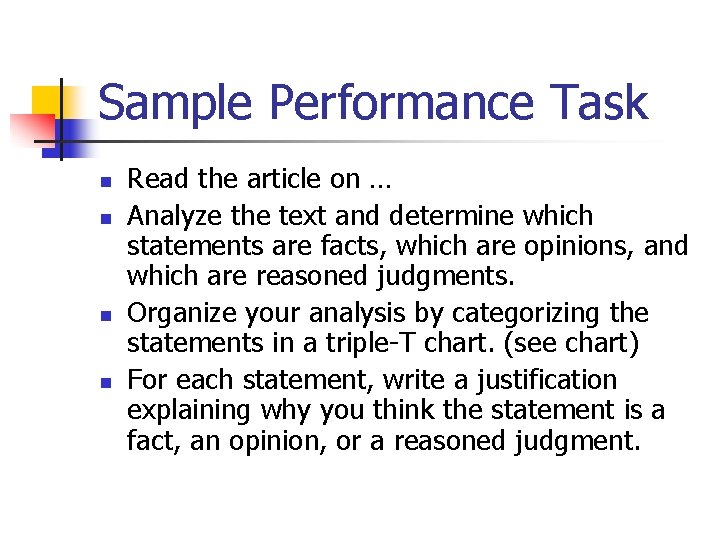
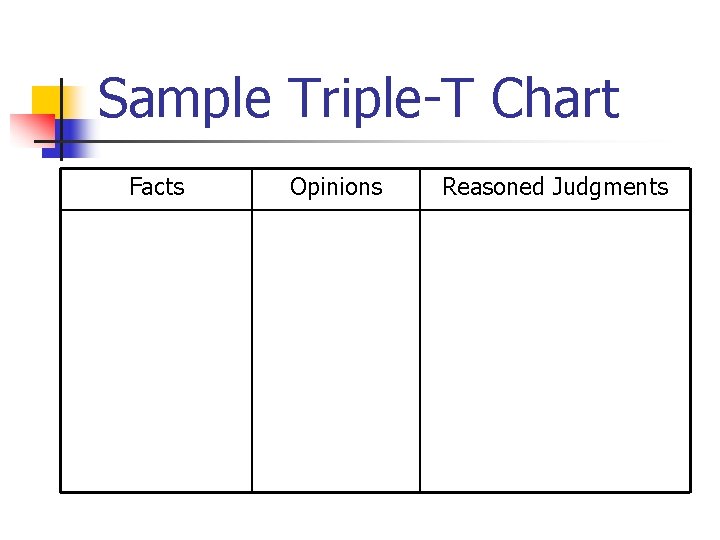
Sample Performance Task n n Read the article on … Analyze the text and determine which statements are facts, which are opinions, and which are reasoned judgments. Organize your analysis by categorizing the statements in a triple-T chart. (see chart) For each statement, write a justification explaining why you think the statement is a fact, an opinion, or a reasoned judgment.
Sample Triple-T Chart Facts Opinions Reasoned Judgments
Check For Congruence Is the performance task congruent to the learning target in terms of the thinking level required, the topic or content, and the proving behavior that allows the student to make his/her thinking visible?
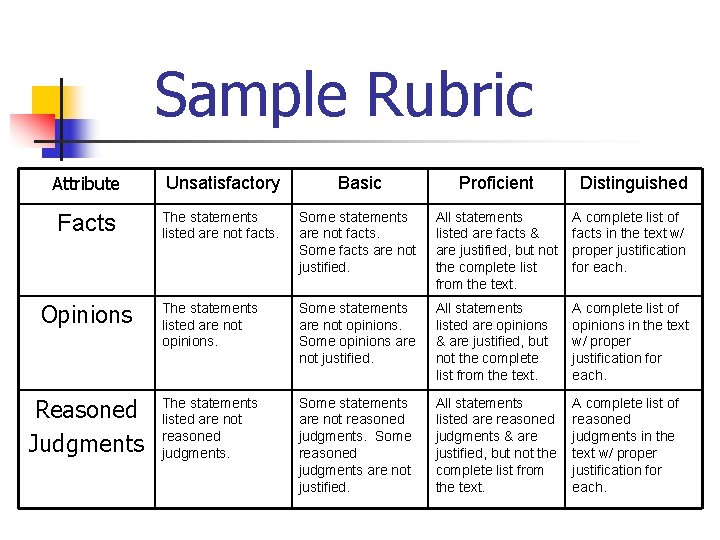
Creating a Rubric for the Performance Task n n n Brainstorm the critical attributes of a quality performance. Cluster ideas if needed into 2 -4 critical attributes. Write descriptors across each level of performance, with increasing quality, for each critical attribute.
Sample Rubric Attribute Unsatisfactory Basic Proficient Facts The statements listed are not facts. Some statements are not facts. Some facts are not justified. All statements listed are facts & are justified, but not the complete list from the text. A complete list of facts in the text w/ proper justification for each. Opinions The statements listed are not opinions. Some statements are not opinions. Some opinions are not justified. All statements listed are opinions & are justified, but not the complete list from the text. A complete list of opinions in the text w/ proper justification for each. Reasoned Judgments The statements listed are not reasoned judgments. Some statements are not reasoned judgments. Some reasoned judgments are not justified. All statements listed are reasoned judgments & are justified, but not the complete list from the text. A complete list of reasoned judgments in the text w/ proper justification for each. Distinguished