
th 7 Science Chapter 1 Section 1 The
- Slides: 26
th 7 Science Chapter 1
§ § § Section 1: The Work of Science Types of Science 1. Earth science – atmosphere, solar system, geology (rock layers, volcanoes, etc. ) § 2. Life science – plants, animals, other living things § 3. Physical science – matter and energy – chemistry and physics
§ Critical Thinking § Thinking in depth, trying to find an answer, separating important information from unimportant information
§ § § § Solving Problems Scientific Method -State the Problem -Gather Information 5 senses – taste, touch, smell, sight, hearing Make observations -Form a hypothesis A prediction about what you think will happen
§ -Test hypothesis with an experiment § You can only change one variable at a time! § -Analyze data § Set up charts, graphs, tables § -Draw Conclusions § Logical answer based on observations, data, and analysis § Report Results § Communication with other scientists
§ Measuring with Scientific Units § Scientists use the SI system (metric), based on units of 10. § Length – meter (m) § Volume – liter (L), centimeter cubed (cm 3) § Mass – gram (g)
§ Safety § Most important safety rule is ask your teacher before beginning anything.
Section 2 § Section 2 – Living Things § An organism is any living thing, no matter how big or small § Examples of nonliving things: water, air, sun, clouds § Living things are organized § Cell – smallest unit § Tissues § Organ system (digestive, circulatory) § Organism
§ Some organisms are made up of only one cell, some have many cells. § Living things react to their surroundings. § Anything that causes some change in an organism is called a stimulus. § The reaction to a stimulus is called a response. § Stimuli is more than one stimulus
§ Homeostasis – ability to keep a balance within the body no matter what conditions are outside the body. § Living things use energy § Plant – use the Sun’s energy to make their own food (photosynthesis) § Humans – eating food
§ Living things grow and develop § Increase in the number and size of their cells. § Living things reproduce § Without reproduction the species would become extinct. § Living things need a proper place to live. § Raw materials – food, drink, oxygen
Classifying § § § Spontaneous Generation – old belief Biogenesis – New (current Belief) Spontaneous Generation – Life could arise from non- living materials. Biogenesis – Life can arise ONLY from Life Pasteur finally showed that living things do not come from nonliving things
Classification § Aristotle – was one of the first people to classify organisms § Plant or Animal § Linnaeus – simplified the system § Still use Linnaeus’s system today § Binomial Nomenclature – two-word name used to classify living things § It minimizes confusion among scientists § System provides information about the species § Classifies organisms by traits and evolutionary histories
§ Classification § § § § Based in LATIN Two Words ( Genus + Species or specific name) Capitalize ONLY the FIRST word – Genus) Second word is the Species (Not Capitalized) Written in Italics or Underlined Scientific name for humans = Homo sapien Scientific name for wolf – Canus lupus
§ An advantage of our scientific naming system is that biologists can communicate regardless of their native languages. Minimizes confusion
§ Scientific names prevent confusion. § Two different organisms can NOT have the same scientific name but they might have the same common name. § The easiest and most efficient field guide to use to identify an organism would be a dichotomous key. § The dichotomous key uses TWO paired descriptions at each step.
§ The dichotomous key has three basic functions § Avoids errors in communication § It classifies organisms with similar evolutionary histories together. § It gives descriptive information
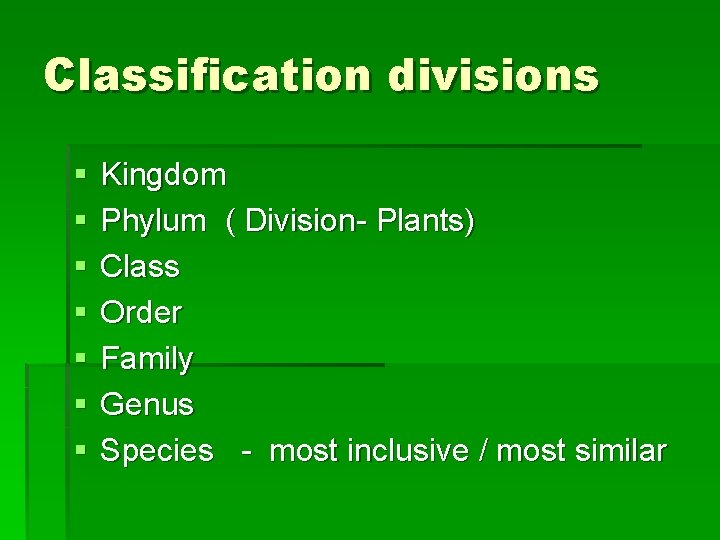
Classification divisions § § § § Kingdom Phylum ( Division- Plants) Class Order Family Genus Species - most inclusive / most similar
§ Each level of classification is based on SHARED characteristics § Family is made up of similar Order § Class is made up of similar Phylum § Species is made up of similar Genus § Etc. . § Broadest group – Kingdom § Most Inclusive – Species § Species - Organisms that are similar in structure and form and successfully reproduce among themselves.
The Six Kingdoms § The classification system most commonly used today separates organisms into six (6) Kingdoms § Each level of classification contains all organisms that share the same characteristics
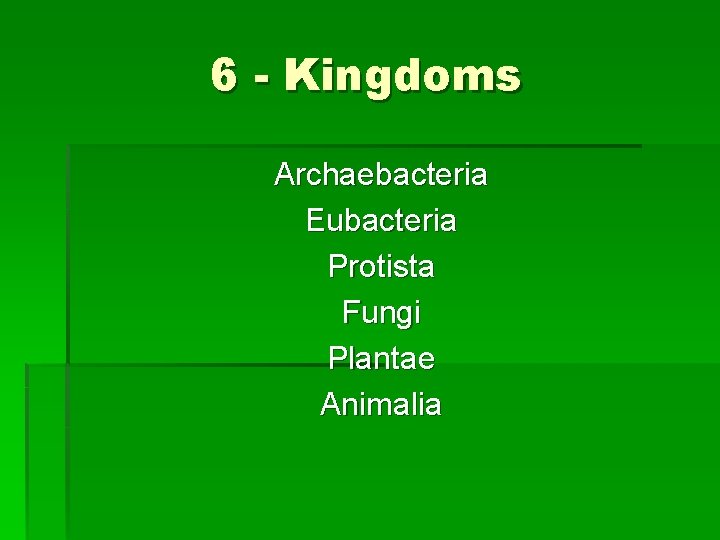
6 - Kingdoms Archaebacteria Eubacteria Protista Fungi Plantae Animalia
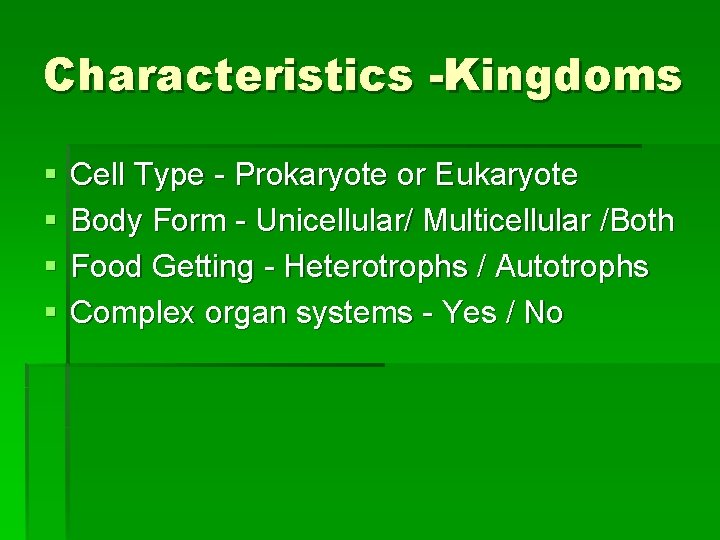
Characteristics -Kingdoms § § Cell Type - Prokaryote or Eukaryote Body Form - Unicellular/ Multicellular /Both Food Getting - Heterotrophs / Autotrophs Complex organ systems - Yes / No
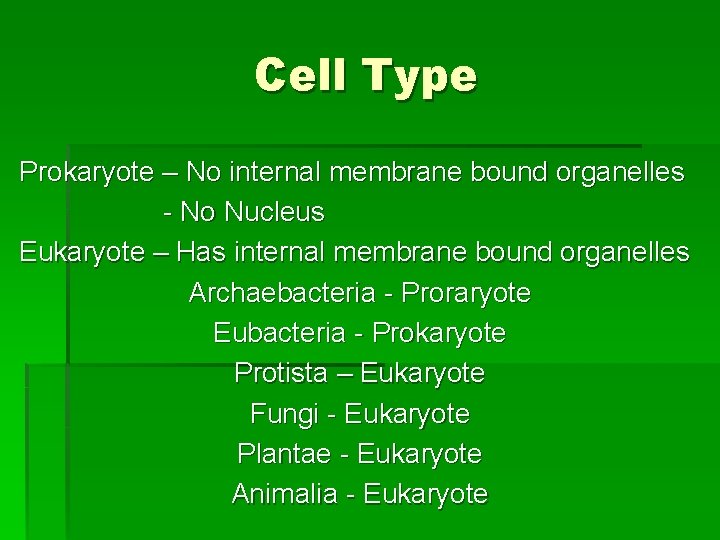
Cell Type Prokaryote – No internal membrane bound organelles - No Nucleus Eukaryote – Has internal membrane bound organelles Archaebacteria - Proraryote Eubacteria - Prokaryote Protista – Eukaryote Fungi - Eukaryote Plantae - Eukaryote Animalia - Eukaryote
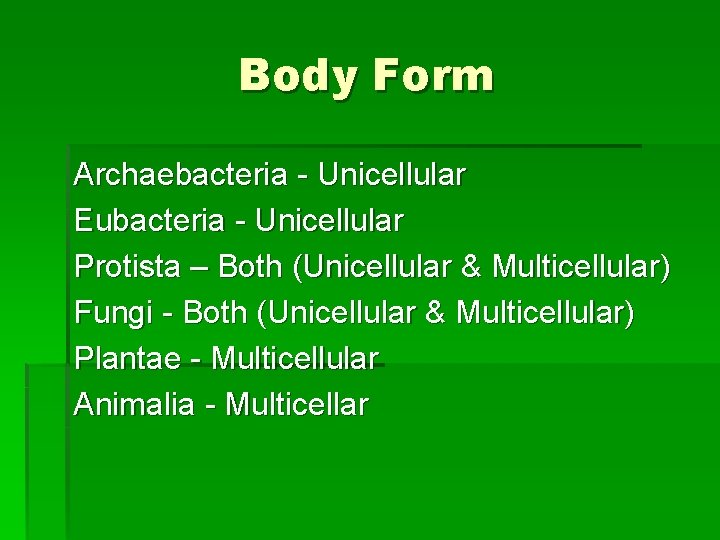
Body Form Archaebacteria - Unicellular Eubacteria - Unicellular Protista – Both (Unicellular & Multicellular) Fungi - Both (Unicellular & Multicellular) Plantae - Multicellular Animalia - Multicellar
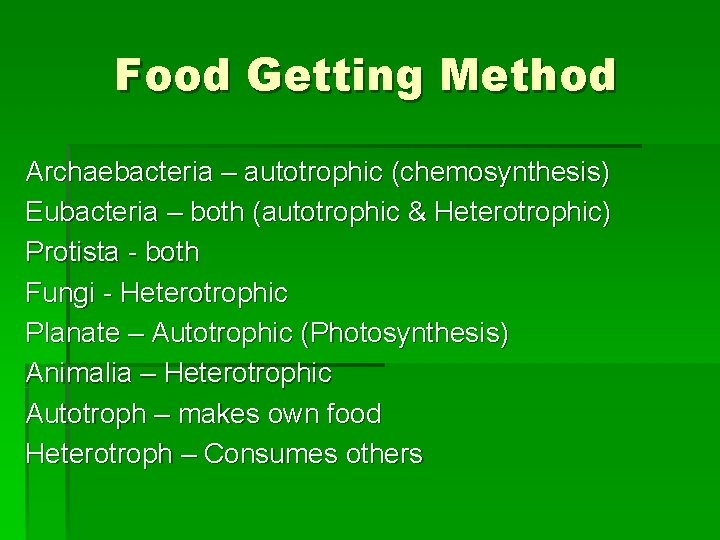
Food Getting Method Archaebacteria – autotrophic (chemosynthesis) Eubacteria – both (autotrophic & Heterotrophic) Protista - both Fungi - Heterotrophic Planate – Autotrophic (Photosynthesis) Animalia – Heterotrophic Autotroph – makes own food Heterotroph – Consumes others
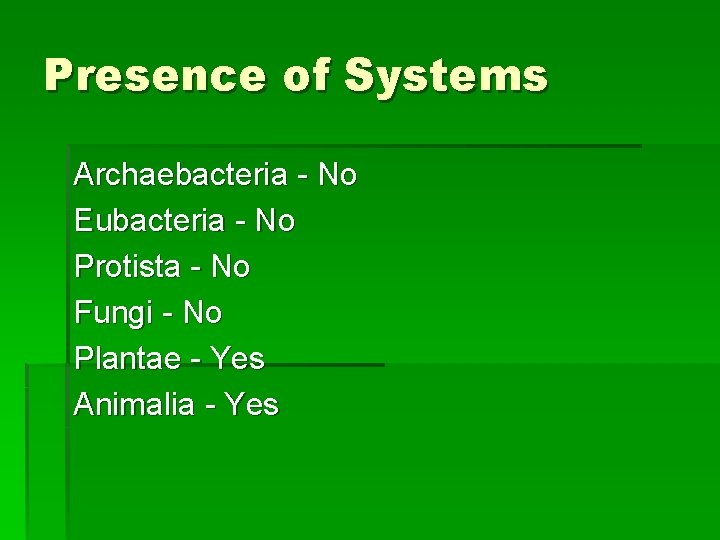
Presence of Systems Archaebacteria - No Eubacteria - No Protista - No Fungi - No Plantae - Yes Animalia - Yes