
th 6 Grade Math and Science Week AT
- Slides: 10
th 6 Grade Math and Science Week AT A Glance (WAG) March 8 -12, 2021
Standard(s) Science Unit 4: Solar System and Beyond Learning Target(s) of the Week S 6 E 1. Obtain, evaluate, and communicate information about current scientific views of the universe and how those views evolved. d. Develop and use a model to explain the interaction of gravity and inertia that governs the motion of objects in the solar system. c. Analyze and interpret data to compare and contrast the planets in our solar system in terms of: • relative to Earth, • surface and atmospheric features, • relative distance from the sun, and • ability to support life.
Standard(s) Math Unit 3 B: One Step Equations and Inequalities Learning Target(s) of the Week Priority Standards MGSE 6. EE. 9 Use variables to represent two quantities in a realworld problem that change in relationship to one another. a. Write an equation to express one quantity, the dependent variable, in terms of the other quantity, the independent variable. b. b. Analyze the relationship between the dependent and independent variables using graphs and tables, and relate these to the equation.
Day 1 (Science) Unit 4: Solar System and Beyond Learning Target(s) of the Week S 6 E 1. Obtain, evaluate, and communicate information about current scientific views of the universe and how those views evolved. a. Ask questions to determine changes in models of Earth’s position in the solar system, and origins of the universe as evidence that scientific theories change with the addition of new information. AGENDA Class Opener – Mystery Science Whole Group – Solar System Power. Point Closing-”The Solar System” Video Clip Discussion Post Asynchronous Period –Space Choice Board
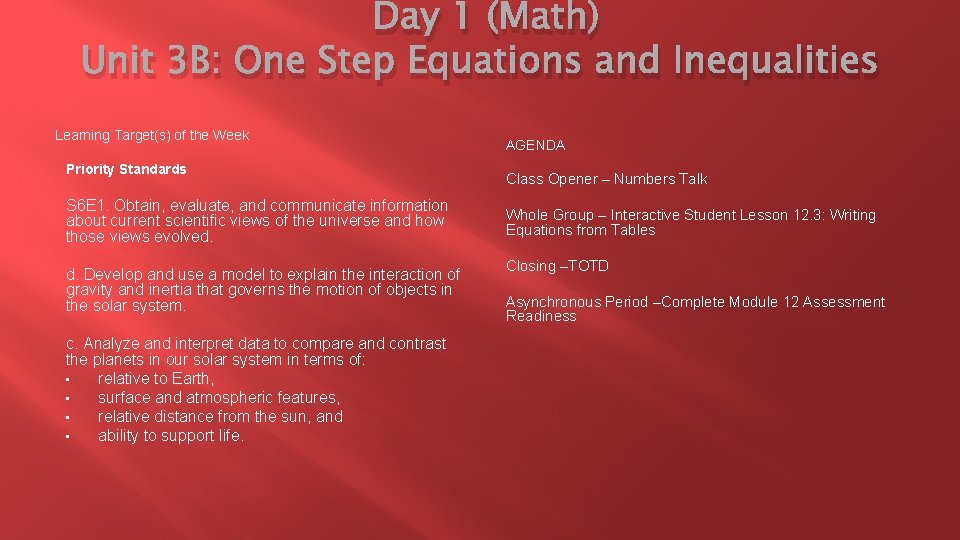
Day 1 (Math) Unit 3 B: One Step Equations and Inequalities Learning Target(s) of the Week Priority Standards S 6 E 1. Obtain, evaluate, and communicate information about current scientific views of the universe and how those views evolved. d. Develop and use a model to explain the interaction of gravity and inertia that governs the motion of objects in the solar system. c. Analyze and interpret data to compare and contrast the planets in our solar system in terms of: • relative to Earth, • surface and atmospheric features, • relative distance from the sun, and • ability to support life. AGENDA Class Opener – Numbers Talk Whole Group – Interactive Student Lesson 12. 3: Writing Equations from Tables Closing –TOTD Asynchronous Period –Complete Module 12 Assessment Readiness
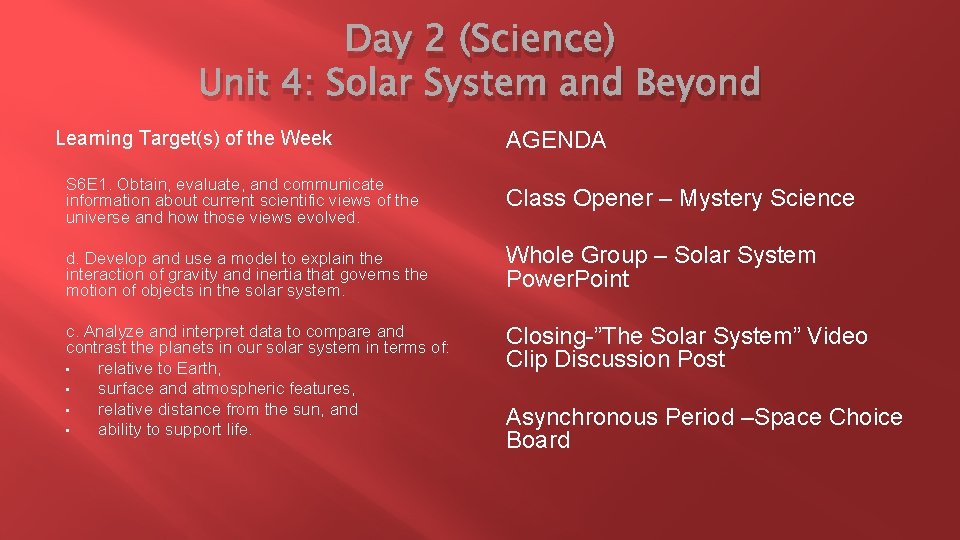
Day 2 (Science) Unit 4: Solar System and Beyond Learning Target(s) of the Week AGENDA S 6 E 1. Obtain, evaluate, and communicate information about current scientific views of the universe and how those views evolved. Class Opener – Mystery Science d. Develop and use a model to explain the interaction of gravity and inertia that governs the motion of objects in the solar system. Whole Group – Solar System Power. Point c. Analyze and interpret data to compare and contrast the planets in our solar system in terms of: • relative to Earth, • surface and atmospheric features, • relative distance from the sun, and • ability to support life. Closing-”The Solar System” Video Clip Discussion Post Asynchronous Period –Space Choice Board
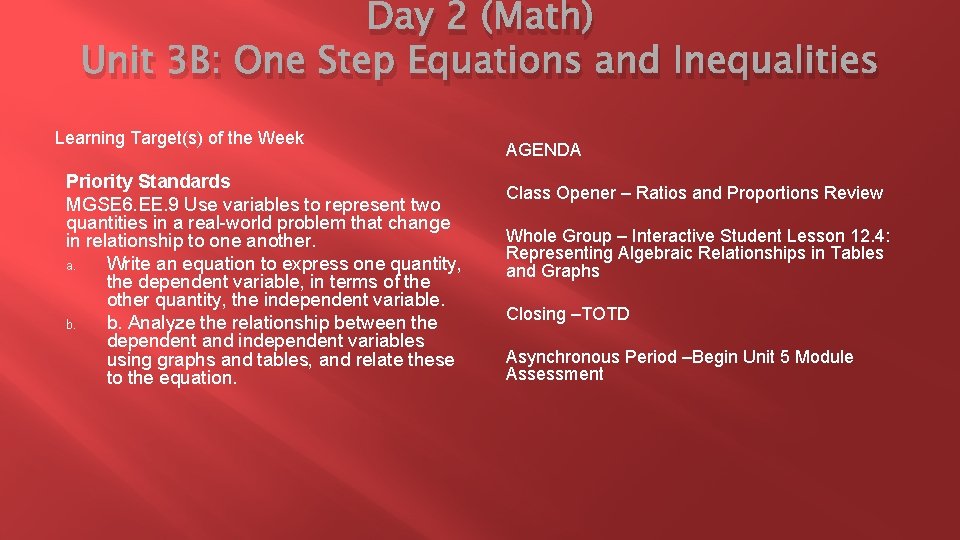
Day 2 (Math) Unit 3 B: One Step Equations and Inequalities Learning Target(s) of the Week Priority Standards MGSE 6. EE. 9 Use variables to represent two quantities in a real-world problem that change in relationship to one another. a. Write an equation to express one quantity, the dependent variable, in terms of the other quantity, the independent variable. b. b. Analyze the relationship between the dependent and independent variables using graphs and tables, and relate these to the equation. AGENDA Class Opener – Ratios and Proportions Review Whole Group – Interactive Student Lesson 12. 4: Representing Algebraic Relationships in Tables and Graphs Closing –TOTD Asynchronous Period –Begin Unit 5 Module Assessment
Friday (Math and Science) No School (Teacher Workday)
Mathematics Additional Resources � For additional support, please see your "Go Math" online textbook. You may also visit the "Math on the Spot" for support as well. You may use the FEV tutor resource as well.
Science Additional Resources � For additional support, please see your online textbook. You may also visit https: //sciencespot. net for many interactive science activities and information for support as well. You may use the FEV tutor resource as well.