
TH 19 ERA CENTURY GOTHIC By Victoria Lance

TH 19 ERA CENTURY GOTHIC By Victoria, Lance, Sabah, Diya
CONTENTS • 19 th Century America • British English • American English • The Masque of the Red Death
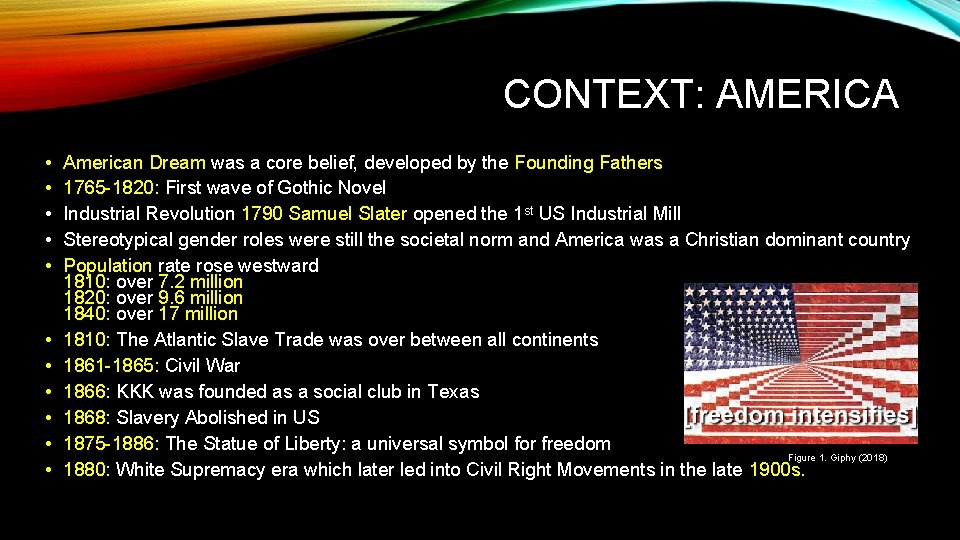
CONTEXT: AMERICA • • • American Dream was a core belief, developed by the Founding Fathers 1765 -1820: First wave of Gothic Novel Industrial Revolution 1790 Samuel Slater opened the 1 st US Industrial Mill Stereotypical gender roles were still the societal norm and America was a Christian dominant country Population rate rose westward 1810: over 7. 2 million 1820: over 9. 6 million 1840: over 17 million 1810: The Atlantic Slave Trade was over between all continents 1861 -1865: Civil War 1866: KKK was founded as a social club in Texas 1868: Slavery Abolished in US 1875 -1886: The Statue of Liberty: a universal symbol for freedom Figure 1. Giphy (2018) 1880: White Supremacy era which later led into Civil Right Movements in the late 1900 s.
INFLUENCES OF GOTHIC • In literature it is usually associated with the English Romanticism movement and all things medieval • Literature influenced the attitudes, imaginations and beliefs of writers of all genres and artists • Medievalism was a heavy influence onto the era and there were many attempts to reconstruct this ‘offering of an ideal nobility and harmony’
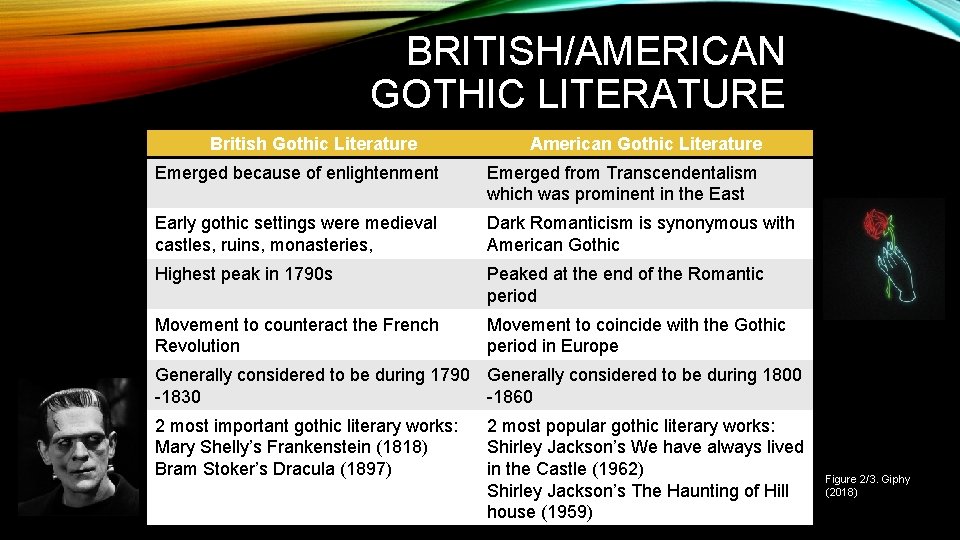
BRITISH/AMERICAN GOTHIC LITERATURE British Gothic Literature American Gothic Literature Emerged because of enlightenment Emerged from Transcendentalism which was prominent in the East Early gothic settings were medieval castles, ruins, monasteries, Dark Romanticism is synonymous with American Gothic Highest peak in 1790 s Peaked at the end of the Romantic period Movement to counteract the French Revolution Movement to coincide with the Gothic period in Europe Generally considered to be during 1790 Generally considered to be during 1800 -1830 -1860 2 most important gothic literary works: Mary Shelly’s Frankenstein (1818) Bram Stoker’s Dracula (1897) 2 most popular gothic literary works: Shirley Jackson’s We have always lived in the Castle (1962) Shirley Jackson’s The Haunting of Hill house (1959) Figure 2/3. Giphy (2018)

GENERAL CONVENTIONS OF GOTHIC CONVENTIONS: • Shadows, flickering candles, electrical faults, strange glowing firelight • Crazed laughter • Abandoned areas • Characters being trapped • Baying of wolves and dogs • Sighs, moans, clanking, howls and eerie sounds • Footsteps • Slamming doors • Storms GOTHIC TONE AND MOOD: • Highly emotional states of terror, anxiety, vengeance, obsession, dread • Mood: mysterious, suspense, terror, melancholy, foreboding MOTIFS: • Doppelgangers • Omens, curses, prophecies • Dreams, nightmares, visions • Light, darkness, shadow, warmth, cold • Psychiatric medical conditions • Forbidden knowledge or power GOTHIC FICTION ELEMENTS: • Fear • Horror • Death • Gloom • Nature • Individuality • Very high emotion
BRIEF HISTORY AND DEVELOPMENT OF BRITISH ENGLISH 19 C • 1800 - 1900 Industrialization, urbanization, emergence of new technologies and scientific discoveries as well as education increased • Industrialisation refers to the development of machine production of goods and new energy resources. • New words were coined for new products, machines and processes that were developed at this time • The industrial and scientific advances created a need for neologisms which derived from Greek and Latin roots. • In the 19 th century there was a rise of the progressive passive • Received Pronunciation (often associated with SE of England) became the accent associated with prestige & good education. • In the Midlands the diphthongs in words like ‘throat’ and ‘stone’ were kept apart whereas in RP they fell together
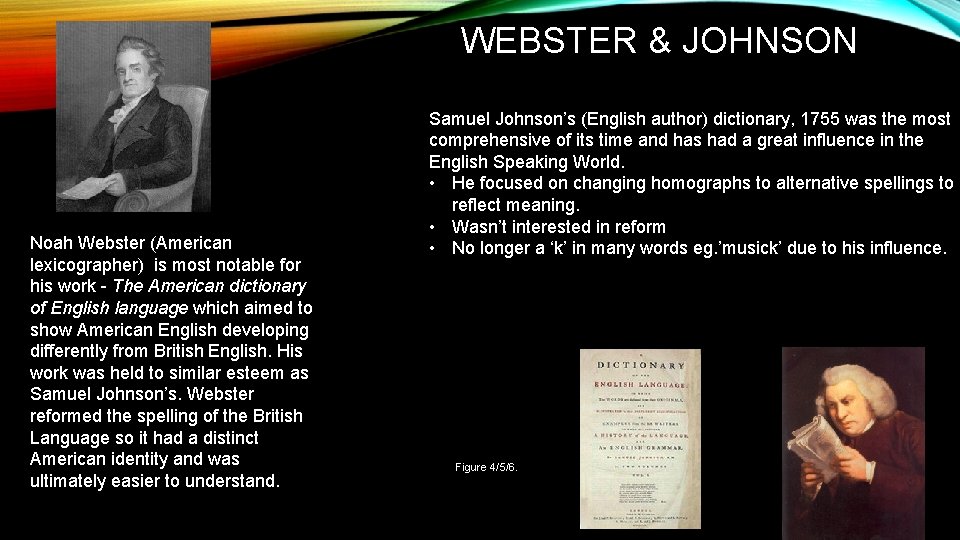
WEBSTER & JOHNSON Noah Webster (American lexicographer) is most notable for his work - The American dictionary of English language which aimed to show American English developing differently from British English. His work was held to similar esteem as Samuel Johnson’s. Webster reformed the spelling of the British Language so it had a distinct American identity and was ultimately easier to understand. Samuel Johnson’s (English author) dictionary, 1755 was the most comprehensive of its time and has had a great influence in the English Speaking World. • He focused on changing homographs to alternative spellings to reflect meaning. • Wasn’t interested in reform • No longer a ‘k’ in many words eg. ’musick’ due to his influence. Figure 4/5/6.
• In terms of the ‘progress of English’, the first expedition that took place in the late 16 th Century is what renounced English as a world language. • The first venture failed due to conflict with the Indians. Crystal, (2002): 242 AMERICAN ENGLISH
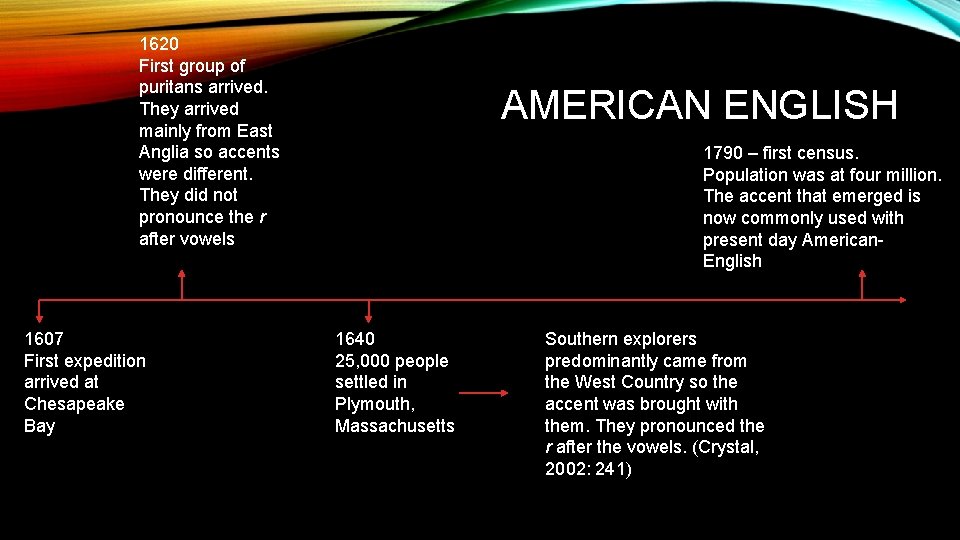
1620 First group of puritans arrived. They arrived mainly from East Anglia so accents were different. They did not pronounce the r after vowels 1607 First expedition arrived at Chesapeake Bay AMERICAN ENGLISH 1790 – first census. Population was at four million. The accent that emerged is now commonly used with present day American. English 1640 25, 000 people settled in Plymouth, Massachusetts Southern explorers predominantly came from the West Country so the accent was brought with them. They pronounced the r after the vowels. (Crystal, 2002: 241)
AMERICAN ENGLISH • The main population movements preserved the three major dialect areas of the east coast: • New England people moved West • Southerners moved along the Gulf Coast and into Texas • Midlanders spread throughout the vast mid-eastern area, across Mississippi into California • (Crystal, 2002)
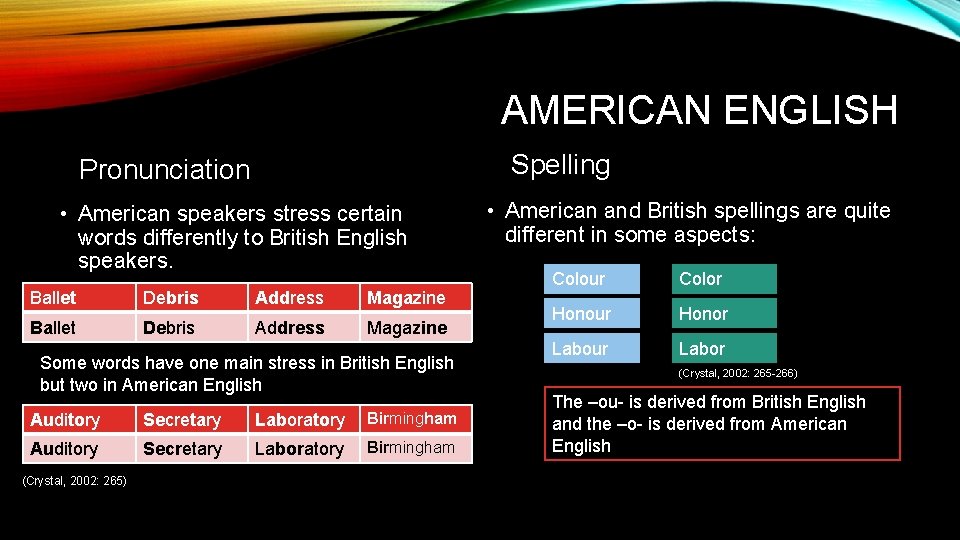
AMERICAN ENGLISH Spelling Pronunciation • American speakers stress certain words differently to British English speakers. Ballet Debris Address Magazine Some words have one main stress in British English but two in American English Auditory Secretary Laboratory Birmingham (Crystal, 2002: 265) • American and British spellings are quite different in some aspects: Colour Color Honour Honor Labour Labor (Crystal, 2002: 265 -266) The –ou- is derived from British English and the –o- is derived from American English
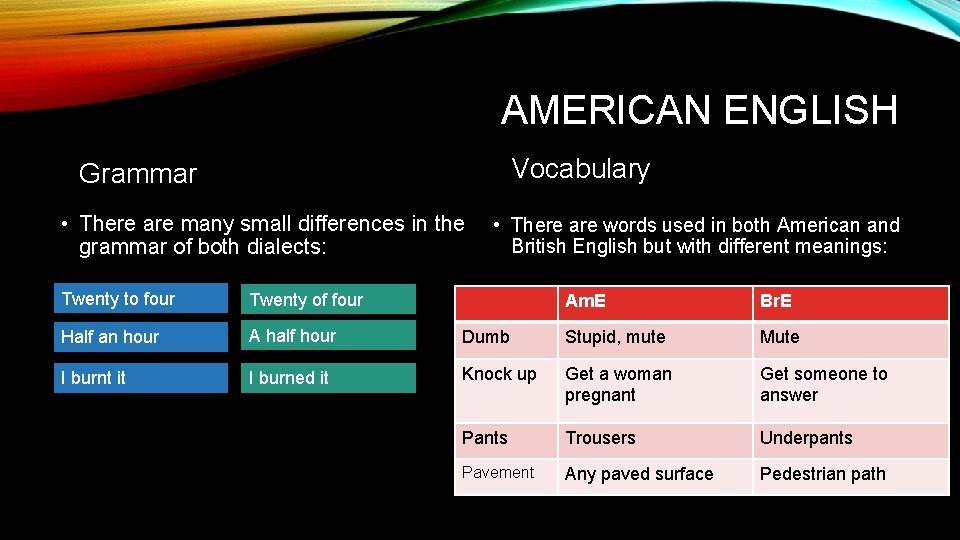
AMERICAN ENGLISH Vocabulary Grammar • There are many small differences in the grammar of both dialects: Twenty to four Twenty of four Half an hour A half hour I burnt it I burned it • There are words used in both American and British English but with different meanings: Am. E Br. E Dumb Stupid, mute Mute Knock up Get a woman pregnant Get someone to answer Pants Trousers Underpants Pavement Any paved surface Pedestrian path
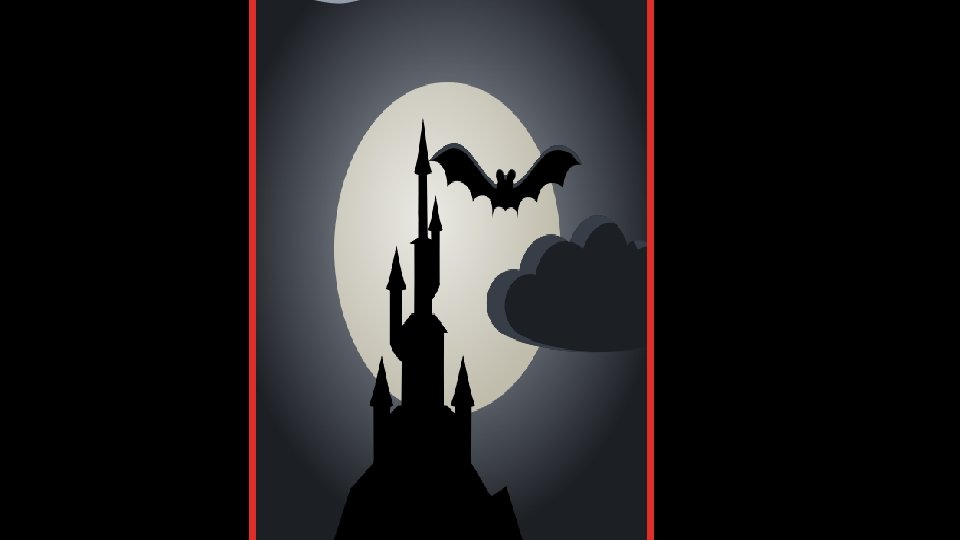
THE MASQUE OF THE RED DEATH Summary: 'The Red Death' takes over Prince Prospero's kingdom. He locks himself and his company away in the abbey to evade death. Conventions of the gothic genre that are evident: Terror- Poe uses terror (i. e. inexplicit descriptions) rather than horror to open the readers mind without making them distressed (Bowen 2014). Beauty vs horror- Poe creates a sharp contrast between the beauty and pain found in death. Human fallibility- Prince Prospero and his company believe they can avoid death. Madness- it isn't clear whether the Prince is actually mad. This might be a commentary on the judgement of 19 th Century society. Figure 8. Gloomy setting- the corruption of the perfect setting highlights that not even the upper class are untouchable. American authors used settings (e. g. the abbey) that weren't apart of the American landscape, as it was believed that there wasn't enough architectural history in America to use in Gothic literature. Hence, their eyes were “trained” on the European landscape. (Crow 2009: 10) Supernatural- the masked figure is described as ghostlike and unhuman.
ANALYSIS OF THE MASQUE OF THE RED DEATH • The seven apartments- allegory for the stages of human life. Prince Prospero chases the masked figure through the seven apartments, where he finally encounters the figure in the black room. Thus, he both literally and metaphorically runs to his death. • The ebony clock- each time it chimes, the party stops. The clock serves as a reminder to the guests that they cannot avoid death and suggests that death is approaching. • The red death- the masked figures identity remains unknown and is a physical manifestation of death. The use of person deixis further elevates the mysteries surrounding death. Figure 9.
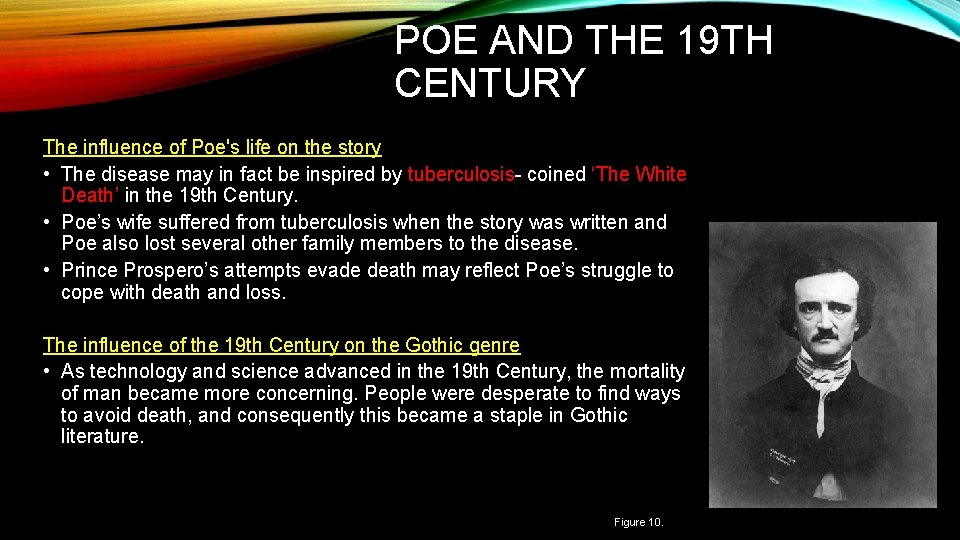
POE AND THE 19 TH CENTURY The influence of Poe's life on the story • The disease may in fact be inspired by tuberculosis- coined ‘The White Death’ in the 19 th Century. • Poe’s wife suffered from tuberculosis when the story was written and Poe also lost several other family members to the disease. • Prince Prospero’s attempts evade death may reflect Poe’s struggle to cope with death and loss. The influence of the 19 th Century on the Gothic genre • As technology and science advanced in the 19 th Century, the mortality of man became more concerning. People were desperate to find ways to avoid death, and consequently this became a staple in Gothic literature. Figure 10.
THE LANGUAGE USED IN MASQUE OF THE RED DEATH • With the gothic era dominating 19 th Century literature, many new words relating to gothic themes entered the language. For example, Spectral, which is used to describe the masked figure. • Arguably, Poe's writing is somewhat closer to British English than American English. For example, he uses the British expression "half an hour" rather than the Americanism "a half hour". • Many American writers were under pressure to please British critics as British literature had much more history and acclaim, whilst also attempting to establish a native identity (Britannica 2018) • Poe's use of the word 'apartment' is distinctly American. The word entered the language in the 17 th Century.
![REFERENCES Britannica Inc. (2018) Varieties of English- British English [online] available from< https: //www.](http://slidetodoc.com/presentation_image_h2/bd3dd569c4830235304e73e5e08dddbc/image-19.jpg "REFERENCES Britannica Inc. (2018) Varieties of English- British English [online] available from< https: //www.")
REFERENCES Britannica Inc. (2018) Varieties of English- British English [online] available from< https: //www. britannica. com/topic/English-language/Varieties-of-English > [5 November 2018] Britannica, Inc. (2018) American Literature – The 19 th Century [online] available from <https: //www. britannica. com/art/American-literature/The-19 th-century> [10 November 2018] Crow, C. (2009) American Gothic. Cardiff: University of Wales Press Crystal, D. (2002) The English Language. 2 nd Edition. London: Penguin Books Purple Planet Music (n. d. ) Purple Planet Music [online] available from <https: //www. purple-planet. com/creepy> [21 November 2018] The British Library (n. d. ) Gothic Motifs [online] available from <https: //www. bl. uk/romantics-andvictorians/articles/gothic-motifs> [31 October 2018] The Centre for the Study of Christianity and Culture, University of York (1999) Crossref-it. info [online] <https: //crossref-it. info/articles/91/gothic-and-the-medieval-revival>; [2 November 2018] The English Spelling Society (2018). A brief history of English spelling [online] available from <http: //spellingsociety. org/history#/page/9> [5 November 2018] Oxford University Press. (2018) Nineteen Century English- an overview [online] available from https: //public. oed. com/blog/nineteenth-century-english-an-overview/ [3 November 2018]
![LIST OF FIGURES Giphy Inc. (2018) Giphy [online] available from<https: //giphy. com/search/royalty-freeromantic-era> [21 November](http://slidetodoc.com/presentation_image_h2/bd3dd569c4830235304e73e5e08dddbc/image-20.jpg "LIST OF FIGURES Giphy Inc. (2018) Giphy [online] available from<https: //giphy. com/search/royalty-freeromantic-era> [21 November")
LIST OF FIGURES Giphy Inc. (2018) Giphy [online] available from<https: //giphy. com/search/royalty-freeromantic-era> [21 November 2018]
- Slides: 20