
TGC Timing Adjustment Chikara Fukunaga TMU ATLAS Timing
- Slides: 13
TGC Timing Adjustment Chikara Fukunaga (TMU) ATLAS Timing Workshop 5 July ‘ 07
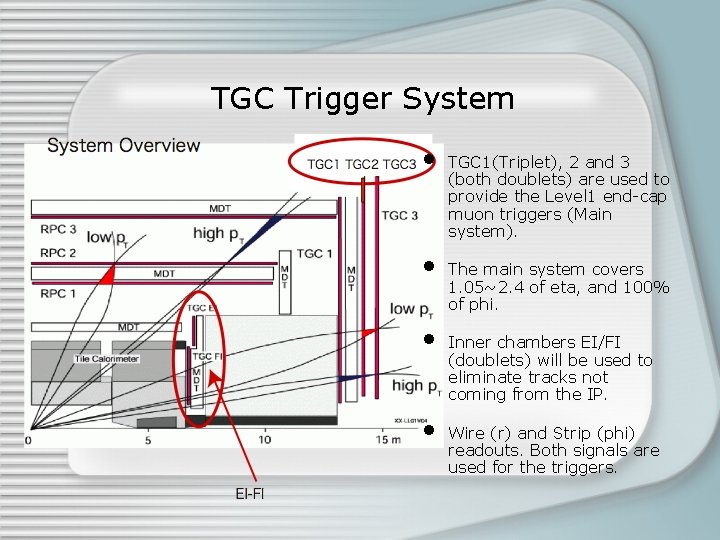
TGC Trigger System • • TGC 1(Triplet), 2 and 3 (both doublets) are used to provide the Level 1 end-cap muon triggers (Main system). The main system covers 1. 05~2. 4 of eta, and 100% of phi. Inner chambers EI/FI (doublets) will be used to eliminate tracks not coming from the IP. Wire (r) and Strip (phi) readouts. Both signals are used for the triggers.
Overview of TGC Electronics System 2 for EI/FI/side 3 for SL/side, 12 for ROD
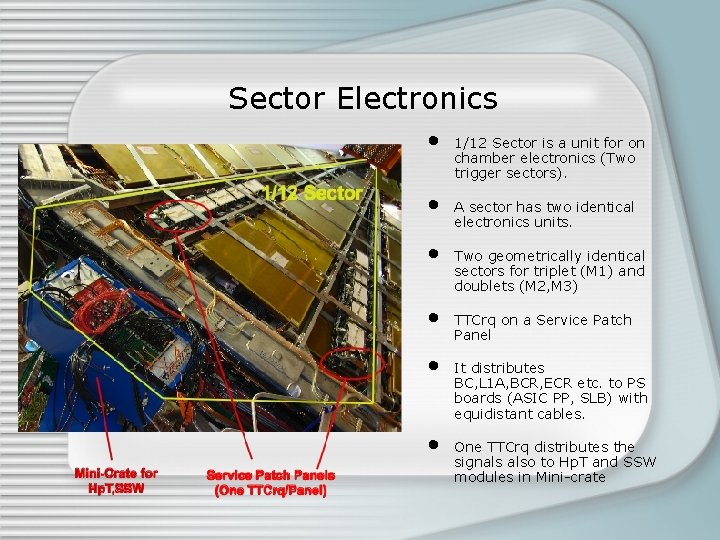
Sector Electronics • • • 1/12 Sector is a unit for on chamber electronics (Two trigger sectors). A sector has two identical electronics units. Two geometrically identical sectors for triplet (M 1) and doublets (M 2, M 3) TTCrq on a Service Patch Panel It distributes BC, L 1 A, BCR, ECR etc. to PS boards (ASIC PP, SLB) with equidistant cables. One TTCrq distributes the signals also to Hp. T and SSW modules in Mini-crate
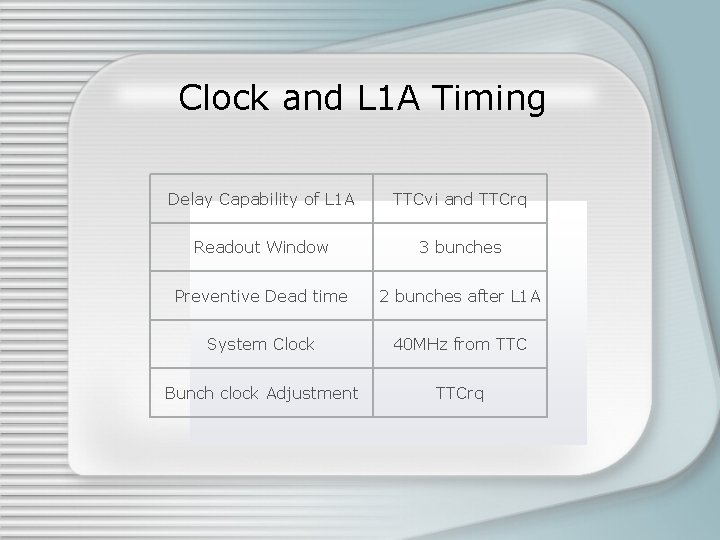
Clock and L 1 A Timing Delay Capability of L 1 A TTCvi and TTCrq Readout Window 3 bunches Preventive Dead time 2 bunches after L 1 A System Clock 40 MHz from TTC Bunch clock Adjustment TTCrq
Adjustment of L 1 -buffer depth • • • Adjustment of Depth of Level 1 buffer (128 steps) The L 1 A latency will be common for cosmic and beam runs if the MUCTPI-CTP latency is fixed. Even if the Latency changes, we can quickly re-adjust the depth with this setup.
Alignment of Trigger signals w/o Beam
Alignment of Trigger with Beam
BCID • • • TTCvi forms the BCR from the Orbit. The delay capabilities for the BCR We have independent L 1 buffer for BCID in the SLB ASIC. TTCvi for ROD. 12 -bit BCID you form is always in the range of 0. . 3563? Front-end system counts up to 4095 if BCR does not come properly. ROD will handle the BCID correctly in between 0 and 3563. BCID checking : Consistency of Front-end BCIDs are checked in ROD A global BCR delay parameter : TTCvi Can the last 3 bits of the BCID be aligned with the BCID in the MUCTPI? : Reconfiguration of FPGA in Sector Logic
BCID Alignment • Are you ready for BCID alignment for the M 4 week? What needs to be done still? – We can adjust the BCID of the front-end system by changing the depth of the BCID L 1 buffer. This is ready. – As ROD independently counts BC, the number will be different from one of the front-end system even for the same L 1 A. We have to check the difference (offset) and adjust BCR timing or the depth of the L 1 buffer for BCID iteratively. We need some more work, but will be ready for the M 4 week.
Long Gap and Sensitivity to Bunch drift • We have not yet any fixed plan to do in the long gap. We need some more discussion for possibility of calibration for the system/detector in this gap. • ROD needs one test pulse trigger, generated by the CTP, in the long gap which is assigned to the TGC. • Sensitivity to slow drift of the bunches wrt to the clock. We have to estimate this in near future.
• • Event Count Reset Distribution of the ECR: standard TTC partition Where do you have event counters, where do you form L 1 ID ? SLB ASIC on a PS-board for the Front-end System, and ROD Would you agree to set the ROD to the initial L 1 ID (0 x 00 ffffff) in the prepare. For. Run transition? A register in the ROD module can be set to whatever is wanted. Do you need any ECR before or after prepare. For. Run? If so, for which purpose, and at what time? Should this ECR be provided centrally, or can it be generated locally? One ECR is needed before the first trigger of a run. This siganl can be provided either centrally or locally.
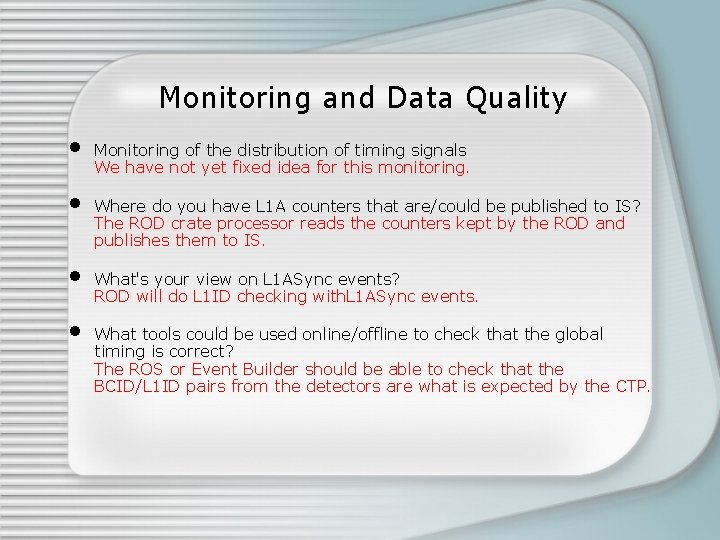
Monitoring and Data Quality • • Monitoring of the distribution of timing signals We have not yet fixed idea for this monitoring. Where do you have L 1 A counters that are/could be published to IS? The ROD crate processor reads the counters kept by the ROD and publishes them to IS. What's your view on L 1 ASync events? ROD will do L 1 ID checking with. L 1 ASync events. What tools could be used online/offline to check that the global timing is correct? The ROS or Event Builder should be able to check that the BCID/L 1 ID pairs from the detectors are what is expected by the CTP.