
TFRC TCP Friendly Rate Control using TCP Equation
- Slides: 28
TFRC: TCP Friendly Rate Control using TCP Equation Based Congestion Model ECE 599: Multimedia Networking Thinh Nguyen
References p S. Floyd, J. Padhye, J. Widmer “Equation Based Congestion Control for Unicast Applications”, Sigcomm 2000 p J. Padhye, V. Firoiu, D. Towsley, J. Kurose” Modeling TCP Throughput: a Simple Model and its Empirical Validation” Sigcomm 98
Internet Transport Protocols p UDP n n n p TCP n n n p No congestion control No reliability – no retransmission of lost packets Small throughput and delay fluctuation (jitter) Congestion control Reliability – automatic retransmission Large throughput and delay fluctuations Multimedia Protocols n n Congestion control Small throughput and delay fluctuation Fair with TCP No need for retransmission
TCP Bandwidth Model Goal: Estimate TCP bandwidth based on the loss rates and round trip times
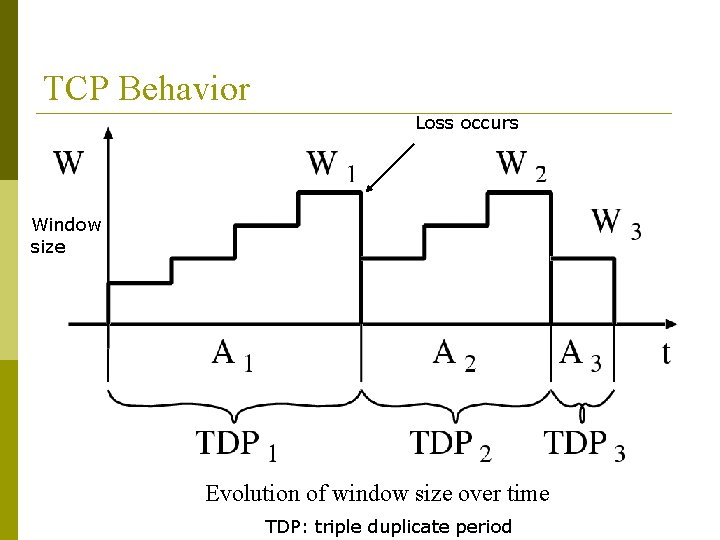
TCP Behavior Loss occurs Window size Evolution of window size over time TDP: triple duplicate period
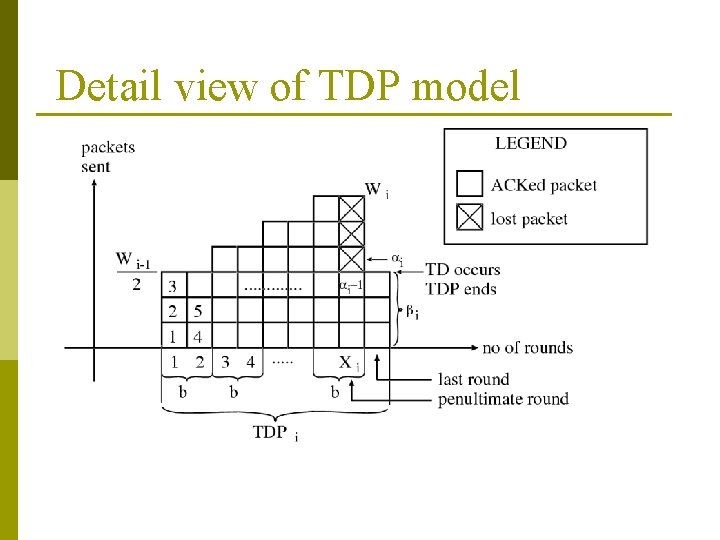
Detail view of TDP model
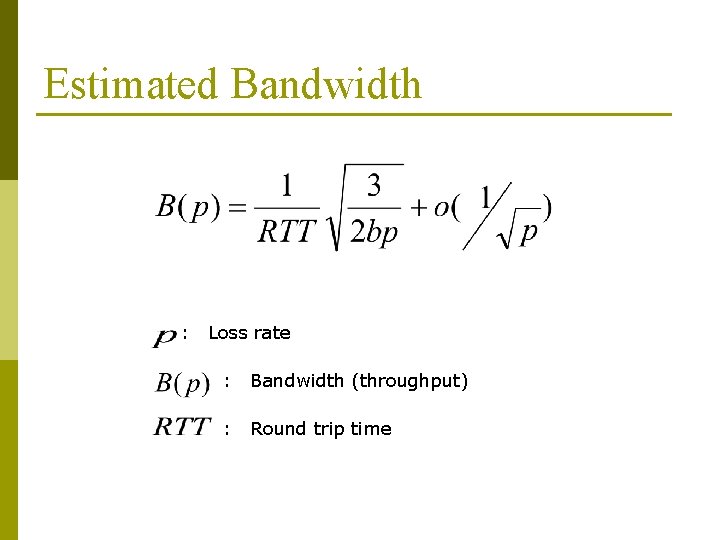
Estimated Bandwidth : Loss rate : Bandwidth (throughput) : Round trip time
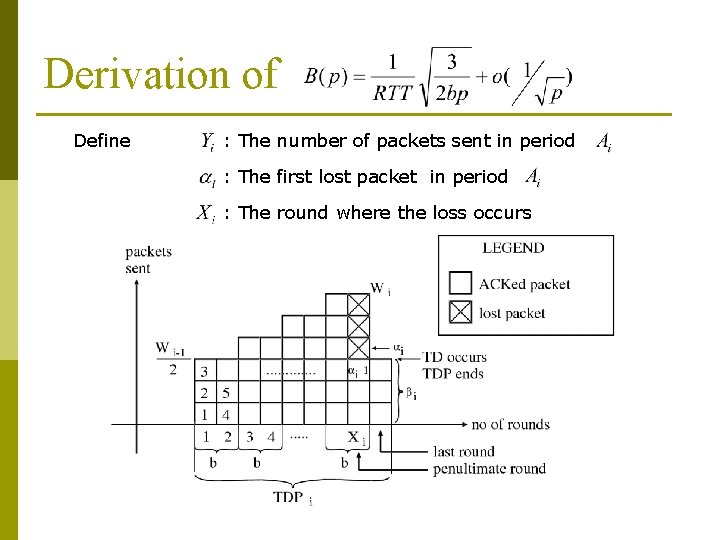
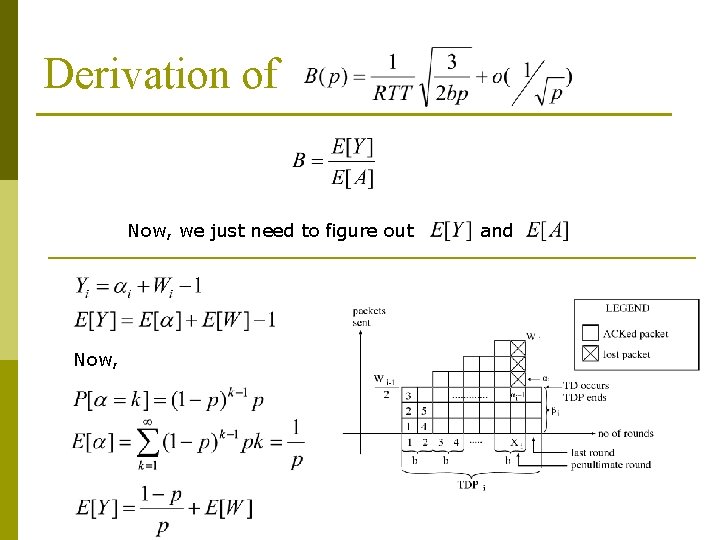
Derivation of Define : The number of packets sent in period : The first lost packet in period : The round where the loss occurs
Derivation of Now, we just need to figure out Now, and
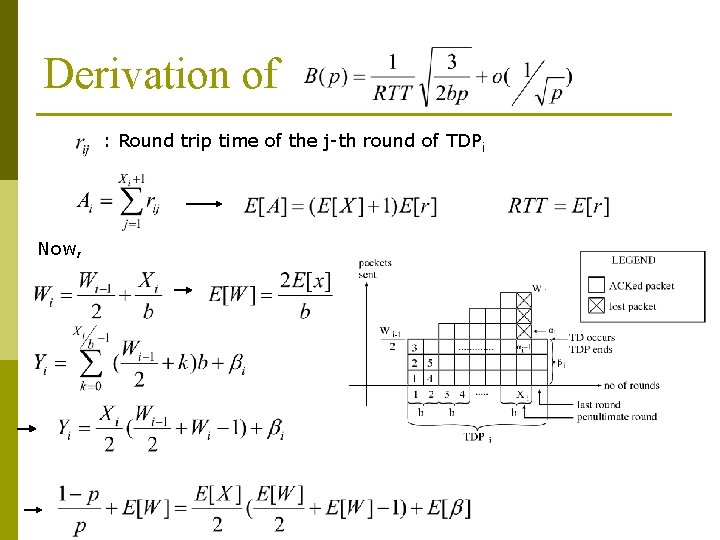
Derivation of : Round trip time of the j-th round of TDPi Now,
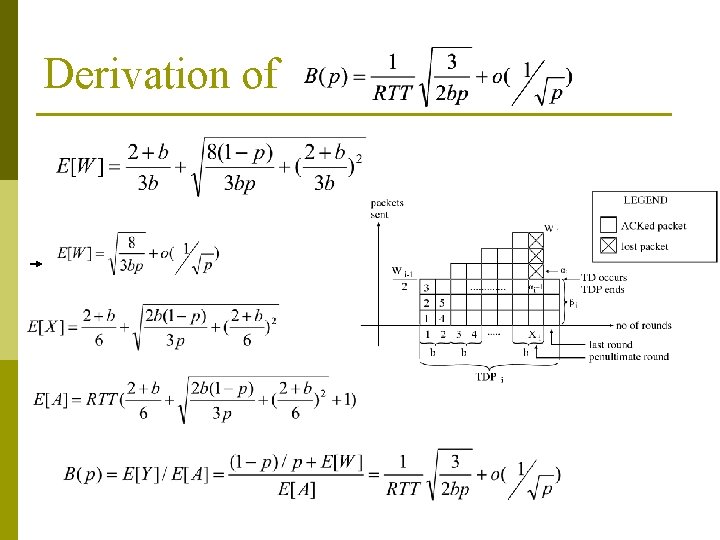
Derivation of
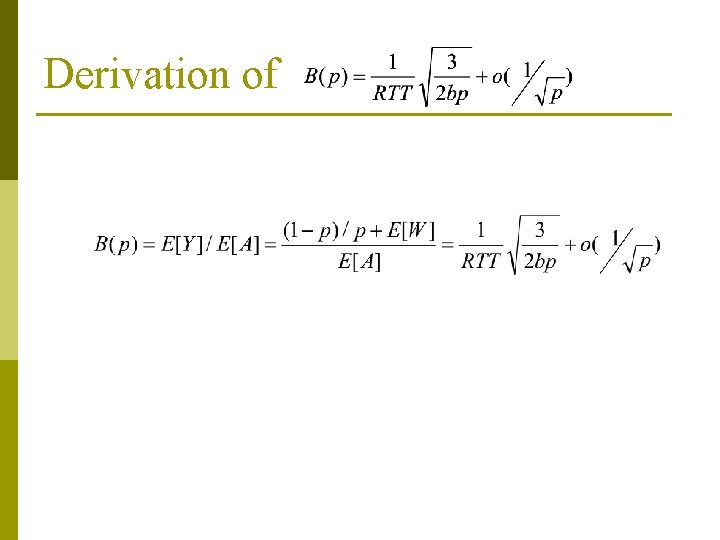
Derivation of
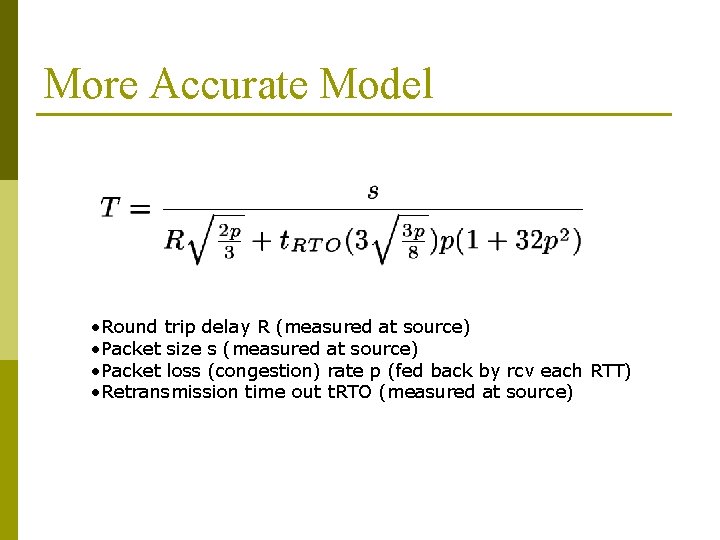
More Accurate Model • Round trip delay R (measured at source) • Packet size s (measured at source) • Packet loss (congestion) rate p (fed back by rcv each RTT) • Retransmission time out t. RTO (measured at source)
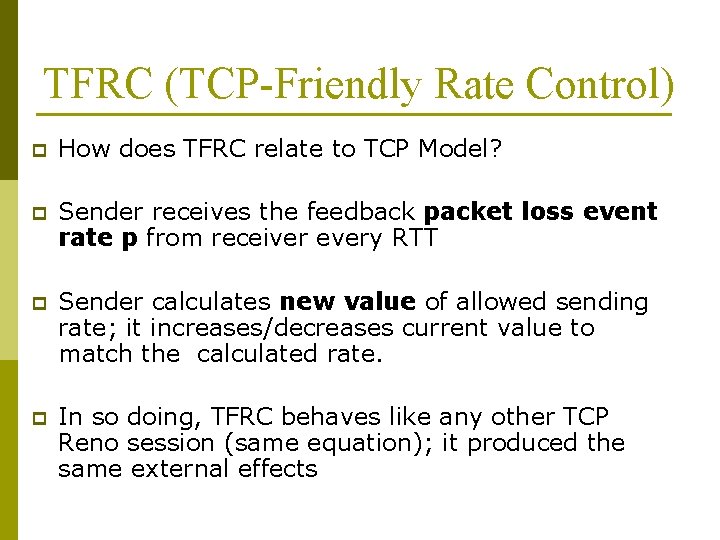
TFRC (TCP-Friendly Rate Control) p How does TFRC relate to TCP Model? p Sender receives the feedback packet loss event rate p from receiver every RTT p Sender calculates new value of allowed sending rate; it increases/decreases current value to match the calculated rate. p In so doing, TFRC behaves like any other TCP Reno session (same equation); it produced the same external effects
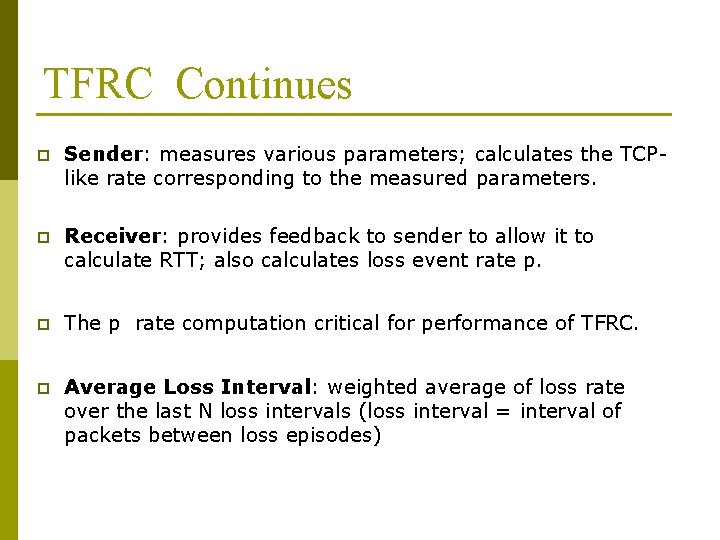
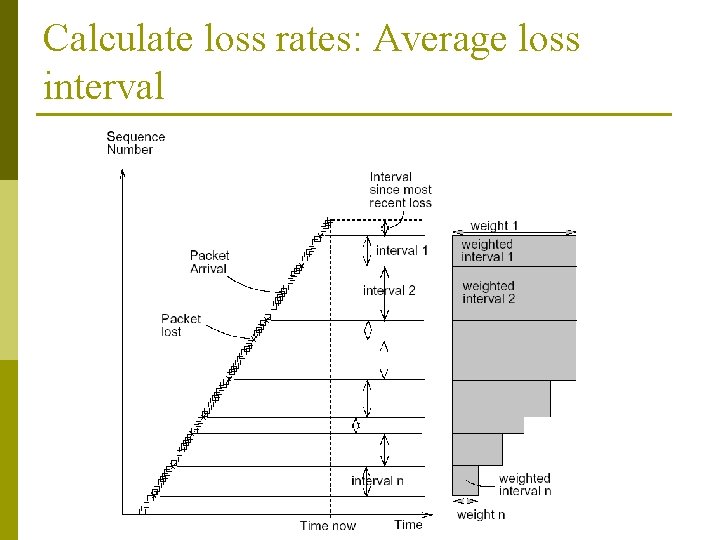
TFRC Continues p Sender: measures various parameters; calculates the TCPlike rate corresponding to the measured parameters. p Receiver: provides feedback to sender to allow it to calculate RTT; also calculates loss event rate p. p The p rate computation critical for performance of TFRC. p Average Loss Interval: weighted average of loss rate over the last N loss intervals (loss interval = interval of packets between loss episodes)
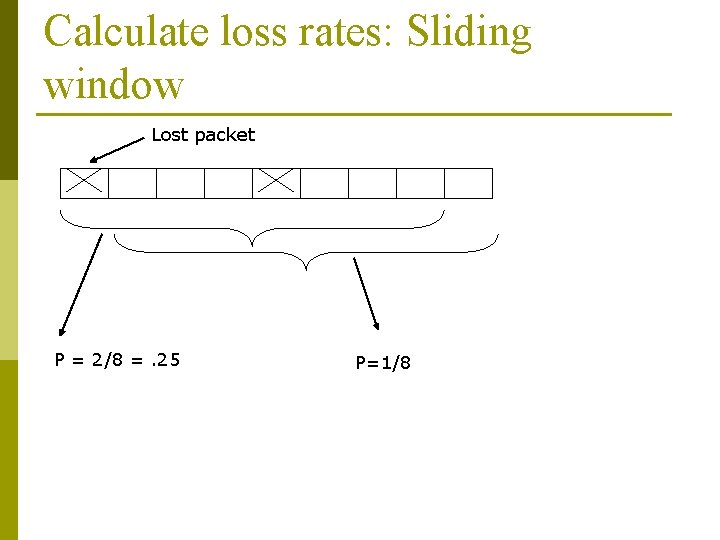
Calculate loss rates: Sliding window Lost packet P = 2/8 =. 25 P=1/8
Calculate loss rates: Average loss interval
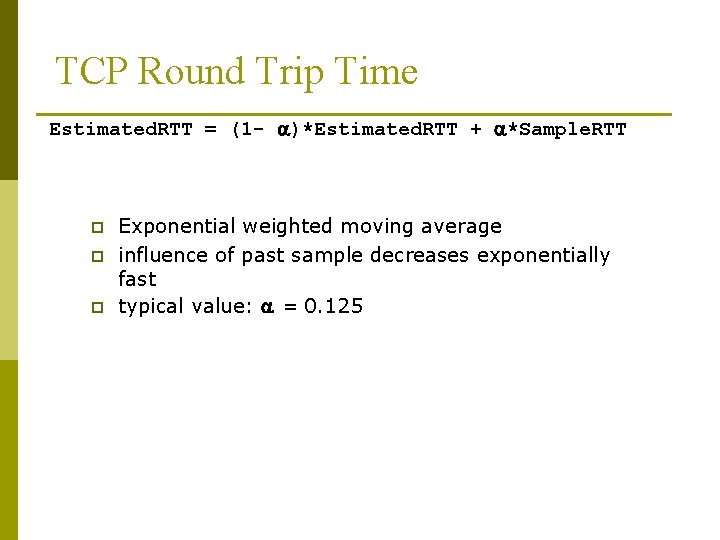
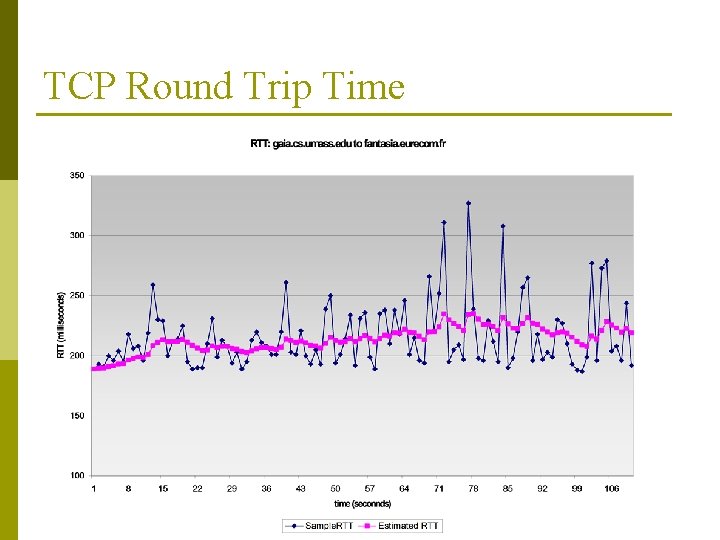
TCP Round Trip Time Estimated. RTT = (1 - )*Estimated. RTT + *Sample. RTT p p p Exponential weighted moving average influence of past sample decreases exponentially fast typical value: = 0. 125
TCP Round Trip Time
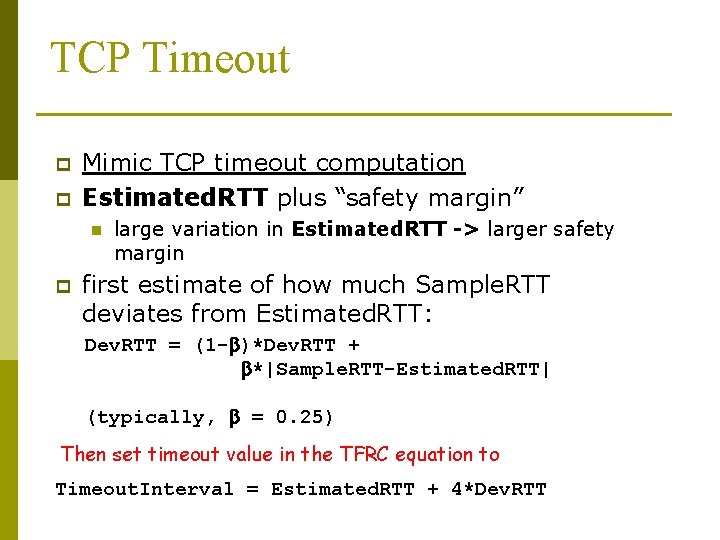
TCP Timeout p p Mimic TCP timeout computation Estimated. RTT plus “safety margin” n p large variation in Estimated. RTT -> larger safety margin first estimate of how much Sample. RTT deviates from Estimated. RTT: Dev. RTT = (1 - )*Dev. RTT + *|Sample. RTT-Estimated. RTT| (typically, = 0. 25) Then set timeout value in the TFRC equation to Timeout. Interval = Estimated. RTT + 4*Dev. RTT
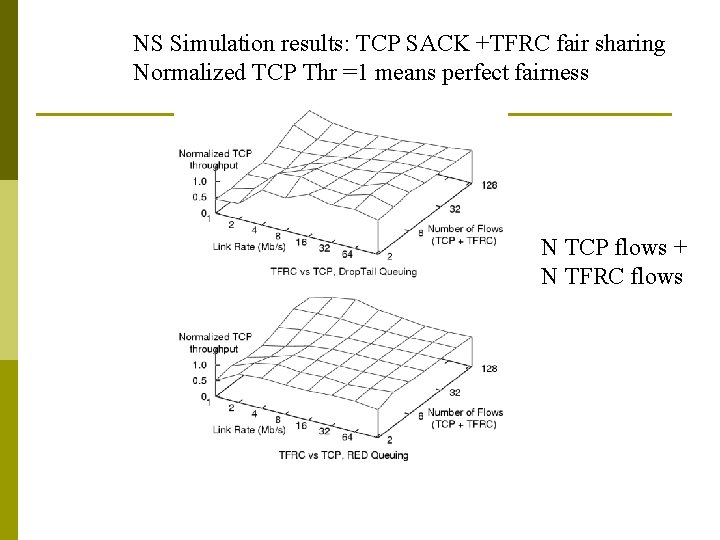
NS Simulation results: TCP SACK +TFRC fair sharing Normalized TCP Thr =1 means perfect fairness N TCP flows + N TFRC flows
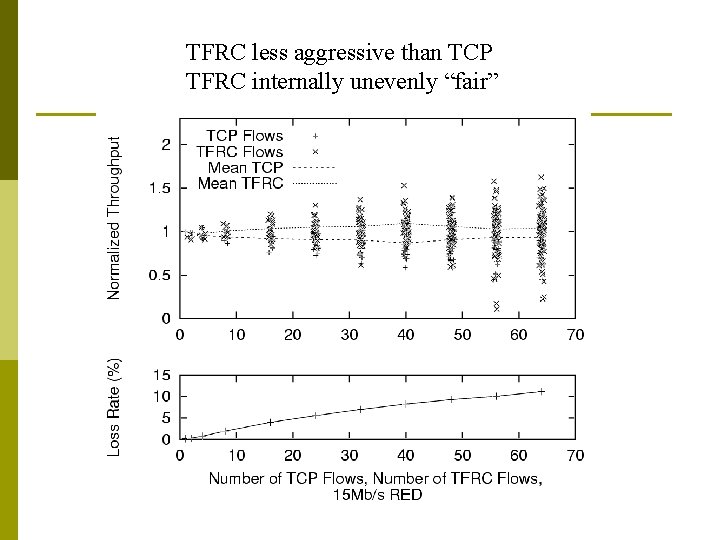
TFRC less aggressive than TCP TFRC internally unevenly “fair”
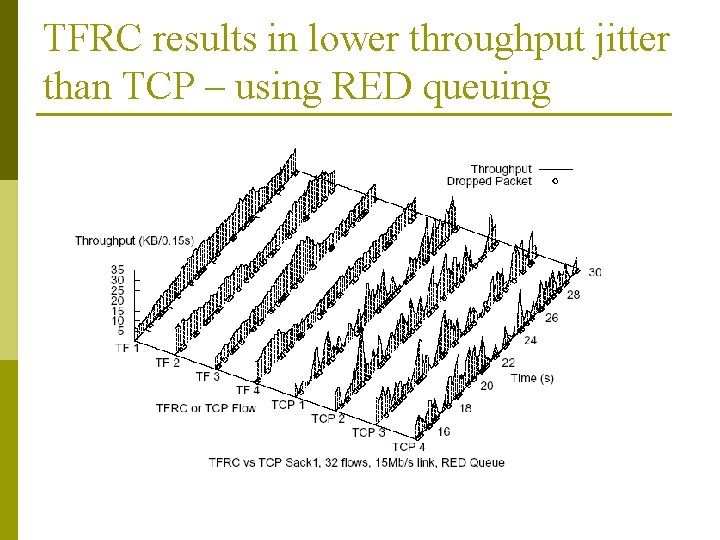
TFRC results in lower throughput jitter than TCP – using RED queuing
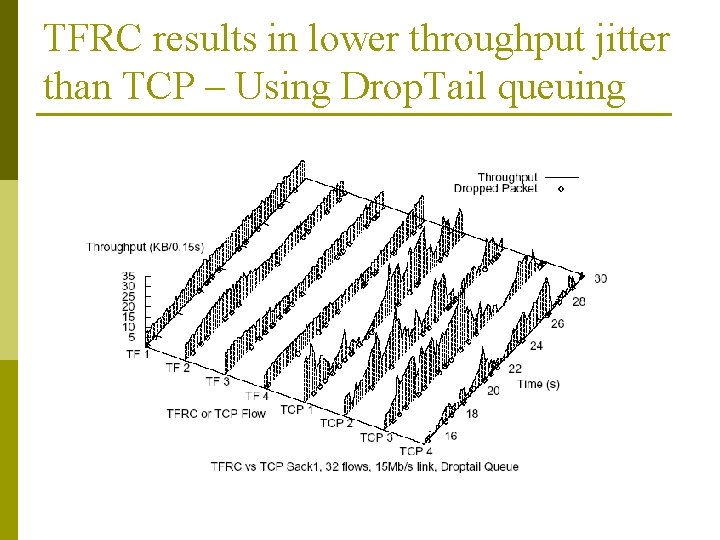
TFRC results in lower throughput jitter than TCP – Using Drop. Tail queuing
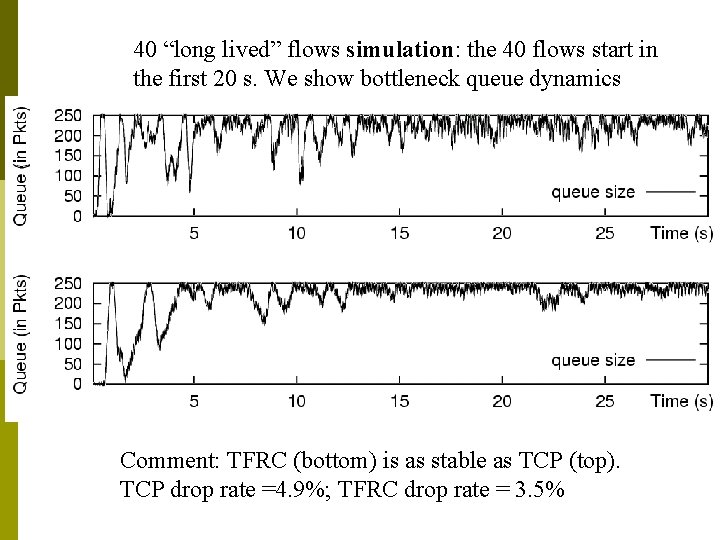
40 “long lived” flows simulation: the 40 flows start in the first 20 s. We show bottleneck queue dynamics Comment: TFRC (bottom) is as stable as TCP (top). TCP drop rate =4. 9%; TFRC drop rate = 3. 5%
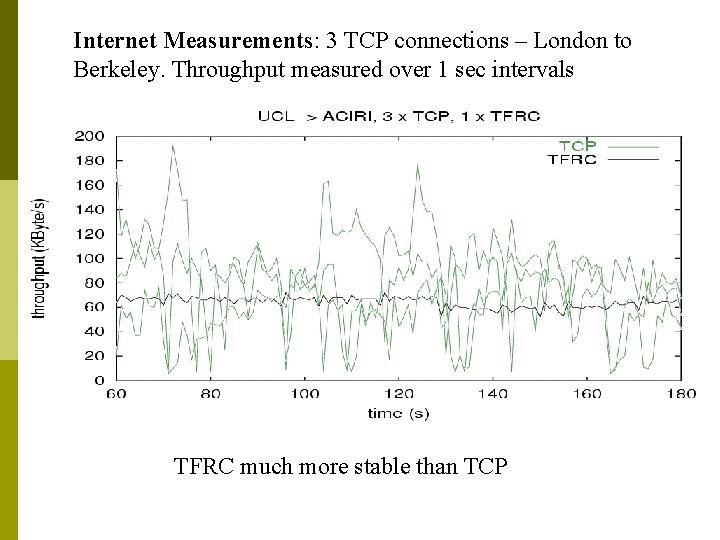
Internet Measurements: 3 TCP connections – London to Berkeley. Throughput measured over 1 sec intervals TFRC much more stable than TCP
Conclusions TFRC is better than TCP for low throughput and delay jitter applications. p TFRC shares bandwidth fairly with TCP p Can be used in Multicast? p