
TFAWS Passive Thermal Paper Session Passive Thermal Coating
- Slides: 13
TFAWS Passive Thermal Paper Session Passive Thermal Coating Observatory Operating in Low. Earth Orbit (PATCOOL) Kevin Bauer NASA Launch Services Program Presented By Kevin Bauer Thermal & Fluids Analysis Workshop TFAWS 2020 August 18 -20, 2020 Virtual Conference
Agenda • • • Background Mission Objectives Thermal Design Modeling Approach Thermal Desktop Model Temperature Predictions TFAWS 2020 – August 18 -20, 2020 2
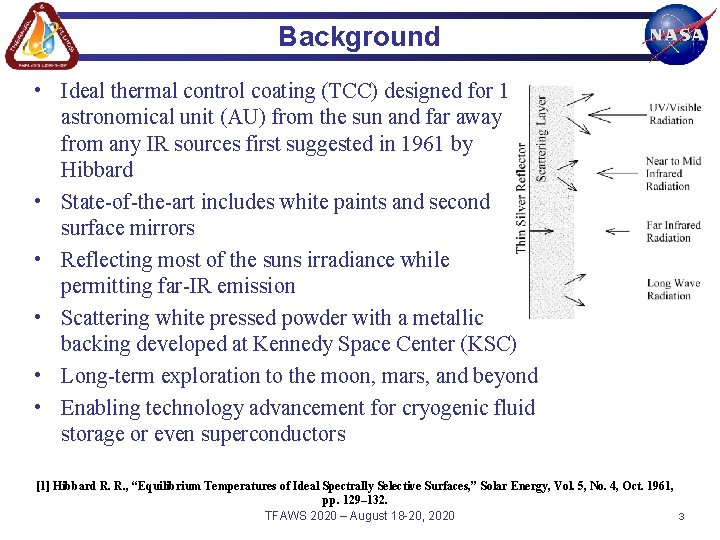
Background • Ideal thermal control coating (TCC) designed for 1 astronomical unit (AU) from the sun and far away from any IR sources first suggested in 1961 by Hibbard • State-of-the-art includes white paints and second surface mirrors • Reflecting most of the suns irradiance while permitting far-IR emission • Scattering white pressed powder with a metallic backing developed at Kennedy Space Center (KSC) • Long-term exploration to the moon, mars, and beyond • Enabling technology advancement for cryogenic fluid storage or even superconductors [1] Hibbard R. R. , “Equilibrium Temperatures of Ideal Spectrally Selective Surfaces, ” Solar Energy, Vol. 5, No. 4, Oct. 1961, pp. 129– 132. 3 TFAWS 2020 – August 18 -20, 2020
Mission Objectives 1. PATCOOL will serve as a performance test for a TCC developed at KSC Ø Ø Comparison to current state-of-the-art thermal control coating AZ-93 white paint Incorporate redundancies to reduce uncertainty 2. Ascertain how close to cryogenic temperatures can the samples reach in a low earth orbit Ø Ø 3. Minimize environmental sources to solar radiation Collect a significant temperature delta between coatings Thermal Desktop model validation Ø Ø Use of empirical data to improve model fidelity How accurate are TCC optical properties? TFAWS 2020 – August 18 -20, 2020 4
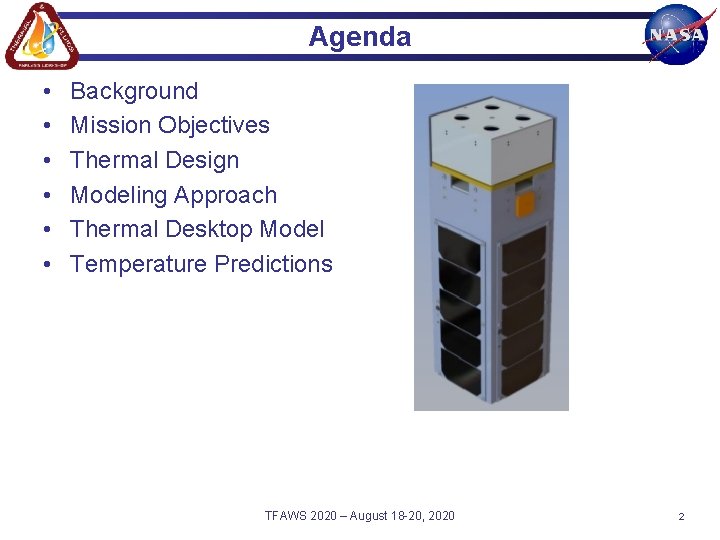
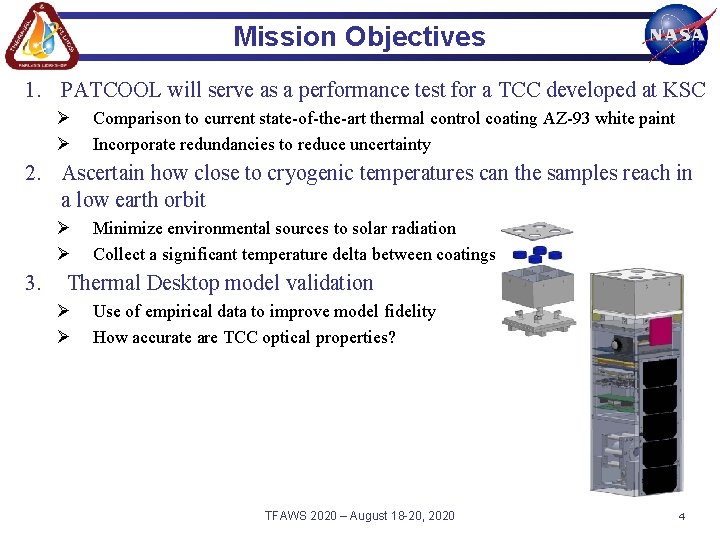
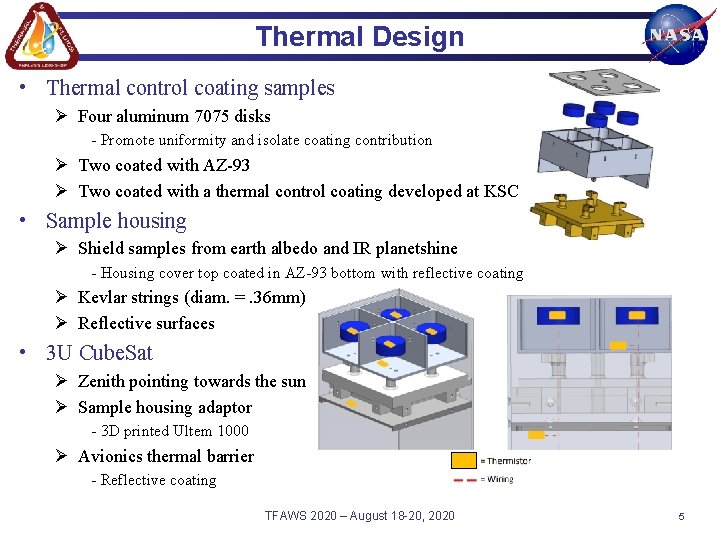
Thermal Design • Thermal control coating samples Ø Four aluminum 7075 disks - Promote uniformity and isolate coating contribution Ø Two coated with AZ-93 Ø Two coated with a thermal control coating developed at KSC • Sample housing Ø Shield samples from earth albedo and IR planetshine - Housing cover top coated in AZ-93 bottom with reflective coating Ø Kevlar strings (diam. =. 36 mm) Ø Reflective surfaces • 3 U Cube. Sat Ø Zenith pointing towards the sun Ø Sample housing adaptor - 3 D printed Ultem 1000 Ø Avionics thermal barrier - Reflective coating TFAWS 2020 – August 18 -20, 2020 5
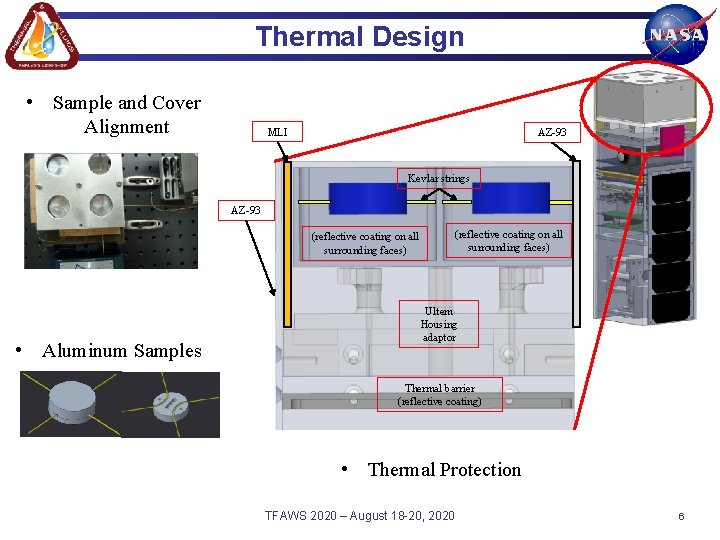
Thermal Design • Sample and Cover Alignment MLI AZ-93 Kevlar strings AZ-93 (reflective coating on all surrounding faces) • Aluminum Samples Ultem Housing adaptor Thermal barrier (reflective coating) • Thermal Protection TFAWS 2020 – August 18 -20, 2020 6
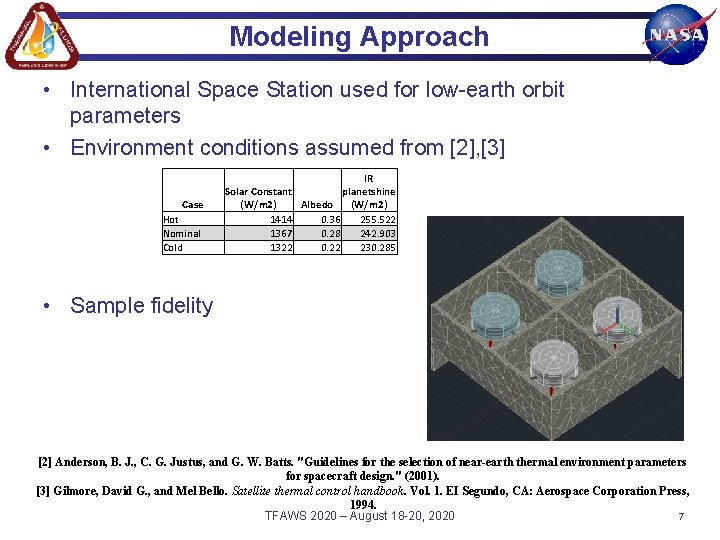
Modeling Approach • International Space Station used for low-earth orbit parameters • Environment conditions assumed from [2], [3] Case Hot Nominal Cold IR planetshine Solar Constant (W/m 2) Albedo (W/m 2) 1414 0. 36 255. 522 1367 0. 28 242. 903 1322 0. 22 230. 285 • Sample fidelity [2] Anderson, B. J. , C. G. Justus, and G. W. Batts. "Guidelines for the selection of near-earth thermal environment parameters for spacecraft design. " (2001). [3] Gilmore, David G. , and Mel Bello. Satellite thermal control handbook. Vol. 1. EI Segundo, CA: Aerospace Corporation Press, 1994. 7 TFAWS 2020 – August 18 -20, 2020
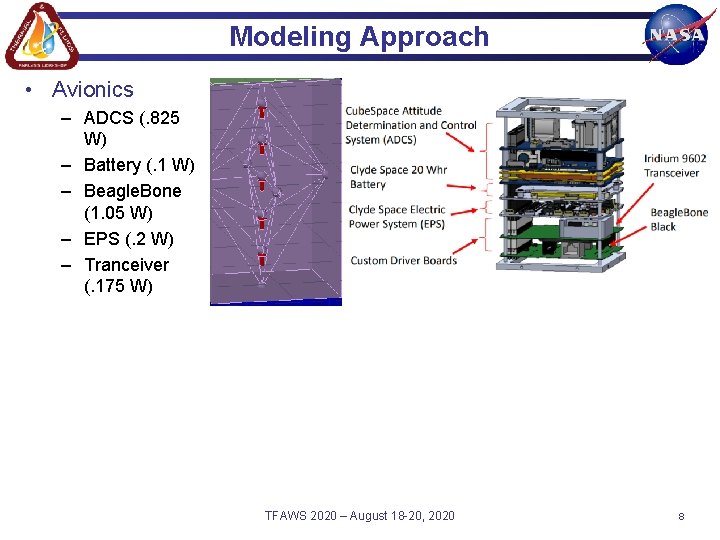
Modeling Approach • Avionics – ADCS (. 825 W) – Battery (. 1 W) – Beagle. Bone (1. 05 W) – EPS (. 2 W) – Tranceiver (. 175 W) TFAWS 2020 – August 18 -20, 2020 8
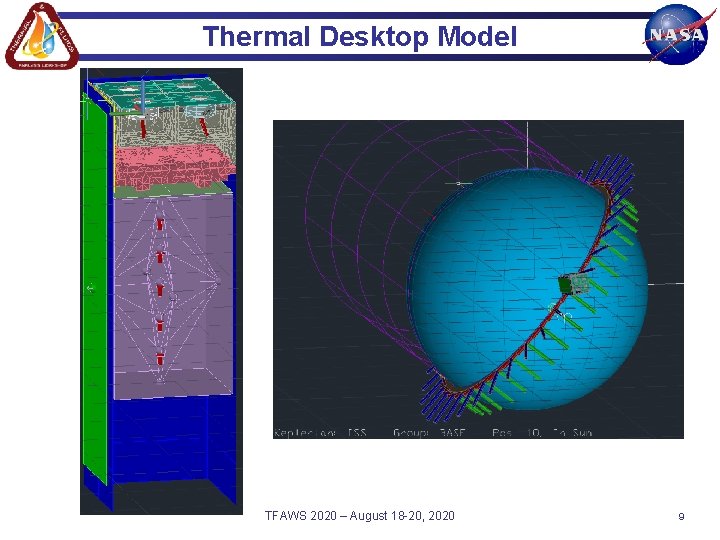
Thermal Desktop Model TFAWS 2020 – August 18 -20, 2020 9
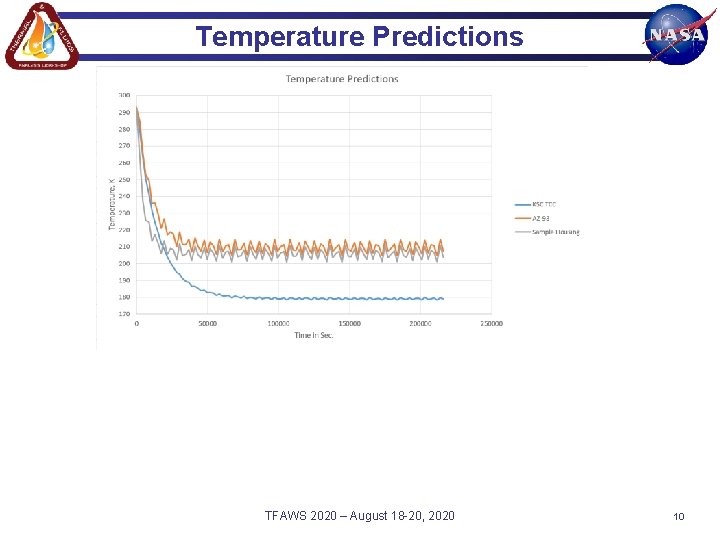
Temperature Predictions TFAWS 2020 – August 18 -20, 2020 10
Future Work • Post processing – Use of subroutines for an overall energy balance on samples • Model Validation through empirical data – Lab testing only accounts for simulated solar radiation TFAWS 2020 – August 18 -20, 2020 11
Questions? nk you for your time and this opportun TFAWS 2020 – August 18 -20, 2020 12
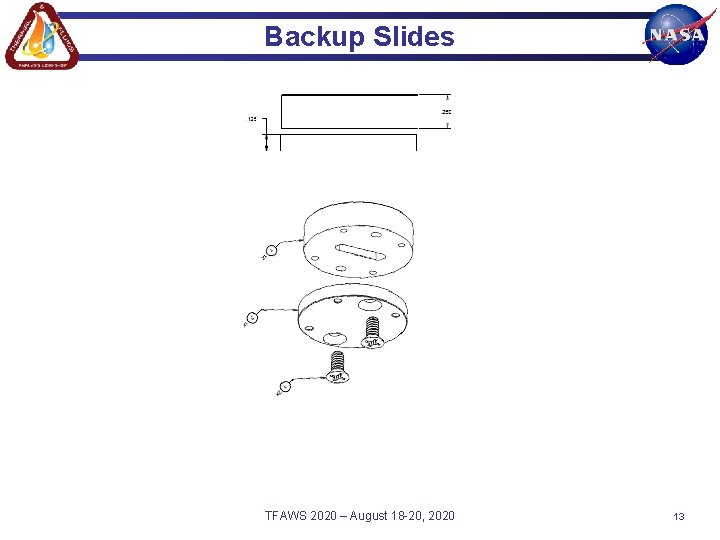
Backup Slides TFAWS 2020 – August 18 -20, 2020 13