
Textured Mesh vs Coloured Point Cloud A Subjective
Textured Mesh vs Coloured Point Cloud: A Subjective Study for Volumetric Video Compression Emin Zerman, Cagri Ozcinar, Pan Gaoy, and Aljosa Smolic 2020 Twelfth International Conference on Quality of Multimedia Experience (Qo. MEX)
Introduction • Volumetric video (VV) is a new form of immersive visual media • Various VV compression works are ongoing (MPEG, JPEG) • Two popular VV formats: • Textured polygonal Mesh • Point cloud • This paper aim to understand perceptual differences between: • Mesh and Point cloud • Various point cloud compression algorithms 2
Related Work • Including: • Methods capture the real-life 3 D content from the scene • Mesh and point cloud compression • Quality assessment (QA) of mesh and point cloud • In QA papers, only some of them consider stateof-the-art compression algorithms • Studies consider QA of VV are rather limited 3
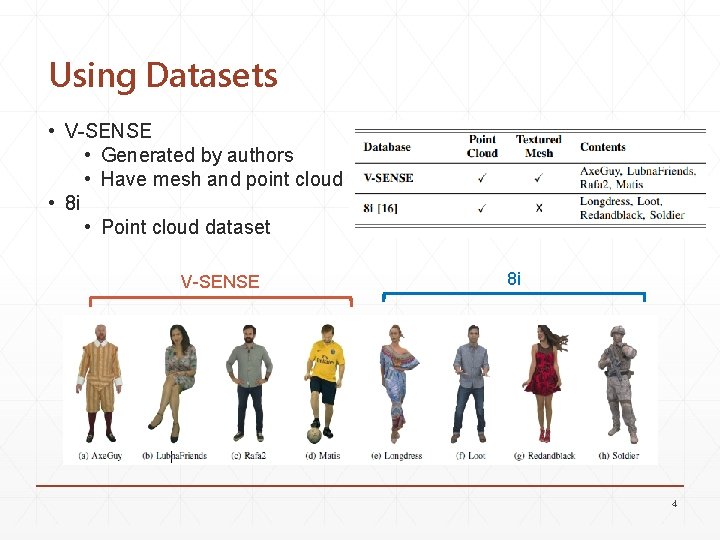
Using Datasets • V-SENSE • Generated by authors • Have mesh and point cloud • 8 i • Point cloud dataset V-SENSE 8 i 4
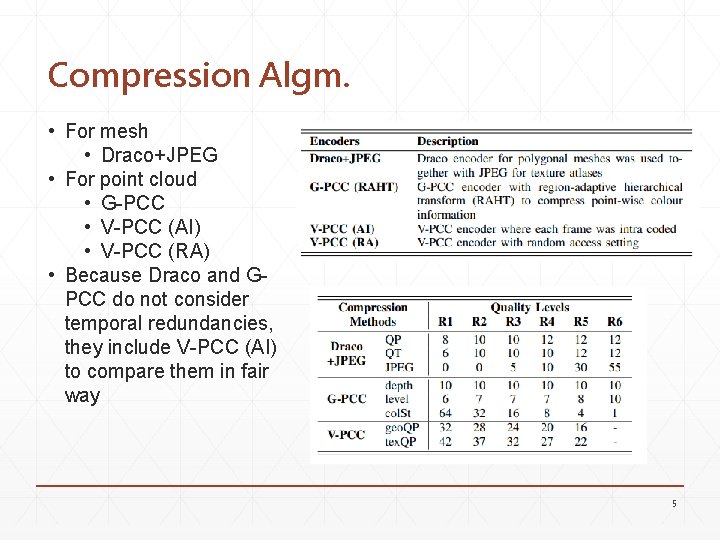
Compression Algm. • For mesh • Draco+JPEG • For point cloud • G-PCC • V-PCC (AI) • V-PCC (RA) • Because Draco and GPCC do not consider temporal redundancies, they include V-PCC (AI) to compare them in fair way 5
Visualization and Experiment Setup • The compressed VVs were rendered using Blender with “point cloud visualizer” add on • Stored as traditional videos (using ffmpeg, X 264 codec, crf 15) • Render on 24’’ LCD Display • The distance between the viewers and the screen was set to three times of the stimulus height, which was around 1 metre • The experiment was conducted in a dark room as recommended by ITU [1] ITU-T, “Subjective video quality assessment methods for multimedia applications, ” ITU-T Recommendation P. 910, 6 Apr 2008.
Experiment Procedure • The participants were first trained on ‘Rafa’ sequence with different V-PCC compression levels • Adopt Absolute Category Rating (ACR) • Each stimulus was 10 seconds long, and participants voted for each stimulus in 1. 5 sec on average • Include two sessions: • First session (30 mins): compare mesh and point cloud • Second session (30 mins): compare different point cloud compression algorithm 7
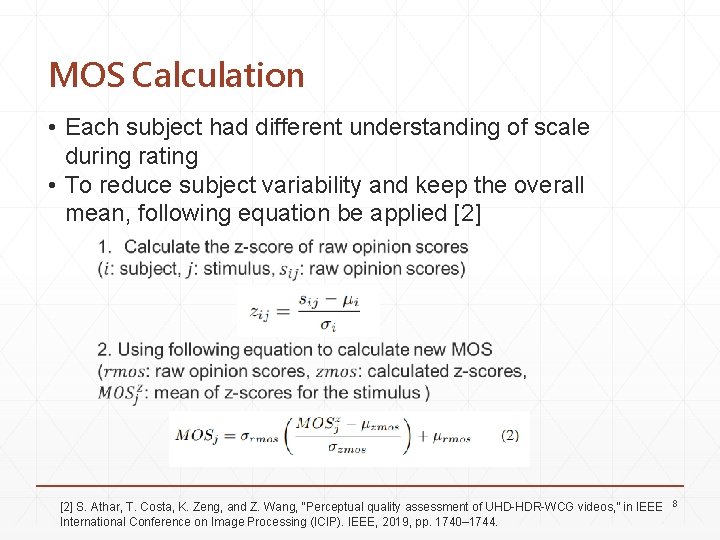
MOS Calculation • Each subject had different understanding of scale during rating • To reduce subject variability and keep the overall mean, following equation be applied [2] S. Athar, T. Costa, K. Zeng, and Z. Wang, “Perceptual quality assessment of UHD-HDR-WCG videos, ” in IEEE International Conference on Image Processing (ICIP). IEEE, 2019, pp. 1740– 1744. 8
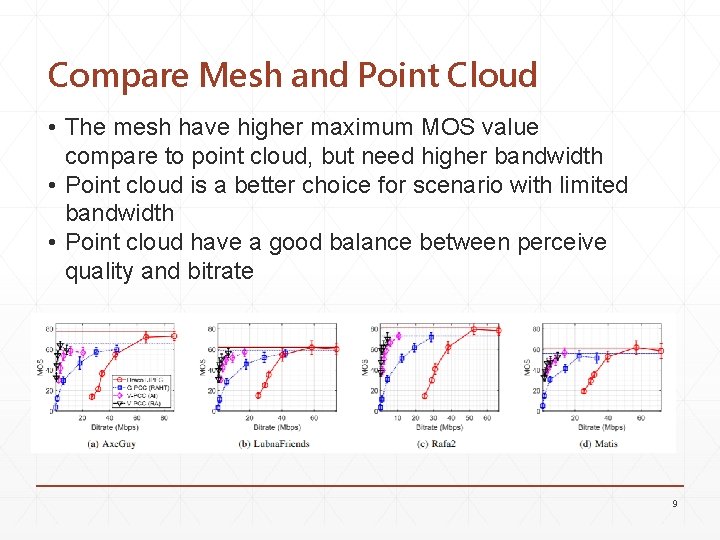
Compare Mesh and Point Cloud • The mesh have higher maximum MOS value compare to point cloud, but need higher bandwidth • Point cloud is a better choice for scenario with limited bandwidth • Point cloud have a good balance between perceive quality and bitrate 9
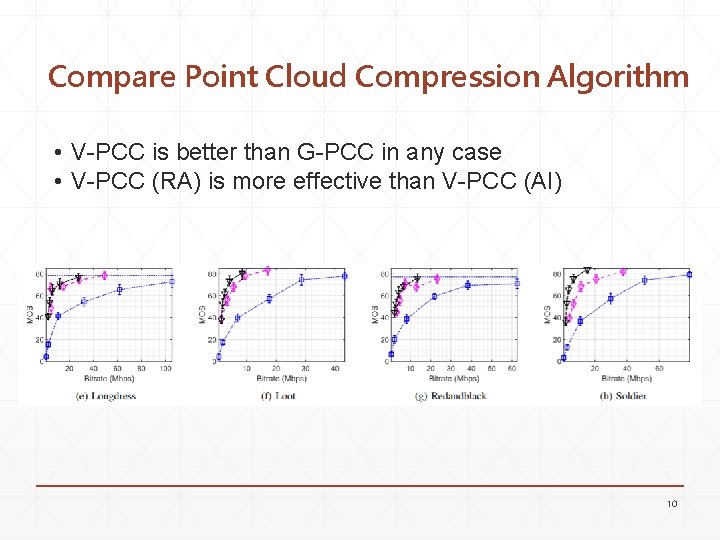
Compare Point Cloud Compression Algorithm • V-PCC is better than G-PCC in any case • V-PCC (RA) is more effective than V-PCC (AI) 10
![BD-MOS • Similar with BD-PSNR, was developed in [3] • V-PCC (RA) performs the](http://slidetodoc.com/presentation_image_h2/85c21536d07b5b3be24c075644bb2909/image-11.jpg "BD-MOS • Similar with BD-PSNR, was developed in [3] • V-PCC (RA) performs the")
BD-MOS • Similar with BD-PSNR, was developed in [3] • V-PCC (RA) performs the best [3] P. Hanhart, M. Rerabek, F. De Simone, and T. Ebrahimi, “Subjective quality evaluation of the upcoming HEVC video compression standard, ” in Applications of Digital Image Processing XXXV. SPIE, 2012 11
Conclusion • Textured mesh can provide the best visualization quality, and are more suitable for high bandwidth scenario • Point cloud is suitable for limited bandwidth scenario • V-PCC is more efficiently than all other compression methods 12
- Slides: 12