
Texture Analysis and Its Applications in Medical Imaging

- Slides: 16
Texture Analysis and Its Applications in Medical Imaging Edward J. Delp Purdue University School of Electrical and Computer Engineering Video and Image Processing Laboratory (VIPER) West Lafayette, Indiana, USA email: ace@ecn. purdue. edu http: //www. ece. purdue. edu/~ace Edward J. Delp Texture Analysis February 2000 Slide 1
What is Texture? • There is no good definition of texture in images! – IEEE: “texture is an attribute representing the spatial arrangement of the gray levels of the pixels in a region” – R. C. Gonzalez and P. Wintz (2 nd Edition): “we intuitively view this descriptor as providing a measure of properties such as smoothness, coarseness, and regularity” – W. K. Pratt: “several authors have attempted qualitatively to define texture” Edward J. Delp Texture Analysis February 2000 Slide 2
What is Texture? • J. K. Hawkins, “Textural Properties for Pattern Recognition, ” in Picture Processing and Pyschopictorics edited by B. S. Lipkins and A. Rosenfeld: – some “order” is repeated over a region which is large in comparison to the order’s size – the order consists of a in the nonrandom arrangement of elementary parts – the parts are roughly uniform entities having approximately the same dimensions everywhere in the region Edward J. Delp Texture Analysis February 2000 Slide 3
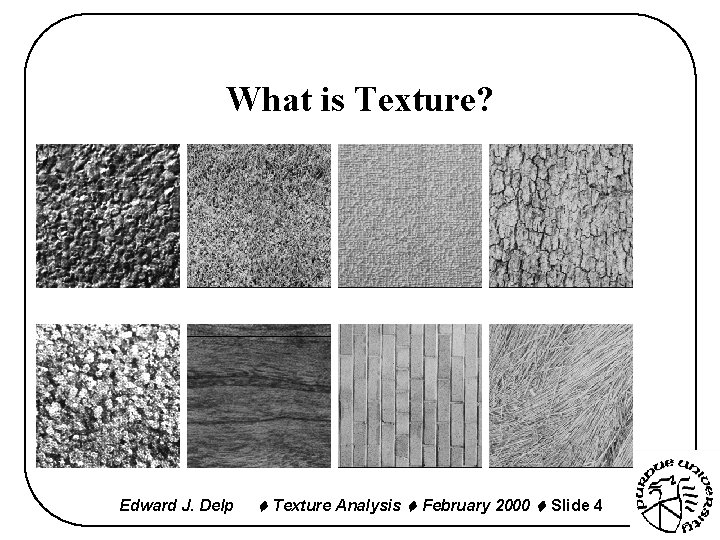
What is Texture? Edward J. Delp Texture Analysis February 2000 Slide 4
Textures • “Statistical” Textures • “Geometrical” Textures • Color Textures Edward J. Delp Texture Analysis February 2000 Slide 5
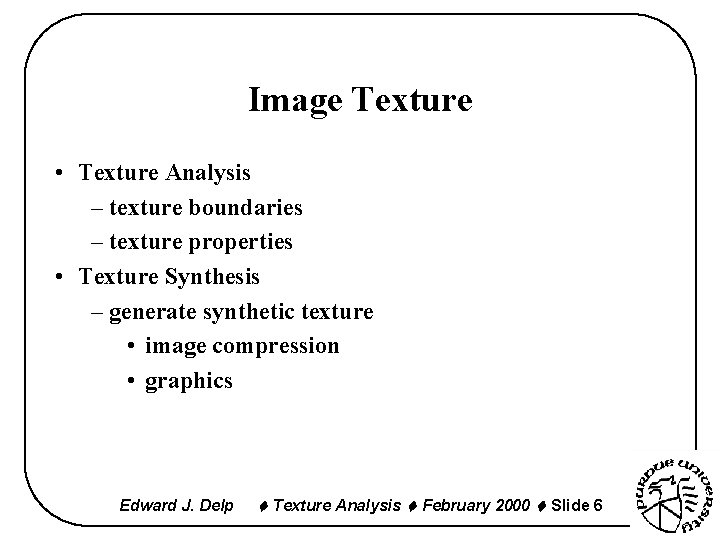
Image Texture • Texture Analysis – texture boundaries – texture properties • Texture Synthesis – generate synthetic texture • image compression • graphics Edward J. Delp Texture Analysis February 2000 Slide 6
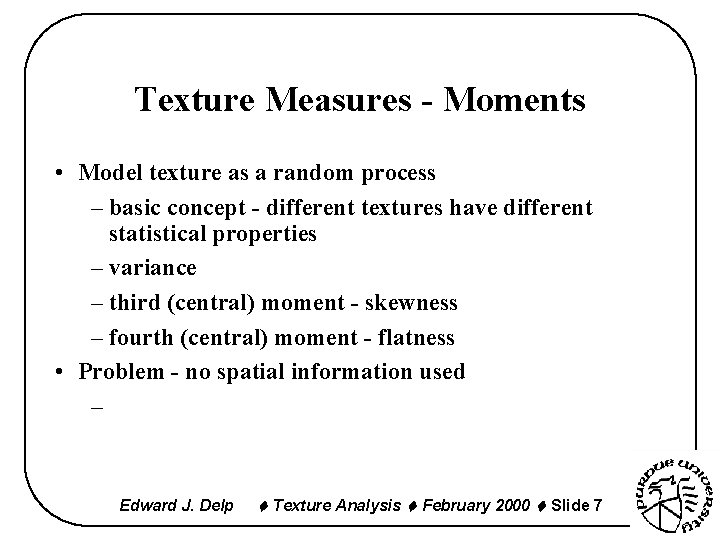
Texture Measures - Moments • Model texture as a random process – basic concept - different textures have different statistical properties – variance – third (central) moment - skewness – fourth (central) moment - flatness • Problem - no spatial information used – Edward J. Delp Texture Analysis February 2000 Slide 7
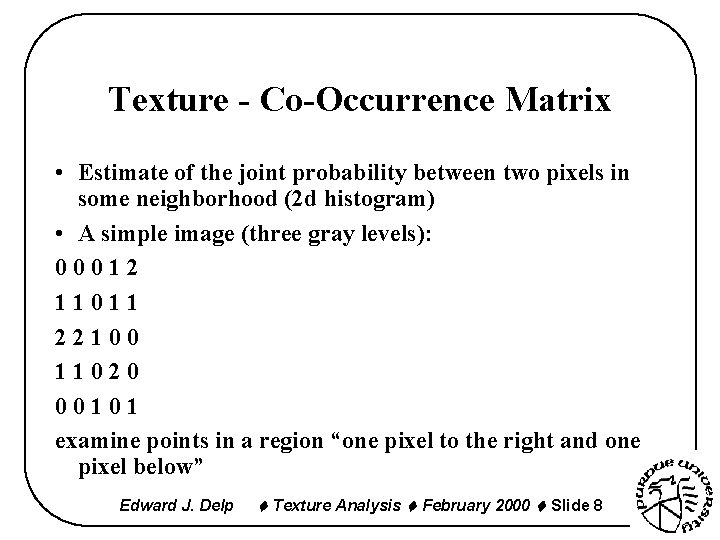
Texture - Co-Occurrence Matrix • Estimate of the joint probability between two pixels in some neighborhood (2 d histogram) • A simple image (three gray levels): 00012 11011 22100 11020 00101 examine points in a region “one pixel to the right and one pixel below” Edward J. Delp Texture Analysis February 2000 Slide 8
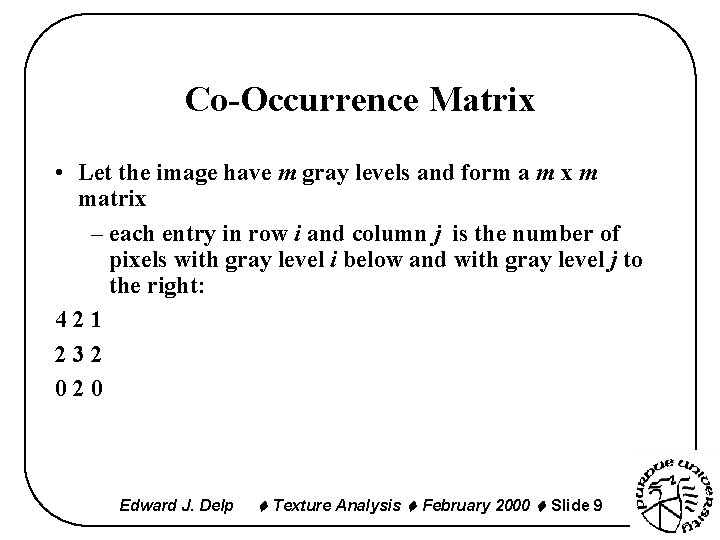
Co-Occurrence Matrix • Let the image have m gray levels and form a m x m matrix – each entry in row i and column j is the number of pixels with gray level i below and with gray level j to the right: 421 232 020 Edward J. Delp Texture Analysis February 2000 Slide 9
Co-Occurrence Matrix • Divide each entry by the total number of point pairs • Measures used: – maximum value – entropy – total energy • Captures information about relative spatial position Edward J. Delp Texture Analysis February 2000 Slide 10
Texture - Other • Edge density • run length measures • frequency domain methods Edward J. Delp Texture Analysis February 2000 Slide 11
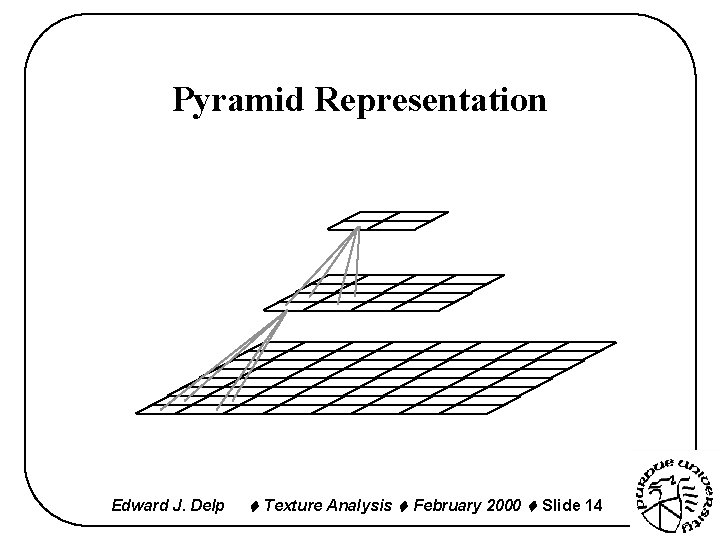
Multiresolution Decomposition • Transforms – Gaussian Pyramid – Morphological Pyramid – DCT – Wavelet Edward J. Delp Texture Analysis February 2000 Slide 12
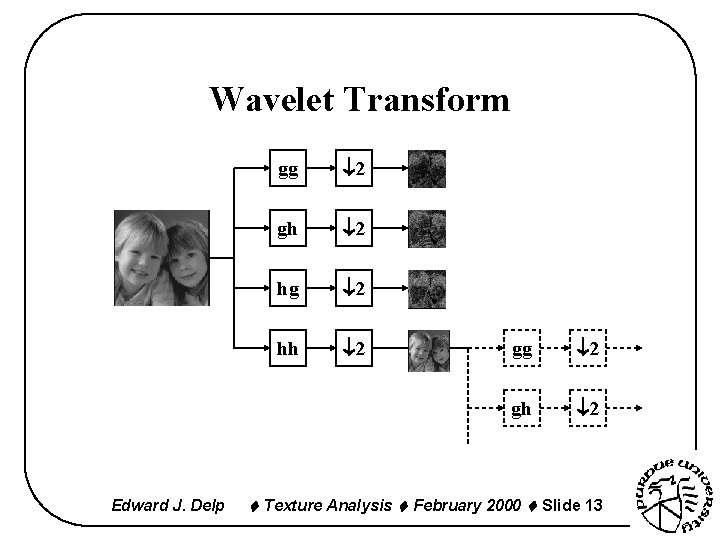
Wavelet Transform Edward J. Delp gg 2 gh 2 hg 2 hh 2 gg 2 gh 2 Texture Analysis February 2000 Slide 13
Pyramid Representation Edward J. Delp Texture Analysis February 2000 Slide 14
Why Wavelets? • Tool for many multiresolution image processing and analysis techniques – rate scalable compression (JPEG 2000) – image watermarking – denoising – medical imaging – image and video databases – texture analysis Edward J. Delp Texture Analysis February 2000 Slide 15
Wavelet Texture Analysis • Excellent web site: http: //ua. ac. be/~visielab/wta. html Edward J. Delp Texture Analysis February 2000 Slide 16