
Textual DSLs illustrated with Eclipse Tools Sven Efftinge
- Slides: 29
Textual DSLs illustrated with Eclipse Tools Sven Efftinge sven@applied-abstractions. com Arno Haase arno@applied-abstractions. com Markus Völter markus@applied-abstractions. com © 2 0 0 6 Applied Abstractions applied-abstractions. com 1
Textual DSLs About Applied Abstractions Sven Efftinge Arno Haase Markus Völter Bernd Kolb © 2 0 0 6 Applied Abstractions applied-abstractions. com 2
Textual DSLs Model-Driven Development is about levels of abstraction • Defining a metamodel that fits the domain • It is about defining languages • concrete syntax matters • as simple as possible • as flexible as necessary • intuitive, good match for the domain • “ubiquitous language“ • useful for communication • . . . although it is not the most important part • different syntaxes for the same metamodel are possible © 2 0 0 6 Applied Abstractions applied-abstractions. com
Textual DSLs What is a DSL (1): Domain • a DSL is a language for a domain • can be anything: technical, “business“, . . . • GUI, component model, workflow description, . . . • description of an insurance contract, . . . • it is based on a deep understanding of the domain • domain experts • searching for the suitable abstractions • evolving, growing the language © 2 0 0 6 Applied Abstractions applied-abstractions. com 4
Textual DSLs What is a DSL (2): Specific • A DSL is specific • Good match for the domain's abstractions • bounded in scope • does one thing only, and does that well • different trade-offs from a general-purpose language • readable or even writable for domain experts • small number of orthogonal concepts © 2 0 0 6 Applied Abstractions applied-abstractions. com 5
Textual DSLs What is a DSL (3): Language • a DSL is a language • precise semantics: executable (interpreted, compiled, cross -compiled) • expressive • complete with regard to its domain © 2 0 0 6 Applied Abstractions applied-abstractions. com
Textual DSLs What is a DSL (4): Characteristics • Different characteristics for different domains • Concrete Syntax: textual vs. graphical • Domain Selection: structural vs. behavioural • Expressive Power: declarative vs. imperative • Execution: interpretation vs. compilation/transformation • Integration: internal vs. external • Tool Support: editor, debugger, … © 2 0 0 6 Applied Abstractions applied-abstractions. com
Textual DSLs Why concrete syntax is important • Abstract Syntax defines grammar for the language – most important for tools • Concrete Syntax is the “UI” for the language – critical for DSL users • concise vs. redundant • intuitive • simple to write and read • Tool support matters • IDE integration • syntax highlighting • metamodel awareness © 2 0 0 6 Applied Abstractions applied-abstractions. com
Textual DSLs Different syntax for different abstractions / domains • Different concrete syntax is well established for different domains • class diagrams to describe types and structure • state charts • textual expression notation for behaviour • XML for structured data • The abstraction should drive syntax decision, not vice versa • Available tool support often decides the syntax • UML has its uses, but it is no panacea • building specific textual languages – and IDEs to work with them – has become feasible © 2 0 0 6 Applied Abstractions applied-abstractions. com
Textual DSLs UML ? • UML is a pre-defined metamodel and syntax • covers the rather general domain of “OO SW Development” • inflexible in its notations • can be extended but not restricted • But what about UML 2 profiles? • well-defined ways of using stereotypes and tagged values • but the syntax remains pre-defined (at least in practice) • UML is useful, but it is not the answer to every problem • building specific graphical and textual tools has become feasible (e. g. Eclipse GMF) • keep an open mind © 2 0 0 6 Applied Abstractions applied-abstractions. com
Textual DSLs Tradeoffs for textual DSLs • With both textual and graphical syntax you can • Model for any meta model • verify constraints in real time • (Eclipse) write ordinary EMF models • Graphical Editors are good to show structural relationships • Textual Editors are better for „algorithmic“ aspects, or hierarchical models • Textual Editors integrate better with CVS etc. (diff, merge) © 2 0 0 6 Applied Abstractions applied-abstractions. com
Textual DSLs Parts of a textual language (1): Parser • Every textual language requires a parser • transform one or more text files into an object representation (aka AST) • check for syntactical correctness • Acts as a linker • Parsers are typically generated based on a formal syntax definition (such as EBNF) • antlr, javacc, LPG, … © 2 0 0 6 Applied Abstractions applied-abstractions. com
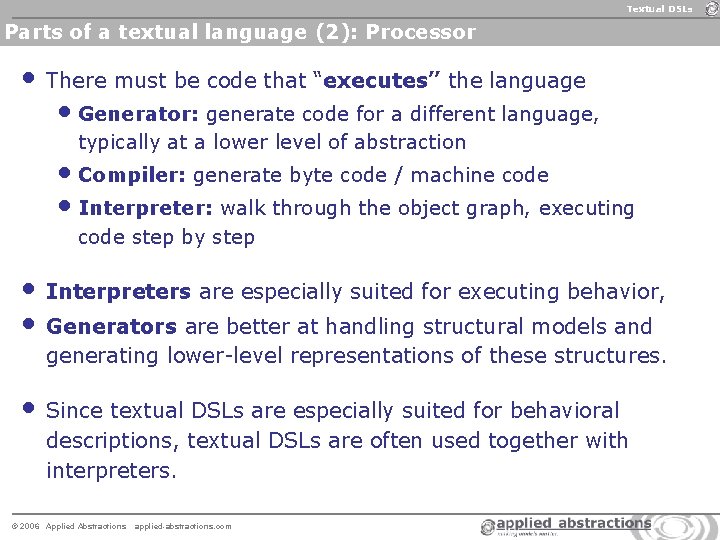
Textual DSLs Parts of a textual language (2): Processor • There must be code that “executes” the language • Generator: generate code for a different language, typically at a lower level of abstraction • Compiler: generate byte code / machine code • Interpreter: walk through the object graph, executing code step by step • • Interpreters are especially suited for executing behavior, • Since textual DSLs are especially suited for behavioral descriptions, textual DSLs are often used together with interpreters. Generators are better at handling structural models and generating lower-level representations of these structures. © 2 0 0 6 Applied Abstractions applied-abstractions. com
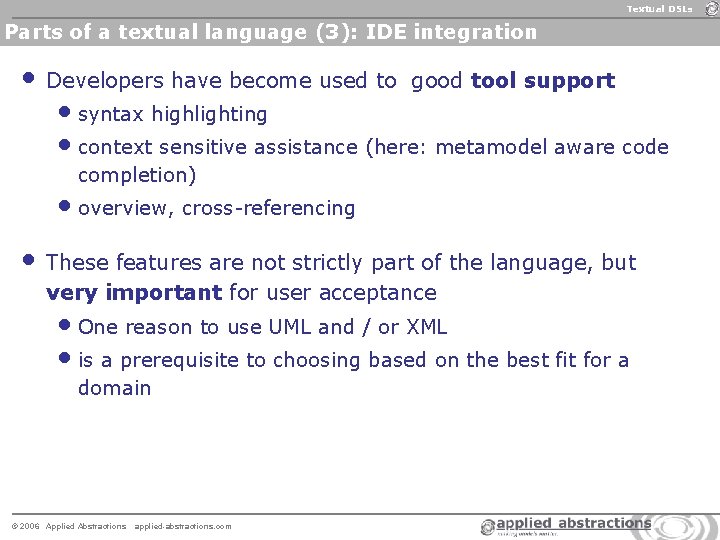
Textual DSLs Parts of a textual language (3): IDE integration • Developers have become used to good tool support • syntax highlighting • context sensitive assistance (here: metamodel aware code completion) • overview, cross-referencing • These features are not strictly part of the language, but very important for user acceptance • One reason to use UML and / or XML • is a prerequisite to choosing based on the best fit for a domain © 2 0 0 6 Applied Abstractions applied-abstractions. com
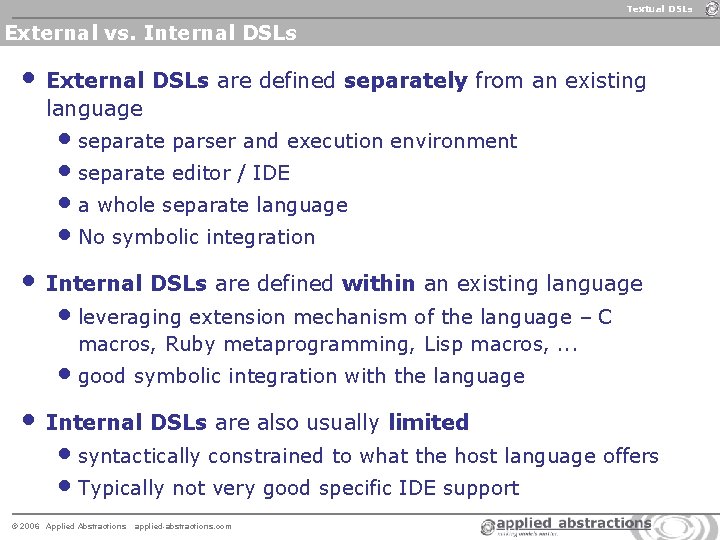
Textual DSLs External vs. Internal DSLs • External DSLs are defined separately from an existing language • separate parser and execution environment • separate editor / IDE • a whole separate language • No symbolic integration • Internal DSLs are defined within an existing language • leveraging extension mechanism of the language – C macros, Ruby metaprogramming, Lisp macros, . . . • good symbolic integration with the language • Internal DSLs are also usually limited • syntactically constrained to what the host language offers • Typically not very good specific IDE support © 2 0 0 6 Applied Abstractions applied-abstractions. com
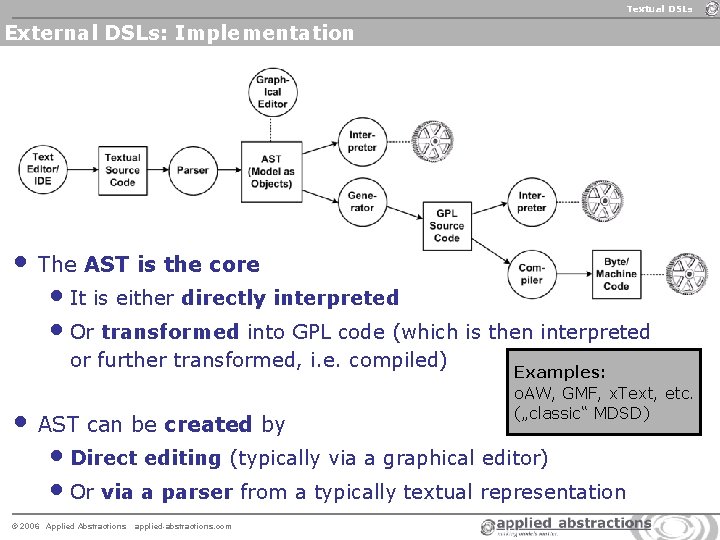
Textual DSLs External DSLs: Implementation • The AST is the core • It is either directly interpreted • Or transformed into GPL code (which is then interpreted or further transformed, i. e. compiled) • AST can be created by Examples: o. AW, GMF, x. Text, etc. („classic“ MDSD) • Direct editing (typically via a graphical editor) • Or via a parser from a typically textual representation © 2 0 0 6 Applied Abstractions applied-abstractions. com
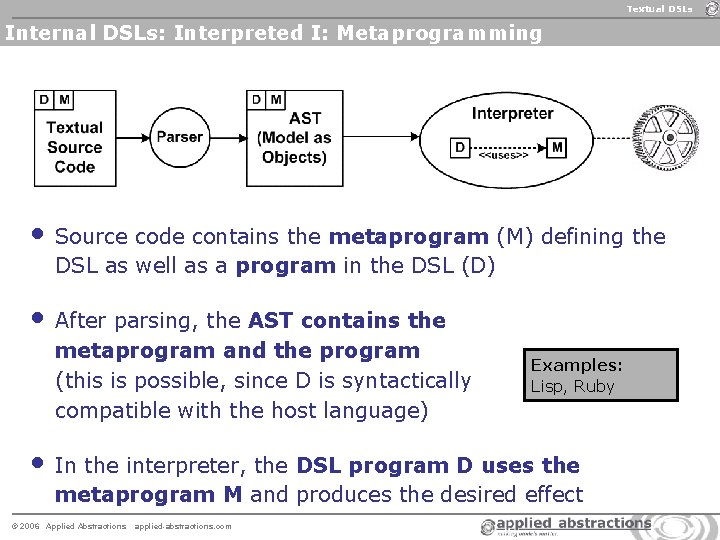
Textual DSLs Internal DSLs: Interpreted I: Metaprogramming • Source code contains the metaprogram (M) defining the DSL as well as a program in the DSL (D) • After parsing, the AST contains the metaprogram and the program (this is possible, since D is syntactically compatible with the host language) • Examples: Lisp, Ruby In the interpreter, the DSL program D uses the metaprogram M and produces the desired effect © 2 0 0 6 Applied Abstractions applied-abstractions. com
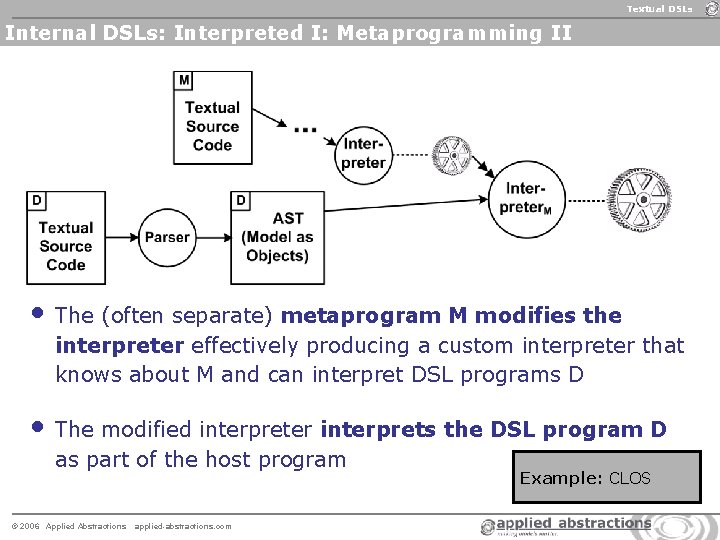
Textual DSLs Internal DSLs: Interpreted I: Metaprogramming II • The (often separate) metaprogram M modifies the interpreter effectively producing a custom interpreter that knows about M and can interpret DSL programs D • The modified interpreter interprets the DSL program D as part of the host program Example: CLOS © 2 0 0 6 Applied Abstractions applied-abstractions. com
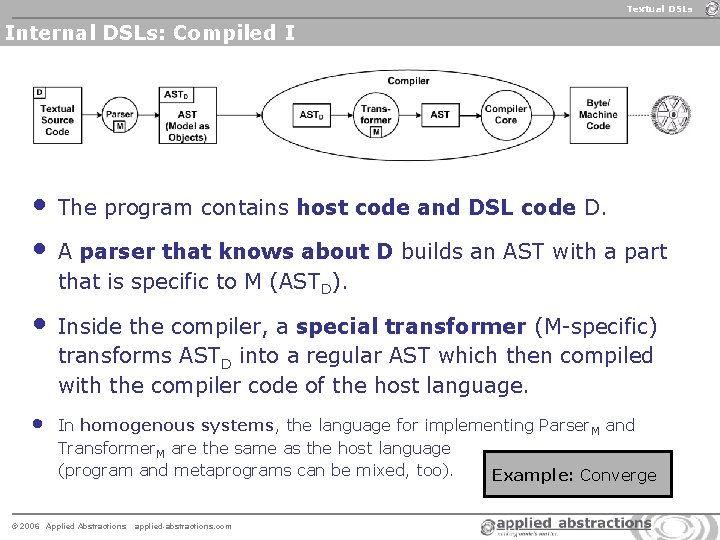
Textual DSLs Internal DSLs: Compiled I • • The program contains host code and DSL code D. • Inside the compiler, a special transformer (M-specific) transforms ASTD into a regular AST which then compiled with the compiler code of the host language. • A parser that knows about D builds an AST with a part that is specific to M (ASTD). In homogenous systems, the language for implementing Parser. M and Transformer. M are the same as the host language (program and metaprograms can be mixed, too). Example: Converge © 2 0 0 6 Applied Abstractions applied-abstractions. com
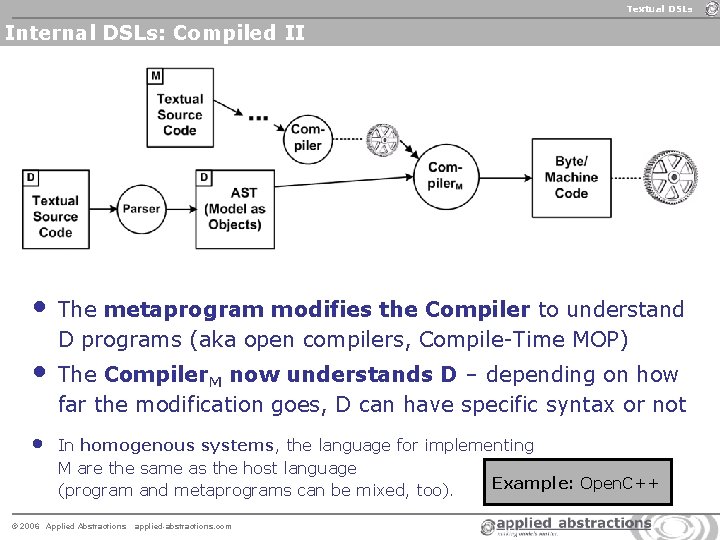
Textual DSLs Internal DSLs: Compiled II • • • The metaprogram modifies the Compiler to understand D programs (aka open compilers, Compile-Time MOP) The Compiler. M now understands D – depending on how far the modification goes, D can have specific syntax or not In homogenous systems, the language for implementing M are the same as the host language Example: Open. C++ (program and metaprograms can be mixed, too). © 2 0 0 6 Applied Abstractions applied-abstractions. com
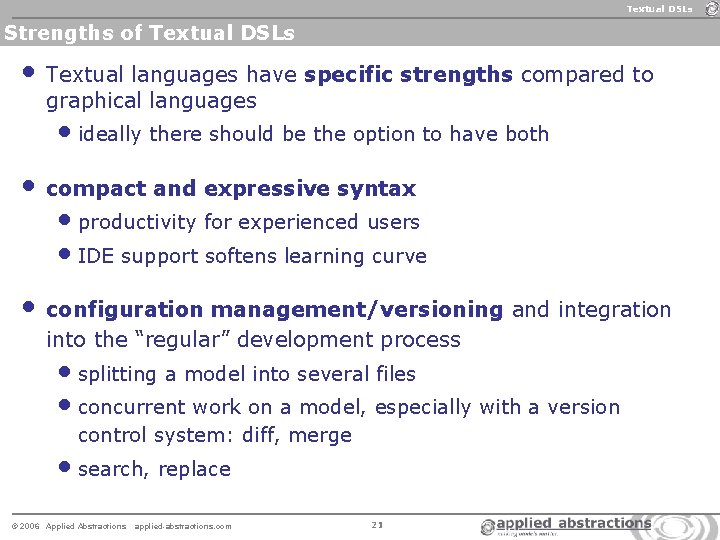
Textual DSLs Strengths of Textual DSLs • Textual languages have specific strengths compared to graphical languages • ideally there should be the option to have both • compact and expressive syntax • configuration management/versioning and integration into the “regular” development process • productivity for experienced users • IDE support softens learning curve • splitting a model into several files • concurrent work on a model, especially with a version control system: diff, merge • search, replace © 2 0 0 6 Applied Abstractions applied-abstractions. com 21
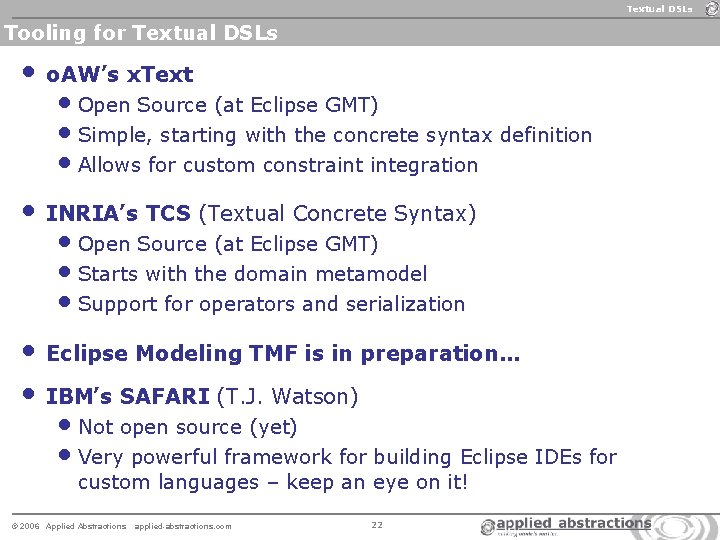
Textual DSLs Tooling for Textual DSLs • o. AW’s x. Text • Open Source (at Eclipse GMT) • Simple, starting with the concrete syntax definition • Allows for custom constraint integration • INRIA’s TCS (Textual Concrete Syntax) • Open Source (at Eclipse GMT) • Starts with the domain metamodel • Support for operators and serialization • • Eclipse Modeling TMF is in preparation… IBM’s SAFARI (T. J. Watson) • Not open source (yet) • Very powerful framework for building Eclipse IDEs for custom languages – keep an eye on it! © 2 0 0 6 Applied Abstractions applied-abstractions. com 22
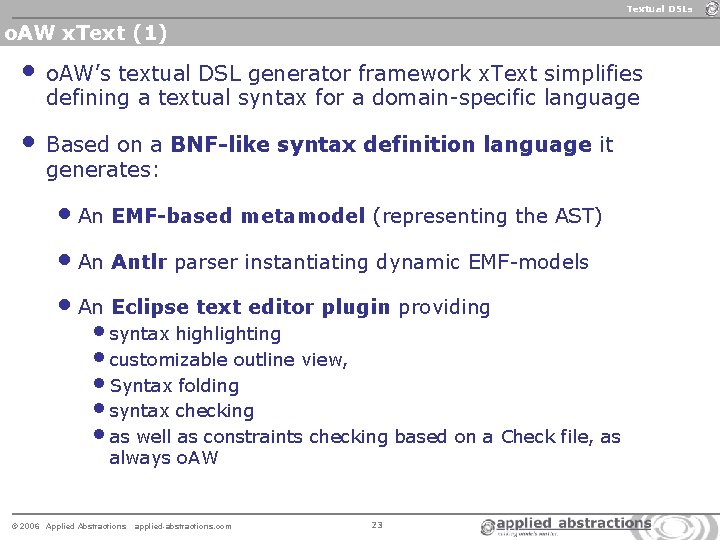
Textual DSLs o. AW x. Text (1) • o. AW’s textual DSL generator framework x. Text simplifies defining a textual syntax for a domain-specific language • Based on a BNF-like syntax definition language it generates: • An EMF-based metamodel (representing the AST) • An Antlr parser instantiating dynamic EMF-models • An Eclipse text editor plugin providing • syntax highlighting • customizable outline view, • Syntax folding • syntax checking • as well as constraints checking based on a Check file, as always o. AW © 2 0 0 6 Applied Abstractions applied-abstractions. com 23
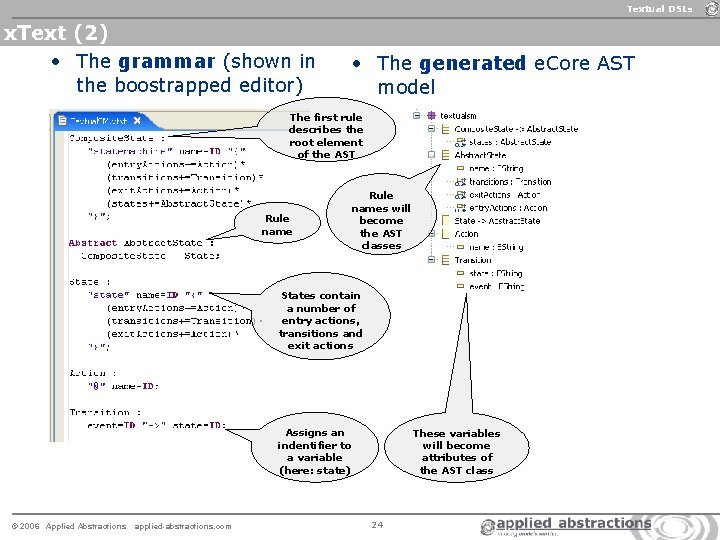
Textual DSLs x. Text (2) • The grammar (shown in the boostrapped editor) • The generated e. Core AST model The first rule describes the root element of the AST Rule names will become the AST classes States contain a number of entry actions, transitions and exit actions Assigns an indentifier to a variable (here: state) © 2 0 0 6 Applied Abstractions applied-abstractions. com These variables will become attributes of the AST class 24
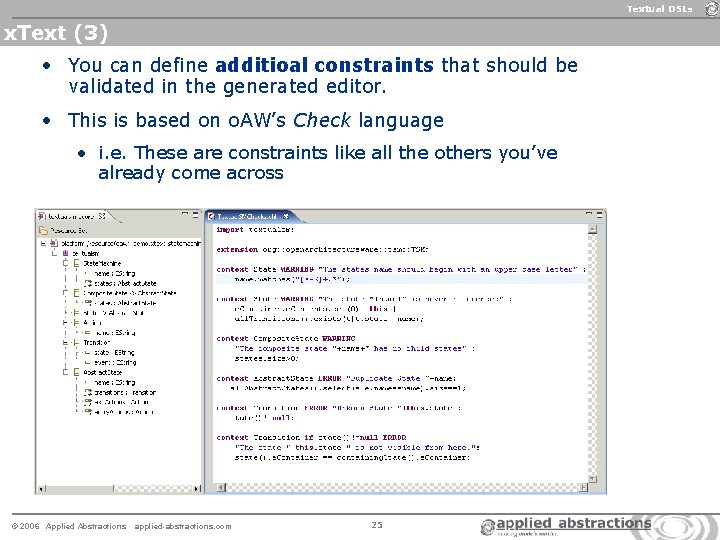
Textual DSLs x. Text (3) • You can define additioal constraints that should be validated in the generated editor. • This is based on o. AW’s Check language • i. e. These are constraints like all the others you’ve already come across © 2 0 0 6 Applied Abstractions applied-abstractions. com 25
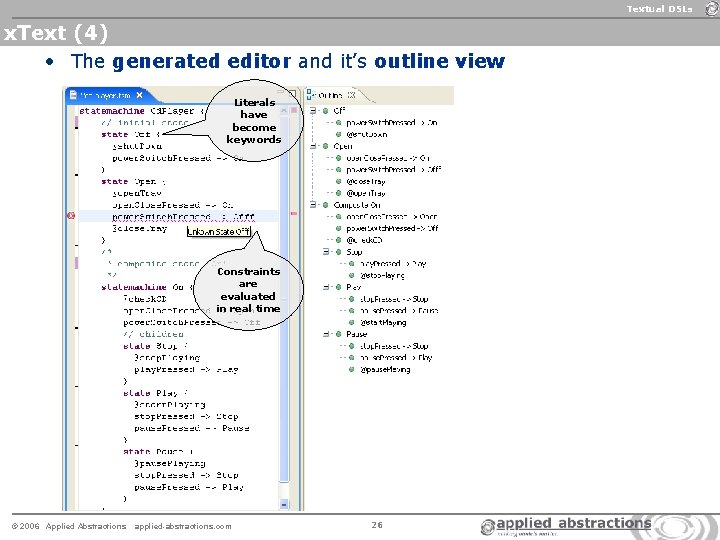
Textual DSLs x. Text (4) • The generated editor and it’s outline view Literals have become keywords Constraints are evaluated in real time © 2 0 0 6 Applied Abstractions applied-abstractions. com 26
Textual DSLs x. Text (5) • <DEMO> © 2 0 0 6 Applied Abstractions applied-abstractions. com 27
Textual DSLs THE END. Thanks! Please ask questions! © 2 0 0 6 Applied Abstractions applied-abstractions. com 28
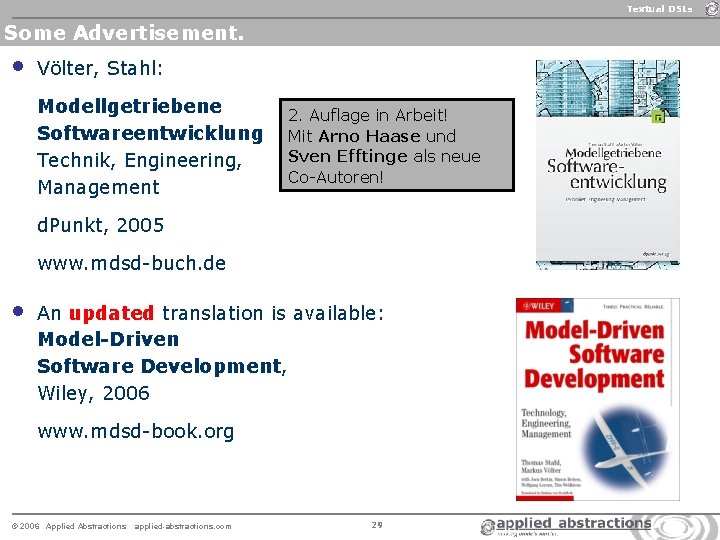
Textual DSLs Some Advertisement. • Völter, Stahl: Modellgetriebene Softwareentwicklung Technik, Engineering, Management 2. Auflage in Arbeit! Mit Arno Haase und Sven Efftinge als neue Co-Autoren! d. Punkt, 2005 www. mdsd-buch. de • An updated translation is available: Model-Driven Software Development, Wiley, 2006 www. mdsd-book. org © 2 0 0 6 Applied Abstractions applied-abstractions. com 29