
Textiles Section 3 Materials and Their Working properties


- Slides: 15
Textiles • Section 3 • Materials and Their Working properties
Objectives • Know the primary sources of materials for producing textiles • Be able to recognise and characterise different types of textile • Understand how the physical and working properties of a range of textiles affect their performance
Informing design decisions Unit 1 New and emerging technologies Textiles • Textiles are highly adaptable and can be constructed to maximize different properties including a very high strength to weight ratio, which means less materials can be used to make strong and robust products.
Informing design decisions Unit 1 New and emerging technologies Availability of textiles Textiles are available in many different forms including rolls, yarns and fibres. They can be made into a multitude of shapes and products using different processing methods. Some textiles can be very cheaply produced and some are extremely expensive, especially when using rare fibres and labour intensive techniques.
Informing design decisions Unit 1 New and emerging technologies Categorisation of textiles • The categories of textiles covered here include: • natural fibres • synthetic fibres • blended and mixed fibres • woven fabric • knitted textiles
Informing design decisions Unit 1 New and emerging technologies Plant-based natural fibres • Plant fibres can be spun together to create a yarn. Fabrics made from plant based materials are renewable but take a long time to grow. • Task • On your worksheet, fill in the information about cotton, wool and silk from page 20 in your text book
Informing design decisions Unit 1 New and emerging technologies Questions Name as many different types of wool as possible and link them to the animal that produces the fibres that the wool is made from. Eg angora – angora rabbit, merino – marino sheep, mohair – angora goat, cashmere – cashmere goats, wool can also be from camels, llamas and alpacas What properties of silk make it suitable for luxury items of clothing? Lightweight, cool when the body is hot and warm when cold, quick drying
Informing design decisions Unit 1 New and emerging technologies Synthetic Fibres Synthetic fibres are made from polymers (long chain molecules). These molecules come mainly from coal and oil – non renewable fossil fuels. Synthetic fibres are therefore much less sustainable than natural fibres. Task Complete the worksheet on synthetic fibres using page 20 in your textbook.
Informing design decisions Unit 1 New and emerging technologies Blended and mixed fibres • Blended and Mixed fibres • The properties of a fabric can be enhanced when fibres are combined together. This is called a blend or a mixture. Textile and fabric manufacturers will blend or mix fibres depending on the product that is to be produced. This process can enhance the qualities of the resulting fabric giving it the combined properties of both fibres. One of the best known blends is that of polyester and cotton, called poly/cotton.
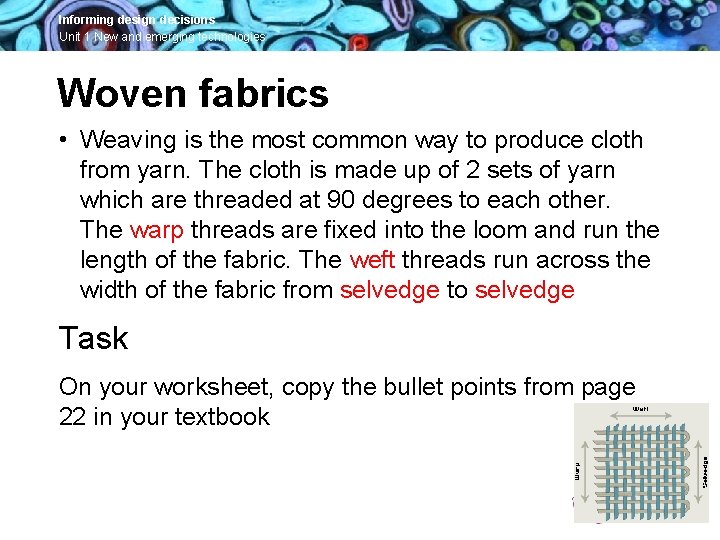
Informing design decisions Unit 1 New and emerging technologies Woven fabrics • Weaving is the most common way to produce cloth from yarn. The cloth is made up of 2 sets of yarn which are threaded at 90 degrees to each other. The warp threads are fixed into the loom and run the length of the fabric. The weft threads run across the width of the fabric from selvedge to selvedge Task On your worksheet, copy the bullet points from page 22 in your textbook
Informing design decisions Unit 1 New and emerging technologies Knitted Textiles • Knitting is a traditional technique of interlocking yarn loops together to produce a fabric and has been used for well over 2000 years, There are 2 types of knitted fabrics – weft knit and warp knit. With all knitted fabrics, if a yarn breaks then it can come apart or ladder. Knitting can be done by hand or machine. • Task • Complete the notes form page 22 – Knitted Yarns – on your worksheet
Informing design decisions Unit 1 New and emerging technologies Woven or knitted? • Look. The basic difference between woven and knit fabrics is in the yarn or thread that composes them. . • Stretching is one of the tests to know whether a fabric is knit or woven. . • Wrinkle. The wrinkle test is another way to measure your fabrics. . • Fray. Apply the fray test if you're still unsure.
Informing design decisions Unit 1 New and emerging technologies Non Woven Textiles • Non-woven fabrics are made directly from fibres without being spun into yarns. The most commonly available non woven fabrics are bonded fabrics made from a web of fibres held together with heat or adhesive. Common use of non woven fabrics include disposable products such as garments worn by surgeons and crime scene investigators, dishcloths and interfacings. Non woven fabrics can be given special treatments such as flame resistance to make head rests covers on trains and aircraft.
Informing design decisions Unit 1 New and emerging technologies Felting • Felting is a mechanical process which has traditionally been done by hand but is now mainly machine produced. It involves matting together wool or synthetic fibres using a combination of heat, pressure, moisture and movement to mesh the fibres together in a random way. Felt can be formed into shapes when wet but does not have any elasticity and will not drape when dry. It is strong and can pull apart under tension, but unlike woven fabric, will not fray when cut. Task Complete the worksheets copying the information from your text books on pages 22 for knitted and felted fabrics.
Informing design decisions Unit 1 New and emerging technologies Question • What might happen to woollen felted products if they are washed? • They tend to shrink