
Textiles Production Processes These icons indicate that teachers
- Slides: 14
Textiles Production Processes These icons indicate that teacher’s notes or useful web addresses are available in the Notes Page. This icon indicates that the slide contains activities created in Flash. These activities are not editable. For more detailed instructions, see the Getting Started presentation. 1 of 14 © Boardworks Ltd 2005
Learning objectives To understand that different methods of production are used to produce different items, depending on the number of items being produced. To be able to give examples of textile items manufactured by one-off, batch and mass production. To be familiar with different production systems used to produce textile goods, including cell production and the make-through system. To compare just-in-time production with traditional stock control methods. 2 of 14 © Boardworks Ltd 2005
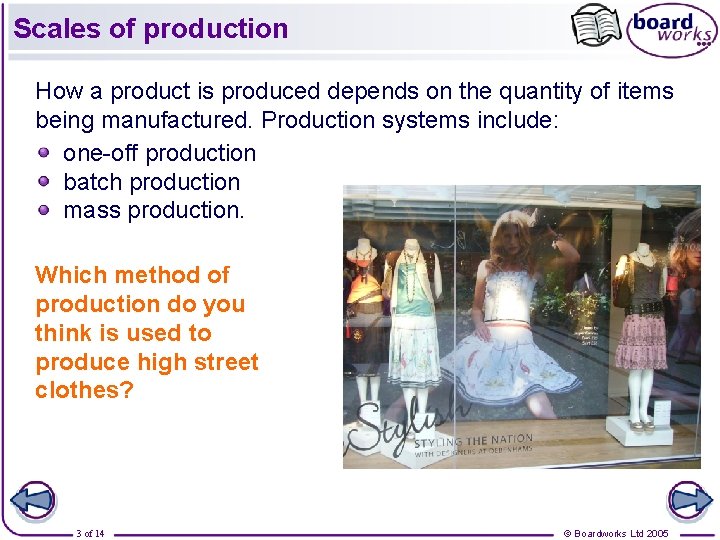
Scales of production How a product is produced depends on the quantity of items being manufactured. Production systems include: one-off production batch production mass production. Which method of production do you think is used to produce high street clothes? 3 of 14 © Boardworks Ltd 2005
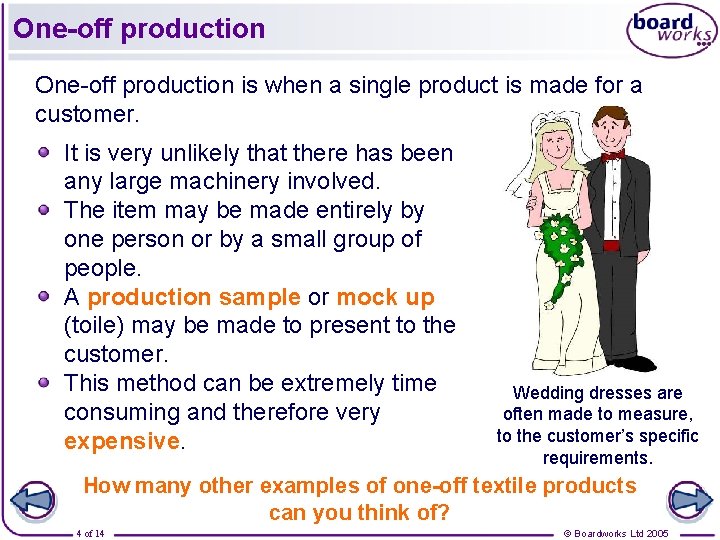
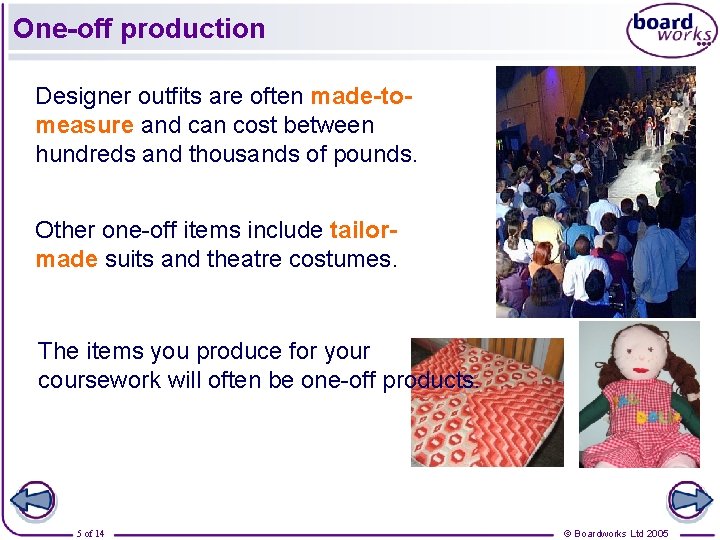
One-off production is when a single product is made for a customer. It is very unlikely that there has been any large machinery involved. The item may be made entirely by one person or by a small group of people. A production sample or mock up (toile) may be made to present to the customer. This method can be extremely time consuming and therefore very expensive. Wedding dresses are often made to measure, to the customer’s specific requirements. How many other examples of one-off textile products can you think of? 4 of 14 © Boardworks Ltd 2005
One-off production Designer outfits are often made-tomeasure and can cost between hundreds and thousands of pounds. Other one-off items include tailormade suits and theatre costumes. The items you produce for your coursework will often be one-off products. 5 of 14 © Boardworks Ltd 2005
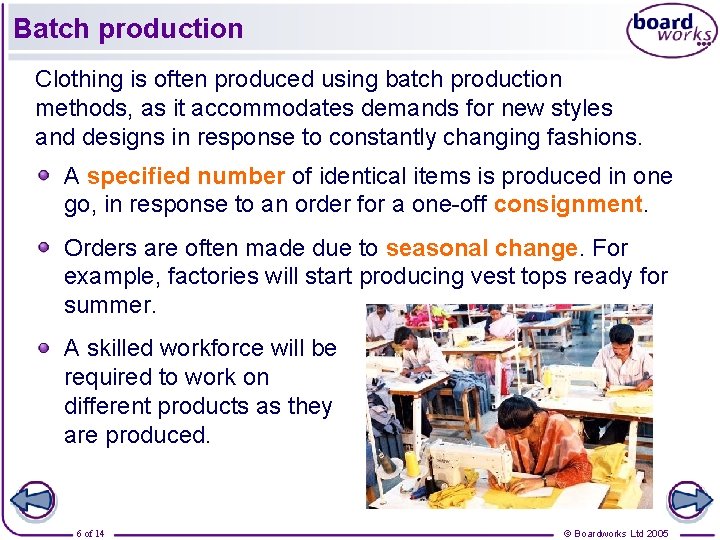
Batch production Clothing is often produced using batch production methods, as it accommodates demands for new styles and designs in response to constantly changing fashions. A specified number of identical items is produced in one go, in response to an order for a one-off consignment. Orders are often made due to seasonal change. For example, factories will start producing vest tops ready for summer. A skilled workforce will be required to work on different products as they are produced. 6 of 14 © Boardworks Ltd 2005
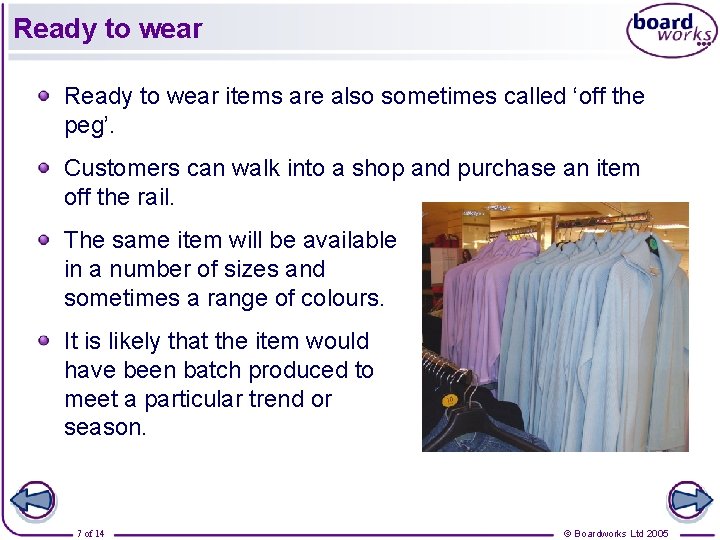
Ready to wear items are also sometimes called ‘off the peg’. Customers can walk into a shop and purchase an item off the rail. The same item will be available in a number of sizes and sometimes a range of colours. It is likely that the item would have been batch produced to meet a particular trend or season. 7 of 14 © Boardworks Ltd 2005
Mass production is one of the most economical methods of manufacture as the more items produced in a short period of time, the lower the costs. Each worker will complete one task before passing the product down the production line. Mass production often uses a continuous production system which never stops: machinery runs 24 hours a day to produce items, with machines only stopping to be cleaned. To make this process worthwhile, the product must be in high demand. 8 of 14 © Boardworks Ltd 2005
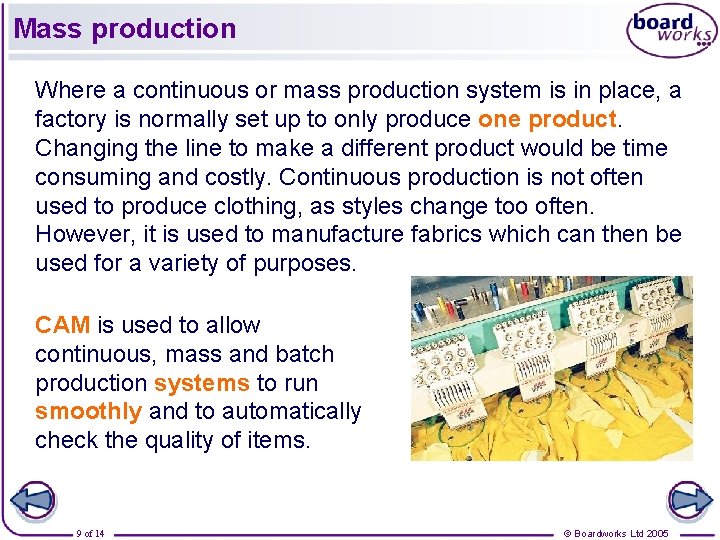
Mass production Where a continuous or mass production system is in place, a factory is normally set up to only produce one product. Changing the line to make a different product would be time consuming and costly. Continuous production is not often used to produce clothing, as styles change too often. However, it is used to manufacture fabrics which can then be used for a variety of purposes. CAM is used to allow continuous, mass and batch production systems to run smoothly and to automatically check the quality of items. 9 of 14 © Boardworks Ltd 2005
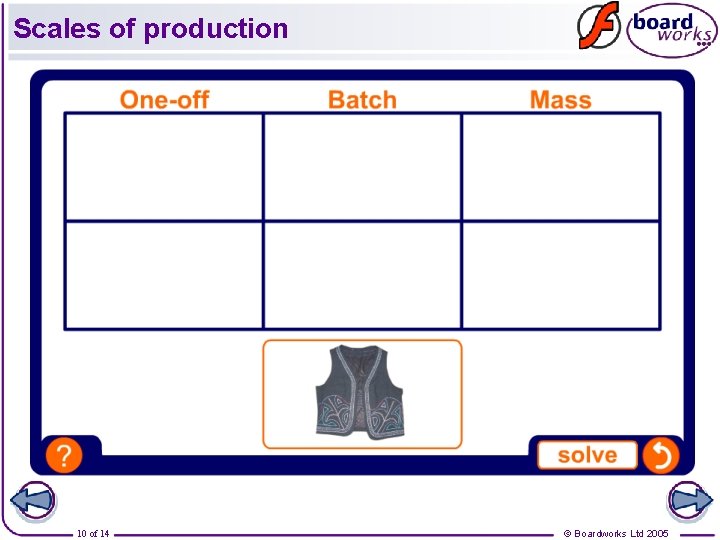
Scales of production 10 of 14 © Boardworks Ltd 2005
Textile production systems In textile manufacturing, goods are produced using a range of production systems depending on the type of product, the number of items being made and the skills the staff have. Cell production involves staff working in small teams. Each person is responsible for the finished end product. Workers concentrate on a different parts of the garment/textile item at a time. Progressive bundle production is similar to cell production. However, staff are accountable for a particular part of the garment/textile item. The make-through system is when the garment/textile item is produced by one person, or a small team, from start to finish. This system tends only to be used in very small factories which employ extremely skilled staff. 11 of 14 © Boardworks Ltd 2005
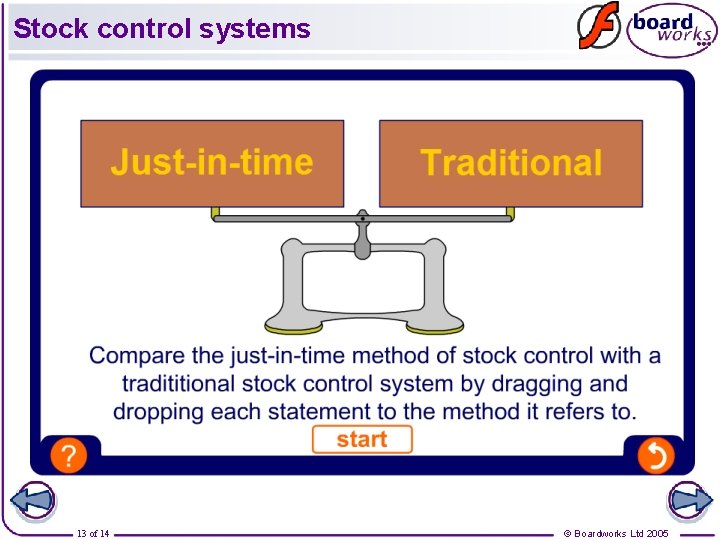
Just-in-time production relies greatly on an excellent team of stock controllers. It works on the basis that components arrive just in time for manufacture. Control systems are put in place to ensure that component stocks are replenished on a rolling basis. This method reduces warehouse and storage costs. One drawback is that if components do not arrive, there are major implications as manufacture will stop, incurring heavy costs. 12 of 14 © Boardworks Ltd 2005
Stock control systems 13 of 14 © Boardworks Ltd 2005
Key points One-off production is when a single product is made for a customer, for example a made-to-measure wedding dress. Batch production is when a number of identical items are produced at once, for example an item of clothing for sale on the high street. Mass production is when a large number of identical items are produced, often on a continuous production line. Just-in-time production is a system of stock control where components arrive at the production line just as they are needed. 14 of 14 © Boardworks Ltd 2005