
Textiles Health and Safety These icons indicate that
- Slides: 15
Textiles Health and Safety These icons indicate that teacher’s notes or useful web addresses are available in the Notes Page. This icon indicates that the slide contains activities created in Flash. These activities are not editable. For more detailed instructions, see the Getting Started presentation. 11 ofof 15 15 © Boardworks Ltd 2005
Learning objectives To understand the importance of adhering to health and safety guidelines at school and in the workplace. To understand the importance of producing products that are safe for the end user. 2 of 15 © Boardworks Ltd 2005
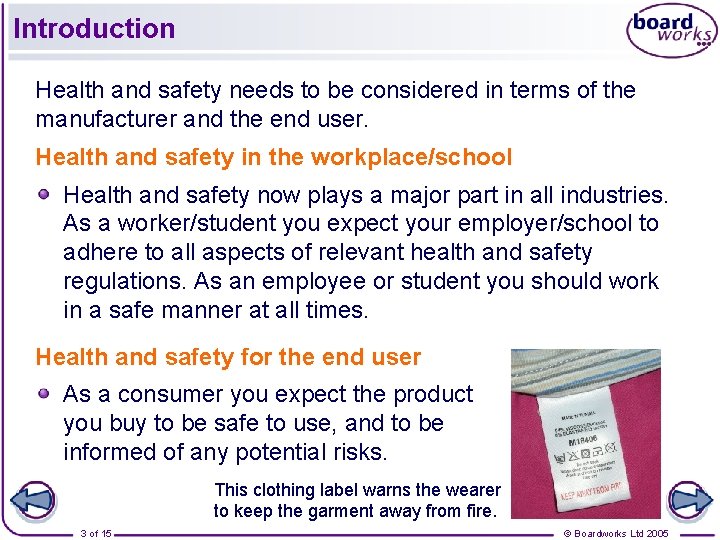
Introduction Health and safety needs to be considered in terms of the manufacturer and the end user. Health and safety in the workplace/school Health and safety now plays a major part in all industries. As a worker/student you expect your employer/school to adhere to all aspects of relevant health and safety regulations. As an employee or student you should work in a safe manner at all times. Health and safety for the end user As a consumer you expect the product you buy to be safe to use, and to be informed of any potential risks. This clothing label warns the wearer to keep the garment away from fire. 3 of 15 © Boardworks Ltd 2005
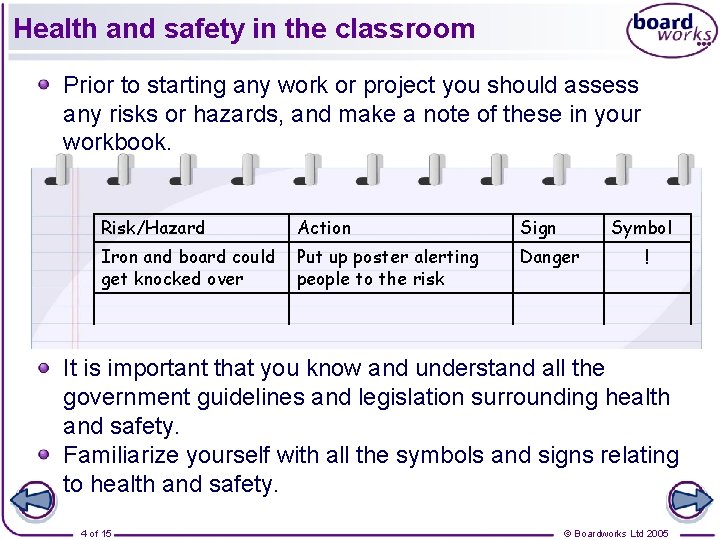
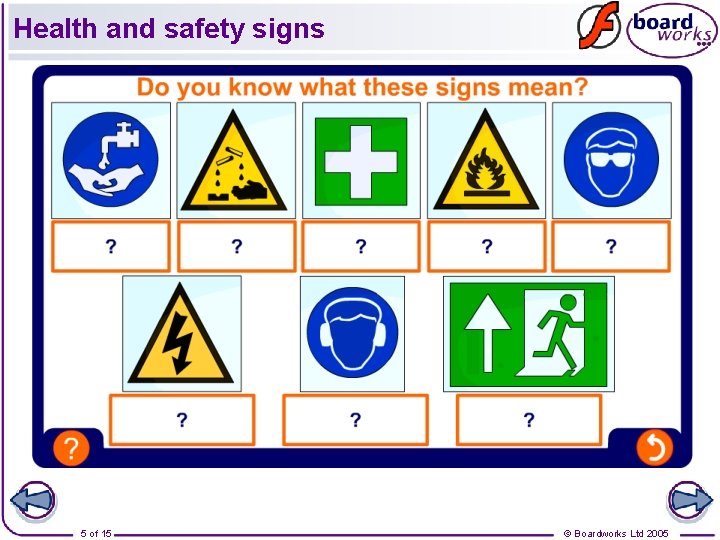
Health and safety in the classroom Prior to starting any work or project you should assess any risks or hazards, and make a note of these in your workbook. Risk/Hazard Action Sign Symbol Iron and board could get knocked over Put up poster alerting people to the risk Danger ! It is important that you know and understand all the government guidelines and legislation surrounding health and safety. Familiarize yourself with all the symbols and signs relating to health and safety. 4 of 15 © Boardworks Ltd 2005
Health and safety signs 5 of 15 © Boardworks Ltd 2005
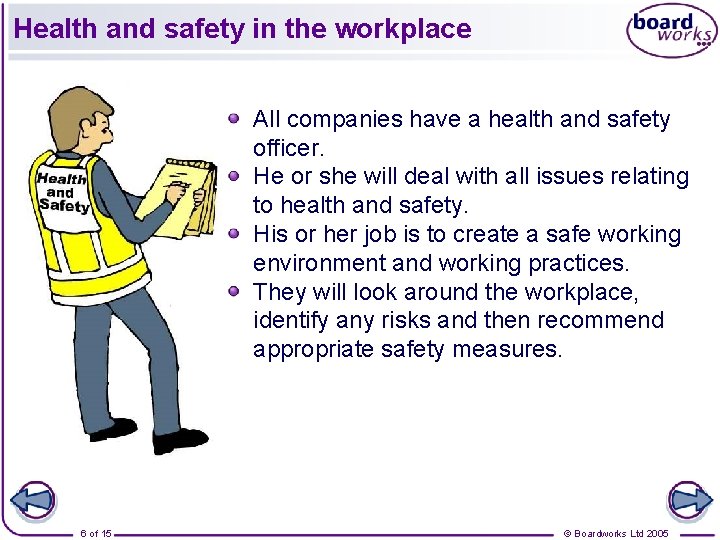
Health and safety in the workplace All companies have a health and safety officer. He or she will deal with all issues relating to health and safety. His or her job is to create a safe working environment and working practices. They will look around the workplace, identify any risks and then recommend appropriate safety measures. 6 of 15 © Boardworks Ltd 2005
The role of the health and safety officer The health and safety officer will: carry out a health and safety audit, noting potential hazards and risks draw up a health and safety manual issue safety wear to the relevant staff ensure safety equipment is accessible where it is required for a particular piece of machinery check equipment is calibrated, tested and has labels fixed displaying relevant information ensure necessary health and safety signs are displayed make sure that medical points are highlighted and fully stocked make sure that any new staff are trained and fully aware of the Health and Safety regulations. 7 of 15 © Boardworks Ltd 2005
Health and safety laws Laws and guidelines are in place to protect workers. These are regulated by the UK and European Safety Laws. The Health and Safety at Work Act (1974) requires employers to identify potential hazards in the workplace and reduce risks to employees. The Workplace (Health, Safety and Welfare) Regulations (1992) require European countries to comply with a common code of practice to make workplaces safe for all employees. 8 of 15 © Boardworks Ltd 2005
Health and safety guidelines There are health and safety guidelines in place for your textiles rooms and workshops. When you are working on practical items you will need to identify and adhere to health and safety guidelines. You should ask yourself a number of questions. Are there any risks involved when using this equipment? Are there any risks involved when using these materials? Do I need to wear any protective clothing? Do my health and safety considerations need to change if my product is batch or mass produced? Will my end product be safe for its intended user? 9 of 15 © Boardworks Ltd 2005
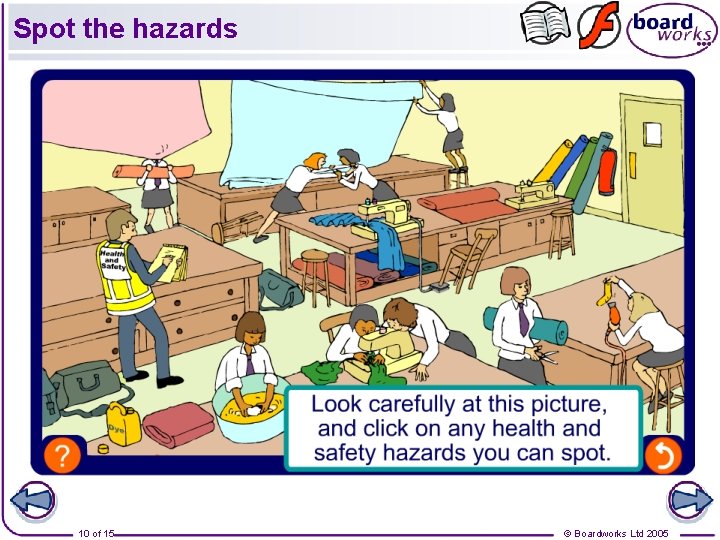
Spot the hazards 10 of 15 © Boardworks Ltd 2005
Health and safety in the classroom If you were a health and safety officer in your school, what would you do to make your textiles room or workshop safer? Highlight five hazards in your textiles room. Which signs would you display to alert students to the dangers? Do you need to provide any protective clothing? What would you do if an accident occurred? 11 of 15 © Boardworks Ltd 2005
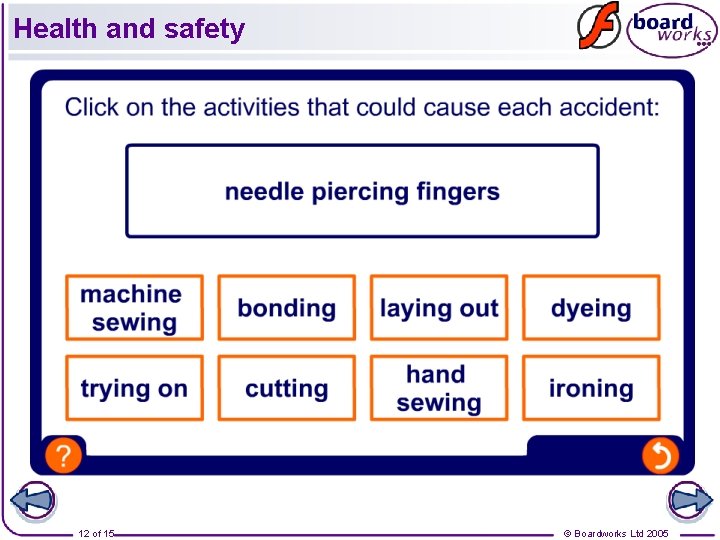
Health and safety 12 of 15 © Boardworks Ltd 2005
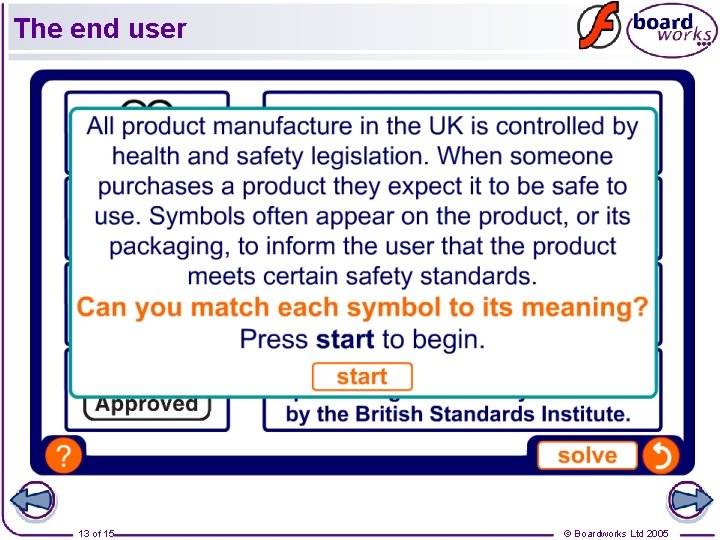
The end user 13 of 15 © Boardworks Ltd 2005
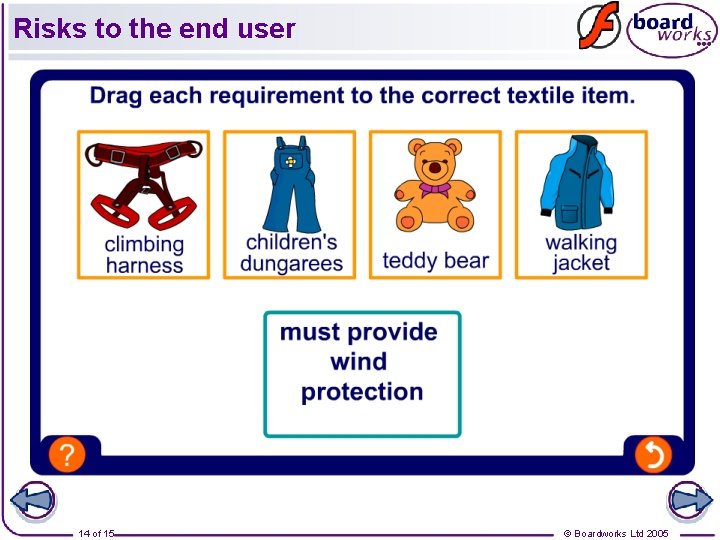
Risks to the end user 14 of 15 © Boardworks Ltd 2005
Key points When designing a product, you need to think about whether it will be safe to make and to use. Before starting a project you should carry out a risk assessment, noting potential risks and hazards. All workplaces must conform to safety standards, and signs warning of any hazards must be displayed. A health and safety officer will ensure that regulations are complied with. In the classroom, particular care must be taken when working with machines, sharp tools and dyes. End products must conform to safety standards and not present a risk to the end user. 15 of 15 © Boardworks Ltd 2005