
Textiles explained Fibres to fabrics Learning objectives By
Textiles explained Fibres to fabrics
Learning objectives By the end of this lesson, you should be able to: • explain the importance of designing for the future – sustainability • show understanding of textiles and where they come from • recall and show good understanding of the design process. Exploring Design and Technology for Key Stage 3 © Hodder & Stoughton 2020
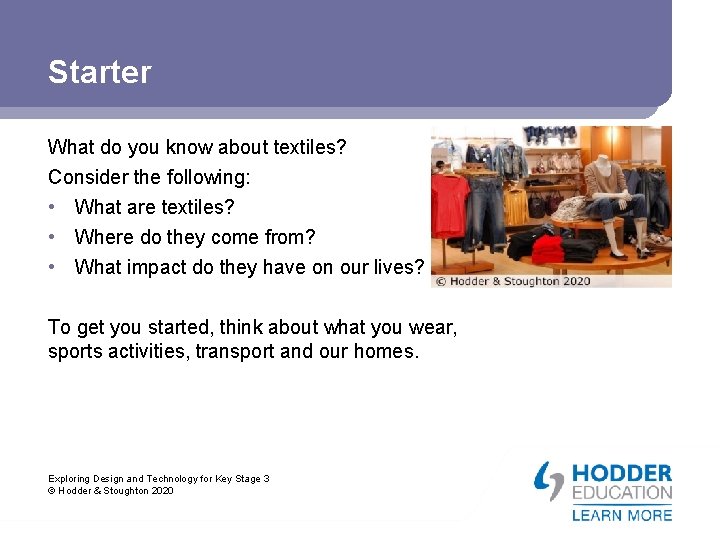
Starter What do you know about textiles? Consider the following: • What are textiles? • Where do they come from? • What impact do they have on our lives? To get you started, think about what you wear, sports activities, transport and our homes. Exploring Design and Technology for Key Stage 3 © Hodder & Stoughton 2020

Where do textile fabrics come from? Textile fabrics are woven or knitted from yarn, which is made from fibres: • A fibre is the smallest element of a fabric; it looks like a human hair. • Fibres come from several sources and can be either: ‒ natural (i. e. from plants or animals), or ‒ synthetic (i. e. manmade/ manufactured). Exploring Design and Technology for Key Stage 3 © Hodder & Stoughton 2020
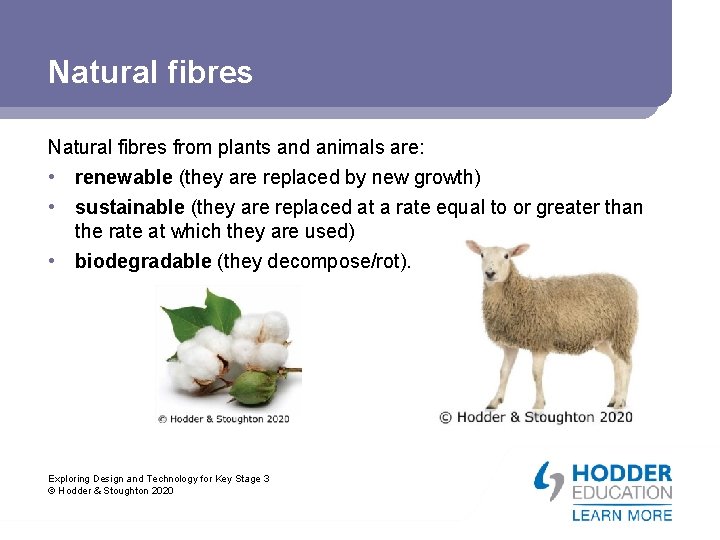
Natural fibres from plants and animals are: • renewable (they are replaced by new growth) • sustainable (they are replaced at a rate equal to or greater than the rate at which they are used) • biodegradable (they decompose/rot). Exploring Design and Technology for Key Stage 3 © Hodder & Stoughton 2020
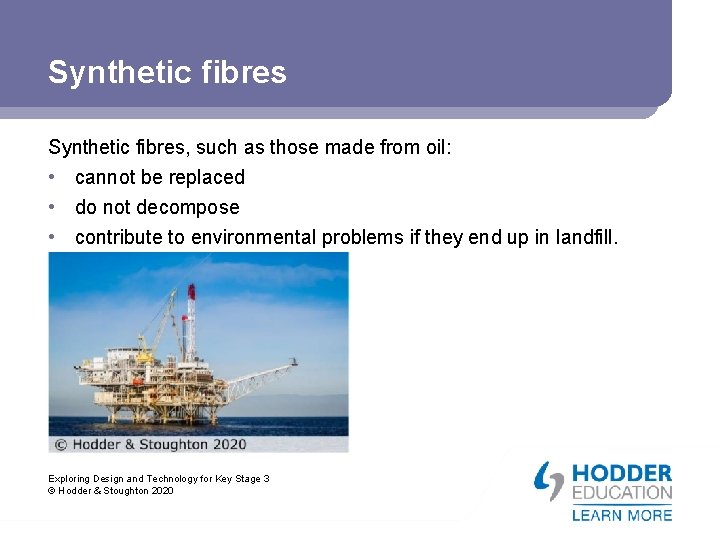
Synthetic fibres, such as those made from oil: • cannot be replaced • do not decompose • contribute to environmental problems if they end up in landfill. Exploring Design and Technology for Key Stage 3 © Hodder & Stoughton 2020
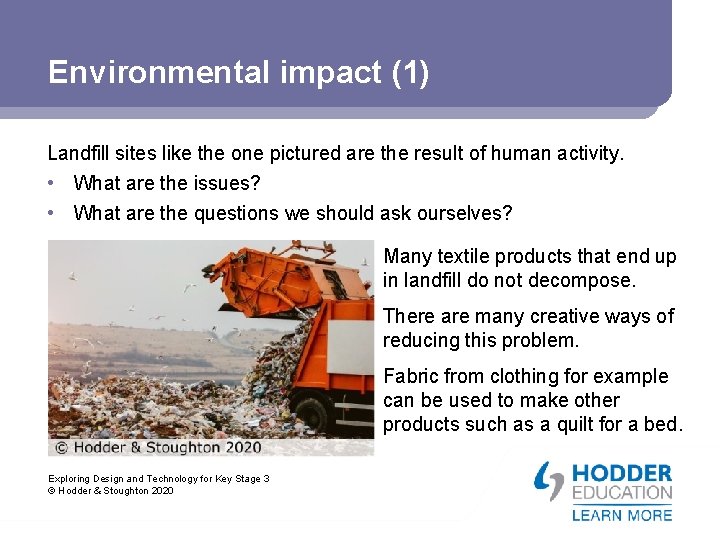
Environmental impact (1) Landfill sites like the one pictured are the result of human activity. • What are the issues? • What are the questions we should ask ourselves? Many textile products that end up in landfill do not decompose. There are many creative ways of reducing this problem. Fabric from clothing for example can be used to make other products such as a quilt for a bed. Exploring Design and Technology for Key Stage 3 © Hodder & Stoughton 2020

Environmental impact (2) Approximately how long do you think the following products take to decompose? Disposable nappy? 3 months Glass bottle? Undetermined 550 years 25– 40 years Batteries? Orange peel? Newspaper? Milk carton? Pair of cotton gloves? 100 years 6 months Exploring Design and Technology for Key Stage 3 © Hodder & Stoughton 2020 6 weeks Leather shoe? 5 years
The design process Before textile products are made in a factory, they go through a series of steps in order to get the best design. This is called the design process: • Designers are given a design brief – a problem they have to solve. • Research is needed – to find information to help solve the problem. • Design – the information is used to generate ideas. • Manufacture – designers make a prototype of the final design. • Evaluation – the strengths and weaknesses of a design are considered. Exploring Design and Technology for Key Stage 3 © Hodder & Stoughton 2020
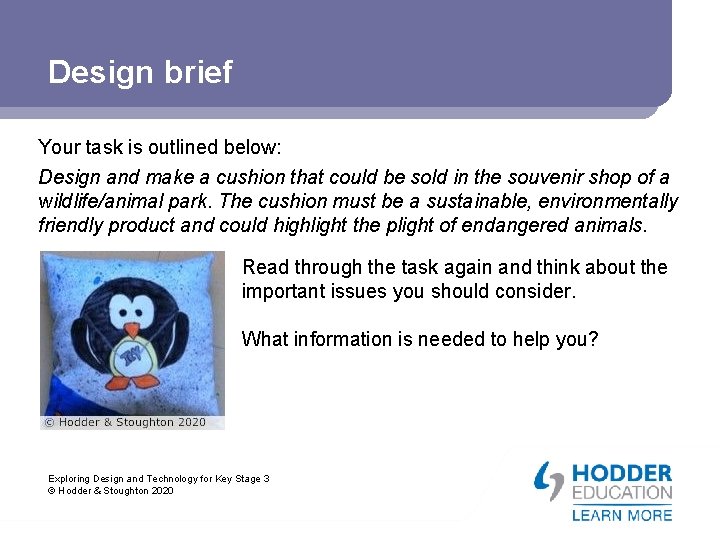
Design brief Your task is outlined below: Design and make a cushion that could be sold in the souvenir shop of a wildlife/animal park. The cushion must be a sustainable, environmentally friendly product and could highlight the plight of endangered animals. Read through the task again and think about the important issues you should consider. What information is needed to help you? Exploring Design and Technology for Key Stage 3 © Hodder & Stoughton 2020
Plenary Complete the interactive quiz: Fibres and fabrics. Exploring Design and Technology for Key Stage 3 © Hodder & Stoughton 2020
Homework • Collect pictures of endangered wild animals and present them as an inspiration board. • Find pictures of existing cushion products and analyse their key features. Remember … you will be referring to this work when you start designing. Exploring Design and Technology for Key Stage 3 © Hodder & Stoughton 2020
- Slides: 12