
Textiles Components These icons indicate that teachers notes

- Slides: 22
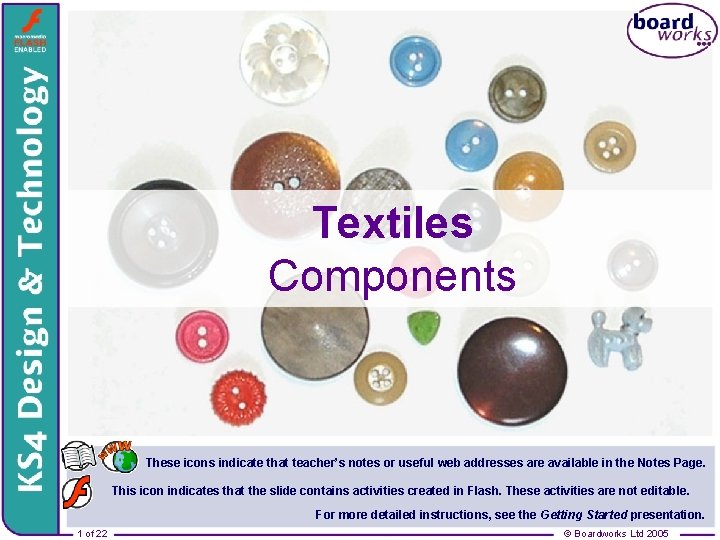
Textiles Components These icons indicate that teacher’s notes or useful web addresses are available in the Notes Page. This icon indicates that the slide contains activities created in Flash. These activities are not editable. For more detailed instructions, see the Getting Started presentation. 1 of 22 © Boardworks Ltd 2005
Learning objectives To become familiar with the range of threads, yarns, fastenings, elastics, bindings, interfaces and fillings used when manufacturing textile items. 2 of 22 © Boardworks Ltd 2005
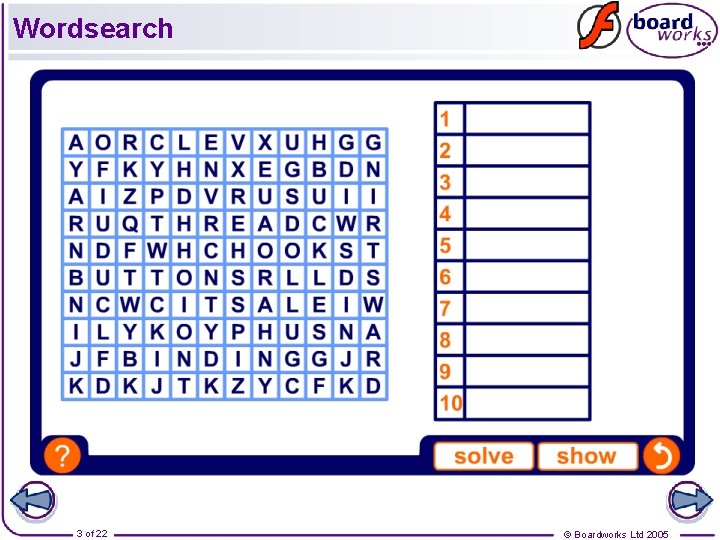
Wordsearch 3 of 22 © Boardworks Ltd 2005
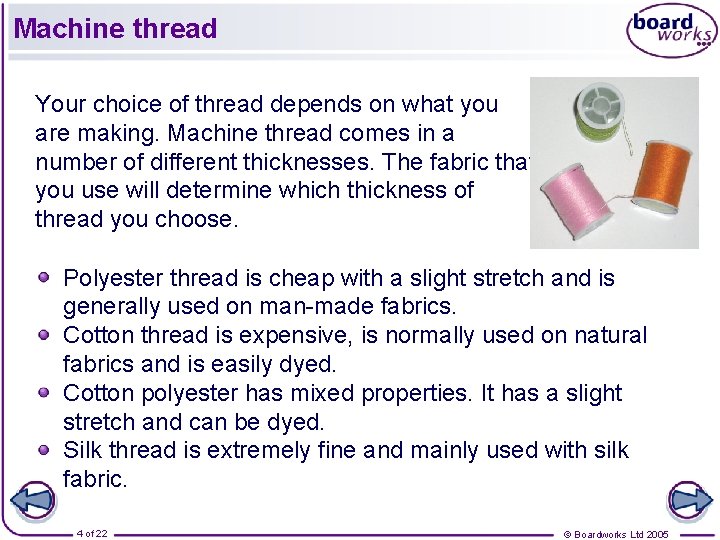
Machine thread Your choice of thread depends on what you are making. Machine thread comes in a number of different thicknesses. The fabric that you use will determine which thickness of thread you choose. Polyester thread is cheap with a slight stretch and is generally used on man-made fabrics. Cotton thread is expensive, is normally used on natural fabrics and is easily dyed. Cotton polyester has mixed properties. It has a slight stretch and can be dyed. Silk thread is extremely fine and mainly used with silk fabric. 4 of 22 © Boardworks Ltd 2005
Embroidery thread Mercerized cotton is a twisted thread and is supplied in a single thickness. Stranded cotton comes in a hank of six threads. The count of fabric will determine how many threads are used. Pearl (perle) cotton is a 100% cotton thread which comes in two thicknesses. It is a twisted thread which is used on tapestry canvas, linen and even weave. It is thick and adds more dimension. Silk embroidery threads are used on very fine fabrics. 5 of 22 © Boardworks Ltd 2005
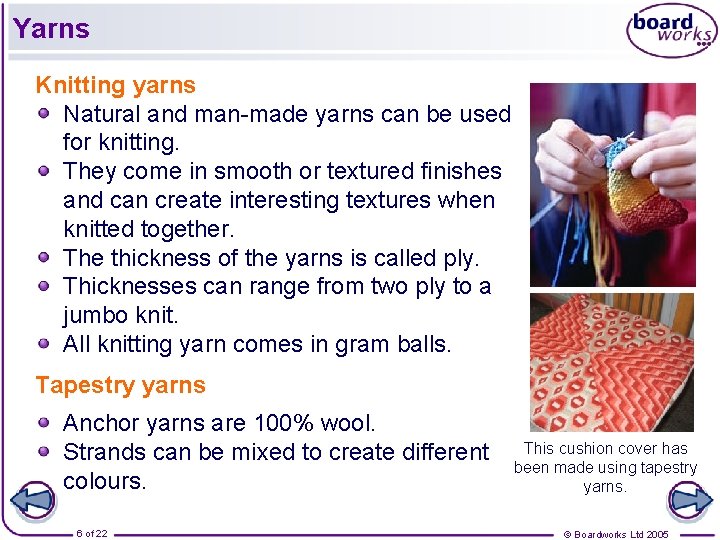
Yarns Knitting yarns Natural and man-made yarns can be used for knitting. They come in smooth or textured finishes and can create interesting textures when knitted together. The thickness of the yarns is called ply. Thicknesses can range from two ply to a jumbo knit. All knitting yarn comes in gram balls. Tapestry yarns Anchor yarns are 100% wool. Strands can be mixed to create different colours. 6 of 22 This cushion cover has been made using tapestry yarns. © Boardworks Ltd 2005
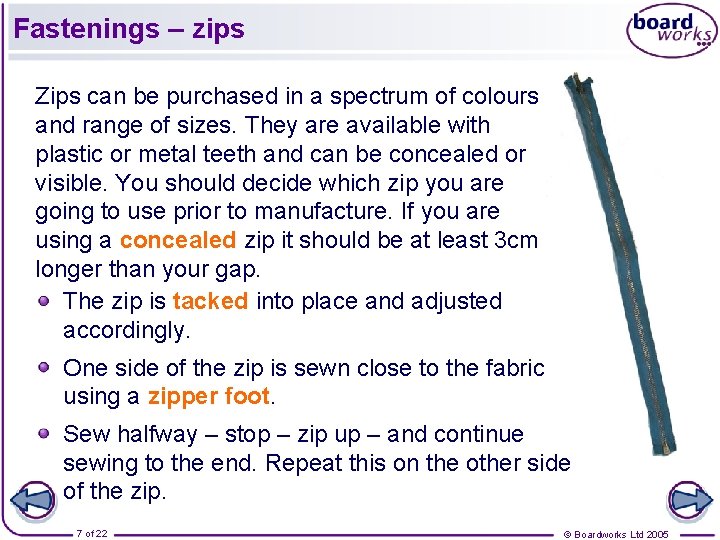
Fastenings – zips Zips can be purchased in a spectrum of colours and range of sizes. They are available with plastic or metal teeth and can be concealed or visible. You should decide which zip you are going to use prior to manufacture. If you are using a concealed zip it should be at least 3 cm longer than your gap. The zip is tacked into place and adjusted accordingly. One side of the zip is sewn close to the fabric using a zipper foot. Sew halfway – stop – zip up – and continue sewing to the end. Repeat this on the other side of the zip. 7 of 22 © Boardworks Ltd 2005
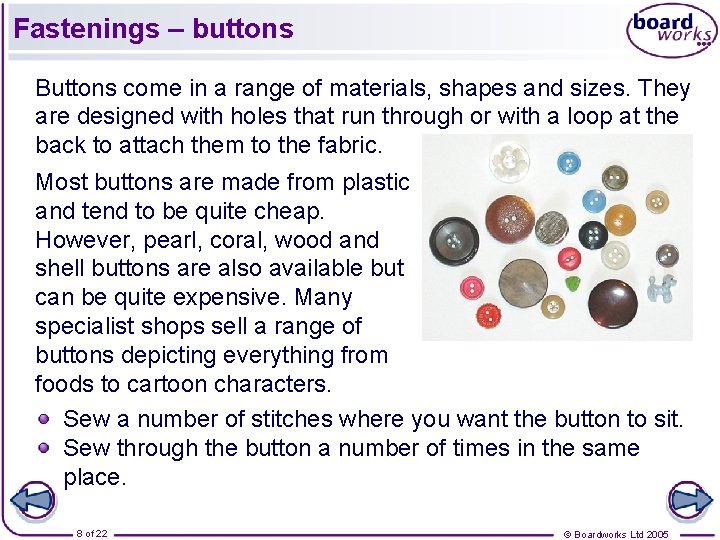
Fastenings – buttons Buttons come in a range of materials, shapes and sizes. They are designed with holes that run through or with a loop at the back to attach them to the fabric. Most buttons are made from plastic and tend to be quite cheap. However, pearl, coral, wood and shell buttons are also available but can be quite expensive. Many specialist shops sell a range of buttons depicting everything from foods to cartoon characters. Sew a number of stitches where you want the button to sit. Sew through the button a number of times in the same place. 8 of 22 © Boardworks Ltd 2005
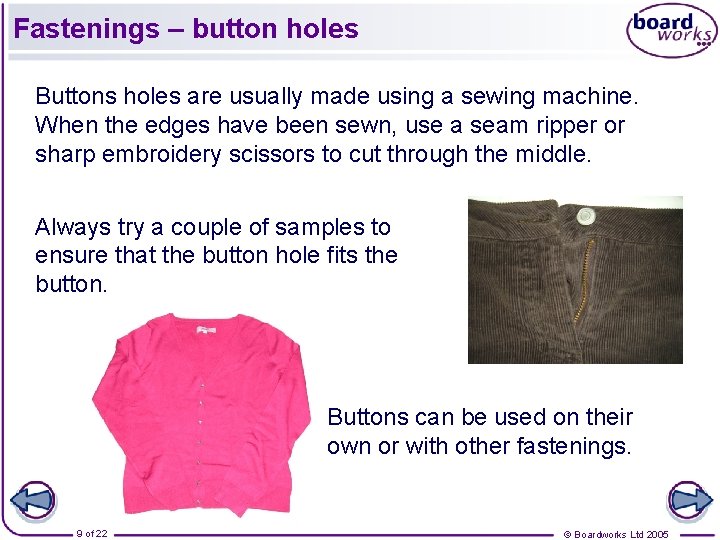
Fastenings – button holes Buttons holes are usually made using a sewing machine. When the edges have been sewn, use a seam ripper or sharp embroidery scissors to cut through the middle. Always try a couple of samples to ensure that the button hole fits the button. Buttons can be used on their own or with other fastenings. 9 of 22 © Boardworks Ltd 2005
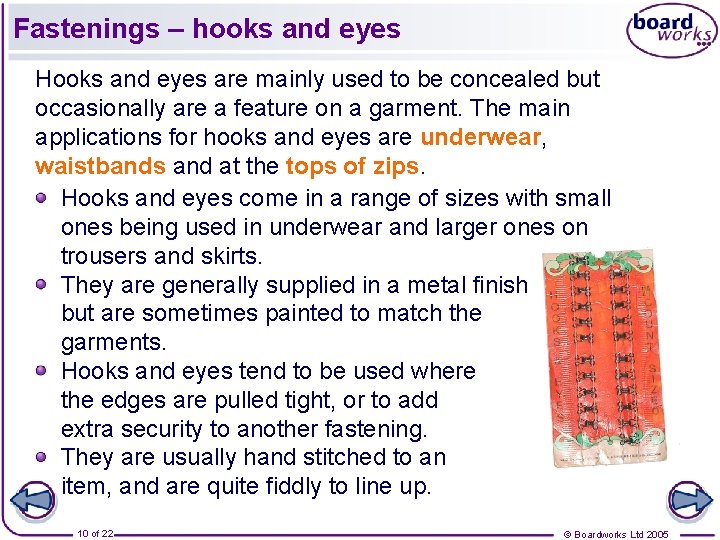
Fastenings – hooks and eyes Hooks and eyes are mainly used to be concealed but occasionally are a feature on a garment. The main applications for hooks and eyes are underwear, waistbands and at the tops of zips. Hooks and eyes come in a range of sizes with small ones being used in underwear and larger ones on trousers and skirts. They are generally supplied in a metal finish but are sometimes painted to match the garments. Hooks and eyes tend to be used where the edges are pulled tight, or to add extra security to another fastening. They are usually hand stitched to an item, and are quite fiddly to line up. 10 of 22 © Boardworks Ltd 2005
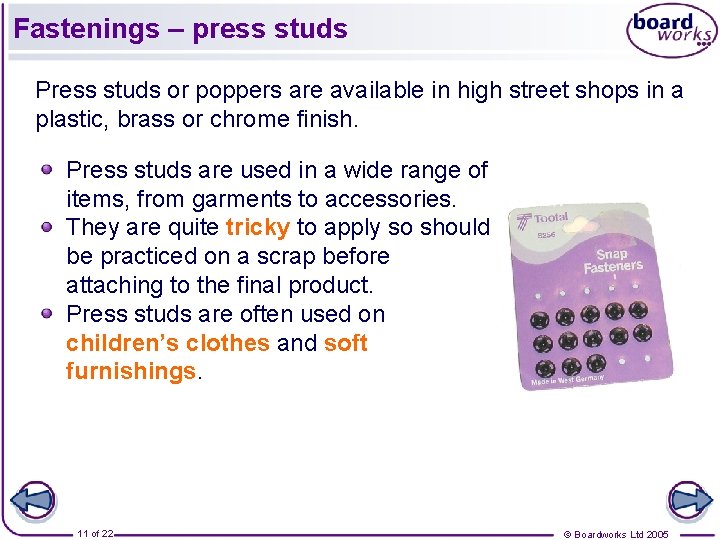
Fastenings – press studs Press studs or poppers are available in high street shops in a plastic, brass or chrome finish. Press studs are used in a wide range of items, from garments to accessories. They are quite tricky to apply so should be practiced on a scrap before attaching to the final product. Press studs are often used on children’s clothes and soft furnishings. 11 of 22 © Boardworks Ltd 2005
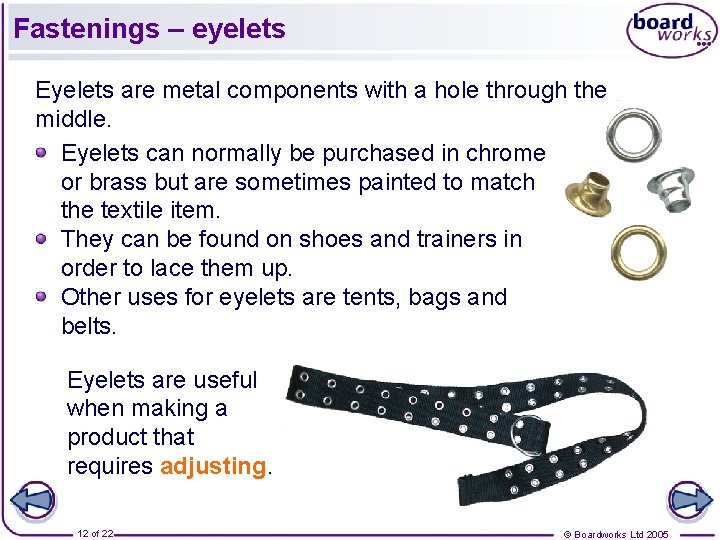
Fastenings – eyelets Eyelets are metal components with a hole through the middle. Eyelets can normally be purchased in chrome or brass but are sometimes painted to match the textile item. They can be found on shoes and trainers in order to lace them up. Other uses for eyelets are tents, bags and belts. Eyelets are useful when making a product that requires adjusting. 12 of 22 © Boardworks Ltd 2005
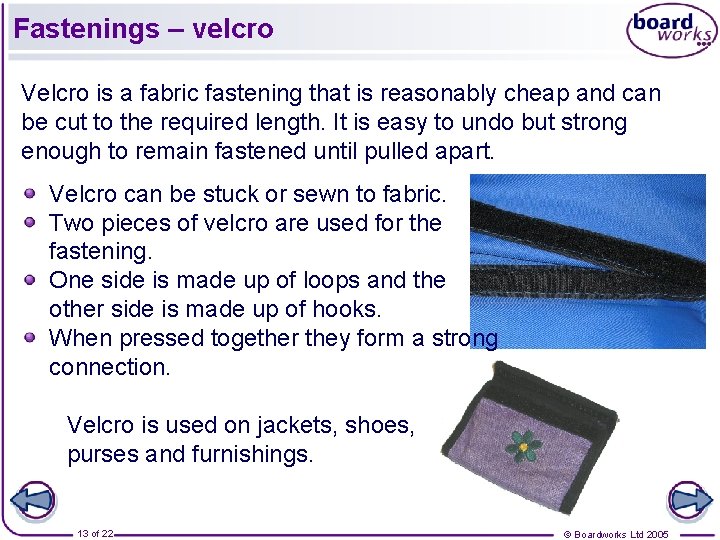
Fastenings – velcro Velcro is a fabric fastening that is reasonably cheap and can be cut to the required length. It is easy to undo but strong enough to remain fastened until pulled apart. Velcro can be stuck or sewn to fabric. Two pieces of velcro are used for the fastening. One side is made up of loops and the other side is made up of hooks. When pressed together they form a strong connection. Velcro is used on jackets, shoes, purses and furnishings. 13 of 22 © Boardworks Ltd 2005
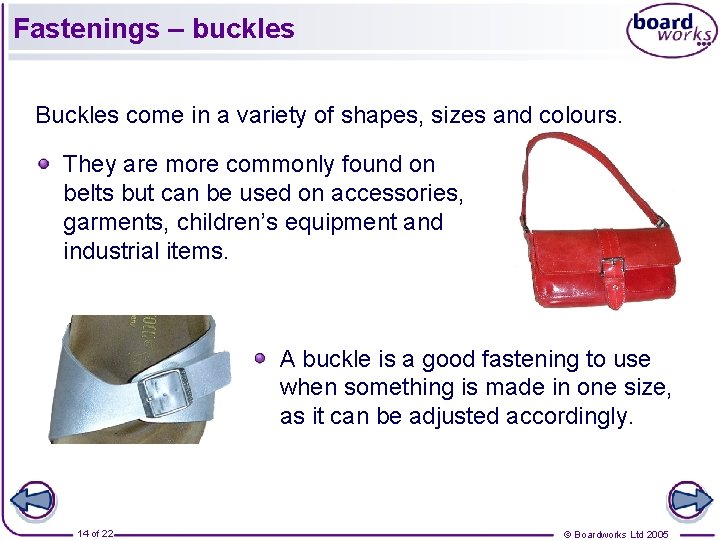
Fastenings – buckles Buckles come in a variety of shapes, sizes and colours. They are more commonly found on belts but can be used on accessories, garments, children’s equipment and industrial items. A buckle is a good fastening to use when something is made in one size, as it can be adjusted accordingly. 14 of 22 © Boardworks Ltd 2005
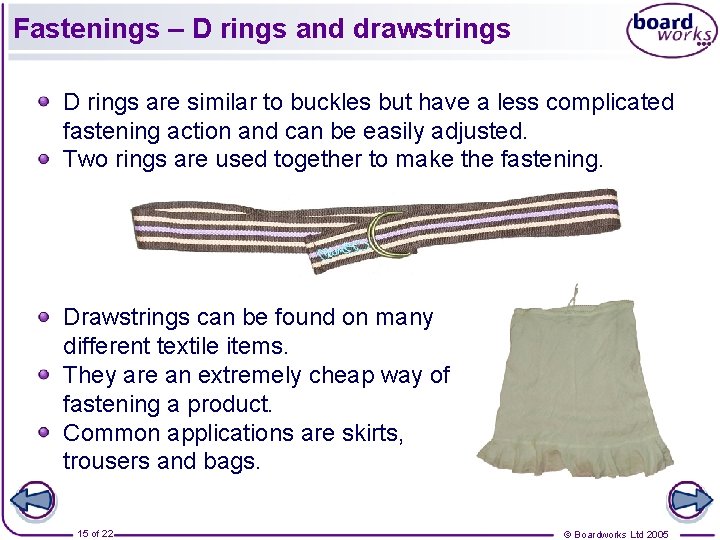
Fastenings – D rings and drawstrings D rings are similar to buckles but have a less complicated fastening action and can be easily adjusted. Two rings are used together to make the fastening. Drawstrings can be found on many different textile items. They are an extremely cheap way of fastening a product. Common applications are skirts, trousers and bags. 15 of 22 © Boardworks Ltd 2005
Fastenings quiz 16 of 22 © Boardworks Ltd 2005
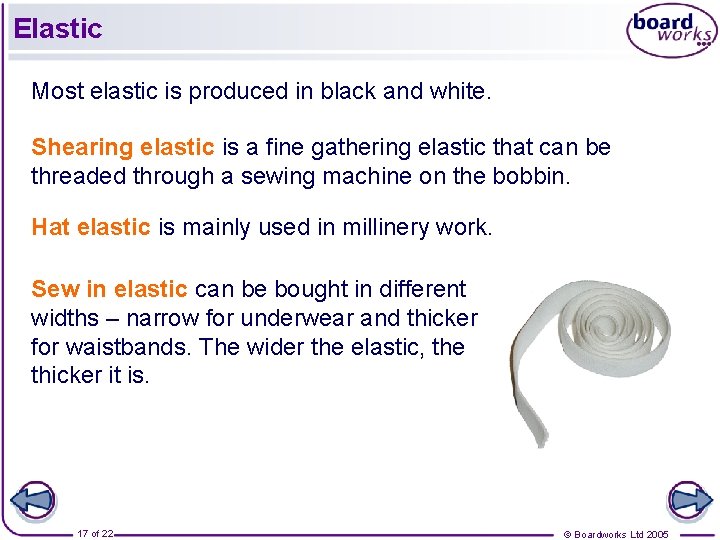
Elastic Most elastic is produced in black and white. Shearing elastic is a fine gathering elastic that can be threaded through a sewing machine on the bobbin. Hat elastic is mainly used in millinery work. Sew in elastic can be bought in different widths – narrow for underwear and thicker for waistbands. The wider the elastic, the thicker it is. 17 of 22 © Boardworks Ltd 2005
Bindings 18 of 22 © Boardworks Ltd 2005
Interfacing is used to reinforce a fabric, and can not usually be seen from the outside of the item. Common applications are collars, waist bands and the reverses of badges and logos. Vilene is a non-woven fabric which is manufactured in black or white. Iron-on Vilene is coated in glue on one side. It should be cut to the size of the matching pattern piece and then ironed to the fabric. When it is ironed it bonds together with the fabric it is being ironed onto. Sew-in Vilene is stitched to the pattern piece. Vilene for stretch fabric is also available. 19 of 22 © Boardworks Ltd 2005
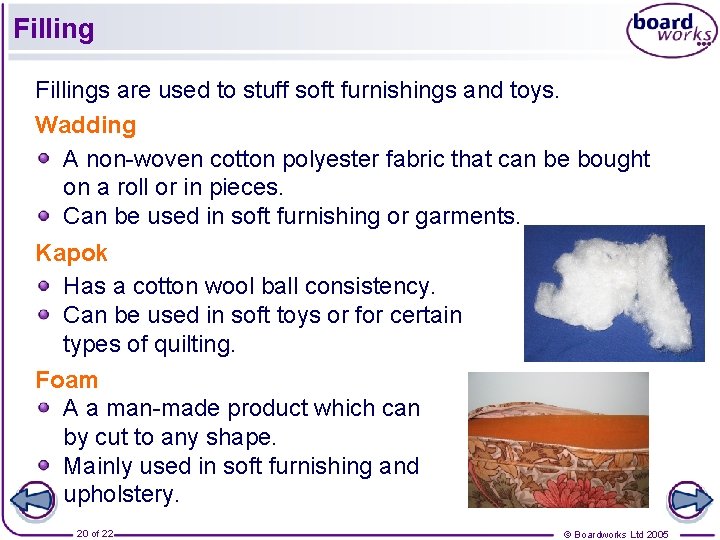
Fillings are used to stuff soft furnishings and toys. Wadding A non-woven cotton polyester fabric that can be bought on a roll or in pieces. Can be used in soft furnishing or garments. Kapok Has a cotton wool ball consistency. Can be used in soft toys or for certain types of quilting. Foam A a man-made product which can by cut to any shape. Mainly used in soft furnishing and upholstery. 20 of 22 © Boardworks Ltd 2005
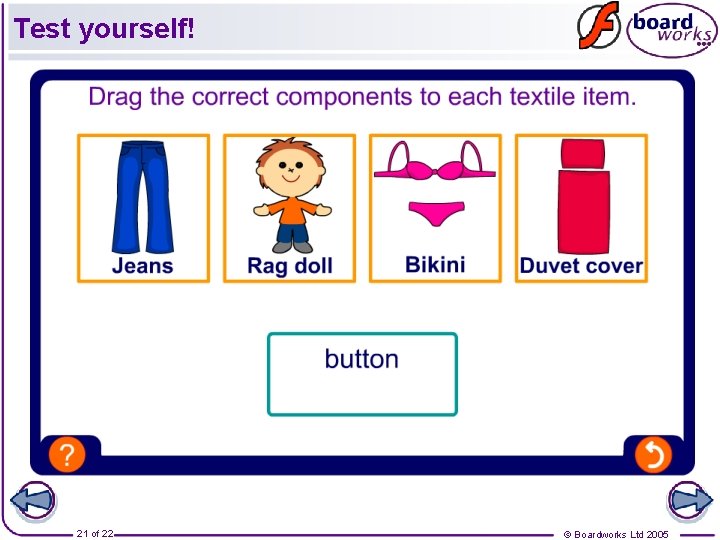
Test yourself! 21 of 22 © Boardworks Ltd 2005
Key points Machine thread is used to sew fabric together. The fabric determines which thread should be used. Embroidery thread is used to decorate fabric. Yarn is used for knitting items and for tapestry. Fastenings include zips, buttons, hooks and eyes, press studs, eyelets, buckles, D rings and drawstrings. Elastic comes in a range of thicknesses and is used in waistbands and hats as well as other textile items. Bindings are used to cover the edges of fabrics. Interfacing reinforces fabric and is used in collars and waistbands. Fillings are used to stuff soft furnishings, toys and quilts. 22 of 22 © Boardworks Ltd 2005