
Textbook Chp 8 Pg 143 152 Overview of
* Textbook Chp 8, Pg 143 -152
*Overview of Thermal Physics *Temperature vs Heat *Thermometric Properties *Thermocouple *
*2 categories – Microscopic (small scale) and Macroscope (large scale) *Pressure, Volume and Temperature are macroscopic phenomenon. These are observable in real life. *Collisions, vibrations and movement of molecules are microscopic phenomenon. These are theoretical (not observable in real life) *In Kinetic Theory, we used microscopic theories to explain macroscopic phenomenon *
*Temperature is a macroscopic quantity (observable) *It is a measure of how hot and how cold an object is *Microscopically, the temperature is determined by the average kinetic energy of the molecules *Hotter the object, faster the molecules *
*Heat is a very specific term in physics *Heat refers to the amount of thermal energy when thermal energy is being transferred from a hotter to colder region *The term “Thermal Energy” is used when there is no transferring. *http: //www. youtube. com/watch? v=yx. BTEMnr. ZZk *We will study heat more in the next chapter *
*There is a need to measure temperature accurately, and the human body cannot do that. *Hence the need for thermometers, instruments designed to measure temperature. *In your syllabus, you are required to be familiar with 3 kinds thermometers and how they work. *Each kind of thermometer vary by their thermometric property (what changes when temperature changes) *
*You should already be very familiar with the liquid in glass thermometer (either the alcohol or the mercury versions) *The thermometric property is the volume of a fixed mass of liquid Alcohol-in-glass Thermometer * Mercury-in-glass Thermometer
*To make a thermometer, you don’t just need some alcohol or mercury, you need to read it against a scale *To construct a scale, you need two fixed points of temperature *Usually the two points are the * Ice Point (melting point of pure water) * Steam Point (boiling point of pure water at 1 atm) *
*There is a complex looking formula in your textbook. Recommend NOT to memorize this formula. *Instead follow this thinking process: 1. What is the total length from 0°C to 100°C? 2. What is length for each°C? 3. Hence, solve the unknown length/temperature. *
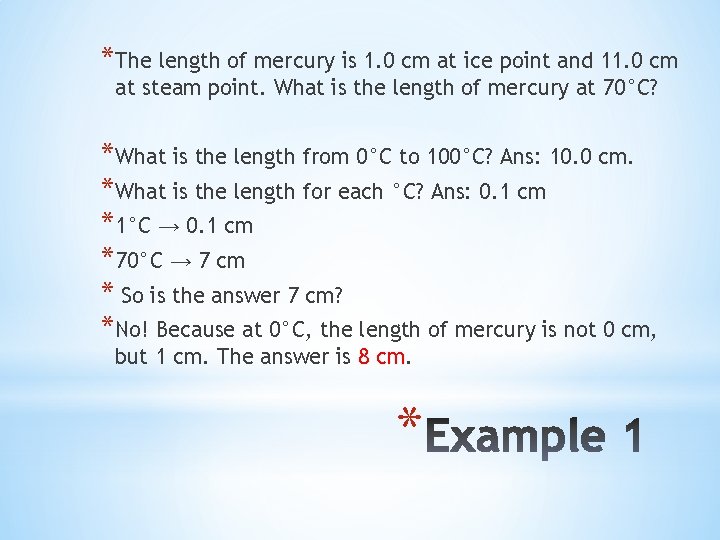
*The length of mercury is 1. 0 cm at ice point and 11. 0 cm at steam point. What is the length of mercury at 70°C? *What is the length from 0°C to 100°C? Ans: 10. 0 cm. *What is the length for each °C? Ans: 0. 1 cm *1°C → 0. 1 cm *70°C → 7 cm * So is the answer 7 cm? *No! Because at 0°C, the length of mercury is not 0 cm, but 1 cm. The answer is 8 cm. *
*The length of an alcohol thermometer is 5 cm in ice point and 85 cm in steam point. What temperature is it when the length is 65. 4 cm? *
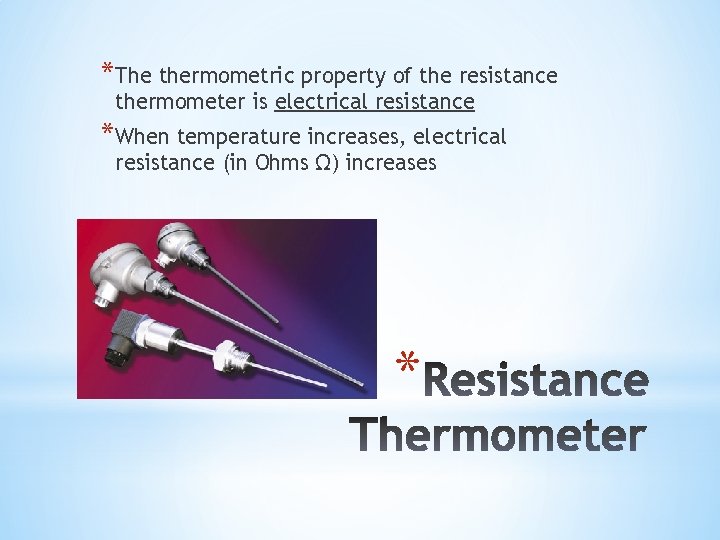
*The thermometric property of the resistance thermometer is electrical resistance *When temperature increases, electrical resistance (in Ohms Ω) increases *
*The resistance of a resistance thermometer is 50. 0 Ω at ice point. If the resistance is 51. 5 when the temperature is 50 °C, what is the resistance at steam point? *
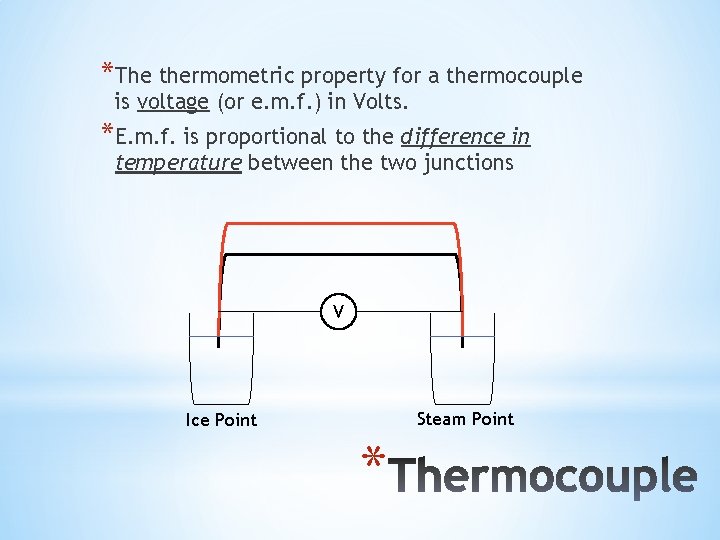
*The thermometric property for a thermocouple is voltage (or e. m. f. ) in Volts. *E. m. f. is proportional to the difference in temperature between the two junctions V Steam Point Ice Point *
*When the cold junction is in melting ice and when the hot junction is in boiling water, the e. m. f produced is 2. 00 V. If the hot junction is placed in water of 50 C, what is the e. m. f. ? *
*Overview of Thermal Physics *Temperature vs Heat *Thermometric Properties *Thermocouple *
- Slides: 17