
Text Structure Overview What is text structure What



- Slides: 22
Text Structure
Overview • What is text structure? • What are the common text structures? • How does text structure help readers understand nonfiction?
What is text structure? • Text structure refers to the internal organization of a text • As authors write a text to communicate an idea, they will use a structure that goes along with the idea
What are the common text structures? Description • This text structure shows what an item or place is like • Transitions in this structure might include spatial words, such as next to, on top of, beside, and so forth
What are the common text structures? Sequence or Chronological order • Also known as time order, sequence, or temporal order • This structure is organized from one point in time to another
What are the common text structures? Sequence or Chronological order • Transition words such as first, next, later, and finally are included to help the reader understand how events relate to one another • Dates and times are also used
What are the common text structures? Compare and contrast • This text structure shows how two or more ideas or items are similar or different • The text may use a clustered approach, with details about one topic followed by details about the other • The text may also show an alternating approach, with the author going back between the two topics
What are the common text structures? Compare and contrast • Transition words may include like, similar, unlike, on the other hand, also, and too • Compare and contrast paragraphs are often embedded in other text structures as an author needs to explain a similarity or difference
What are the common text structures? Cause and effect • This text structure shows how one or more causes led to one or more effects • This text structure also has a strong time component, since causes come before effects
What are the common text structures? Cause and effect • Transition words such as cause, effect, as a result, consequently, and because are used
What are the common text structures? Problem and solution • This text structure presents a problem, and shows how it can be (or has been) solved • This text structure can be confused with cause and effect
What are the common text structures? Problem and solution • The key difference is that problem and solution always has a solution, while cause and effect does not • Transitions may include problem, solution, solve, effect, hopeful, and so forth
How does text structure help readers? • When readers do not have a strong knowledge of the topic of a text, they depend more on the structure (Cataldo and Oakhill) • A well-written text guides the reader through the content
How does text structure help readers? • Research shows that efficient searchers use the structure of the text to help them find specific information
How does text structure help readers? • The structure of a text can help readers find answers to questions, as well • For example, knowing that causes come before effects can help students to narrow their search as they’re trying to find the answer to a question
How does text structure help readers? • Text structure is also an important component to summarizing • When readers summarize, they need to reflect the text structure in the summary
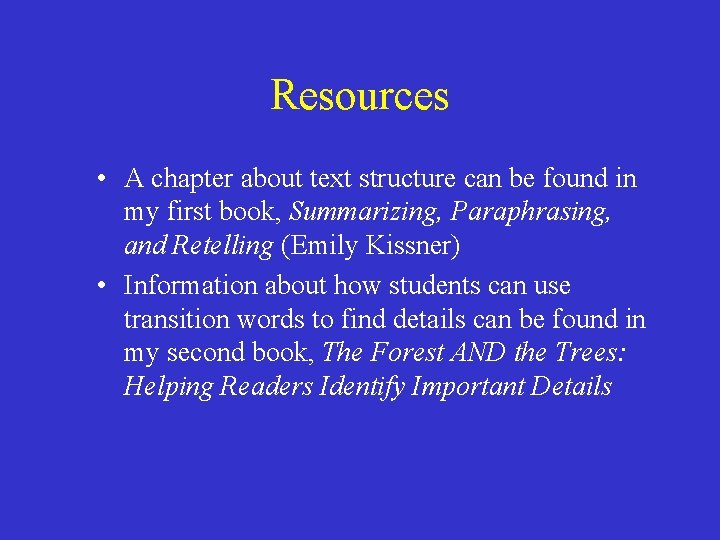
Resources • A chapter about text structure can be found in my first book, Summarizing, Paraphrasing, and Retelling (Emily Kissner) • Information about how students can use transition words to find details can be found in my second book, The Forest AND the Trees: Helping Readers Identify Important Details
Resources • Toolkit Texts: Heinemann Firsthand. Available at www. comprehensiontoolkit. com
Resources • • A free Powerpoint for teaching text structure to students is available at Teacherspay. Teachers “Understanding Text Structures” explicitly teaches the different structures
Resources • • Teaching Students to Read Nonfiction, by Alice Boynton and Wiley Blevins, is an excellent resource with short texts for students Available from Scholastic
Resources • Nonfiction Passages with Graphic Organizers, also available from Scholastic, is another good resource
References • • Cataldo, Maria and Jane Oakhill. 2000. “Why Are Poor Comprehenders Inefficient Searchers? An Investigation into the Effects of Text Representation and Spatial Memory on the Ability to Locate Information in Text. ” Journal of Educational Psychology 92 (4) 791 -799. Meyer, B. J. F. 1985. “Prose Analysis: Purpose, Procedures, and Problems. ” In Understanding Expository Text, edited by B. K. Britton, and J. B. Black. Hillsdale, NJ: Lawrence Erlbaum Associates.