
Text Sets Building Knowledge and Vocabulary Five Essential
Text Sets: Building Knowledge and Vocabulary
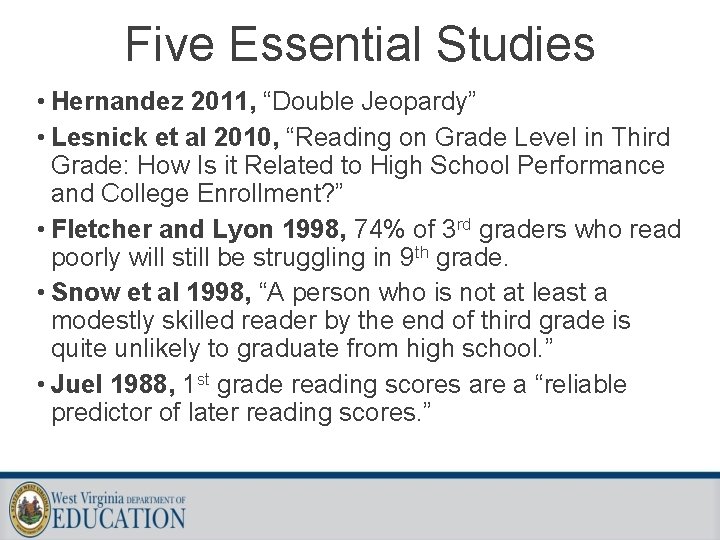
Five Essential Studies • Hernandez 2011, “Double Jeopardy” • Lesnick et al 2010, “Reading on Grade Level in Third Grade: How Is it Related to High School Performance and College Enrollment? ” • Fletcher and Lyon 1998, 74% of 3 rd graders who read poorly will still be struggling in 9 th grade. • Snow et al 1998, “A person who is not at least a modestly skilled reader by the end of third grade is quite unlikely to graduate from high school. ” • Juel 1988, 1 st grade reading scores are a “reliable predictor of later reading scores. ”
Why? • How is it that tests so early can predict results so many years later? • What are we doing in schools that might be perpetuating these trends? • What are we not doing in schools that might be perpetuating these trends? • Why does the gap between struggling and proficient readers increase the longer they are in school?
What are not the causes? • Lack of critical thinking • Failure to know or use comprehension strategies • Failure to master the standards
Quick Quiz: WHICH IS HARDER?
Question 1: Literal Meaning Low on Bloom’s Taxonomy Restate the following sentence in your own words:
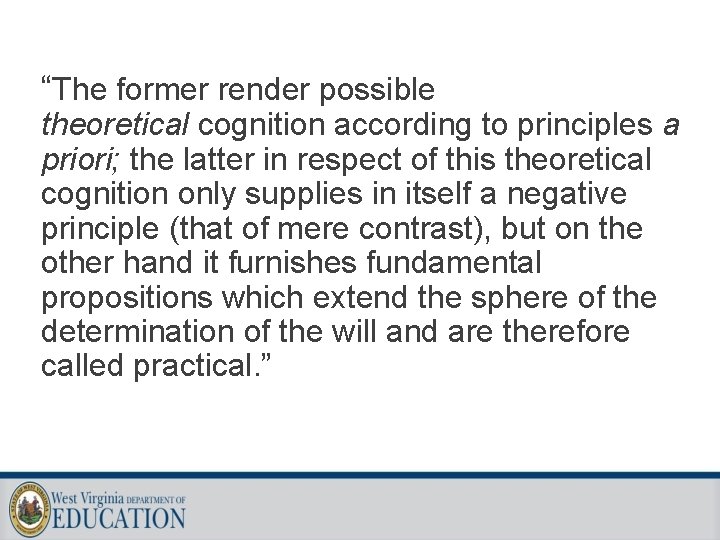
“The former render possible theoretical cognition according to principles a priori; the latter in respect of this theoretical cognition only supplies in itself a negative principle (that of mere contrast), but on the other hand it furnishes fundamental propositions which extend the sphere of the determination of the will and are therefore called practical. ”
Question 2: Synthesis High on Bloom’s Taxonomy Read the following passage, then write a letter to the editor defending the moral values the main character displays with regard to animals.
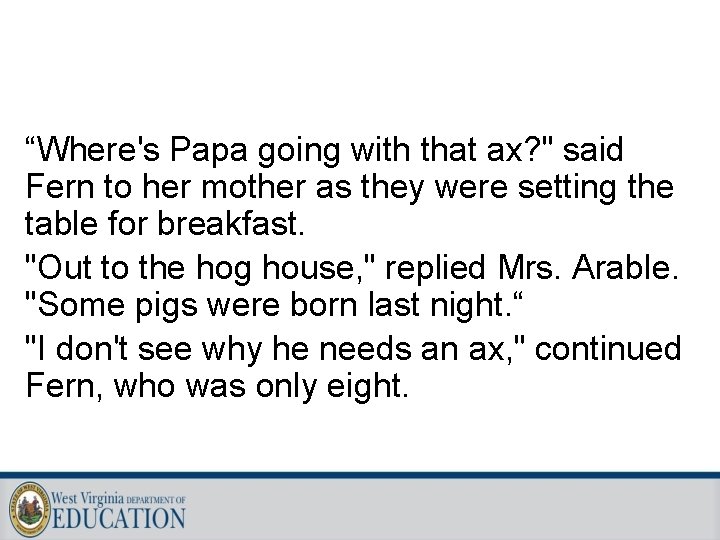
“Where's Papa going with that ax? " said Fern to her mother as they were setting the table for breakfast. "Out to the hog house, " replied Mrs. Arable. "Some pigs were born last night. “ "I don't see why he needs an ax, " continued Fern, who was only eight.
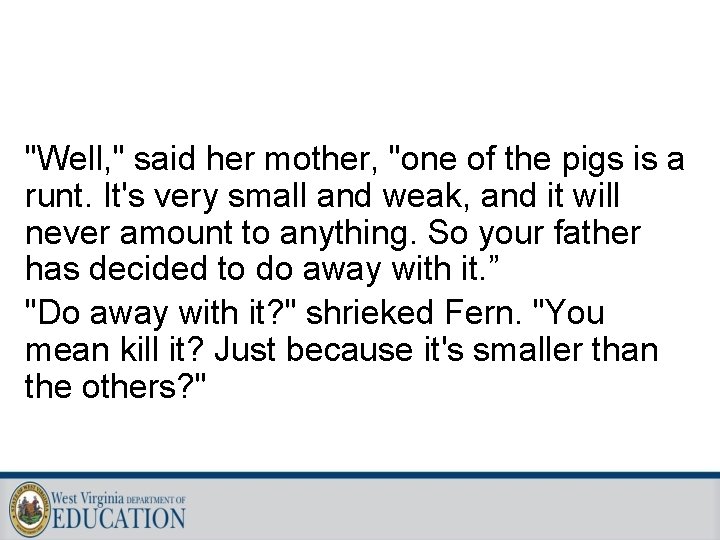
"Well, " said her mother, "one of the pigs is a runt. It's very small and weak, and it will never amount to anything. So your father has decided to do away with it. ” "Do away with it? " shrieked Fern. "You mean kill it? Just because it's smaller than the others? "
Which question was easier? • Why? • Would a lesson (or a whole week of lessons) on “finding main idea” or “making inferences” help you to answer question 1?
What are not the causes? • Lack of critical thinking • Failure to know or use comprehension strategies • Failure to master the standards
Everyone knows knowledge plays a role in comprehension, but how big of a role?
“The Baseball Study, ” Recht & Leslie (1988)
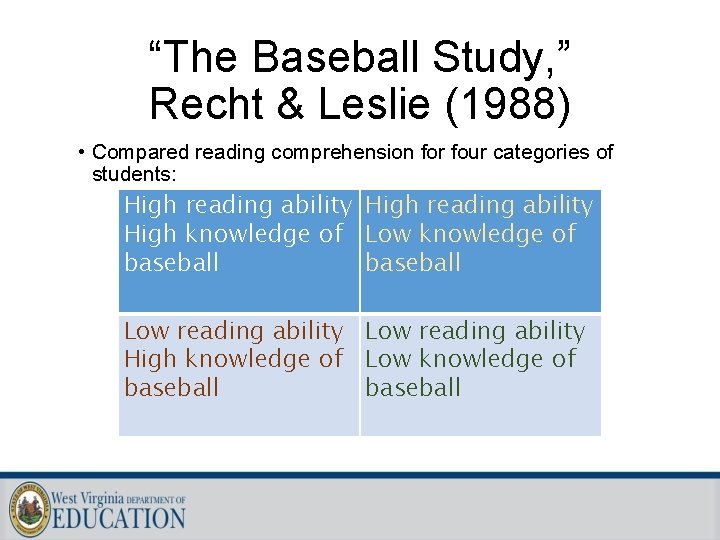
“The Baseball Study, ” Recht & Leslie (1988) • Compared reading comprehension for four categories of students: High reading ability High knowledge of Low knowledge of baseball Low reading ability High knowledge of Low knowledge of baseball
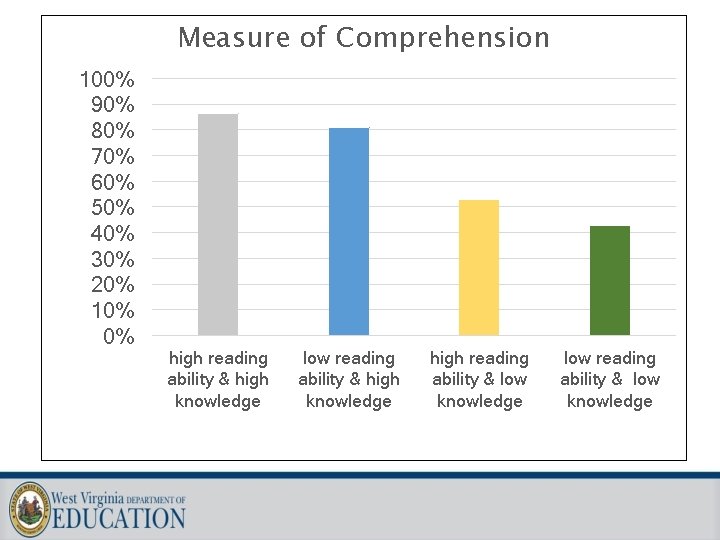
Measure of Comprehension 100% 90% 80% 70% 60% 50% 40% 30% 20% 10% 0% high reading ability & high knowledge low reading ability & high knowledge high reading ability & low knowledge low reading ability & low knowledge
Findings • Knowledge of the topic had a MUCH bigger impact on comprehension than generalized reading ability did. (pg. 18) • With sufficient prior knowledge, “low ability” students performed similarly to higher ability students. (pg. 19) The difference in their performance was not statistically significant.
A student doesn’t have ONE level. Each student has MANY LEVELS depending on topic & knowledge.
Vocabulary • Research has shown that when it comes to risk factors for vocabulary development, poverty trumps race, urban vs. rural community, limited English proficiency, and language impairments. • Vocabulary interventions have to be powerful enough to accelerate, not just incrementally advance word learning for students coming from low-income households to narrow the achievement gap. (Marulis and Neuman, 2011)
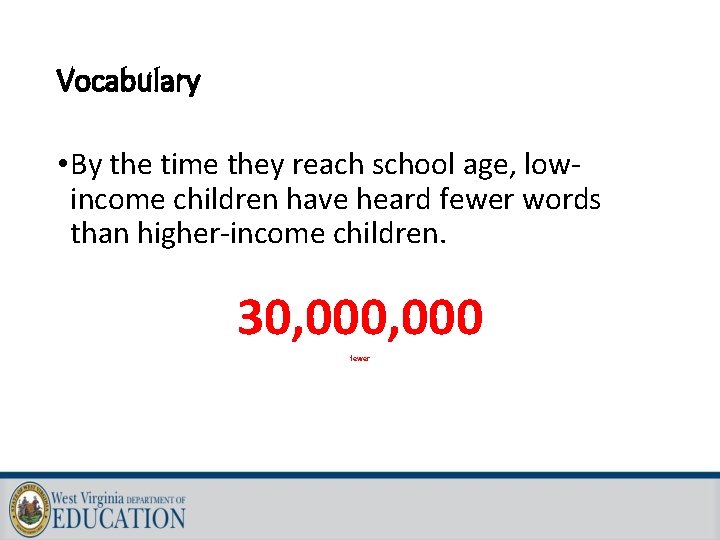
Vocabulary • By the time they reach school age, lowincome children have heard fewer words than higher-income children. 30, 000 fewer
Imagine what it’s like to be a student with vocabulary and knowledge deficits… …on test day.
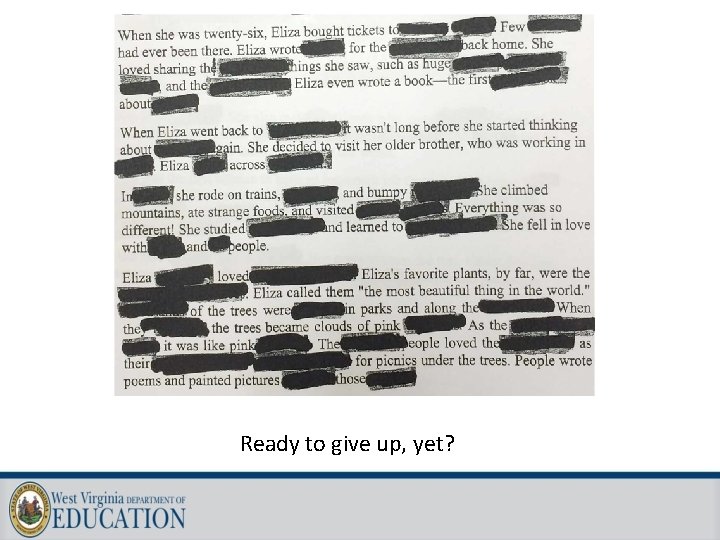
Ready to give up, yet?
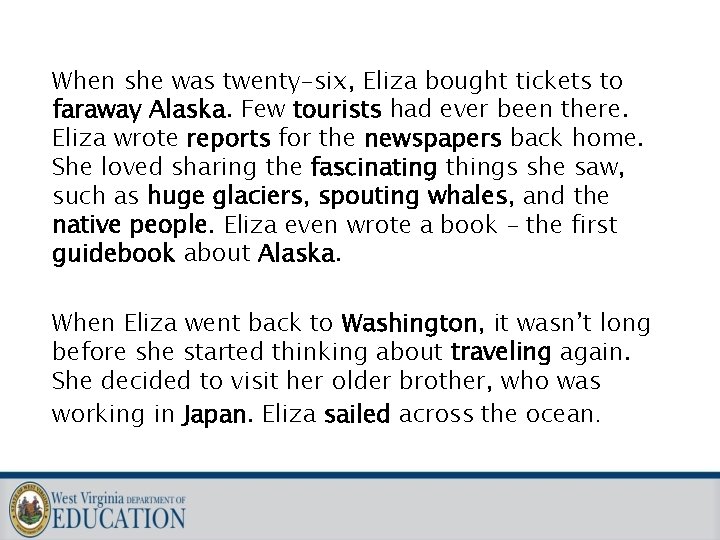
When she was twenty-six, Eliza bought tickets to faraway Alaska. Few tourists had ever been there. Eliza wrote reports for the newspapers back home. She loved sharing the fascinating things she saw, such as huge glaciers, spouting whales, and the native people. Eliza even wrote a book – the first guidebook about Alaska. When Eliza went back to Washington, it wasn’t long before she started thinking about traveling again. She decided to visit her older brother, who was working in Japan. Eliza sailed across the ocean.
We owe our students a better experience reading than this. We have to help them get the vocabulary and knowledge of the world they need to be able to read complex text.
• Students cannot build knowledge and vocabulary without a high volume of reading. • Most words are learned through reading or being read to. • Building knowledge helps level the playing field for students.
Not all high-volume reading is equally effective • Research by Landauer and Dumais into vocabulary acquisition shows that students acquire vocabulary up to four times faster when they read a series of related texts. • Reading a number of texts within a topic grows knowledge and vocabulary far faster than any other approach.
Text Sets – Expert Packs 1. Collection of resources organized for students to build knowledge about a specific topic 2. Glossary of terms to help students access challenging vocabulary (repeated terms and concepts) 3. Suggested activities to help students capture and express their learning
Activities
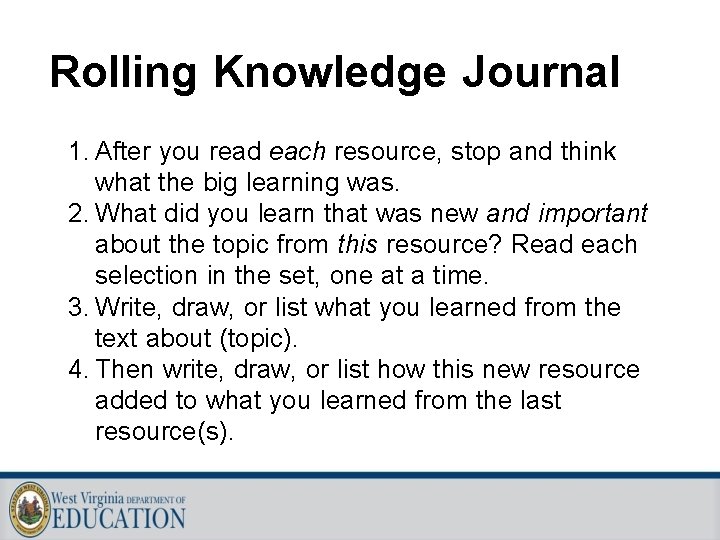
Rolling Knowledge Journal 1. After you read each resource, stop and think what the big learning was. 2. What did you learn that was new and important about the topic from this resource? Read each selection in the set, one at a time. 3. Write, draw, or list what you learned from the text about (topic). 4. Then write, draw, or list how this new resource added to what you learned from the last resource(s).
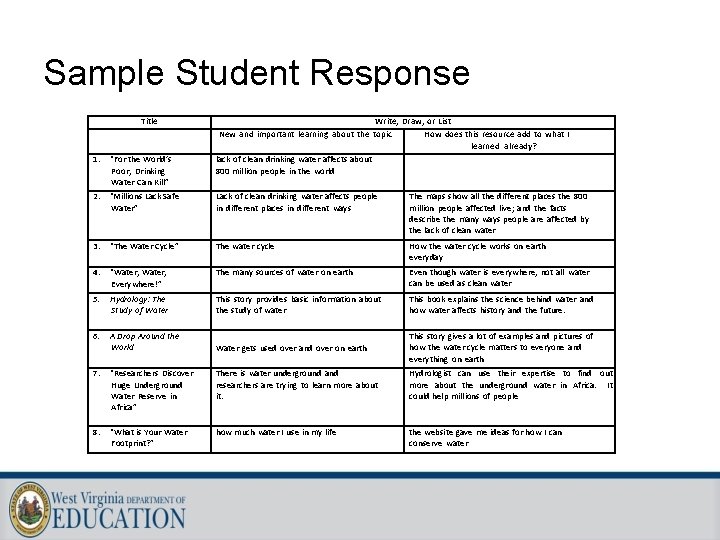
Sample Student Response Title Write, Draw, or List New and important learning about the topic How does this resource add to what I learned already? 1. “For the World’s Poor, Drinking Water Can Kill” lack of clean drinking water affects about 800 million people in the world 2. “Millions Lack Safe Water” Lack of clean drinking water affects people in different places in different ways The maps show all the different places the 800 million people affected live; and the facts describe the many ways people are affected by the lack of clean water 3. “The Water Cycle” The water cycle How the water cycle works on earth everyday 4. “Water, Everywhere!” The many sources of water on earth Even though water is everywhere, not all water can be used as clean water 5. Hydrology: The Study of Water This story provides basic information about the study of water This book explains the science behind water and how water affects history and the future. 6. A Drop Around the World Water gets used over and over on earth This story gives a lot of examples and pictures of how the water cycle matters to everyone and everything on earth 7. “Researchers Discover Huge Underground Water Reserve in Africa” There is water underground and researchers are trying to learn more about it. Hydrologist can use their expertise to find out more about the underground water in Africa. It could help millions of people 8. “What is Your Water Footprint? ” how much water I use in my life the website gave me ideas for how I can conserve water
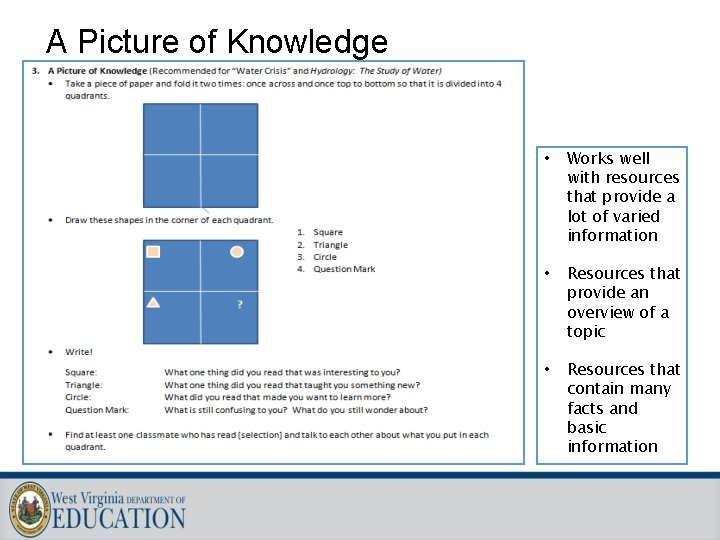
A Picture of Knowledge • Works well with resources that provide a lot of varied information • Resources that provide an overview of a topic • Resources that contain many facts and basic information
• Square: What one thing did you read that was interesting to you? • Triangle: What one thing did you read that taught you something new? • Circle: What did you read that made you want to learn more? • Question Mark: What is still confusing to you? What do you still wonder about?
Text Set Project

WV Library Commission • Text Set Lending Library Request Form
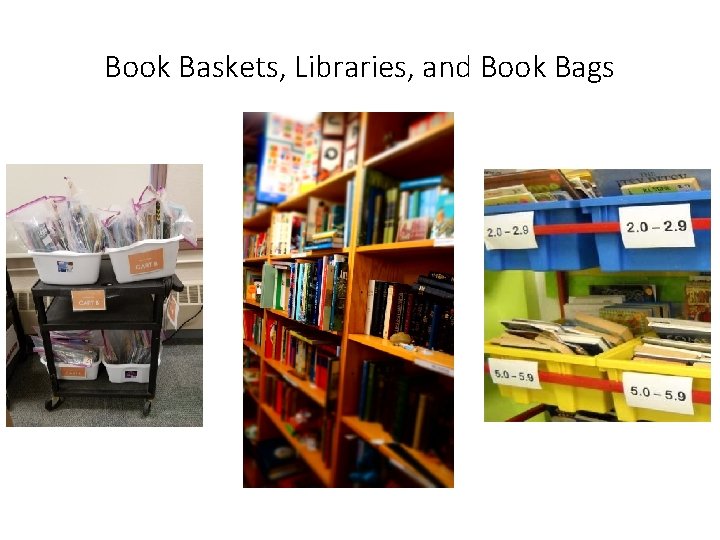
Book Baskets, Libraries, and Book Bags
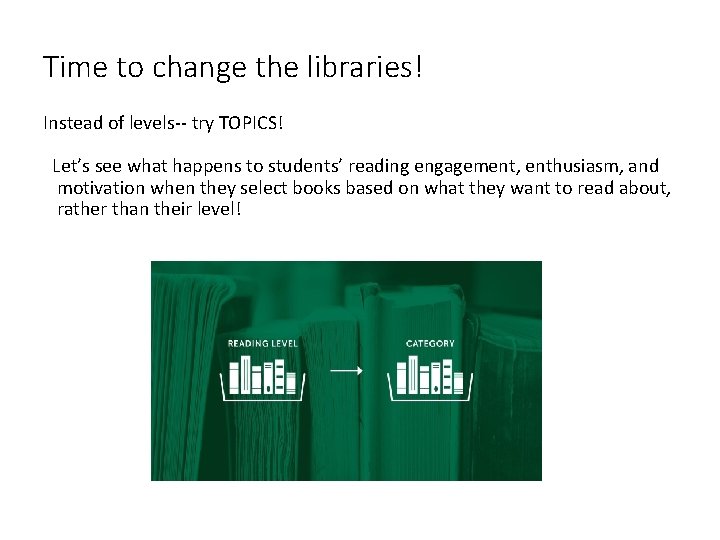
Time to change the libraries! Instead of levels-- try TOPICS! Let’s see what happens to students’ reading engagement, enthusiasm, and motivation when they select books based on what they want to read about, rather than their level!
Text Sets Book Baskets • Library of informational texts organized by topic • Each basket is organized from least complex to most complex Companion Text Sets • Set of related texts that go along with an existing close reading lesson to build • additional knowledge about the topic Include short culminating writing tasks Expert Packs • Build knowledge to create “experts” on an informational topic • Include an annotated bibliography and text complexity that gradually increases • Offer activities that can be structured in a variety of ways Research Packs • Build knowledge in preparation for writing about a Next Gen. science topic • Include writing component with scaffolds for teachers and students • Encourage a gradual release of responsibility with whole group, small group, and individual activities
Christy Schwartz cschwartz@k 12. wv. us Tracy Komorowski tbkomorowski@k 12. wv. us
- Slides: 39