
Text Mining Dr Anil Maheshwari Learning Objectives Differentiate
Text Mining Dr. Anil Maheshwari
Learning Objectives Differentiate between text mining and data mining Understand text mining objectives and application areas Understand the text mining process
Dimensions of Data/Text/Web Mining DTW Mining Inputs Data Domains (industry, function, etc) Types of Data field (categorical, numerical, text, blobs) Data sources (operations, web, office communictions) Data quality (missing values, outliers) DTW Mining Outputs/Goals Objective functions (prediction, cluster, sentiment, etc) Output description types (trees, rules, prediction models) Data representation types DTW Mining Processes Methods (Classification, Clustering, Associations, Sequences) Statistical vs AI machine learning Algorithm types (decision, trees, rules, neural net, etc) Reliability/Accuracy of results (ROC, Confusion matrix, etc)

Data Mining versus Text Mining Both seek for novel and useful patterns Both are semi-automated processes Difference is the nature of the data: Data Mining works on structured data stored in databases Text Mining works on unstructured data in Word documents, PDF files, XML files, etc Text mining – first, impose structure to the data, then mine the structured data
Text Mining Concepts Text mining Objective A semi-automated process of extracting knowledge from unstructured data sources i. e. knowledge discovery in textual databases Structuring a collection of text Traditional approach: bag-of-words New approach: natural language processing for understanding nuances of spoken words Sentiment Analysis A technique used to detect favorable and unfavorable opinions toward specific products and services
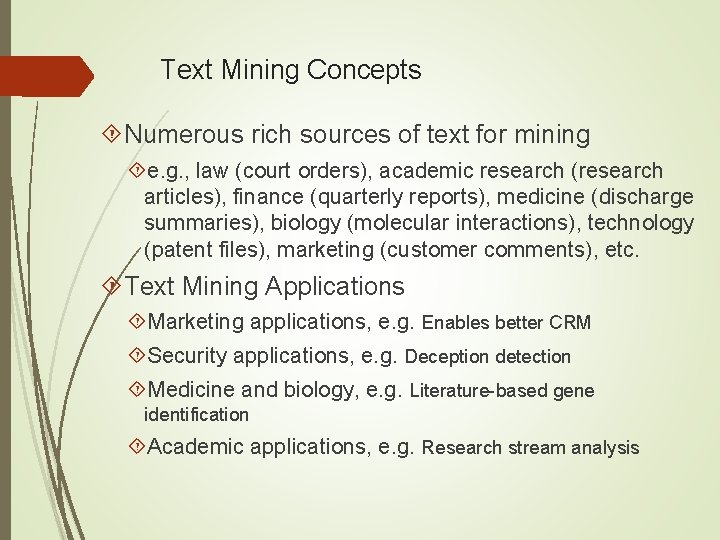
Text Mining Concepts Numerous rich sources of text for mining e. g. , law (court orders), academic research (research articles), finance (quarterly reports), medicine (discharge summaries), biology (molecular interactions), technology (patent files), marketing (customer comments), etc. Text Mining Applications Marketing applications, e. g. Enables better CRM Security applications, e. g. Deception detection Medicine and biology, e. g. Literature-based gene identification Academic applications, e. g. Research stream analysis
Context for Text Mining Process

Text Mining Process – three steps Establish the Corpus of Text: Gather documents, clean, prepare for analysis Structure using Term Document Matrix (TDM): Select a bag of words, compute frequencies of occurrence Mine TDM for Patterns -Apply data mining tools like classification and cluster analysis

Text Mining Process Step 1: Establish the corpus Collect all relevant unstructured data (e. g. , textual documents, XML files, emails, Web pages, short notes, voice recordings…) Digitize, standardize the collection (e. g. , all in ASCII text files) Place the collection in a common place (e. g. , in a flat file, or in a directory as separate files)

Text Mining Process Step 2: Create the Term–by–Document Matrix Document / Terms Doc 1 Doc 2 Doc 3 Doc 4 Doc 5 Doc 6 … investme nt 10 7 1 4 Term Document Matrix Profit happy Success 4 2 5 6 3 2 2 3 4 6 2 2 …

Text Mining Process Step 2: Create the Term–by–Document Matrix (TDM), cont. Should all terms be included? Stop words, include words Synonyms, homonyms Stemming What is the best representation of the indices (values in cells)? Row counts; binary frequencies; log frequencies; Inverse document frequency
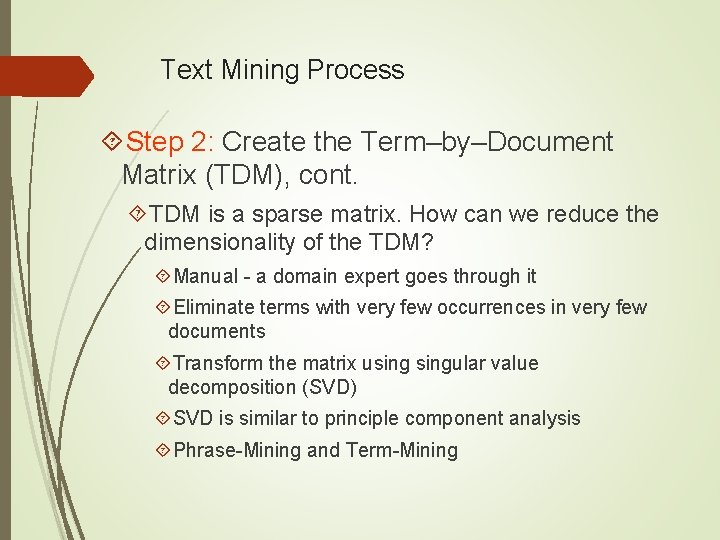
Text Mining Process Step 2: Create the Term–by–Document Matrix (TDM), cont. TDM is a sparse matrix. How can we reduce the dimensionality of the TDM? Manual - a domain expert goes through it Eliminate terms with very few occurrences in very few documents Transform the matrix usingular value decomposition (SVD) SVD is similar to principle component analysis Phrase-Mining and Term-Mining
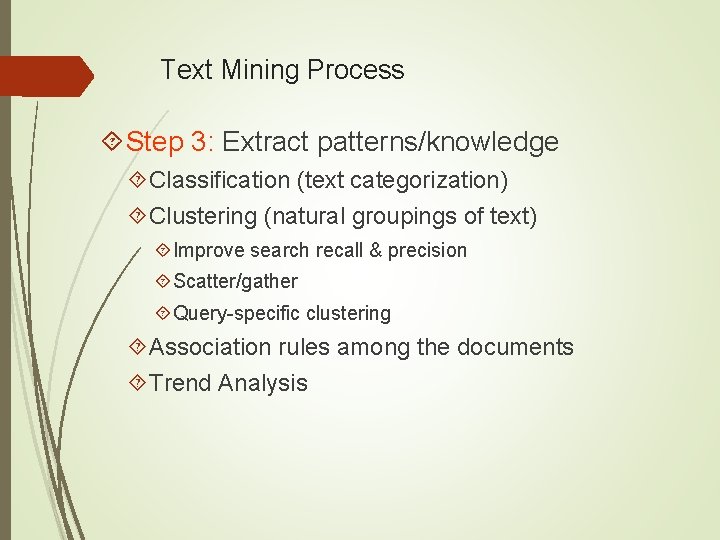
Text Mining Process Step 3: Extract patterns/knowledge Classification (text categorization) Clustering (natural groupings of text) Improve search recall & precision Scatter/gather Query-specific clustering Association rules among the documents Trend Analysis

Thank you.
- Slides: 14