
Text Important Formulas Numbers Doctor notes Notes and
Text Important Formulas Numbers Doctor notes Notes and explanation 1 Lecture No. 5 “No Matter How Many Mistakes You Make Or How Slow You Progress, You Are Still Way Ahead Of Everyone Who Isn’t Trying”
Stretch reflex and tendon jerks Objectives: 1. 2. 3. 4. 5. 6. 7. 8. 9. 2 Describe the structure, innervation and function of the muscle spindle. Describe the components of monosynaptic muscle stretch reflexes, including the role of alpha (α) and gamma (γ) motor neurons. Distinguish between a static and dynamic stretch reflex& damping mechanism. Differentiate between dynamic gamma efferent and Trail endings discharge and their functional role. Distinguish between the primary and secondary afferent fibers of muscle spindle, Intrafusal nuclear bag & nuclear chain. Discuss muscle tone and its abnormalities. Describe the spinal and supra-spinal regulation of the stretch reflex. Describe the structure and function of the Golgi tendon organ and the inverse stretch reflex. Appreciate the clinical importance of the stretch reflexes.
General examples � Vascular tone. � Positive supporting reaction. � Cord reflex. � Stepping and walking reflexes. � Galloping reflex. � Scratch reflex. � Mass reflex (when stool collects and stretches the rectum to evacuate). � Muscle spasm/cramps reflex (when muscles around fractured bone/abdominal inflammation are spastic in order to limit movement and prevent further damage/pain). All are integrated by spinal cord (autonomic reflexes not under our control) 3
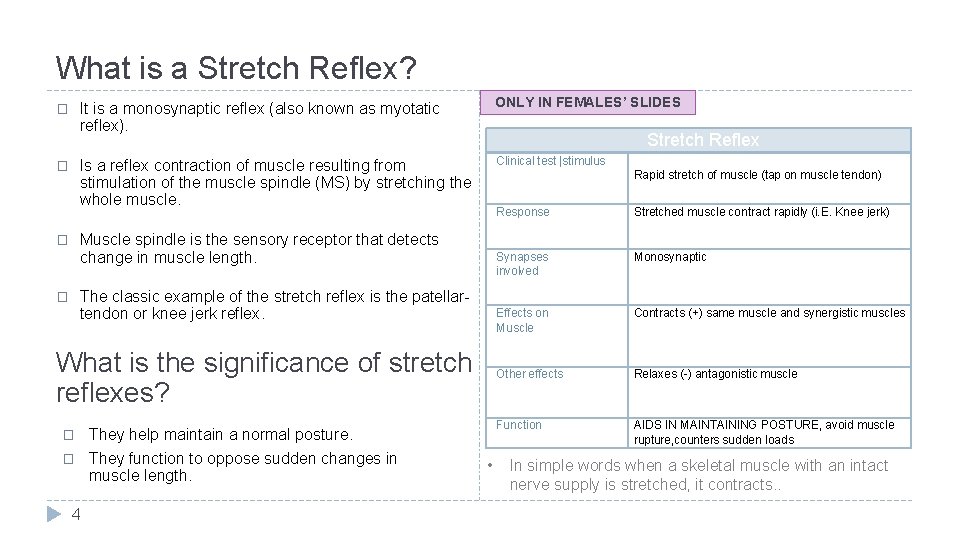
What is a Stretch Reflex? � � It is a monosynaptic reflex (also known as myotatic reflex). ONLY IN FEMALES’ SLIDES Is a reflex contraction of muscle resulting from stimulation of the muscle spindle (MS) by stretching the whole muscle. Clinical test |stimulus Stretch Reflex Rapid stretch of muscle (tap on muscle tendon) Muscle spindle is the sensory receptor that detects change in muscle length. � The classic example of the stretch reflex is the patellartendon or knee jerk reflex. � What is the significance of stretch reflexes? � � 4 They help maintain a normal posture. They function to oppose sudden changes in muscle length. • Response Stretched muscle contract rapidly (i. E. Knee jerk) Synapses involved Monosynaptic Effects on Muscle Contracts (+) same muscle and synergistic muscles Other effects Relaxes (-) antagonistic muscle Function AIDS IN MAINTAINING POSTURE, avoid muscle rupture, counters sudden loads In simple words when a skeletal muscle with an intact nerve supply is stretched, it contracts. .
What is a Stretch Reflex? ONLY IN FEMALES’ SLIDES � Two main types of stretch reflex: • inverse stretch reflex (by Golgi tendon organs). • stretch reflex. � 3 main characteristic: • (monosynaptic)* • Always segmental (reflex happen in the same segment where it has entered in the SC). • Always ipsilateral. *When a reflex arc in an animal consists of only 1 sensory neuron and 1 motor neuron, it is defined as monosynaptic. In polysynaptic reflex pathways, 1 or more interneurons connect afferent and efferent signals. 5 � A stretch reflex causes contraction of a skeletal muscle ( the Effector) in response to stretching the muscle. � This type of reflex occurs via a monosynaptic arc. � The reflex can occur by activation of a single sensory neuron that forms one synapse in the CNS with a single motor neuron. � An example of a stretch reflex is Patellar reflex (Knee Jerk).
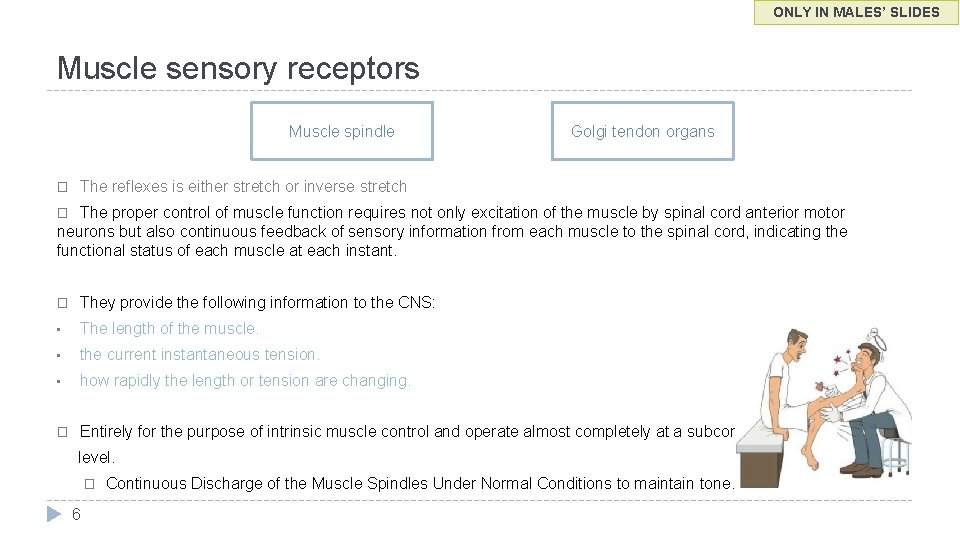
ONLY IN MALES’ SLIDES Muscle sensory receptors Muscle spindle � Golgi tendon organs The reflexes is either stretch or inverse stretch The proper control of muscle function requires not only excitation of the muscle by spinal cord anterior motor neurons but also continuous feedback of sensory information from each muscle to the spinal cord, indicating the functional status of each muscle at each instant. � � They provide the following information to the CNS: • The length of the muscle. • the current instantaneous tension. • how rapidly the length or tension are changing. � Entirely for the purpose of intrinsic muscle control and operate almost completely at a subconscious level. � 6 Continuous Discharge of the Muscle Spindles Under Normal Conditions to maintain tone.
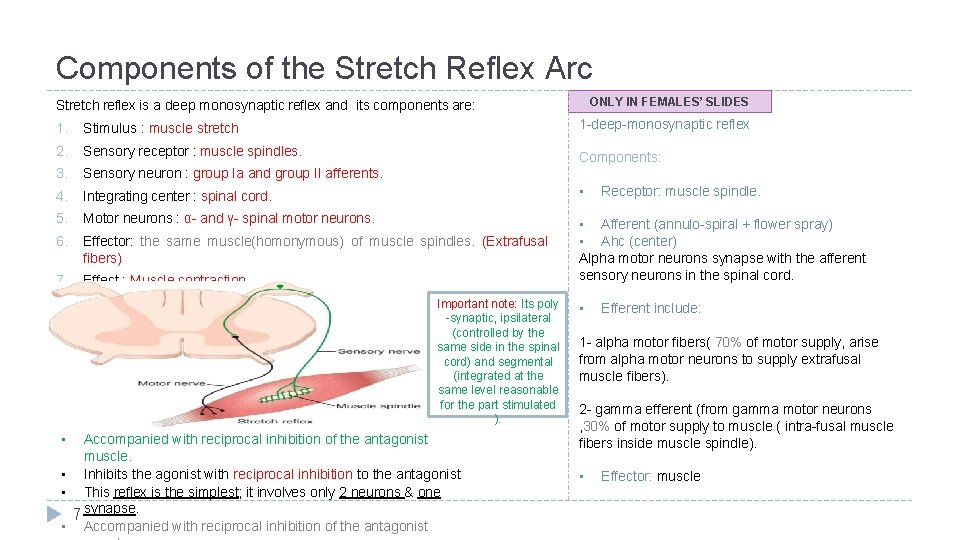
Components of the Stretch Reflex Arc ONLY IN FEMALES’ SLIDES Stretch reflex is a deep monosynaptic reflex and its components are: 1. Stimulus : muscle stretch 1 -deep-monosynaptic reflex 2. Sensory receptor : muscle spindles. Components: 3. Sensory neuron : group Ia and group II afferents. 4. Integrating center : spinal cord. • 5. Motor neurons : α- and γ- spinal motor neurons. 6. Effector: the same muscle(homonymous) of muscle spindles. (Extrafusal fibers) 7. Effect : Muscle contraction • Afferent (annulo-spiral + flower spray) • Ahc (center) Alpha motor neurons synapse with the afferent sensory neurons in the spinal cord. Important note: Its poly -synaptic, ipsilateral (controlled by the same side in the spinal cord) and segmental (integrated at the same level reasonable for the part stimulated ). • Accompanied with reciprocal inhibition of the antagonist muscle. • Inhibits the agonist with reciprocal inhibition to the antagonist • This reflex is the simplest; it involves only 2 neurons & one 7 synapse. • Accompanied with reciprocal inhibition of the antagonist • Receptor: muscle spindle. Efferent include: 1 - alpha motor fibers( 70% of motor supply, arise from alpha motor neurons to supply extrafusal muscle fibers). 2 - gamma efferent (from gamma motor neurons , 30% of motor supply to muscle ( intra-fusal muscle fibers inside muscle spindle). • Effector: muscle
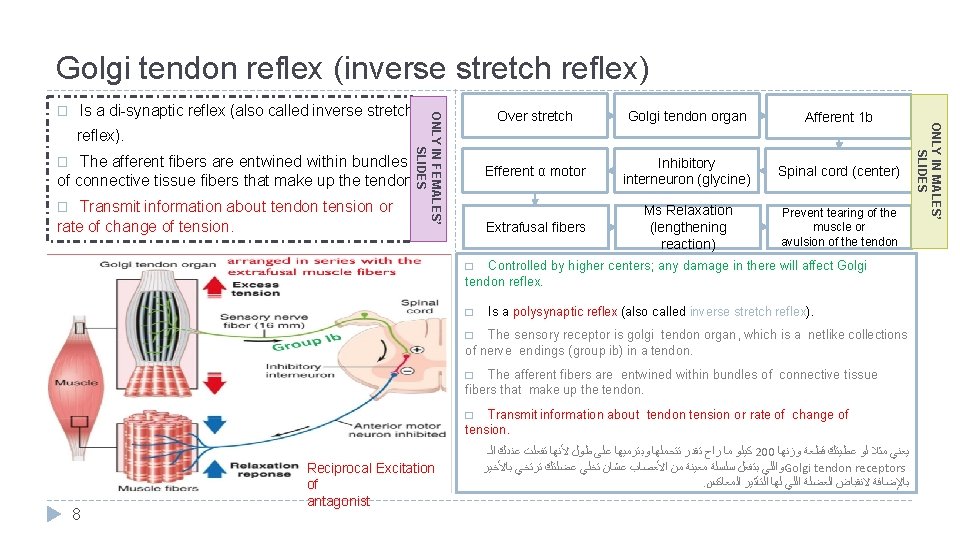
Golgi tendon reflex (inverse stretch reflex) Is a di-synaptic reflex (also called inverse stretch The afferent fibers are entwined within bundles of connective tissue fibers that make up the tendon. � Transmit information about tendon tension or rate of change of tension. � Over stretch Golgi tendon organ Afferent 1 b Efferent α motor Inhibitory interneuron (glycine) Spinal cord (center) Extrafusal fibers Ms Relaxation (lengthening reaction) Prevent tearing of the muscle or avulsion of the tendon Controlled by higher centers; any damage in there will affect Golgi tendon reflex. � � Is a polysynaptic reflex (also called inverse stretch reflex). The sensory receptor is golgi tendon organ, which is a netlike collections of nerve endings (group ib) in a tendon. � The afferent fibers are entwined within bundles of connective tissue fibers that make up the tendon. � Transmit information about tendon tension or rate of change of tension. � 8 Reciprocal Excitation of antagonist ﻛﻴﻠﻮ ﻣﺎ ﺭﺍﺡ ﺗﻘﺪﺭ ﺗﺘﺤﻤﻠﻬﺎ ﻭﺑﺘﺮﻣﻴﻬﺎ ﻋﻠﻰ ﻃﻮﻝ ﻷﻨﻬﺎ ﺗﻔﻌﻠﺖ ﻋﻨﺪﻙ ﺍﻟـ 200 ﻳﻌﻨﻲ ﻣﺜﻼ ﻟﻮ ﻋﻄﻴﺘﻚ ﻗﻄﻌﺔ ﻭﺯﻧﻬﺎ ﻭﺍﻟﻠﻲ ﺑﺘﻔﻌﻞ ﺳﻠﺴﻠﺔ ﻣﻌﻴﻨﺔ ﻣﻦ ﺍﻷﻌﺼﺎﺏ ﻋﺸﺎﻥ ﺗﺨﻠﻲ ﻋﻀﻠﺘﻚ ﺗﺮﺗﺨﻲ ﺑﺎﻷﺨﻴﺮ Golgi tendon receptors. ﺑﺎﻹﺿﺎﻓﺔ ﻻﻧﻘﺒﺎﺽ ﺍﻟﻌﻀﻠﺔ ﺍﻟﻠﻲ ﻟﻬﺎ ﺍﻟﺘﺄﺜﻴﺮ ﺍﻟﻤﻌﺎﻛﺲ ONLY IN MALES’ SLIDES reflex). ONLY IN FEMALES’ SLIDES �
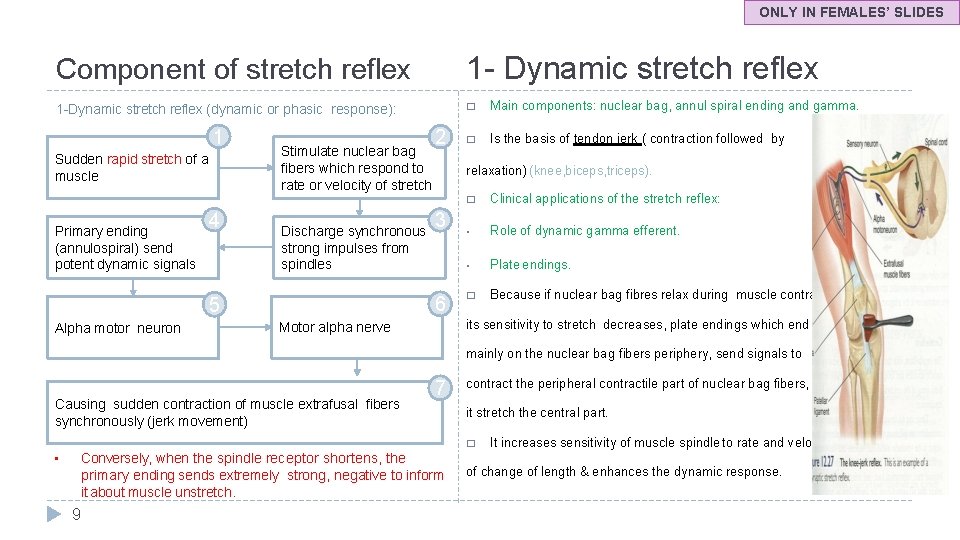
ONLY IN FEMALES’ SLIDES Component of stretch reflex 1 - Dynamic stretch reflex 1 -Dynamic stretch reflex (dynamic or phasic response): � Main components: nuclear bag, annul spiral ending and gamma. � Is the basis of tendon jerk ( contraction followed by 1 Sudden rapid stretch of a muscle Primary ending (annulospiral) send potent dynamic signals 4 Stimulate nuclear bag fibers which respond to rate or velocity of stretch Discharge synchronous strong impulses from spindles relaxation) (knee, biceps, triceps). 3 6 5 Alpha motor neuron 2 � Clinical applications of the stretch reflex: • Role of dynamic gamma efferent. • Plate endings. � Because if nuclear bag fibres relax during muscle contraction its sensitivity to stretch decreases, plate endings which end Motor alpha nerve mainly on the nuclear bag fibers periphery, send signals to Causing sudden contraction of muscle extrafusal fibers synchronously (jerk movement) 7 contract the peripheral contractile part of nuclear bag fibers, so it stretch the central part. � • Conversely, when the spindle receptor shortens, the primary ending sends extremely strong, negative to inform it about muscle unstretch. 9 It increases sensitivity of muscle spindle to rate and velocity of change of length & enhances the dynamic response.
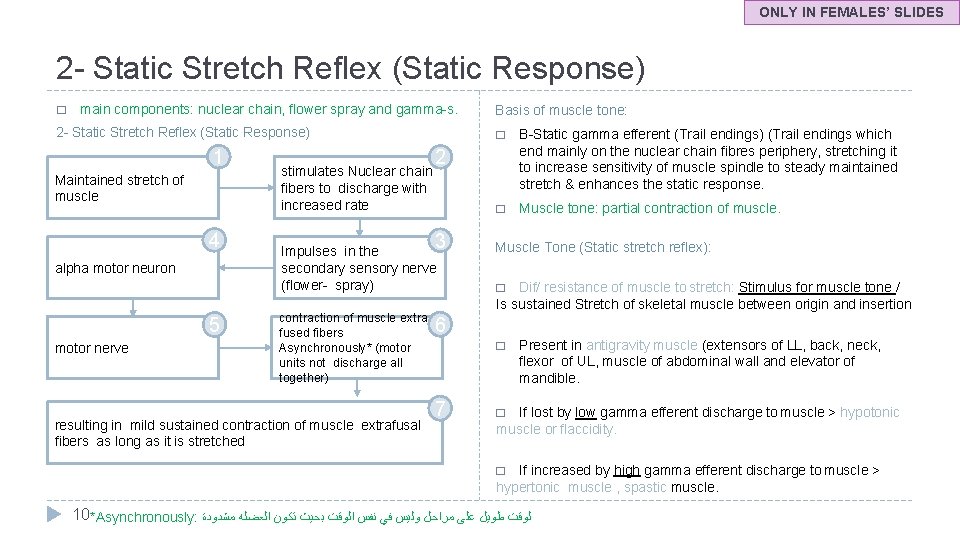
ONLY IN FEMALES’ SLIDES 2 - Static Stretch Reflex (Static Response) � main components: nuclear chain, flower spray and gamma-s. 2 - Static Stretch Reflex (Static Response) 1 Maintained stretch of muscle 4 alpha motor neuron 5 motor nerve stimulates Nuclear chain fibers to discharge with increased rate 3 resulting in mild sustained contraction of muscle extrafusal fibers as long as it is stretched � B-Static gamma efferent (Trail endings) (Trail endings which end mainly on the nuclear chain fibres periphery, stretching it to increase sensitivity of muscle spindle to steady maintained stretch & enhances the static response. � Muscle tone: partial contraction of muscle. 2 Impulses in the secondary sensory nerve (flower- spray) contraction of muscle extra fused fibers Asynchronously* (motor units not discharge all together) Basis of muscle tone: Muscle Tone (Static stretch reflex): Dif/ resistance of muscle to stretch: Stimulus for muscle tone / Is sustained Stretch of skeletal muscle between origin and insertion � 6 � 7 Present in antigravity muscle (extensors of LL, back, neck, flexor of UL, muscle of abdominal wall and elevator of mandible. If lost by low gamma efferent discharge to muscle > hypotonic muscle or flaccidity. � If increased by high gamma efferent discharge to muscle > hypertonic muscle , spastic muscle. � 10*Asynchronously: ﻟﻮﻗﺖ ﻃﻮﻳﻞ ﻋﻠﻰ ﻣﺮﺍﺣﻞ ﻭﻟﻴﺲ ﻓﻲ ﻧﻔﺲ ﺍﻟﻮﻗﺖ ﺑﺤﻴﺚ ﺗﻜﻮﻥ ﺍﻟﻌﻀﻠﻪ ﻣﺸﺪﻭﺩﺓ
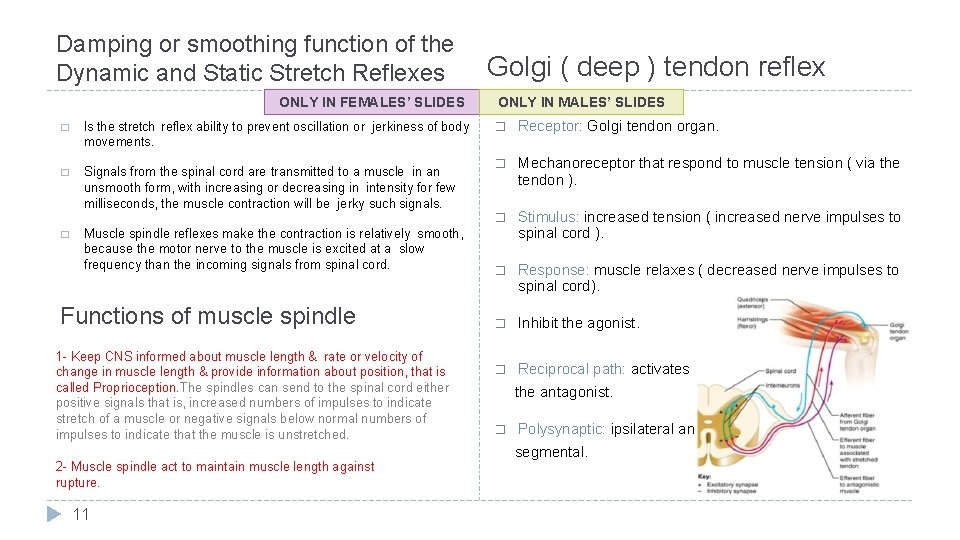
Damping or smoothing function of the Dynamic and Static Stretch Reflexes ONLY IN FEMALES’ SLIDES � Is the stretch reflex ability to prevent oscillation or jerkiness of body movements. � Signals from the spinal cord are transmitted to a muscle in an unsmooth form, with increasing or decreasing in intensity for few milliseconds, the muscle contraction will be jerky such signals. � Muscle spindle reflexes make the contraction is relatively smooth, because the motor nerve to the muscle is excited at a slow frequency than the incoming signals from spinal cord. Functions of muscle spindle 1 - Keep CNS informed about muscle length & rate or velocity of change in muscle length & provide information about position, that is called Proprioception. The spindles can send to the spinal cord either positive signals that is, increased numbers of impulses to indicate stretch of a muscle or negative signals below normal numbers of impulses to indicate that the muscle is unstretched. 2 - Muscle spindle act to maintain muscle length against rupture. 11 Golgi ( deep ) tendon reflex ONLY IN MALES’ SLIDES � Receptor: Golgi tendon organ. � Mechanoreceptor that respond to muscle tension ( via the tendon ). � Stimulus: increased tension ( increased nerve impulses to spinal cord ). � Response: muscle relaxes ( decreased nerve impulses to spinal cord). � Inhibit the agonist. � Reciprocal path: activates the antagonist. � Polysynaptic: ipsilateral and segmental.
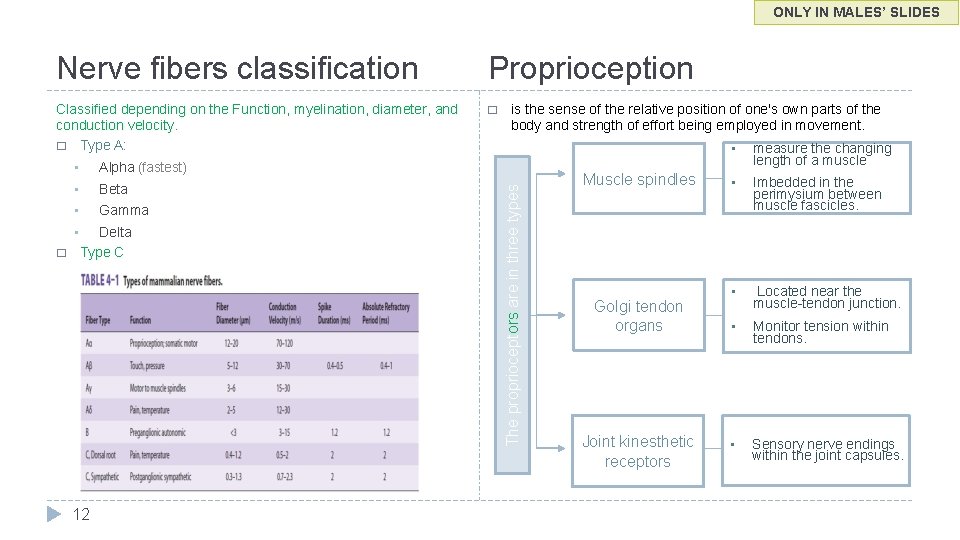
ONLY IN MALES’ SLIDES Nerve fibers classification Proprioception Classified depending on the Function, myelination, diameter, and conduction velocity. � Type A: � Alpha (fastest) • Beta • Gamma • � Delta Type C 12 The proprioceptors are in three types • is the sense of the relative position of one's own parts of the body and strength of effort being employed in movement. Muscle spindles Golgi tendon organs Joint kinesthetic receptors • measure the changing length of a muscle • Imbedded in the perimysium between muscle fascicles. • Located near the muscle-tendon junction. • Monitor tension within tendons. • Sensory nerve endings within the joint capsules.
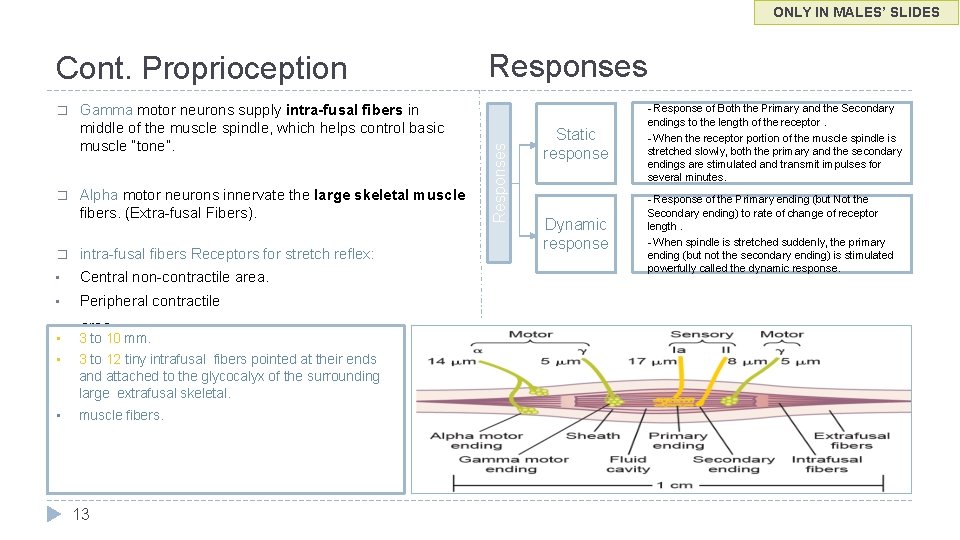
ONLY IN MALES’ SLIDES � � Gamma motor neurons supply intra-fusal fibers in middle of the muscle spindle, which helps control basic muscle “tone”. Alpha motor neurons innervate the large skeletal muscle fibers. (Extra-fusal Fibers). � intra-fusal fibers Receptors for stretch reflex: • Central non-contractile area. • Peripheral contractile • • 3 to 10 mm. • muscle fibers. area. 3 to 12 tiny intrafusal fibers pointed at their ends and attached to the glycocalyx of the surrounding large extrafusal skeletal. 13 Responses Cont. Proprioception Static response - Response of Both the Primary and the Secondary endings to the length of the receptor. - When the receptor portion of the muscle spindle is stretched slowly, both the primary and the secondary endings are stimulated and transmit impulses for several minutes. Dynamic response - Response of the Primary ending (but Not the Secondary ending) to rate of change of receptor length. - When spindle is stretched suddenly, the primary ending (but not the secondary ending) is stimulated powerfully called the dynamic response.
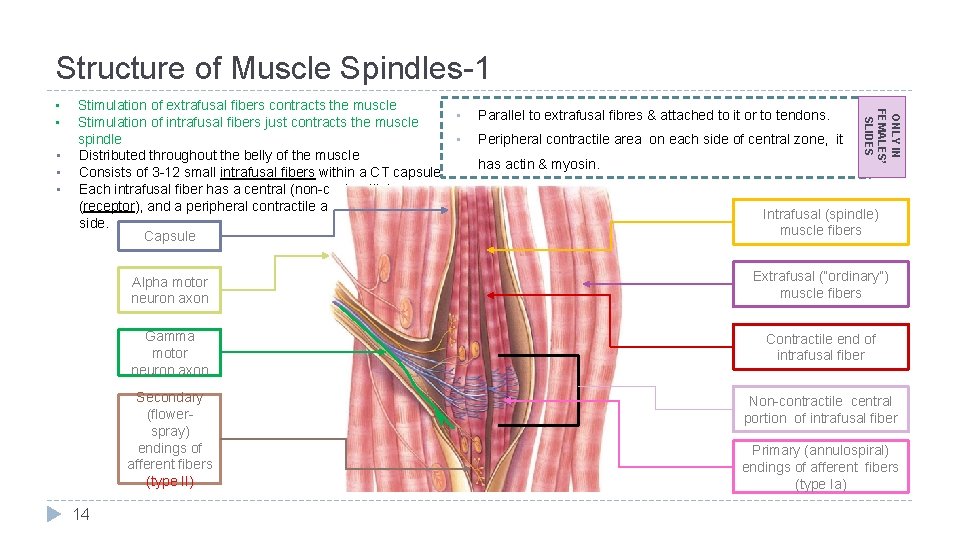
Structure of Muscle Spindles-1 • • • Stimulation of extrafusal fibers contracts the muscle Stimulation of intrafusal fibers just contracts the muscle spindle Distributed throughout the belly of the muscle Consists of 3 -12 small intrafusal fibers within a CT capsule Each intrafusal fiber has a central (non-contractile) area (receptor), and a peripheral contractile area on each side. Capsule 14 • Parallel to extrafusal fibres & attached to it or to tendons. • Peripheral contractile area on each side of central zone, it has actin & myosin. ONLY IN FEMALES’ SLIDES • • Intrafusal (spindle) muscle fibers Alpha motor neuron axon Extrafusal (“ordinary”) muscle fibers Gamma motor neuron axon Contractile end of intrafusal fiber Secondary (flowerspray) endings of afferent fibers (type II) Non-contractile central portion of intrafusal fiber Primary (annulospiral) endings of afferent fibers (type Ia)
Guyton corner � Sensory fibers originate in the central portion of muscle spindle are stimulated by stretch-ing of this midportion of the spindle. The muscle spindle receptor can be excited in two ways: � 1. Lengthening the whole muscle stretches the mid-portion of the spindle and, therefore, excites the receptor. � 2. Even if the length of the entire muscle does not change, contraction of the end portions of the spin-dle’s intrafusal fibers stretches the midportion of the spindle and therefore excites the receptor 15
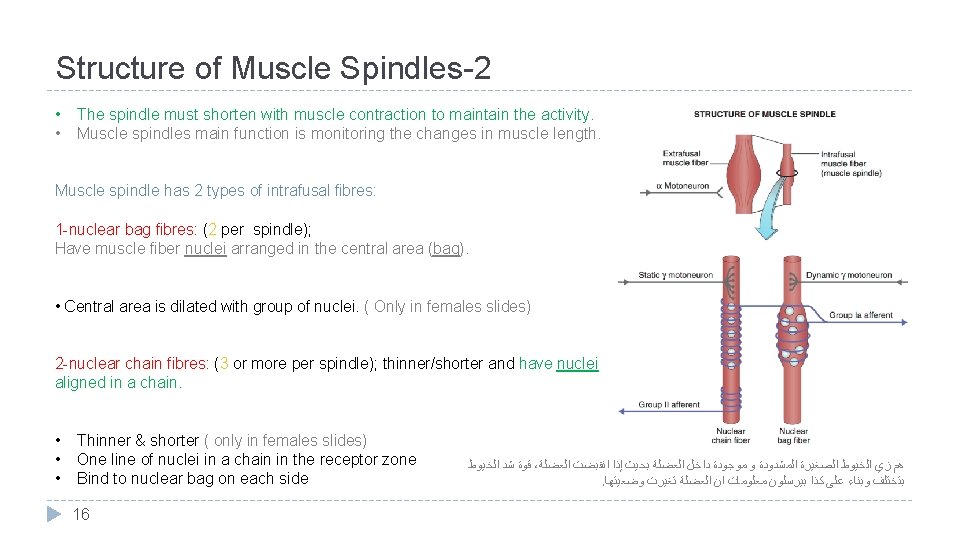
Structure of Muscle Spindles-2 • • The spindle must shorten with muscle contraction to maintain the activity. Muscle spindles main function is monitoring the changes in muscle length. Muscle spindle has 2 types of intrafusal fibres: 1 -nuclear bag fibres: (2 per spindle); Have muscle fiber nuclei arranged in the central area (bag). • Central area is dilated with group of nuclei. ( Only in females slides) 2 -nuclear chain fibres: (3 or more per spindle); thinner/shorter and have nuclei aligned in a chain. • • • Thinner & shorter ( only in females slides) One line of nuclei in a chain in the receptor zone Bind to nuclear bag on each side 16 ﻗﻮﺓ ﺷﺪ ﺍﻟﺨﻴﻮﻁ ، ﻫﻢ ﺯﻱ ﺍﻟﺨﻴﻮﻁ ﺍﻟﺼﻐﻴﺮﺓ ﺍﻟﻤﺸﺪﻭﺩﺓ ﻭ ﻣﻮﺟﻮﺩﺓ ﺩﺍﺧﻞ ﺍﻟﻌﻀﻠﺔ ﺑﺤﻴﺚ ﺇﺫﺍ ﺍﻧﻘﺒﻀﺖ ﺍﻟﻌﻀﻠﺔ . ﺑﺘﺨﺘﻠﻒ ﻭﺑﻨﺎﺀ ﻋﻠﻰ ﻛﺬﺍ ﺑﻴﺮﺳﻠﻮﻥ ﻣﻌﻠﻮﻣﺎﺕ ﺍﻥ ﺍﻟﻌﻀﻠﺔ ﺗﻐﻴﺮﺕ ﻭﺿﻌﻴﺘﻬﺎ
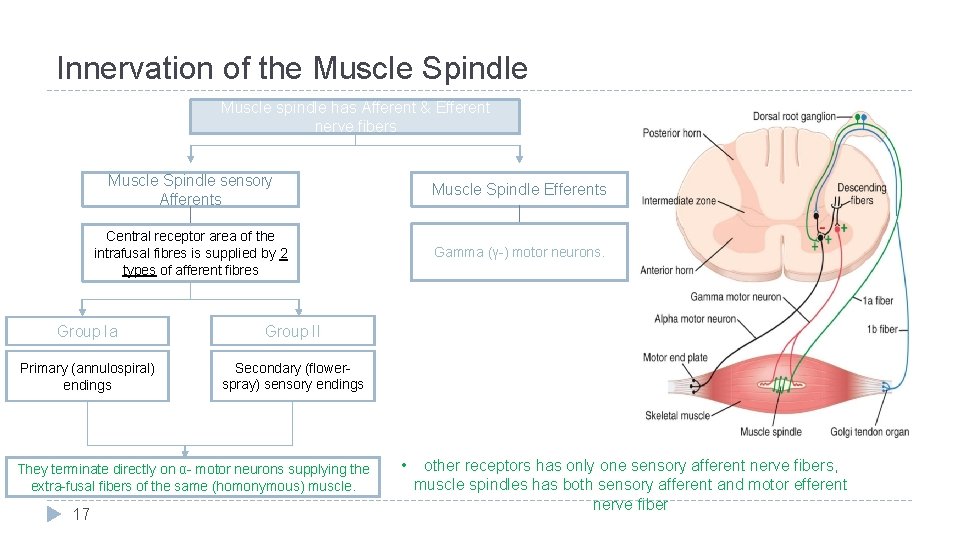
Innervation of the Muscle Spindle Muscle spindle has Afferent & Efferent nerve fibers Muscle Spindle sensory Afferents Muscle Spindle Efferents Central receptor area of the intrafusal fibres is supplied by 2 types of afferent fibres Gamma (γ-) motor neurons. Group Ia Group II Primary (annulospiral) endings Secondary (flowerspray) sensory endings They terminate directly on α- motor neurons supplying the extra-fusal fibers of the same (homonymous) muscle. 17 • other receptors has only one sensory afferent nerve fibers, muscle spindles has both sensory afferent and motor efferent nerve fiber
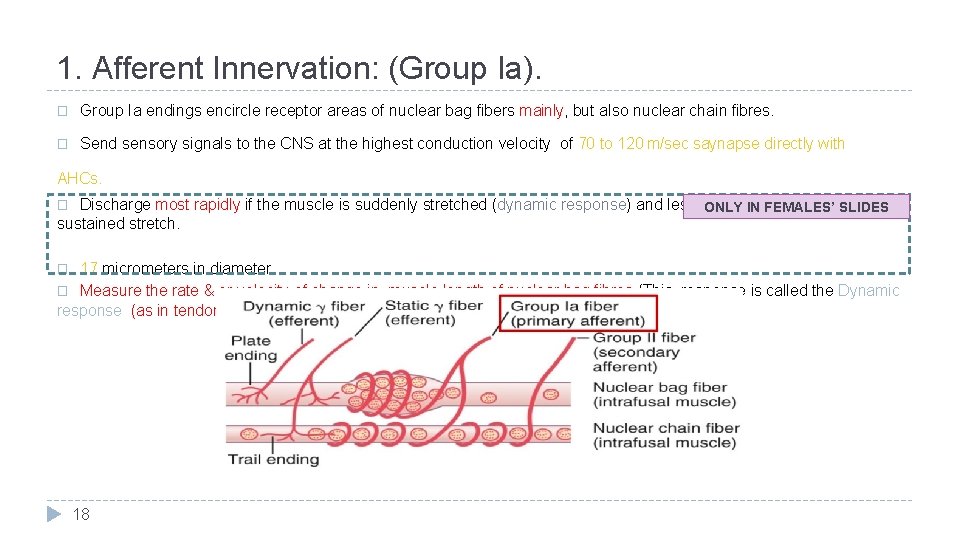
1. Afferent Innervation: (Group Ia). � Group Ia endings encircle receptor areas of nuclear bag fibers mainly, but also nuclear chain fibres. � Send sensory signals to the CNS at the highest conduction velocity of 70 to 120 m/sec saynapse directly with AHCs. Discharge most rapidly if the muscle is suddenly stretched (dynamic response) and less rapidly (or. FEMALES’ not) during ONLY IN SLIDES sustained stretch. � 17 micrometers in diameter. � Measure the rate & or velocity of change in muscle length of nuclear bag fibres (This response is called the Dynamic response (as in tendon jerks) � 18
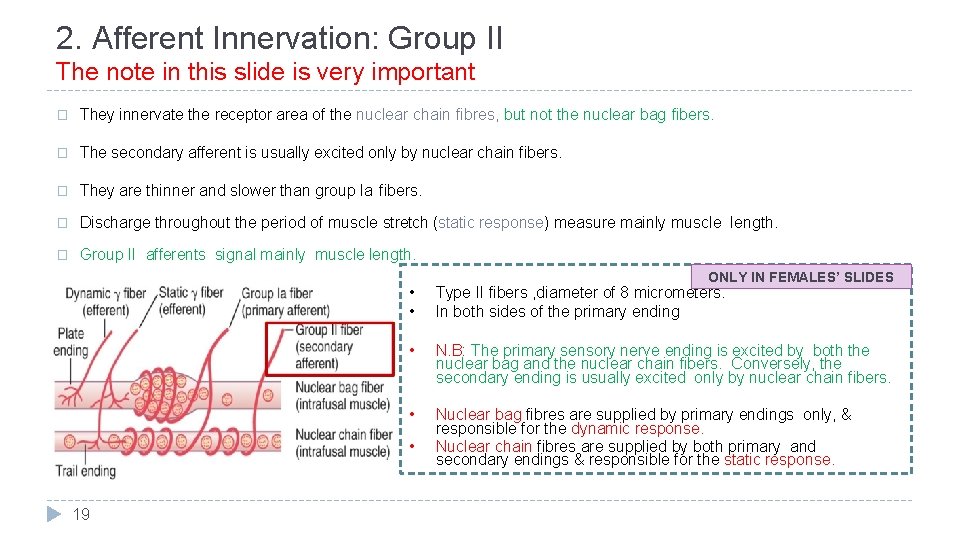
2. Afferent Innervation: Group II The note in this slide is very important � They innervate the receptor area of the nuclear chain fibres, but not the nuclear bag fibers. � The secondary afferent is usually excited only by nuclear chain fibers. � They are thinner and slower than group Ia fibers. � Discharge throughout the period of muscle stretch (static response) measure mainly muscle length. � Group II afferents signal mainly muscle length. • • Type II fibers , diameter of 8 micrometers. In both sides of the primary ending • N. B: The primary sensory nerve ending is excited by both the nuclear bag and the nuclear chain fibers. Conversely, the secondary ending is usually excited only by nuclear chain fibers. • Nuclear bag fibres are supplied by primary endings only, & responsible for the dynamic response. Nuclear chain fibres are supplied by both primary and secondary endings & responsible for the static response. • 19 ONLY IN FEMALES’ SLIDES
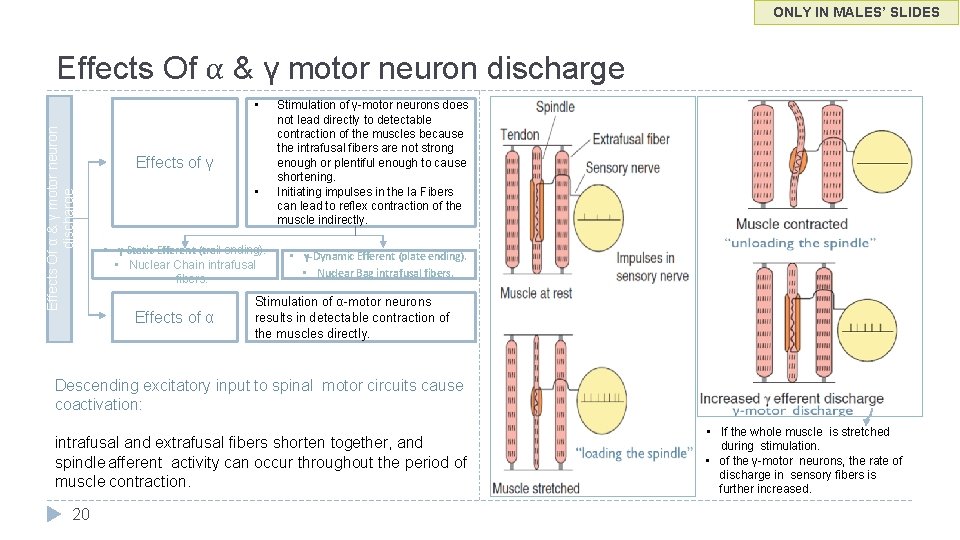
ONLY IN MALES’ SLIDES Effects Of α & γ motor neuron discharge • Effects of γ • • γ-Static Efferent (trail ending). • Nuclear Chain intrafusal fibers. Effects of α Stimulation of γ-motor neurons does not lead directly to detectable contraction of the muscles because the intrafusal fibers are not strong enough or plentiful enough to cause shortening. Initiating impulses in the Ia Fibers can lead to reflex contraction of the muscle indirectly. • γ-Dynamic Efferent (plate ending). • Nuclear Bag intrafusal fibers. Stimulation of α-motor neurons results in detectable contraction of the muscles directly. Descending excitatory input to spinal motor circuits cause coactivation: intrafusal and extrafusal fibers shorten together, and spindle afferent activity can occur throughout the period of muscle contraction. 20 • If the whole muscle is stretched during stimulation. • of the γ-motor neurons, the rate of discharge in sensory fibers is further increased.
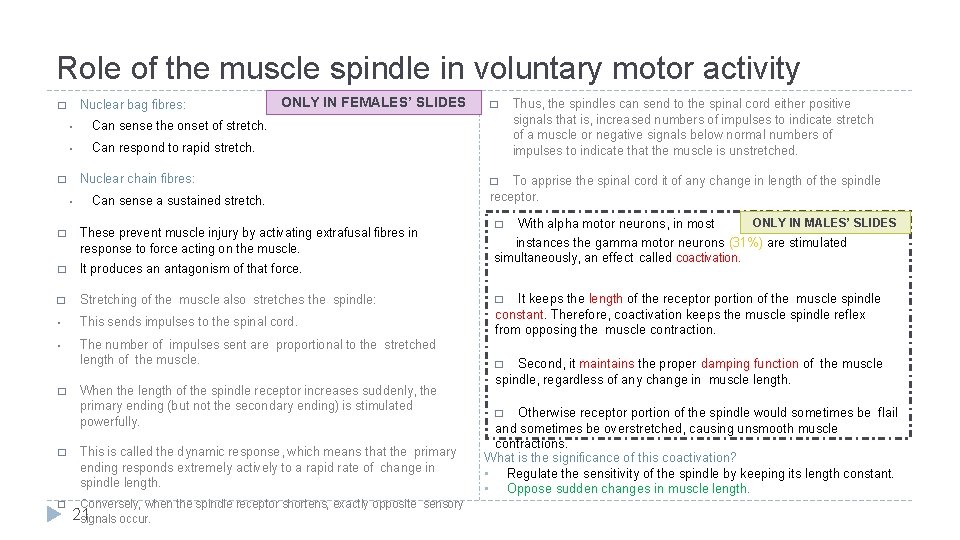
Role of the muscle spindle in voluntary motor activity Nuclear bag fibres: � • Can sense the onset of stretch. • Can respond to rapid stretch. ONLY IN FEMALES’ SLIDES Nuclear chain fibres: � • Can sense a sustained stretch. � These prevent muscle injury by activating extrafusal fibres in response to force acting on the muscle. � It produces an antagonism of that force. � Stretching of the muscle also stretches the spindle: • This sends impulses to the spinal cord. • The number of impulses sent are proportional to the stretched length of the muscle. � � � When the length of the spindle receptor increases suddenly, the primary ending (but not the secondary ending) is stimulated powerfully. This is called the dynamic response, which means that the primary ending responds extremely actively to a rapid rate of change in spindle length. Conversely, when the spindle receptor shortens, exactly opposite sensory 21 signals occur. � Thus, the spindles can send to the spinal cord either positive signals that is, increased numbers of impulses to indicate stretch of a muscle or negative signals below normal numbers of impulses to indicate that the muscle is unstretched. To apprise the spinal cord it of any change in length of the spindle receptor. � ONLY IN MALES’ SLIDES With alpha motor neurons, in most instances the gamma motor neurons (31%) are stimulated simultaneously, an effect called coactivation. � It keeps the length of the receptor portion of the muscle spindle constant. Therefore, coactivation keeps the muscle spindle reflex from opposing the muscle contraction. � Second, it maintains the proper damping function of the muscle spindle, regardless of any change in muscle length. � Otherwise receptor portion of the spindle would sometimes be flail and sometimes be overstretched, causing unsmooth muscle contractions. What is the significance of this coactivation? • Regulate the sensitivity of the spindle by keeping its length constant. • Oppose sudden changes in muscle length. �
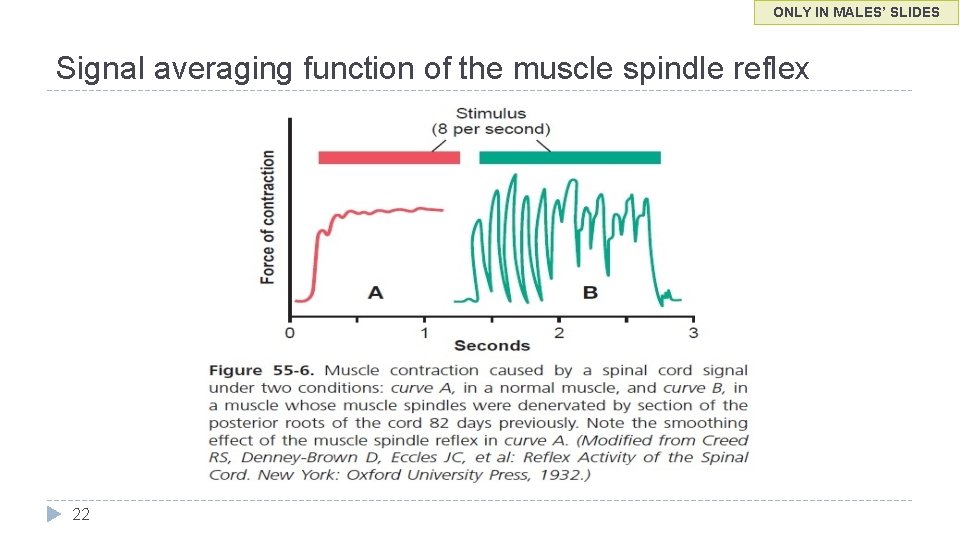
ONLY IN MALES’ SLIDES Signal averaging function of the muscle spindle reflex 22
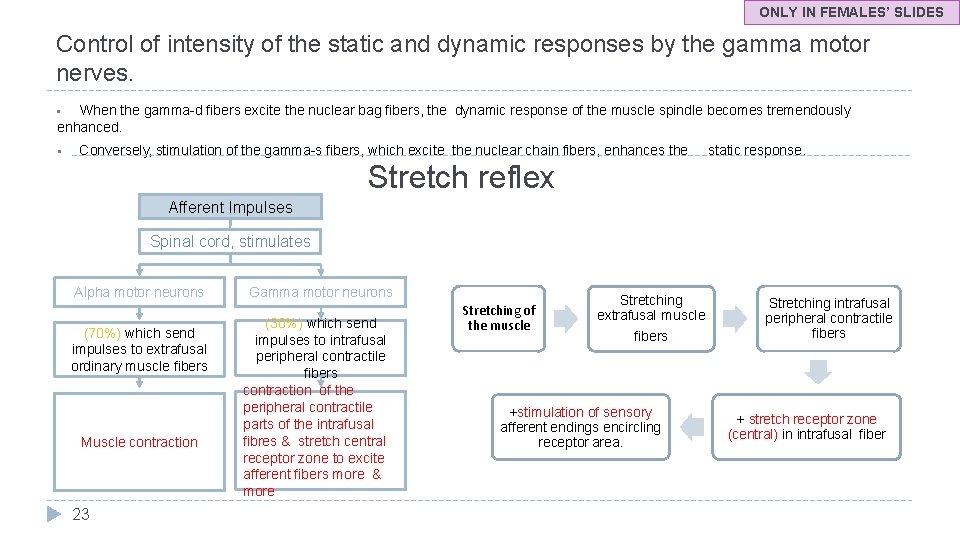
ONLY IN FEMALES’ SLIDES Control of intensity of the static and dynamic responses by the gamma motor nerves. When the gamma-d fibers excite the nuclear bag fibers, the dynamic response of the muscle spindle becomes tremendously enhanced. Conversely, stimulation of the gamma-s fibers, which excite the nuclear chain fibers, enhances the static response. Stretch reflex Afferent Impulses Spinal cord, stimulates Alpha motor neurons (70%) which send impulses to extrafusal ordinary muscle fibers Muscle contraction 23 Gamma motor neurons (30%) which send impulses to intrafusal peripheral contractile fibers contraction of the peripheral contractile parts of the intrafusal fibres & stretch central receptor zone to excite afferent fibers more & more Stretching of the muscle Stretching extrafusal muscle fibers +stimulation of sensory afferent endings encircling receptor area. Stretching intrafusal peripheral contractile fibers + stretch receptor zone (central) in intrafusal fiber
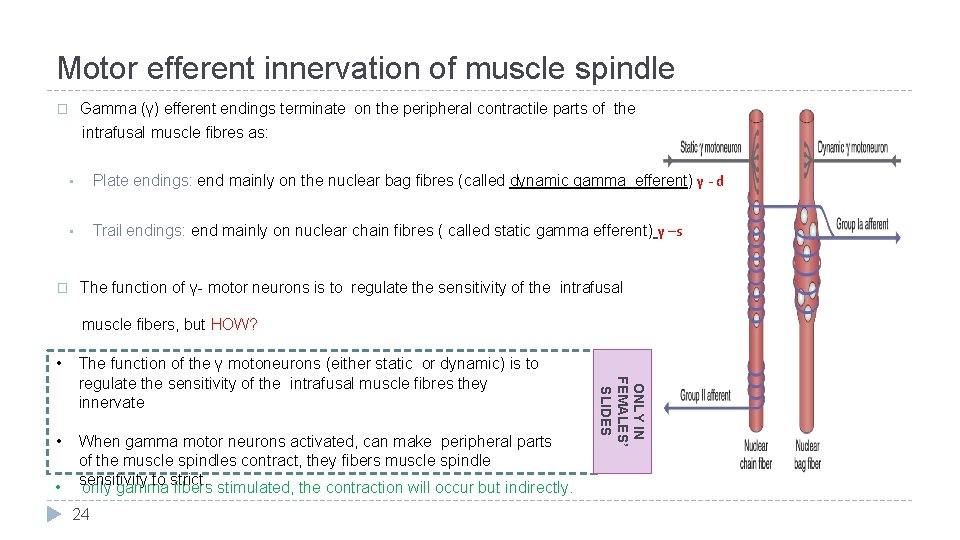
Motor efferent innervation of muscle spindle Gamma (γ) efferent endings terminate on the peripheral contractile parts of the intrafusal muscle fibres as: � � • Plate endings: end mainly on the nuclear bag fibres (called dynamic gamma efferent) γ - d • Trail endings: end mainly on nuclear chain fibres ( called static gamma efferent) γ –s The function of γ- motor neurons is to regulate the sensitivity of the intrafusal muscle fibers, but HOW? The function of the γ motoneurons (either static or dynamic) is to regulate the sensitivity of the intrafusal muscle fibres they innervate • When gamma motor neurons activated, can make peripheral parts of the muscle spindles contract, they fibers muscle spindle sensitivity to strict. only gamma fibers stimulated, the contraction will occur but indirectly. • 24 ONLY IN FEMALES’ SLIDES •
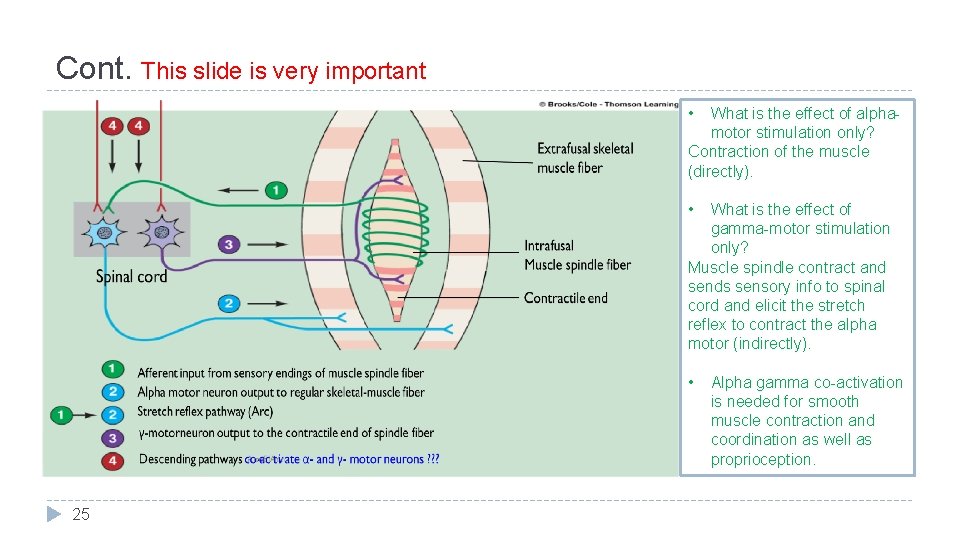
Cont. This slide is very important • What is the effect of alphamotor stimulation only? Contraction of the muscle (directly). • What is the effect of gamma-motor stimulation only? Muscle spindle contract and sends sensory info to spinal cord and elicit the stretch reflex to contract the alpha motor (indirectly). • 25 Alpha gamma co-activation is needed for smooth muscle contraction and coordination as well as proprioception.
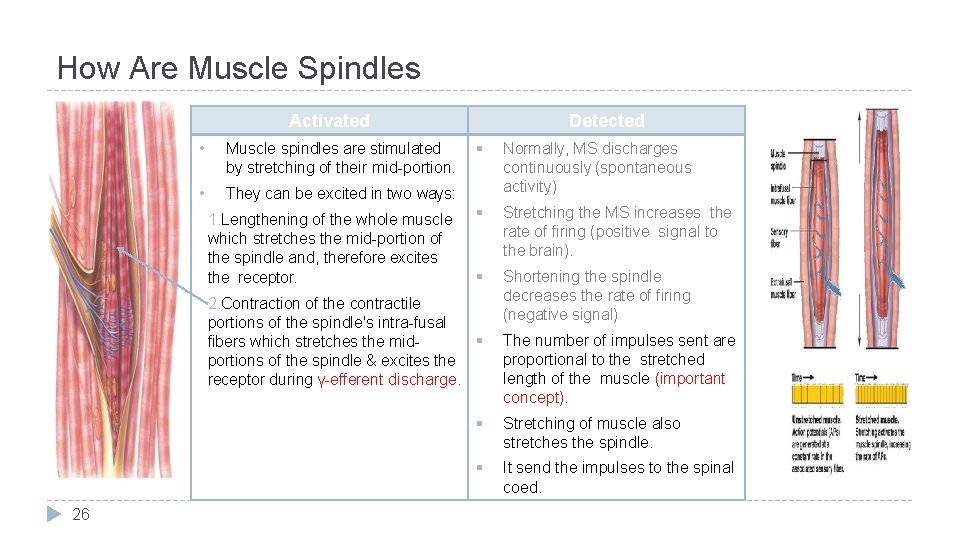
How Are Muscle Spindles Activated • Muscle spindles are stimulated by stretching of their mid-portion. • They can be excited in two ways: 1. Lengthening of the whole muscle which stretches the mid-portion of the spindle and, therefore excites the receptor. Detected Normally, MS discharges continuously (spontaneous activity) Stretching the MS increases the rate of firing (positive signal to the brain). Shortening the spindle decreases the rate of firing (negative signal) 2. Contraction of the contractile portions of the spindle's intra-fusal fibers which stretches the midportions of the spindle & excites the receptor during γ-efferent discharge. 26 The number of impulses sent are proportional to the stretched length of the muscle (important concept). Stretching of muscle also stretches the spindle. It send the impulses to the spinal coed.
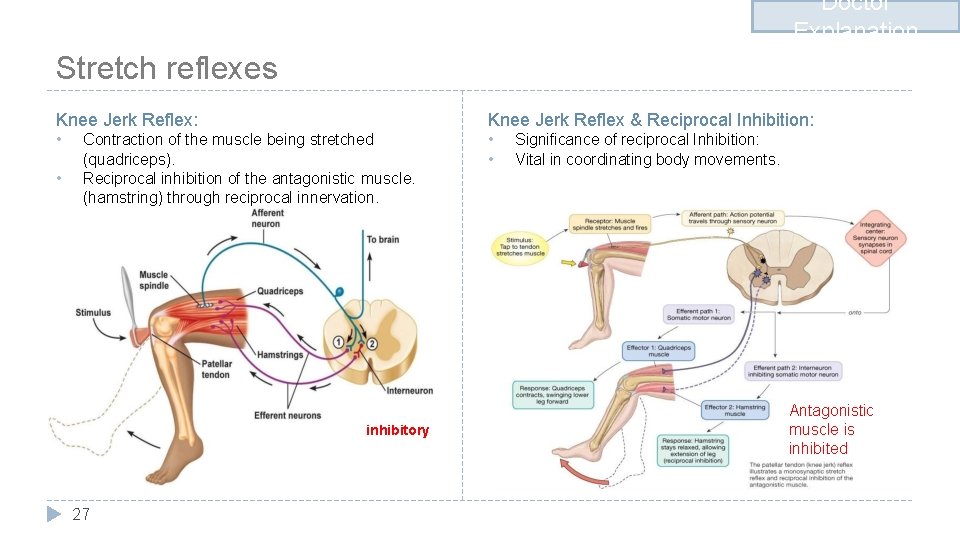
Doctor Explanation Stretch reflexes Knee Jerk Reflex: Knee Jerk Reflex & Reciprocal Inhibition: • • Contraction of the muscle being stretched (quadriceps). Reciprocal inhibition of the antagonistic muscle. (hamstring) through reciprocal innervation. inhibitory 27 Significance of reciprocal Inhibition: Vital in coordinating body movements. Antagonistic muscle is inhibited
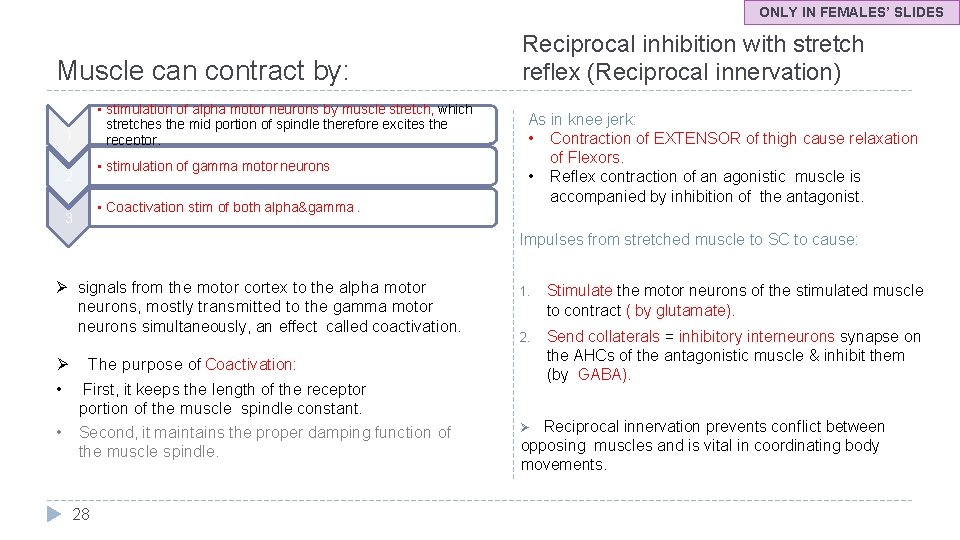
ONLY IN FEMALES’ SLIDES Muscle can contract by: 1 2 3 • stimulation of alpha motor neurons by muscle stretch, which stretches the mid portion of spindle therefore excites the receptor. • stimulation of gamma motor neurons • Coactivation stim of both alpha&gamma. Reciprocal inhibition with stretch reflex (Reciprocal innervation) As in knee jerk: • Contraction of EXTENSOR of thigh cause relaxation of Flexors. • Reflex contraction of an agonistic muscle is accompanied by inhibition of the antagonist. Impulses from stretched muscle to SC to cause: Ø signals from the motor cortex to the alpha motor neurons, mostly transmitted to the gamma motor neurons simultaneously, an effect called coactivation. Ø The purpose of Coactivation: • First, it keeps the length of the receptor portion of the muscle spindle constant. • Second, it maintains the proper damping function of the muscle spindle. 28 1. Stimulate the motor neurons of the stimulated muscle to contract ( by glutamate). 2. Send collaterals = inhibitory interneurons synapse on the AHCs of the antagonistic muscle & inhibit them (by GABA). Reciprocal innervation prevents conflict between opposing muscles and is vital in coordinating body movements. Ø
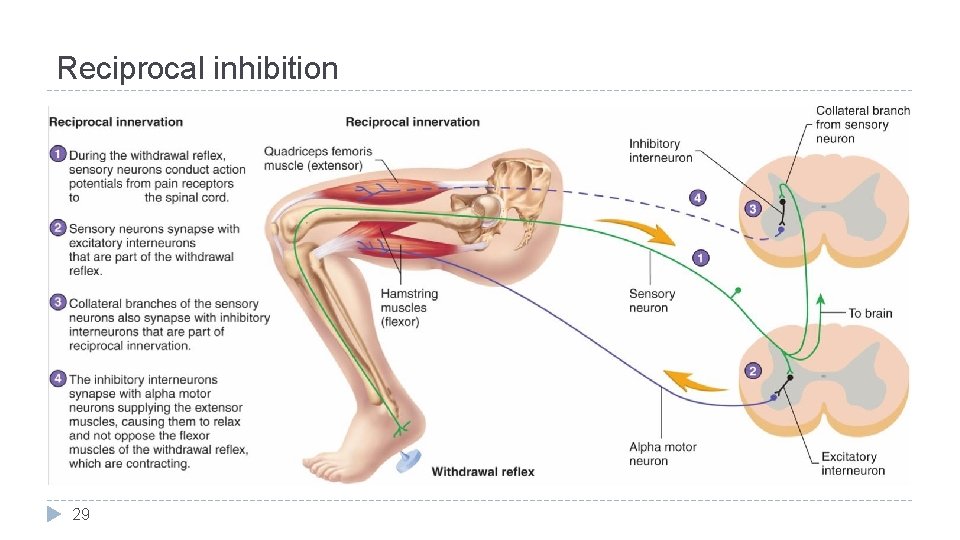
Reciprocal inhibition 29
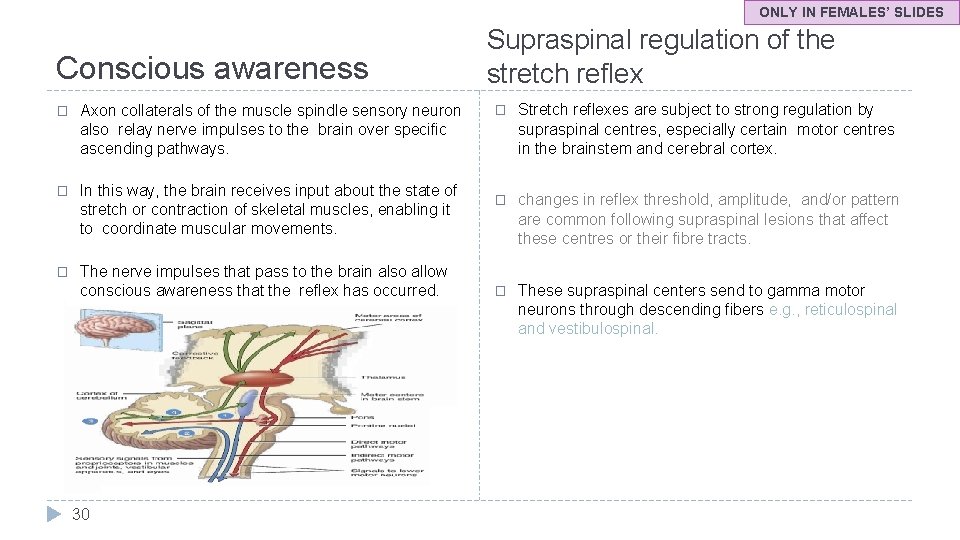
ONLY IN FEMALES’ SLIDES Conscious awareness � Axon collaterals of the muscle spindle sensory neuron also relay nerve impulses to the brain over specific ascending pathways. � In this way, the brain receives input about the state of stretch or contraction of skeletal muscles, enabling it to coordinate muscular movements. � The nerve impulses that pass to the brain also allow conscious awareness that the reflex has occurred. 30 Supraspinal regulation of the stretch reflex � Stretch reflexes are subject to strong regulation by supraspinal centres, especially certain motor centres in the brainstem and cerebral cortex. � changes in reflex threshold, amplitude, and/or pattern are common following supraspinal lesions that affect these centres or their fibre tracts. � These supraspinal centers send to gamma motor neurons through descending fibers e. g. , reticulospinal and vestibulospinal.
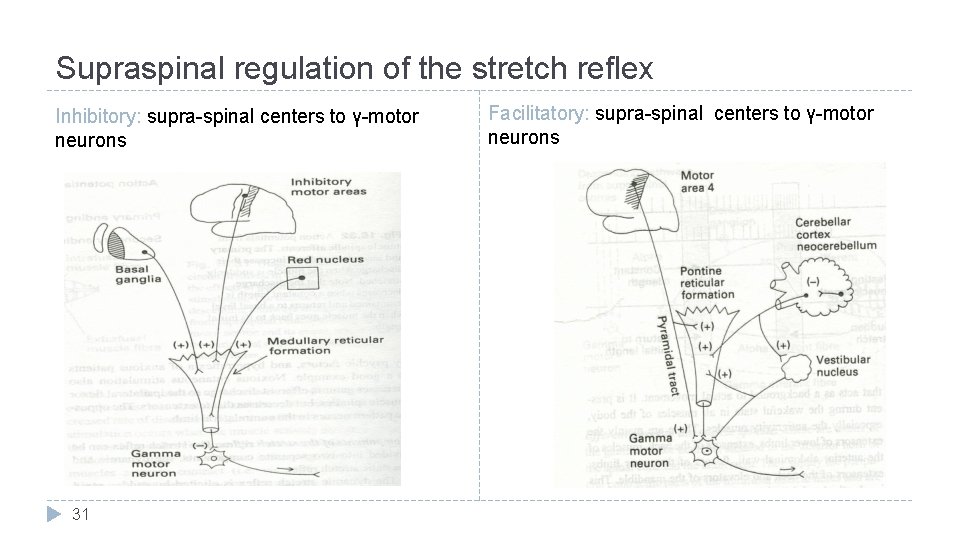
Supraspinal regulation of the stretch reflex Inhibitory: supra-spinal centers to γ-motor neurons 31 Facilitatory: supra-spinal centers to γ-motor neurons
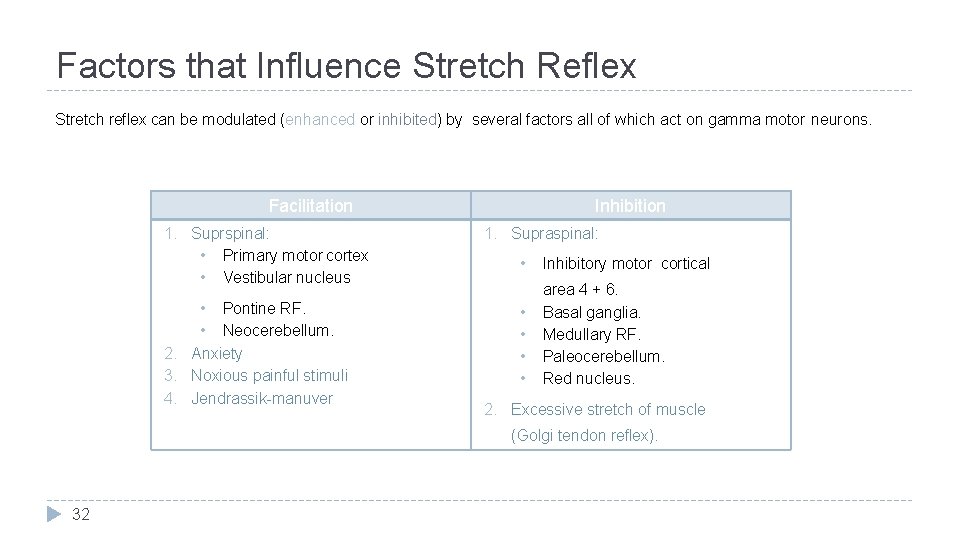
Factors that Influence Stretch Reflex Stretch reflex can be modulated (enhanced or inhibited) by several factors all of which act on gamma motor neurons. Facilitation 1. Suprspinal: • Primary motor cortex • Vestibular nucleus • Pontine RF. • Neocerebellum. 2. Anxiety 3. Noxious painful stimuli 4. Jendrassik-manuver Inhibition 1. Supraspinal: • Inhibitory motor cortical • • area 4 + 6. Basal ganglia. Medullary RF. Paleocerebellum. Red nucleus. 2. Excessive stretch of muscle (Golgi tendon reflex). 32
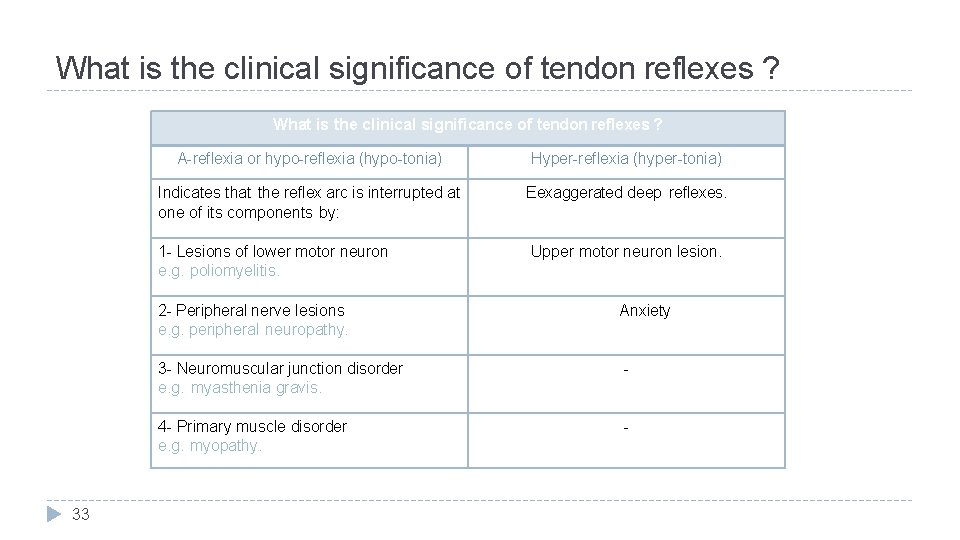
What is the clinical significance of tendon reflexes ? 33 A-reflexia or hypo-reflexia (hypo-tonia) Hyper-reflexia (hyper-tonia) Indicates that the reflex arc is interrupted at one of its components by: Eexaggerated deep reflexes. 1 - Lesions of lower motor neuron e. g. poliomyelitis. Upper motor neuron lesion. 2 - Peripheral nerve lesions e. g. peripheral neuropathy. Anxiety 3 - Neuromuscular junction disorder e. g. myasthenia gravis. - 4 - Primary muscle disorder e. g. myopathy. -
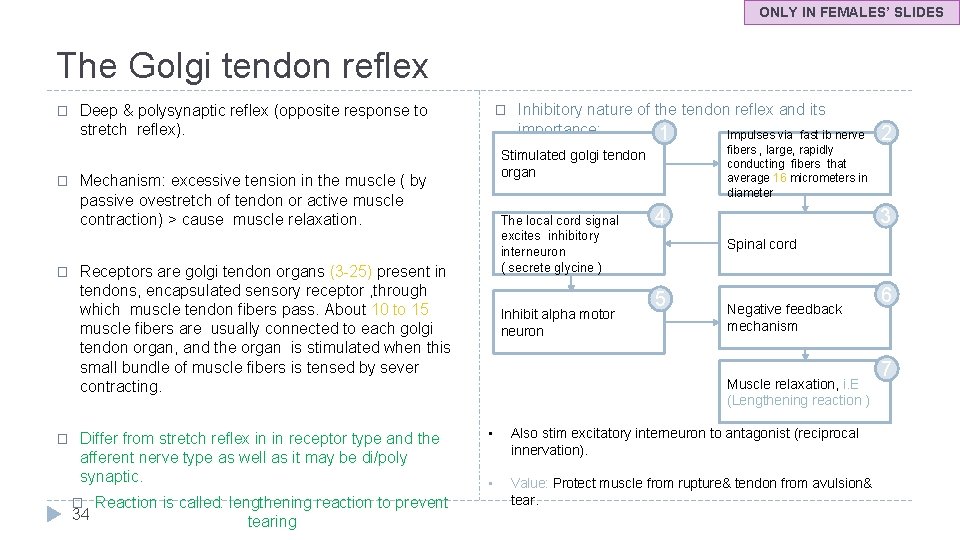
ONLY IN FEMALES’ SLIDES The Golgi tendon reflex � � Deep & polysynaptic reflex (opposite response to stretch reflex). � The local cord signal excites inhibitory interneuron ( secrete glycine ) Receptors are golgi tendon organs (3 -25) present in tendons, encapsulated sensory receptor , through which muscle tendon fibers pass. About 10 to 15 muscle fibers are usually connected to each golgi tendon organ, and the organ is stimulated when this small bundle of muscle fibers is tensed by sever contracting. Reaction is called: lengthening reaction to prevent 34 tearing � fibers , large, rapidly conducting fibers that average 16 micrometers in diameter Stimulated golgi tendon organ Mechanism: excessive tension in the muscle ( by passive ovestretch of tendon or active muscle contraction) > cause muscle relaxation. Differ from stretch reflex in in receptor type and the afferent nerve type as well as it may be di/poly synaptic. Inhibitory nature of the tendon reflex and its importance: Impulses via fast ib nerve 1 Inhibit alpha motor neuron 4 2 3 Spinal cord 5 Negative feedback mechanism Muscle relaxation, i. E (Lengthening reaction ) • Also stim excitatory interneuron to antagonist (reciprocal innervation). • Value: Protect muscle from rupture& tendon from avulsion& tear. 6 7
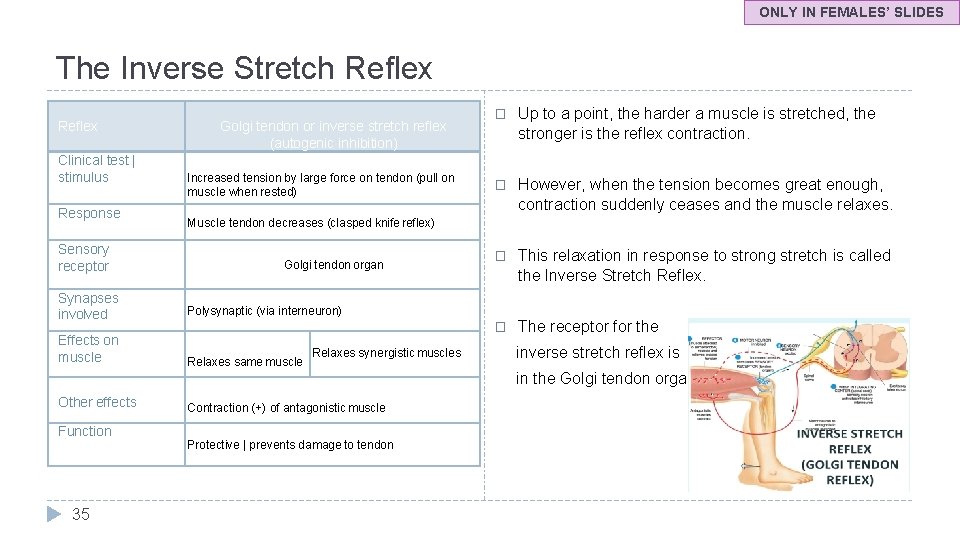
ONLY IN FEMALES’ SLIDES The Inverse Stretch Reflex Clinical test | stimulus Response Sensory receptor Golgi tendon or inverse stretch reflex (autogenic inhibition) Increased tension by large force on tendon (pull on muscle when rested) � Up to a point, the harder a muscle is stretched, the stronger is the reflex contraction. � However, when the tension becomes great enough, contraction suddenly ceases and the muscle relaxes. � This relaxation in response to strong stretch is called the Inverse Stretch Reflex. � The receptor for the Muscle tendon decreases (clasped knife reflex) Golgi tendon organ Synapses involved Polysynaptic (via interneuron) Effects on muscle Relaxes same muscle Relaxes synergistic muscles inverse stretch reflex is in the Golgi tendon organ. Other effects Function 35 Contraction (+) of antagonistic muscle Protective | prevents damage to tendon
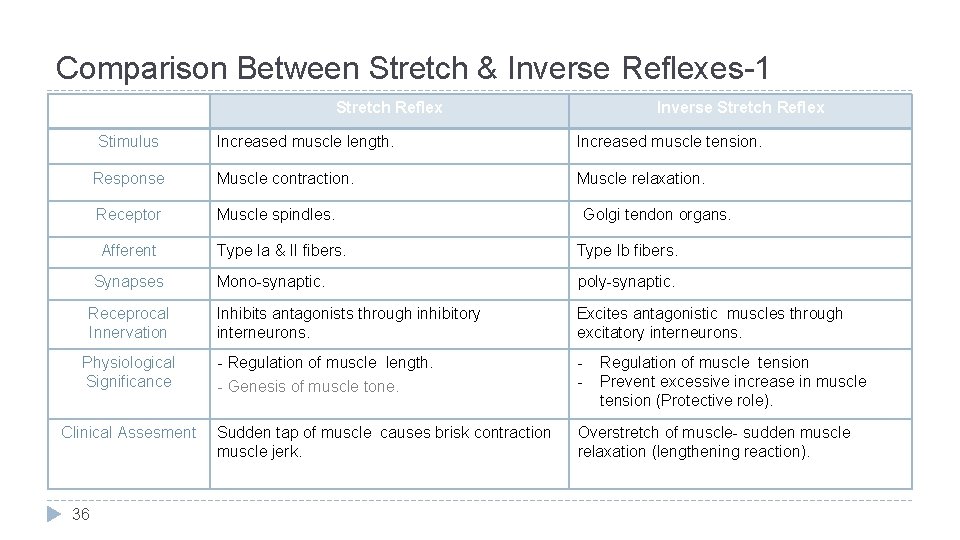
Comparison Between Stretch & Inverse Reflexes-1 Stretch Reflex Stimulus Increased muscle length. Increased muscle tension. Response Muscle contraction. Muscle relaxation. Receptor Muscle spindles. Afferent Type Ia & II fibers. Type Ib fibers. Mono-synaptic. poly-synaptic. Inhibits antagonists through inhibitory interneurons. Excites antagonistic muscles through excitatory interneurons. - Regulation of muscle length. - Genesis of muscle tone. - Sudden tap of muscle causes brisk contraction muscle jerk. Overstretch of muscle- sudden muscle relaxation (lengthening reaction). Synapses Receprocal Innervation Physiological Significance Clinical Assesment 36 Inverse Stretch Reflex Golgi tendon organs. Regulation of muscle tension Prevent excessive increase in muscle tension (Protective role).
Thank you!. ﺍﻋﻤﻞ ﻭ ﺃﻨﺖ ﺗﻌﻠﻢ ﺃﻦ ﺍﻟﻠﻪ ﻻ ﻳﻀﻴﻊ ﺃﺠﺮ ﻣﻦ ﺃﺤﺴﻦ ﻋﻤﻼ ، ﺍﻋﻤﻞ ﻟﺘﻤﺴﺢ ﺩﻣﻌﺔ ، ﺍﻋﻤﻞ ﻟﺘﺮﺳﻢ ﺑﺴﻤﺔ The Physiology 436 Team: Females Members: Ghada Alhadlaq Lama ALTamimi Deena Alnowaiser Durrah Alhamdi Amal Alqarni Males Members: Mohammad almutlaq References: • • Females and Males slides. Guyton and Hall Textbook of Medical Physiology (Thirteenth Edition. ) 37 Team Leaders: Lulwah Alshiha Laila Mathkour Mohammad Alayed Contact us:
- Slides: 37