
Text Important Formulas Numbers Doctor notes Notes and
§ § § Text Important Formulas Numbers Doctor notes Notes and explanation 1 Lecture No. 20 “Worrying Doesn’t Change Anything, But Trusting In God Changes Everything”
AUTOREGULATION OF CEREBRAL BLOOD FLOW Objectives: 1. Describe cerebral circulation & circle of Willis. 2. Explain main arteries that supply blood to brain. 3. Normal Rate of Cerebral Blood Flow. 4. Explain auto-regulation of cerebral blood flow. 5. Explain the factors effecting the cerebral blood flow. 6. Effects of impaired cerebral blood circulation. 2
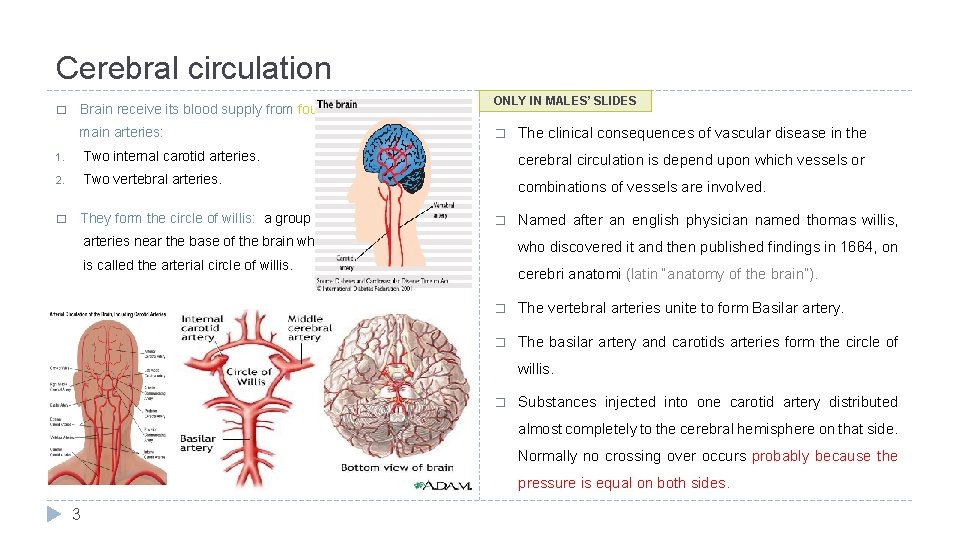
Cerebral circulation � Brain receive its blood supply from four main arteries: ONLY IN MALES’ SLIDES � The clinical consequences of vascular disease in the 1. Two internal carotid arteries. cerebral circulation is depend upon which vessels or 2. Two vertebral arteries. combinations of vessels are involved. � They form the circle of willis: a group of � arteries near the base of the brain which Named after an english physician named thomas willis, who discovered it and then published findings in 1664, on is called the arterial circle of willis. cerebri anatomi (latin “anatomy of the brain”). � The vertebral arteries unite to form Basilar artery. � The basilar artery and carotids arteries form the circle of willis. � Substances injected into one carotid artery distributed almost completely to the cerebral hemisphere on that side. Normally no crossing over occurs probably because the pressure is equal on both sides. 3
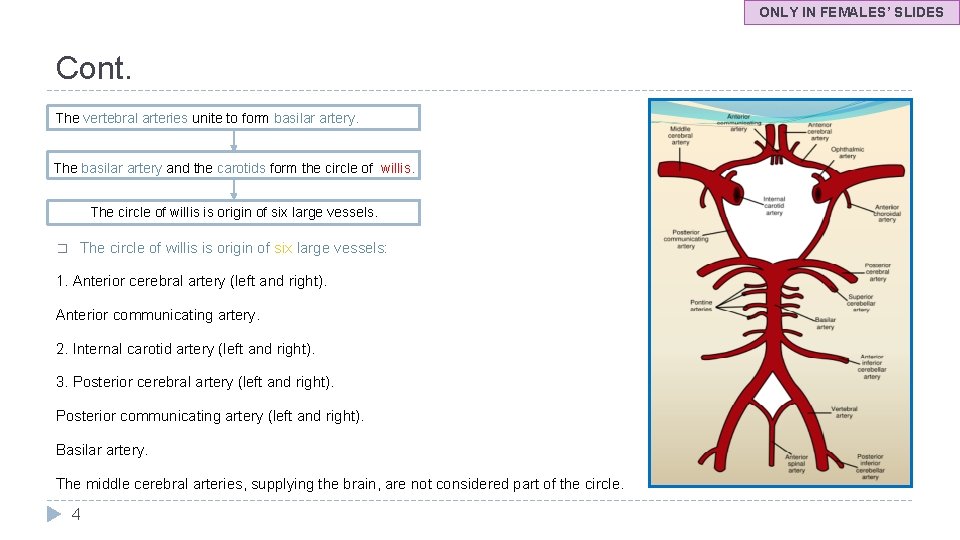
ONLY IN FEMALES’ SLIDES Cont. The vertebral arteries unite to form basilar artery. The basilar artery and the carotids form the circle of willis. The circle of willis is origin of six large vessels. � The circle of willis is origin of six large vessels: 1. Anterior cerebral artery (left and right). Anterior communicating artery. 2. Internal carotid artery (left and right). 3. Posterior cerebral artery (left and right). Posterior communicating artery (left and right). Basilar artery. The middle cerebral arteries, supplying the brain, are not considered part of the circle. 4
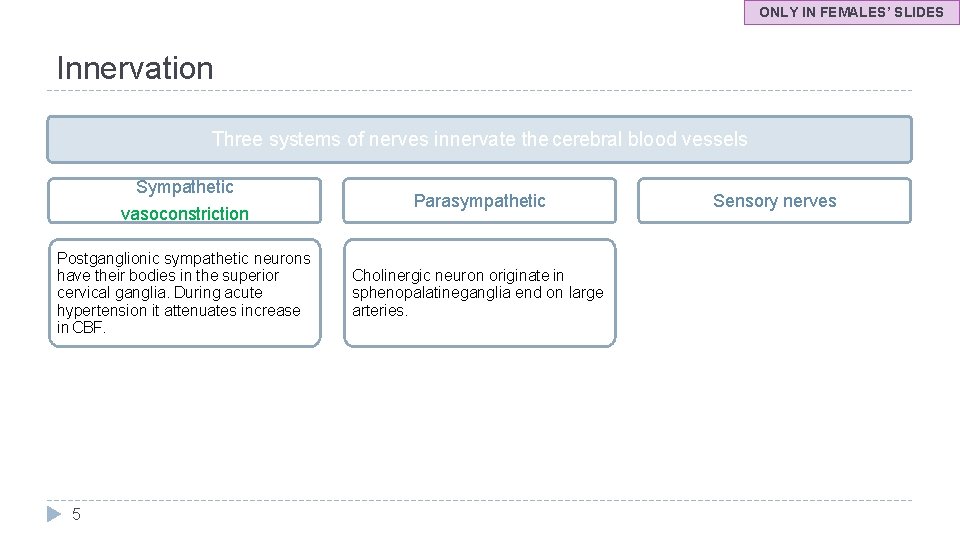
ONLY IN FEMALES’ SLIDES Innervation Three systems of nerves innervate the cerebral blood vessels Sympathetic vasoconstriction Postganglionic sympathetic neurons have their bodies in the superior cervical ganglia. During acute hypertension it attenuates increase in CBF. 5 Parasympathetic Cholinergic neuron originate in sphenopalatineganglia end on large arteries. Sensory nerves
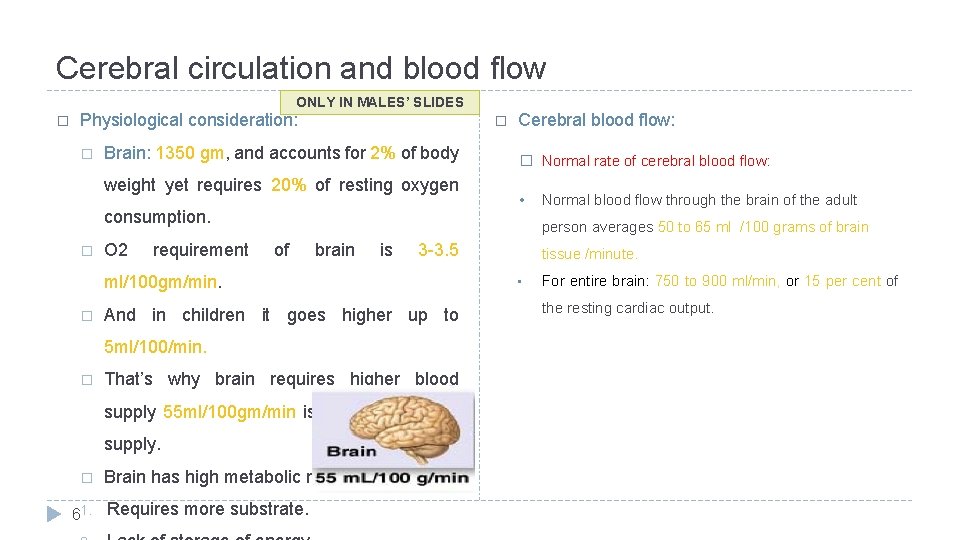
Cerebral circulation and blood flow ONLY IN MALES’ SLIDES � Physiological consideration: � � Brain: 1350 gm, and accounts for 2% of body weight yet requires 20% of resting oxygen consumption. � O 2 requirement of brain is And in children it goes higher up to That’s why brain requires higher blood supply 55 ml/100 gm/min is the rate of blood supply. � • 3 -3. 5 5 ml/100/min. � � Normal rate of cerebral blood flow: Normal blood flow through the brain of the adult person averages 50 to 65 ml /100 grams of brain ml/100 gm/min. � Cerebral blood flow: Brain has high metabolic rate: 61. Requires more substrate. tissue /minute. • For entire brain: 750 to 900 ml/min, or 15 per cent of the resting cardiac output.
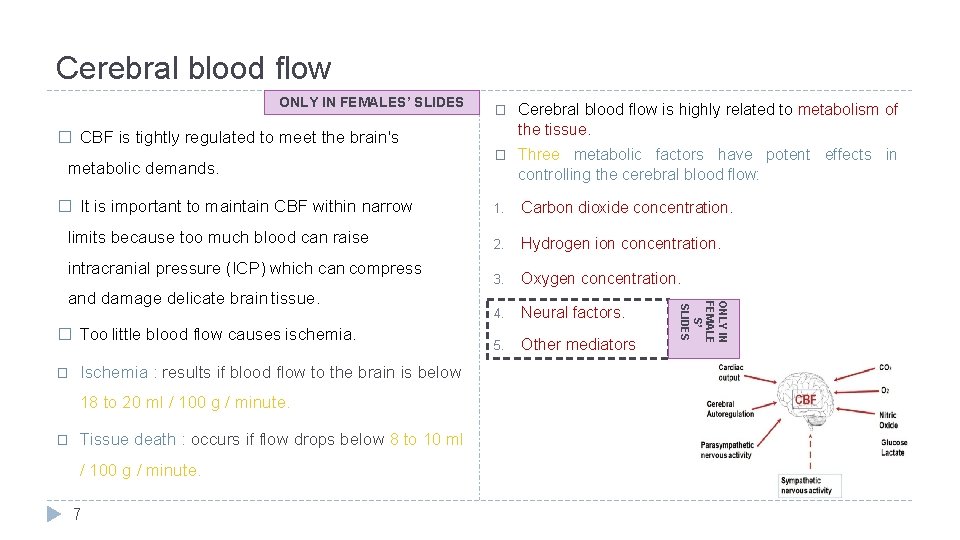
Cerebral blood flow ONLY IN FEMALES’ SLIDES Cerebral blood flow is highly related to metabolism of the tissue. � Three metabolic factors have potent effects in controlling the cerebral blood flow: 1. Carbon dioxide concentration. 2. Hydrogen ion concentration. 3. Oxygen concentration. 4. Neural factors. 5. Other mediators � CBF is tightly regulated to meet the brain's metabolic demands. � It is important to maintain CBF within narrow limits because too much blood can raise intracranial pressure (ICP) which can compress and damage delicate brain tissue. � Too little blood flow causes ischemia. � Ischemia : results if blood flow to the brain is below 18 to 20 ml / 100 g / minute. � Tissue death : occurs if flow drops below 8 to 10 ml / 100 g / minute. 7 ONLY IN FEMALE S’ SLIDES �

cerebral perfusion pressure(CPP) ONLY IN FEMALES’ SLIDES ONLY IN MALES’ SLIDES � Cerebral perfusion pressure (CPP): � The net pressure of blood flow to the brain. � CPP can be defined as: CPP = MAP − ICP. MAP ICP CPP � CPP is regulated by two balanced, opposing. forces Mean arterial pressure(MAP) is the force that pushes blood into the brain. ICP force that pushes out. CPP is normally between 70 - 90 mm. Hg in an adult 8 human Pressure > 20 mm. Hg is abnormal
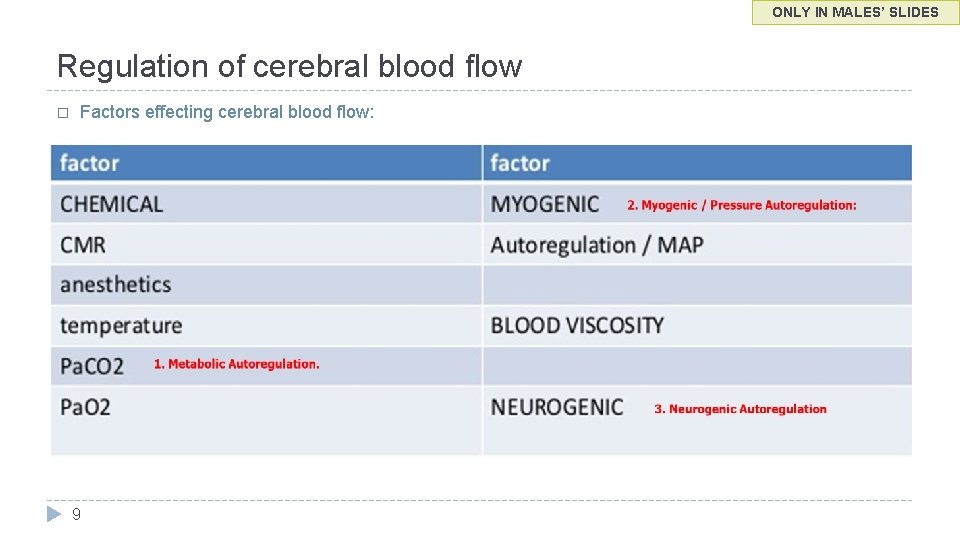
ONLY IN MALES’ SLIDES Regulation of cerebral blood flow � Factors effecting cerebral blood flow: 9
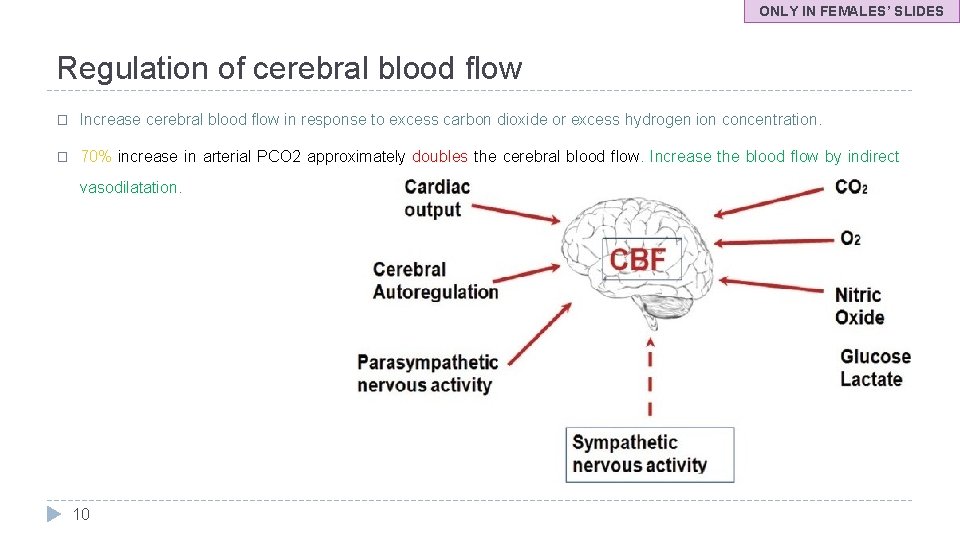
ONLY IN FEMALES’ SLIDES Regulation of cerebral blood flow � Increase cerebral blood flow in response to excess carbon dioxide or excess hydrogen ion concentration. � 70% increase in arterial PCO 2 approximately doubles the cerebral blood flow. Increase the blood flow by indirect vasodilatation. 10
ONLY IN FEMALES’ SLIDES Cont. Hypoxia & hypercapnia: � � � Excess carbon dioxide can dilate blood vessels up to 3. 5 � Neural stimuli: � Under normal conditions sympathetic has little times their normal size. effect, because the blood flow, auto-regulation Blood vessels also dilate in response to low ph. mechanism can override the nervous effects. � When activity in a given region of the brain is heightened, the increase in CO 2 and H+ concentrations � causes increase in CBF. cerebral vasodilatation, and deliver more blood to the area to meet the increased demand. � Hypoxia, or inadequate oxygen, also dilates blood vessels and increases blood flow. During acute hypertension, sympathetic attenuates � The sympathetic nervous system normally constricts the large- and intermediate-sized brain arteries enough to prevent the high pressure from reaching the smaller brain blood vessels. This is � While high levels of oxygen constrict cerebral blood vessels. � Nitric oxide & adenosine are autoregulation mediators. important in preventing vascular hemorrhages into the brain for preventing the occurrence of “cerebral stroke. ” 11
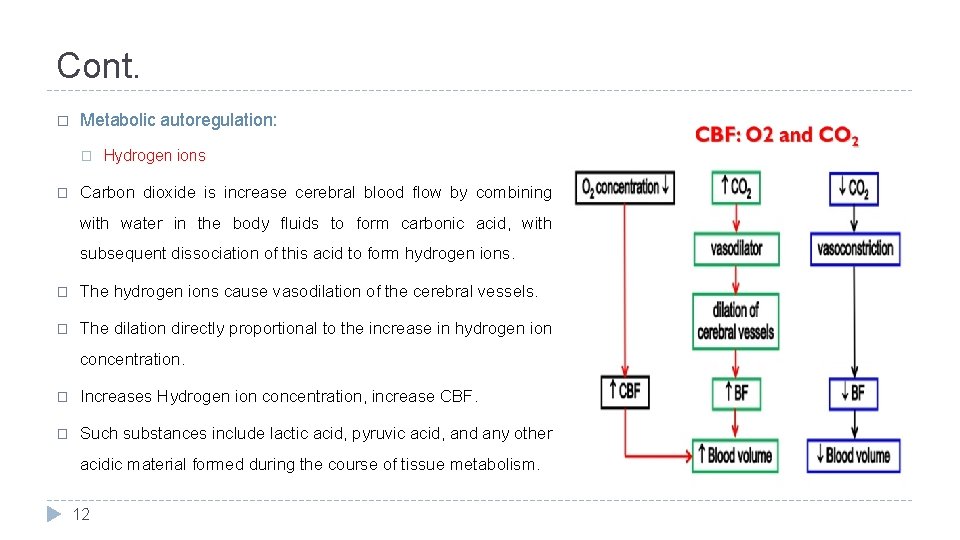
Cont. � Metabolic autoregulation: � � Hydrogen ions Carbon dioxide is increase cerebral blood flow by combining with water in the body fluids to form carbonic acid, with subsequent dissociation of this acid to form hydrogen ions. � The hydrogen ions cause vasodilation of the cerebral vessels. � The dilation directly proportional to the increase in hydrogen ion concentration. � Increases Hydrogen ion concentration, increase CBF. � Such substances include lactic acid, pyruvic acid, and any other acidic material formed during the course of tissue metabolism. 12
Cont. � Increased hydrogen ion depresses neuronal activity. � It is fortunate that an increase in hydrogen ion concentration also causes an increase in blood flow, which in turn carries hydrogen ions, carbon dioxide, and other acid forming substances away from the brain tissues. � concentration greatly Increasing H ion concertation can lead to coma. � Oxygen Deficiency as a Regulator of Cerebral Blood Flow. � The rate of utilization of oxygen by the brain tissue remains within narrow limits - almost exactly 3. 5 (± 0. 2) ml of oxygen per 100 grams of brain tissue per minute. � If blood flow to the brain insufficient to supply this needed amount of oxygen, the oxygen deficiency � � Loss of carbon dioxide removes carbonic acid from the tissues; this, along with removal of other acids, reduces the hydrogen ion concentration back toward normal. Thus, this mechanism helps maintain a constant hydrogen ion concentration in the cerebral fluids and thereby helps to maintain a normal, constant level of neuronal activity. 13 mechanism causing vasodilation, returning the brain blood flow and transport of oxygen to the cerebral tissues to normal.
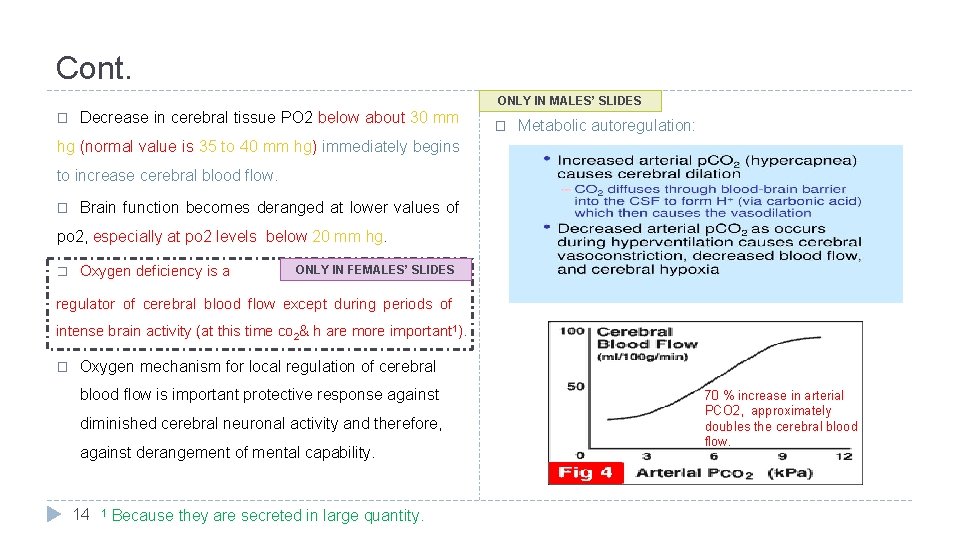
Cont. ONLY IN MALES’ SLIDES � Decrease in cerebral tissue PO 2 below about 30 mm � Metabolic autoregulation: hg (normal value is 35 to 40 mm hg) immediately begins to increase cerebral blood flow. � Brain function becomes deranged at lower values of po 2, especially at po 2 levels below 20 mm hg. � Oxygen deficiency is a ONLY IN FEMALES’ SLIDES regulator of cerebral blood flow except during periods of intense brain activity (at this time co 2& h are more important 1). � Oxygen mechanism for local regulation of cerebral blood flow is important protective response against diminished cerebral neuronal activity and therefore, against derangement of mental capability. 14 1 Because they are secreted in large quantity. 70 % increase in arterial PCO 2, approximately doubles the cerebral blood flow.

ONLY IN MALES’ SLIDES Cont. � Myogenic / Pressure Autoregulation: � Arterioles dilate or constrict in response to changes � Metabolic Autoregulation: � Arterioles dilate in response to potent chemicals that are by-products of metabolism such as lactic acid, carbon dioxide and pyruvic acid. � Myogenic theory: The vascular smooth muscles are � CO 2 is a potent vasodilator. highly responsive to changes in pressure, a process � Increased CO 2 or decreased BP > vasodilation. � Decreased CO 2 or increased BP > vasoconstriction. � Increase Carbon dioxide cerebral vasodilation. � As the arterial tension of CO 2 rises, CBV and CBF increases � When it is decreased vasoconstriction is induced. in BP and ICP in order to maintain a constant CBF. called myogenic activity, that contributes to autoregulation of cerebral blood flow. � Vascular smooth muscle within cerebral arterioles contract to stretch response, regulating pressure changes. Autoregulation of CBF completely BP- (Hypercapnia) causes dependent. 15
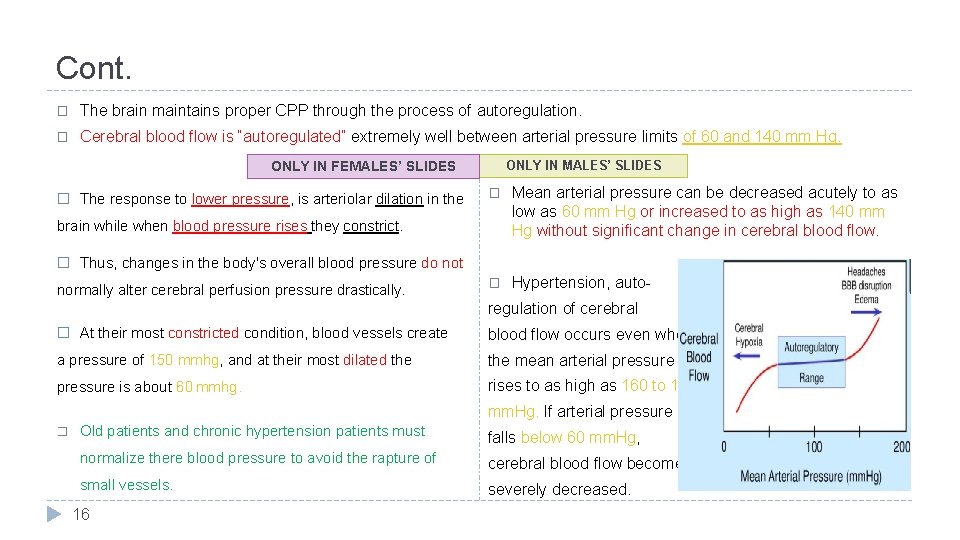
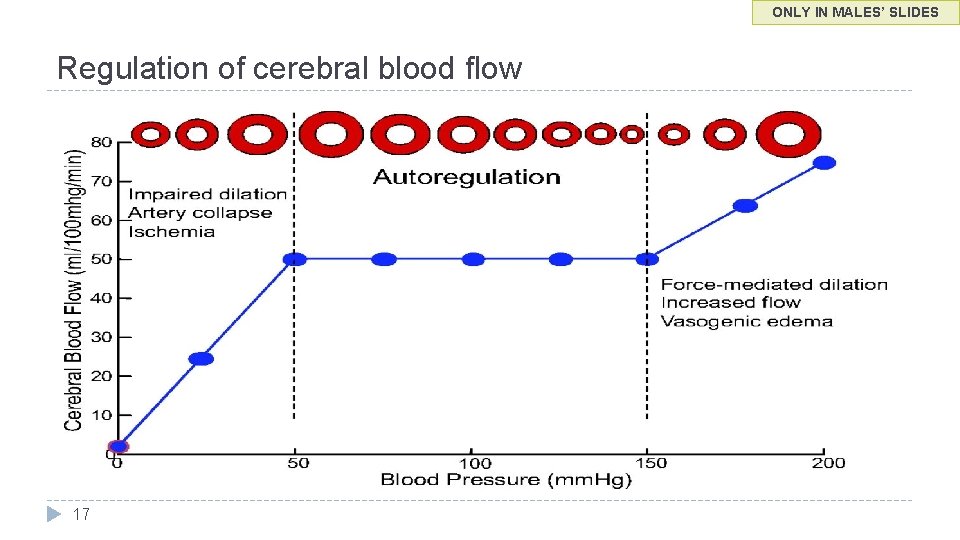
Cont. � The brain maintains proper CPP through the process of autoregulation. � Cerebral blood flow is “autoregulated” extremely well between arterial pressure limits of 60 and 140 mm Hg. ONLY IN MALES’ SLIDES ONLY IN FEMALES’ SLIDES � The response to lower pressure, is arteriolar dilation in the � Mean arterial pressure can be decreased acutely to as low as 60 mm Hg or increased to as high as 140 mm Hg without significant change in cerebral blood flow. � Hypertension, auto- brain while when blood pressure rises they constrict. � Thus, changes in the body's overall blood pressure do not normally alter cerebral perfusion pressure drastically. regulation of cerebral � At their most constricted condition, blood vessels create blood flow occurs even when a pressure of 150 mmhg, and at their most dilated the mean arterial pressure is about 60 mmhg. rises to as high as 160 to 180 mm. Hg. If arterial pressure � Old patients and chronic hypertension patients must falls below 60 mm. Hg, normalize there blood pressure to avoid the rapture of cerebral blood flow become small vessels. severely decreased. 16
ONLY IN MALES’ SLIDES Regulation of cerebral blood flow 17
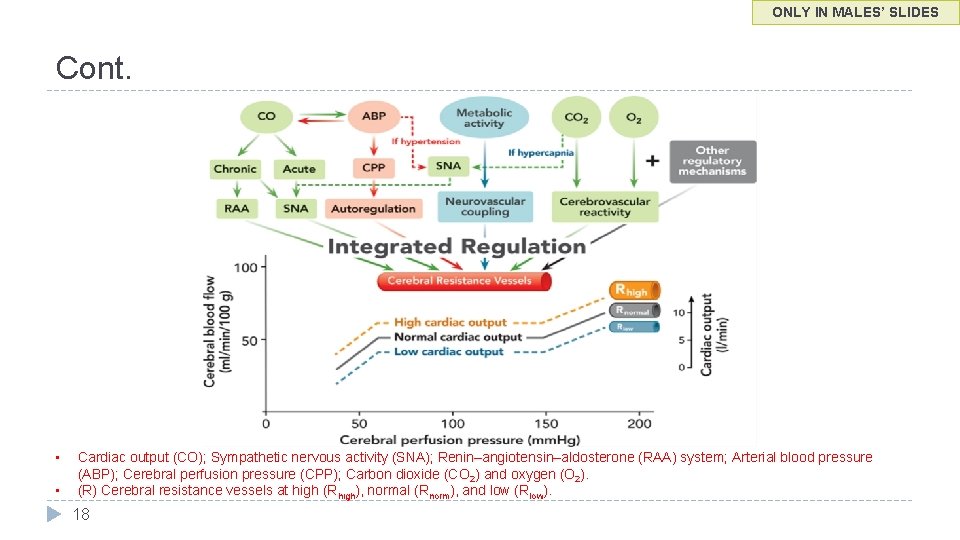
ONLY IN MALES’ SLIDES Cont. • • Cardiac output (CO); Sympathetic nervous activity (SNA); Renin–angiotensin–aldosterone (RAA) system; Arterial blood pressure (ABP); Cerebral perfusion pressure (CPP); Carbon dioxide (CO 2) and oxygen (O 2). (R) Cerebral resistance vessels at high (Rhigh), normal (Rnorm), and low (Rlow). 18
ONLY IN FEMALES’ SLIDES Cont. Autoregulation � When pressures are outside the range of 60 to 150 mm. Hg, the blood vessels' ability to autoregulate pressure through dilation and constriction is lost, and cerebral perfusion is determined by blood pressure alone without autoregulation. � Thus, hypotension can result in severe cerebral ischemia. � Effect of ICP changes on systemic blood pressure: � Cushing reflex: ‘Normally, the ICP [Intracranial Pressure] ranges from 1 to 15 mm Hg (but other sources give ranges like 8 to 18 mm Hg). � If ICP > 33 mm. Hg over a short periodof time, CBF will drop markedly, leading to hypoxia and hypercapnia of vasomotor area causing blood pressure rises. 19
Role of the sympathetic nervous system in controlling cerebral blood flow � ONLY IN MALES’ SLIDES Neurogenic Autoregulation: � The cerebral circulatory system has strong sympathetic innervation that passes upward from the Superior cervical sympathetic ganglia in the neck and then into the brain along with the cerebral arteries. � ANS and Neurochemical control has minor role. � Pressure and Metabolic Autoregulation is most important. 20
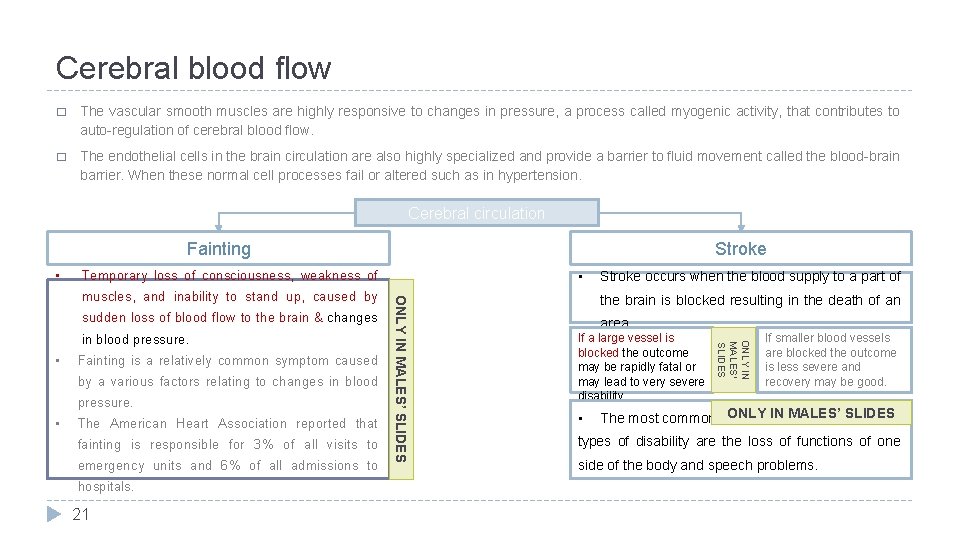
Cerebral blood flow � The vascular smooth muscles are highly responsive to changes in pressure, a process called myogenic activity, that contributes to auto-regulation of cerebral blood flow. � The endothelial cells in the brain circulation are also highly specialized and provide a barrier to fluid movement called the blood-brain barrier. When these normal cell processes fail or altered such as in hypertension. Cerebral circulation Fainting • Temporary loss of consciousness, weakness of sudden loss of blood flow to the brain & changes Fainting is a relatively common symptom caused by a various factors relating to changes in blood pressure. • The American Heart Association reported that fainting is responsible for 3% of all visits to emergency units and 6% of all admissions to hospitals. 21 Stroke occurs when the blood supply to a part of the brain is blocked resulting in the death of an area. If a large vessel is blocked the outcome may be rapidly fatal or may lead to very severe disability. • ONLY IN MALES’ SLIDES in blood pressure. • ONLY IN MALES’ SLIDES muscles, and inability to stand up, caused by • Stroke If smaller blood vessels are blocked the outcome is less severe and recovery may be good. The most common ONLY IN MALES’ SLIDES types of disability are the loss of functions of one side of the body and speech problems.
ONLY IN FEMALES’ SLIDES Stroke If the middle cerebral artery is blocked on the left side of the brain, the person is likely to become: � 1. Almost totally demented because of lost function in wernicke’s speech comprehension area in the left cerebral hemisphere. 2. Unable to speak words because of loss of broca’s motor area for word formation. 3. In addition, loss of function of neural motor control areas of the left hemisphere can create spastic paralysis of most muscles on the opposite side of the body. 4. Blockage of a posterior cerebral artery will cause infarction of the occipital pole on the same side, which causes loss of vision as (hemianopsia). strokes that involve the blood supply to the midbrain can block nerve conduction in major pathways � between the brain and spinal cord, causing both sensory and motor abnormalities. 22
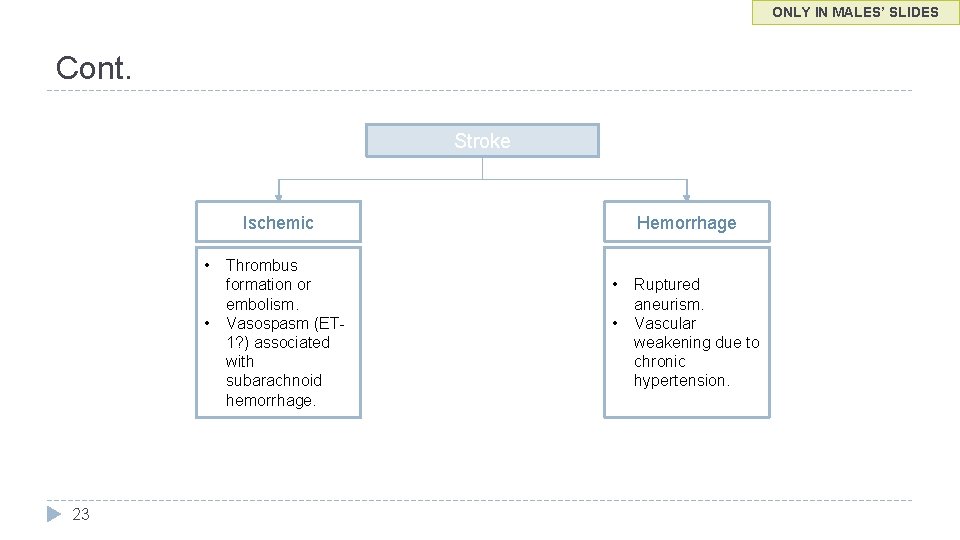
ONLY IN MALES’ SLIDES Cont. Stroke Ischemic • • 23 Thrombus formation or embolism. Vasospasm (ET 1? ) associated with subarachnoid hemorrhage. Hemorrhage • • Ruptured aneurism. Vascular weakening due to chronic hypertension.
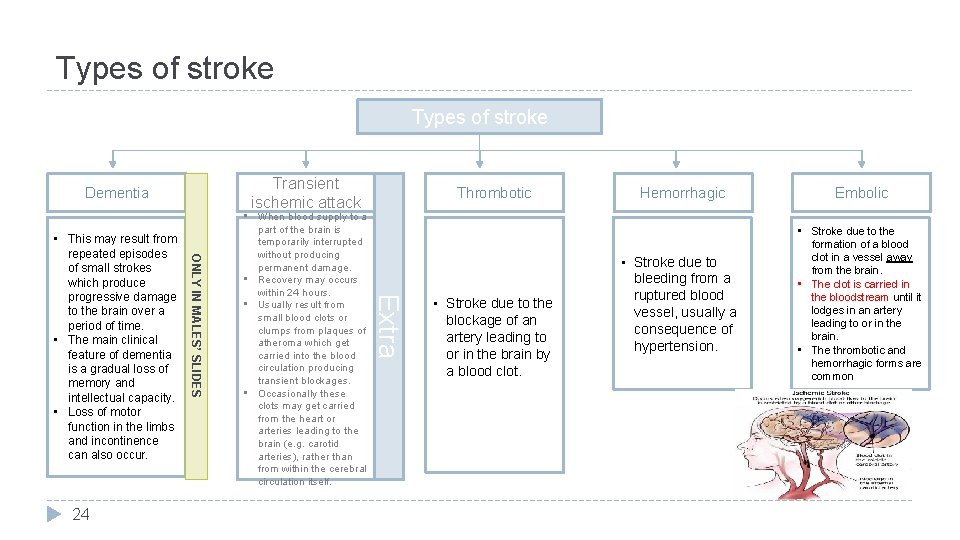
Types of stroke Transient ischemic attack Dementia Extra 24 ONLY IN MALES’ SLIDES • This may result from repeated episodes of small strokes which produce progressive damage to the brain over a period of time. • The main clinical feature of dementia is a gradual loss of memory and intellectual capacity. • Loss of motor function in the limbs and incontinence can also occur. • When blood supply to a part of the brain is temporarily interrupted without producing permanent damage. • Recovery may occurs within 24 hours. • Usually result from small blood clots or clumps from plaques of atheroma which get carried into the blood circulation producing transient blockages. • Occasionally these clots may get carried from the heart or arteries leading to the brain (e. g. carotid arteries), rather than from within the cerebral circulation itself. Thrombotic • Stroke due to the blockage of an artery leading to or in the brain by a blood clot. Hemorrhagic • Stroke due to bleeding from a ruptured blood vessel, usually a consequence of hypertension. Embolic • Stroke due to the formation of a blood clot in a vessel away from the brain. • The clot is carried in the bloodstream until it lodges in an artery leading to or in the brain. • The thrombotic and hemorrhagic forms are common
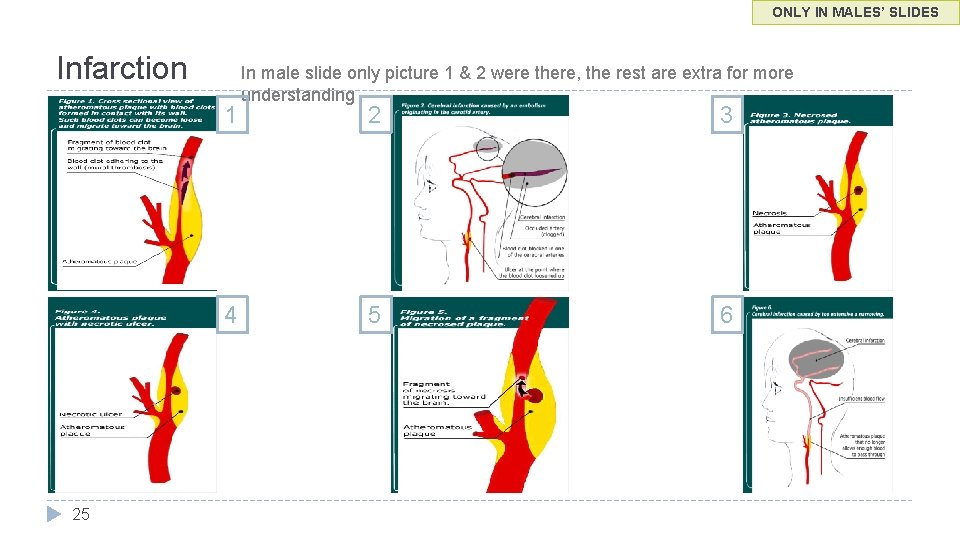
ONLY IN MALES’ SLIDES Infarction 1 4 25 In male slide only picture 1 & 2 were there, the rest are extra for more understanding 2 3 5 6
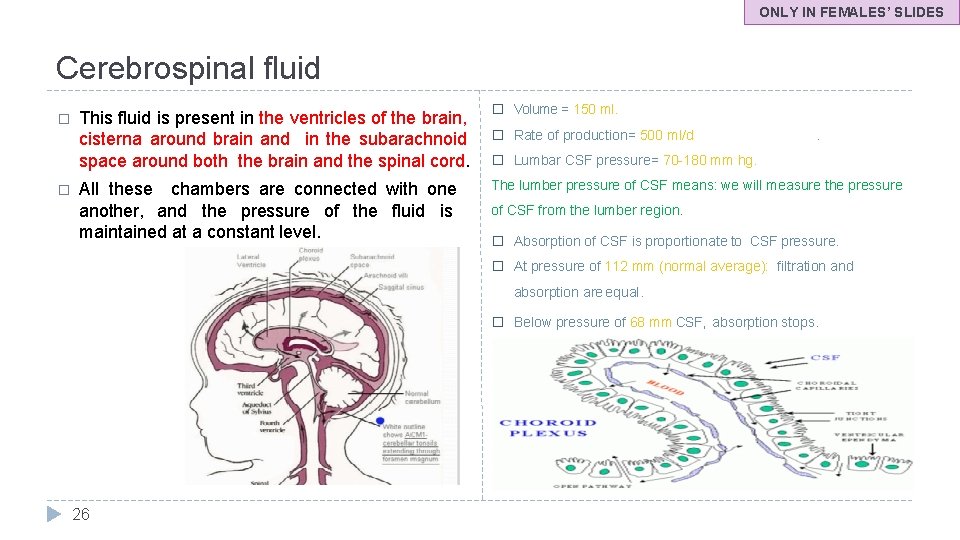
ONLY IN FEMALES’ SLIDES Cerebrospinal fluid � � This fluid is present in the ventricles of the brain, cisterna around brain and in the subarachnoid space around both the brain and the spinal cord. � Volume = 150 ml. All these chambers are connected with one another, and the pressure of the fluid is maintained at a constant level. The lumber pressure of CSF means: we will measure the pressure � Rate of production= 500 ml/d . � Lumbar CSF pressure= 70 -180 mm hg. of CSF from the lumber region. � Absorption of CSF is proportionate to CSF pressure. � At pressure of 112 mm (normal average): filtration and absorption are equal. � Below pressure of 68 mm CSF, absorption stops. 26
Extra Cerebral microcirculation � The metabolic rate of the brain gray matter where the neuronal cell bodies lie is about four times as great as that of white matter; so, the number of capillaries and rate of blood flow are also about four times as great in the gray matter. � An important structural characteristic of the brain capillaries is that: 1. 2. mostly are much less “leaky” than the blood capillaries, because they are supported on all sides by “glial feet” which are small projections from glial cells, provide physical support to prevent overstretching of the capillaries in case of high capillary blood pressure. The walls of the small arterioles leading to the brain capillaries greatly thickened in people who develop high blood pressure, and these arterioles remain significantly constricted all the time to prevent transmission of the high pressure to the capillaries. 27
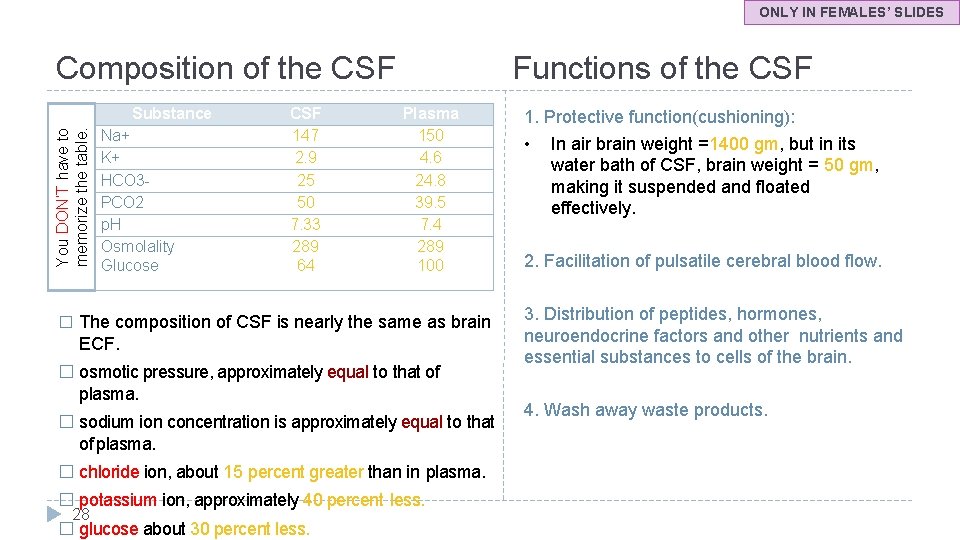
ONLY IN FEMALES’ SLIDES Functions of the CSF Composition of the CSF You DON’T have to memorize the table. Substance Na+ K+ HCO 3 PCO 2 p. H Osmolality Glucose CSF 147 2. 9 25 50 7. 33 289 64 Plasma 150 4. 6 24. 8 39. 5 7. 4 289 100 � The composition of CSF is nearly the same as brain ECF. � osmotic pressure, approximately equal to that of plasma. � sodium ion concentration is approximately equal to that of plasma. � chloride ion, about 15 percent greater than in plasma. � potassium ion, approximately 40 percent less. 28 � glucose about 30 percent less. 1. Protective function(cushioning): • In air brain weight =1400 gm, but in its water bath of CSF, brain weight = 50 gm, making it suspended and floated effectively. 2. Facilitation of pulsatile cerebral blood flow. 3. Distribution of peptides, hormones, neuroendocrine factors and other nutrients and essential substances to cells of the brain. 4. Wash away waste products.
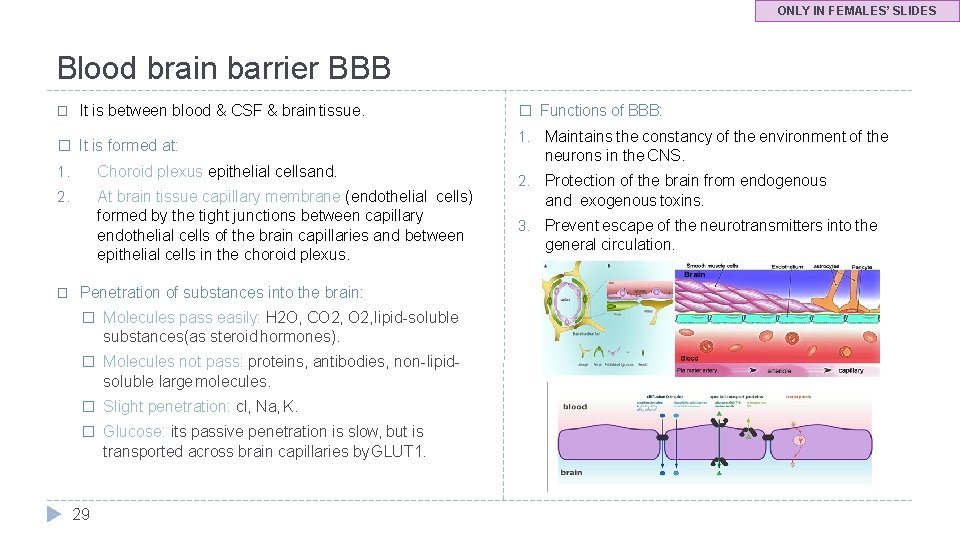
ONLY IN FEMALES’ SLIDES Blood brain barrier BBB � It is between blood & CSF & brain tissue. � It is formed at: 1. Choroid plexus epithelial cellsand. 2. At brain tissue capillary membrane (endothelial cells) formed by the tight junctions between capillary endothelial cells of the brain capillaries and between epithelial cells in the choroid plexus. � Penetration of substances into the brain: � Molecules pass easily: H 2 O, CO 2, lipid-soluble substances(as steroid hormones). � Molecules not pass: proteins, antibodies, non- lipidsoluble large molecules. � Slight penetration: cl, Na, K. � Glucose: its passive penetration is slow, but is transported across brain capillaries by GLUT 1. 29 � Functions of BBB: 1. Maintains the constancy of the environment of the neurons in the CNS. 2. Protection of the brain from endogenous and exogenous toxins. 3. Prevent escape of the neurotransmitters into the general circulation.
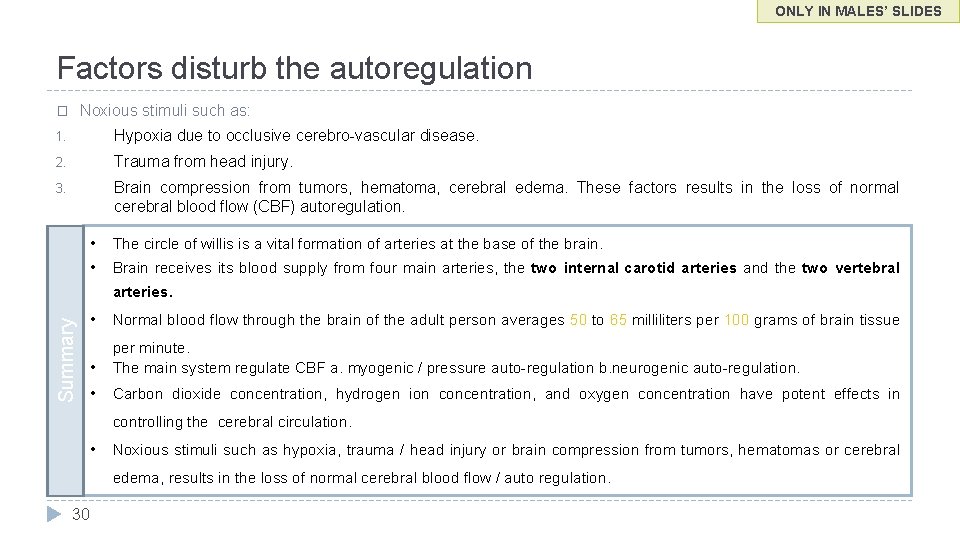
ONLY IN MALES’ SLIDES Factors disturb the autoregulation Noxious stimuli such as: � 1. Hypoxia due to occlusive cerebro-vascular disease. 2. Trauma from head injury. 3. Brain compression from tumors, hematoma, cerebral edema. These factors results in the loss of normal cerebral blood flow (CBF) autoregulation. • The circle of willis is a vital formation of arteries at the base of the brain. • Brain receives its blood supply from four main arteries, the two internal carotid arteries and the two vertebral Summary arteries. • Normal blood flow through the brain of the adult person averages 50 to 65 milliliters per 100 grams of brain tissue • per minute. The main system regulate CBF a. myogenic / pressure auto-regulation b. neurogenic auto-regulation. • Carbon dioxide concentration, hydrogen ion concentration, and oxygen concentration have potent effects in controlling the cerebral circulation. • Noxious stimuli such as hypoxia, trauma / head injury or brain compression from tumors, hematomas or cerebral edema, results in the loss of normal cerebral blood flow / auto regulation. 30
Doctors’ notes � Brain receive its blood supply from four main arteries: two internal carotid arteries, two vertebral arteries. � Brain accounts for 2% of the body weight yet use 20% of o 2 consumption. (He stressed this point). � Factors effecting: (most important 3 myogenic, neurogenic, and metabolic). � High blood pressure (above 150) causes vasogenic edema, low blood pressure (below 50) causes ischemia. � Both low and high blood pressure will cause headaches. High blood pressure headache will also be accompanied with neck / jaw pain. � Cerebral circulatory system has mainly sympathetic innervation. ANS and neurochemical control has minor role. � Pressure and metabolic autoregulation is most important. � The sympathetic nervous system normally constricts the large and intermediate-sized brain arteries enough to prevent the high pressure from reaching the smaller brain blood vessels. � 31 Noxious stimuli (hypoxia, trauma) / head injury or brain compression from tumors, hematomas or

Thank you!. ﺍﻋﻤﻞ ﻭ ﺃﻨﺖ ﺗﻌﻠﻢ ﺃﻦ ﺍﻟﻠﻪ ﻻ ﻳﻀﻴﻊ ﺃﺠﺮ ﻣﻦ ﺃﺤﺴﻦ ﻋﻤﻼ ، ﺍﻋﻤﻞ ﻟﺘﻤﺴﺢ ﺩﻣﻌﺔ ، ﺍﻋﻤﻞ ﻟﺘﺮﺳﻢ ﺑﺴﻤﺔ The Physiology 436 Team: Females Members: Abdullah Alsaeed Team Leaders: Lulwah Alshiha Laila Mathkour Mohammad Alayed Reem Alshathri Rawan Alqahtani Zaina Alkaff References: • • Females’ and Males’ slides. Guyton and Hall Textbook of Medical Physiology (Thirteenth Edition. ) 32 Contact us:
- Slides: 32