
Text Complexity The KY Core Academic Standards for

- Slides: 44
Text Complexity & The KY Core Academic Standards for ELA and Literacy in History/Social Studies, Science & Technical Subjects Denise Amos OVEC ELA Content Specialist www. Denise. Amos. com denise. amos 2@educaton. ky. gov 502 -552 -5735 Kansas Department of Education Text Complexity Resources http: //www. ksde. org/Default. aspx? tabid=4778#Text. Res
Learning Targets: Understand the CCSS text complexity model. Explore the quantitative measures tools. Examine the qualitative rubrics for both literary and informational texts. Ponder reader and task considerations and scaffolding possibilities for texts. Introduce the final recommendation form (i. e. , the “placemat”). 2
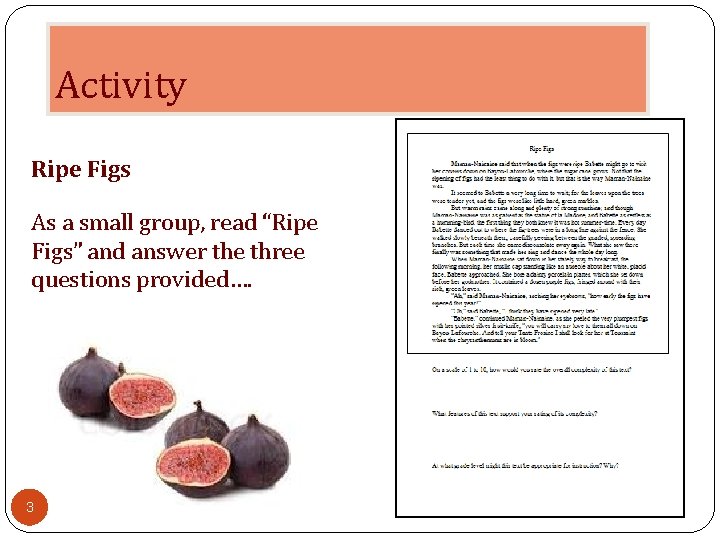
Activity Ripe Figs As a small group, read “Ripe Figs” and answer the three questions provided…. 3
Ripe Figs by Kate Chopin Maman-Nainaine said that when the figs were ripe Babette might go to visit her cousins down on Bayou-Lafourche, where the sugar cane grows. Not that the ripening of figs had the least thing to do with it, but that is the way Maman-Nainaine was. It seemed to Babette a very long time to wait; for the leaves upon the trees were tender yet, and the figs were like little hard, green marbles. But warm rains came along and plenty of strong sunshine; and though Maman-Nainaine was as patient as the statue of la Madone, and Babette as restless as a humming-bird, the first thing they both knew it was hot summer-time. Every day Babette danced out to where the fig-trees were in a long line against the fence. She walked slowly beneath them, carefully peering between the gnarled, spreading branches. But each time she came disconsolate away again. What she saw there finally was something that made her sing and dance the whole day long. 4
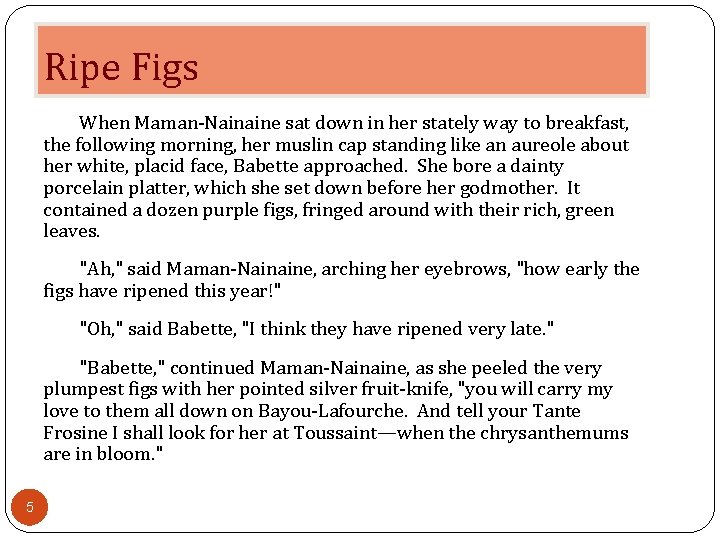
Ripe Figs When Maman-Nainaine sat down in her stately way to breakfast, the following morning, her muslin cap standing like an aureole about her white, placid face, Babette approached. She bore a dainty porcelain platter, which she set down before her godmother. It contained a dozen purple figs, fringed around with their rich, green leaves. "Ah, " said Maman-Nainaine, arching her eyebrows, "how early the figs have ripened this year!" "Oh, " said Babette, "I think they have ripened very late. " "Babette, " continued Maman-Nainaine, as she peeled the very plumpest figs with her pointed silver fruit-knife, "you will carry my love to them all down on Bayou-Lafourche. And tell your Tante Frosine I shall look for her at Toussaint—when the chrysanthemums are in bloom. " 5
Discussion On a scale of 1 to 10, how would you rate the overall complexity of this text? What features of this text support your rating of its complexity? At what grade level might this text be appropriate for instruction? Why? 6
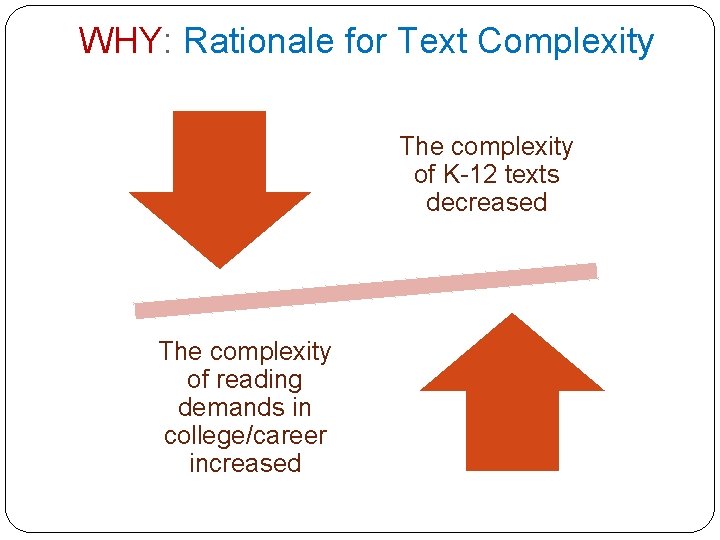
WHY: Rationale for Text Complexity The complexity of K-12 texts decreased The complexity of reading demands in college/career increased
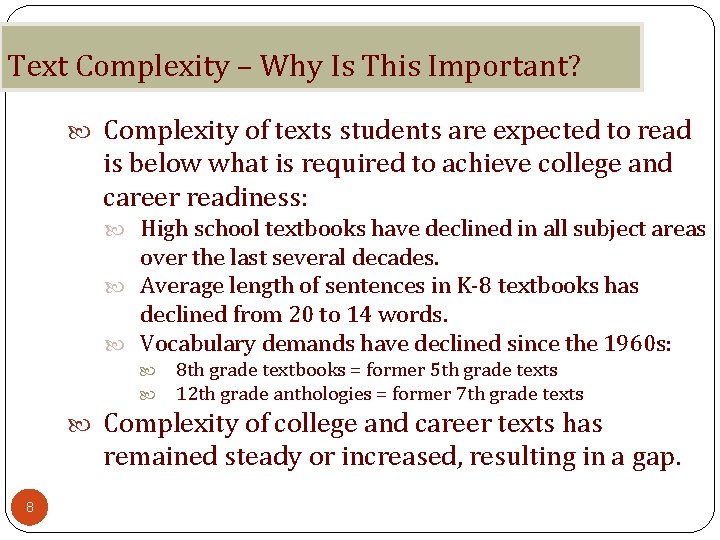
Text Complexity – Why Is This Important? Complexity of texts students are expected to read is below what is required to achieve college and career readiness: High school textbooks have declined in all subject areas over the last several decades. Average length of sentences in K-8 textbooks has declined from 20 to 14 words. Vocabulary demands have declined since the 1960 s: 8 th grade textbooks = former 5 th grade texts 12 th grade anthologies = former 7 th grade texts Complexity of college and career texts has remained steady or increased, resulting in a gap. 8
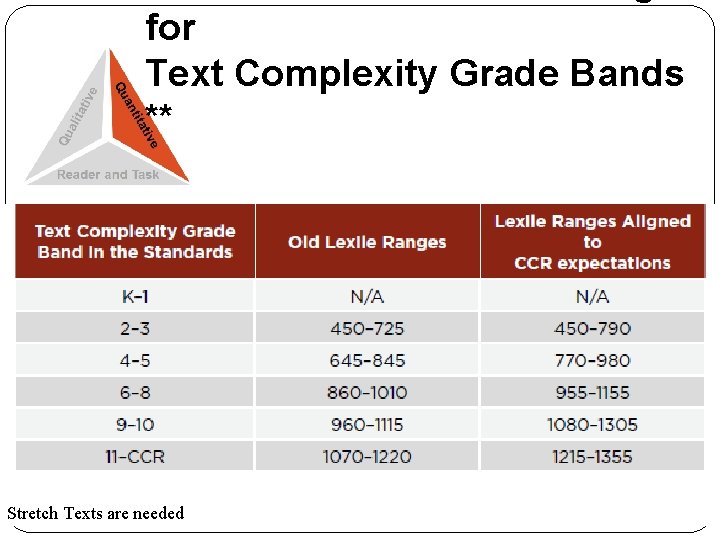
for Text Complexity Grade Bands ** Stretch Texts are needed
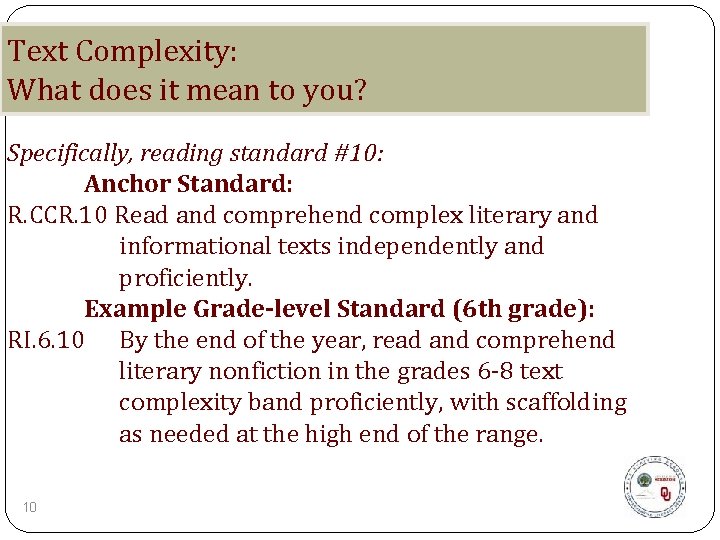
Text Complexity: What does it mean to you? Specifically, reading standard #10: Anchor Standard: R. CCR. 10 Read and comprehend complex literary and informational texts independently and proficiently. Example Grade-level Standard (6 th grade): RI. 6. 10 By the end of the year, read and comprehend literary nonfiction in the grades 6 -8 text complexity band proficiently, with scaffolding as needed at the high end of the range. 10
Guiding Questions So… What do the Common Core State Standards mean by text complexity? What is a text complexity band? and How do we ensure the texts our students are reading are in the appropriate text complexity band? 11
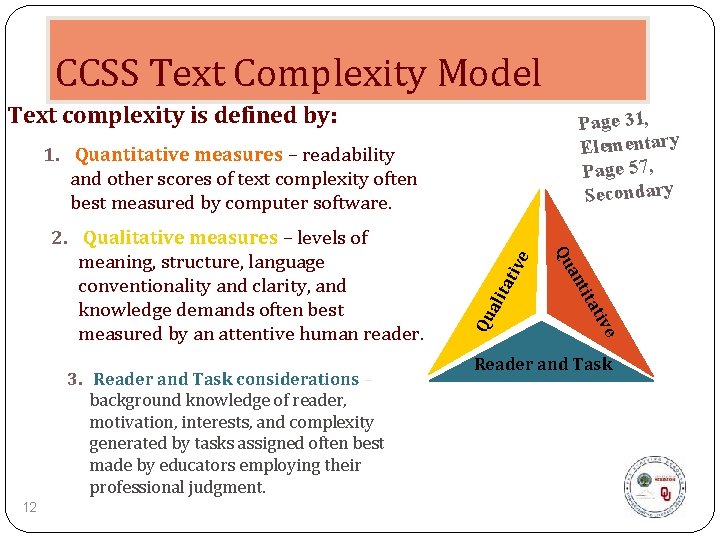
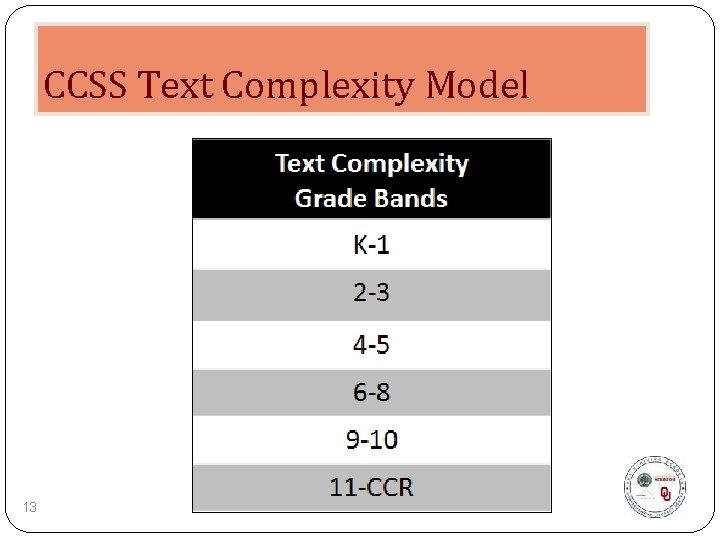
CCSS Text Complexity Model Text complexity is defined by: Page 31, Elementary Page 57, Secondary Qu a ve ati 12 tit 3. Reader and Task considerations – background knowledge of reader, motivation, interests, and complexity generated by tasks assigned often best made by educators employing their professional judgment. an Qu 2. Qualitative measures – levels of meaning, structure, language conventionality and clarity, and knowledge demands often best measured by an attentive human reader. lita tiv e 1. Quantitative measures – readability and other scores of text complexity often best measured by computer software. Reader and Task
CCSS Text Complexity Model 13
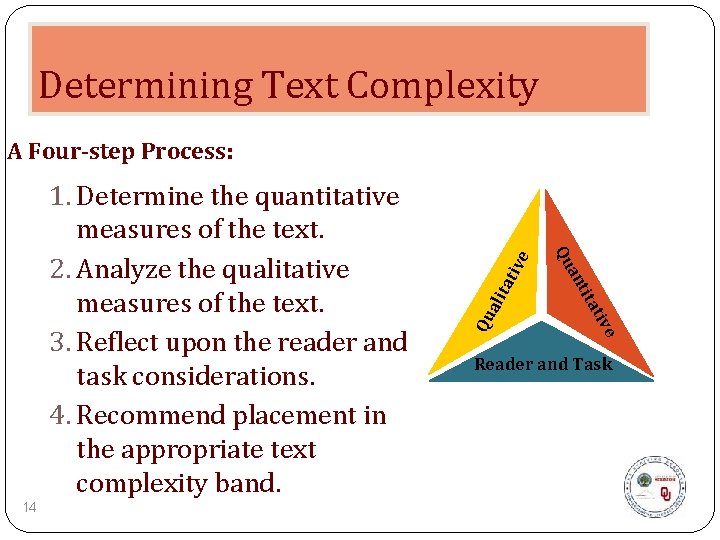
Determining Text Complexity ve ati Qu a tit an 14 Qu 1. Determine the quantitative measures of the text. 2. Analyze the qualitative measures of the text. 3. Reflect upon the reader and task considerations. 4. Recommend placement in the appropriate text complexity band. lita tiv e A Four-step Process: Reader and Task
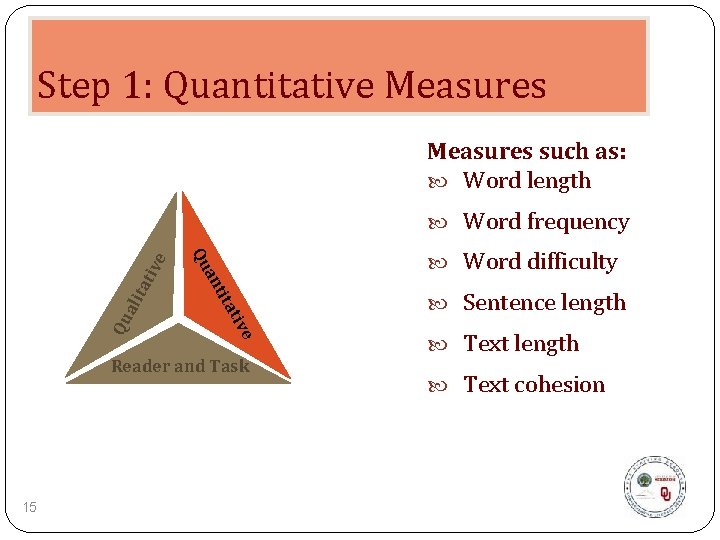
Step 1: Quantitative Measures such as: Word length tat tit ve ati ali an Qu Word difficulty Qu ive Word frequency Reader and Task 15 Sentence length Text cohesion
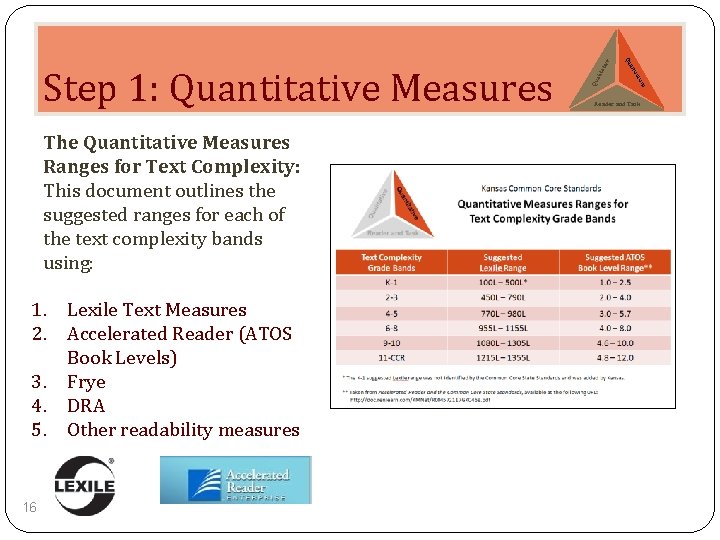
ive Qu ali tat ive 16 tat 1. Lexile Text Measures 2. Accelerated Reader (ATOS Book Levels) 3. Frye 4. DRA 5. Other readability measures ti an The Quantitative Measures Ranges for Text Complexity: This document outlines the suggested ranges for each of the text complexity bands using: Qu Step 1: Quantitative Measures Reader and Task
http: //lexile. com/fab/ky
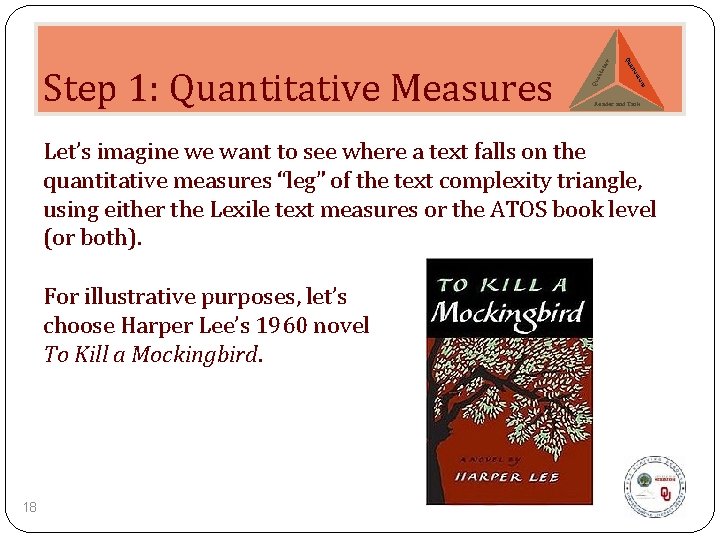
ive ti an ive tat Qu ali tat Qu Step 1: Quantitative Measures Reader and Task Let’s imagine we want to see where a text falls on the quantitative measures “leg” of the text complexity triangle, using either the Lexile text measures or the ATOS book level (or both). For illustrative purposes, let’s choose Harper Lee’s 1960 novel To Kill a Mockingbird. 18
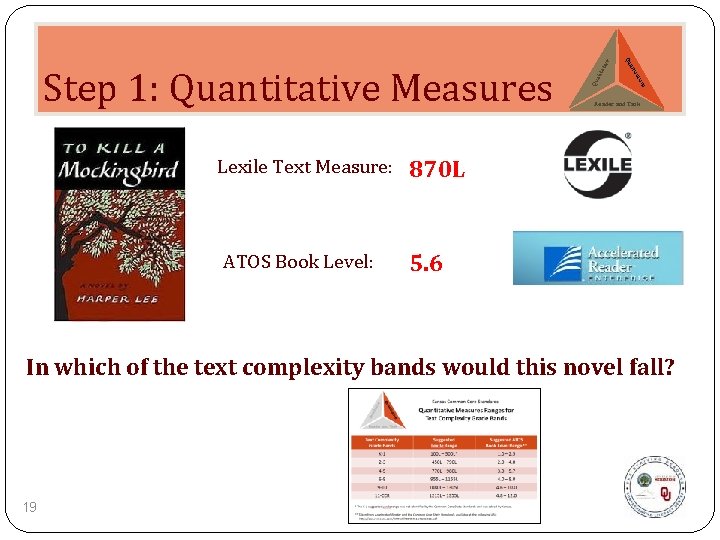
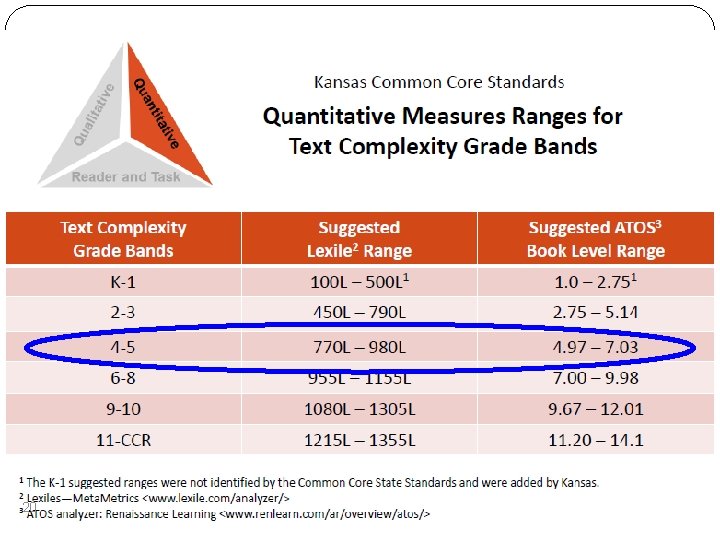
5. 6 ive Qu ali tat ive ATOS Book Level: tat 870 L ti an Lexile Text Measure: Qu Step 1: Quantitative Measures Reader and Task In which of the text complexity bands would this novel fall? 19
20
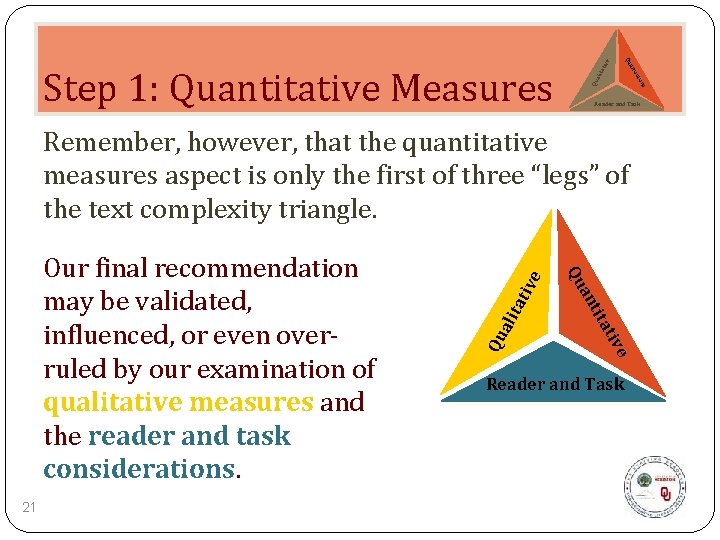
ive ti an tiv e lita Qu a ve ati tit an Qu 21 ive Reader and Task Remember, however, that the quantitative measures aspect is only the first of three “legs” of the text complexity triangle. Our final recommendation may be validated, influenced, or even overruled by our examination of qualitative measures and the reader and task considerations. tat Qu ali tat Qu Step 1: Quantitative Measures Reader and Task
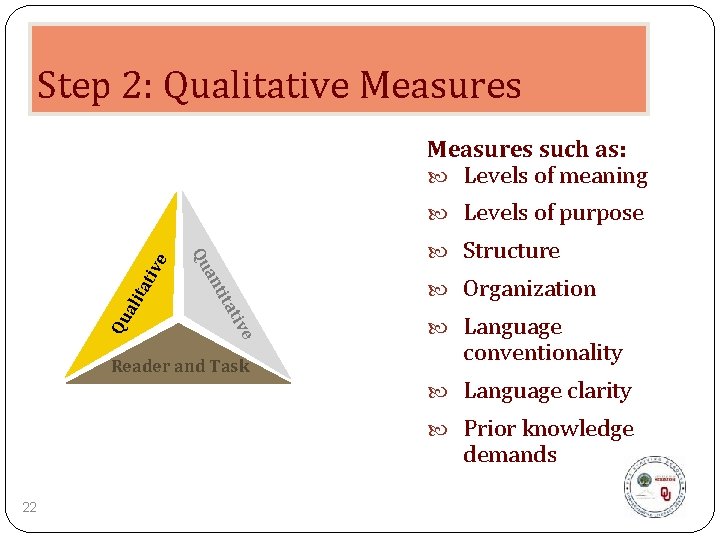
Step 2: Qualitative Measures such as: Levels of meaning ve ati lit ati tit an Qu a Structure Qu ve Levels of purpose Reader and Task Organization Language conventionality Language clarity Prior knowledge demands 22
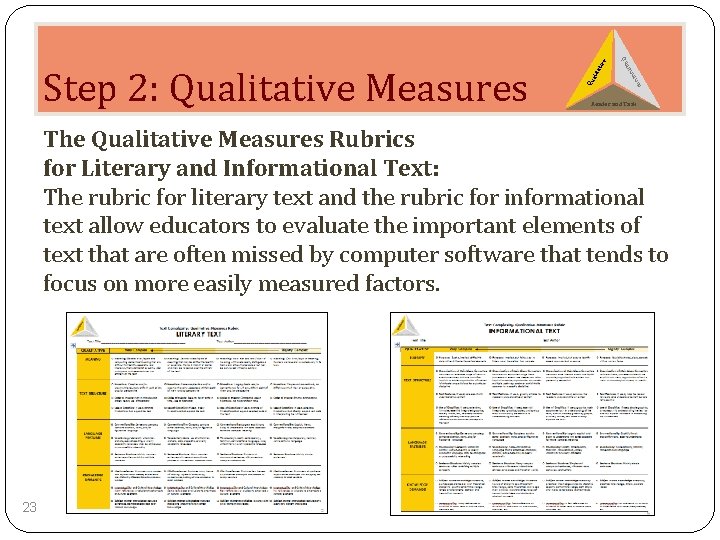
e ati ve ali t v ati Qu tit an Qu Step 2: Qualitative Measures Reader and Task The Qualitative Measures Rubrics for Literary and Informational Text: The rubric for literary text and the rubric for informational text allow educators to evaluate the important elements of text that are often missed by computer software that tends to focus on more easily measured factors. 23
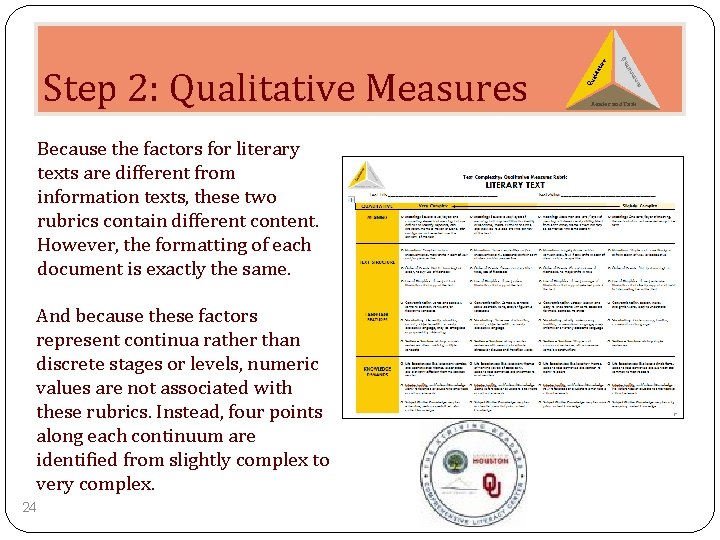
ati ve ali t Qu e 24 v ati And because these factors represent continua rather than discrete stages or levels, numeric values are not associated with these rubrics. Instead, four points along each continuum are identified from slightly complex to very complex. tit an Because the factors for literary texts are different from information texts, these two rubrics contain different content. However, the formatting of each document is exactly the same. Qu Step 2: Qualitative Measures Reader and Task
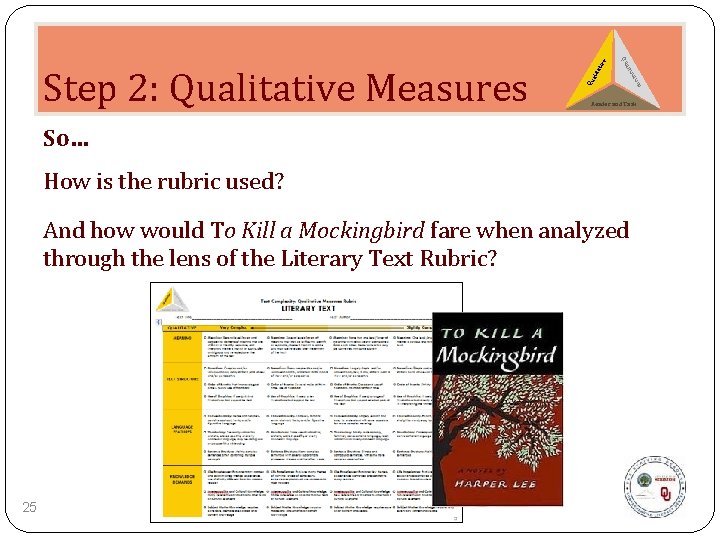
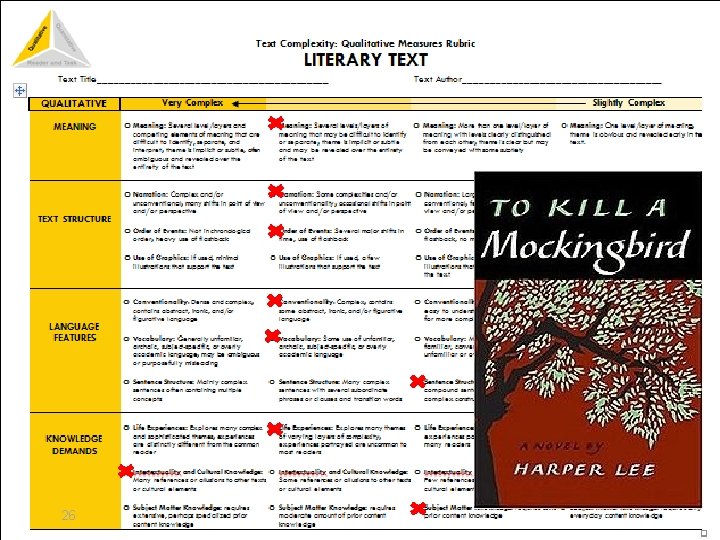
e ati ve ali t Reader and Task So… How is the rubric used? And how would To Kill a Mockingbird fare when analyzed through the lens of the Literary Text Rubric? 25 v ati Qu tit an Qu Step 2: Qualitative Measures
26
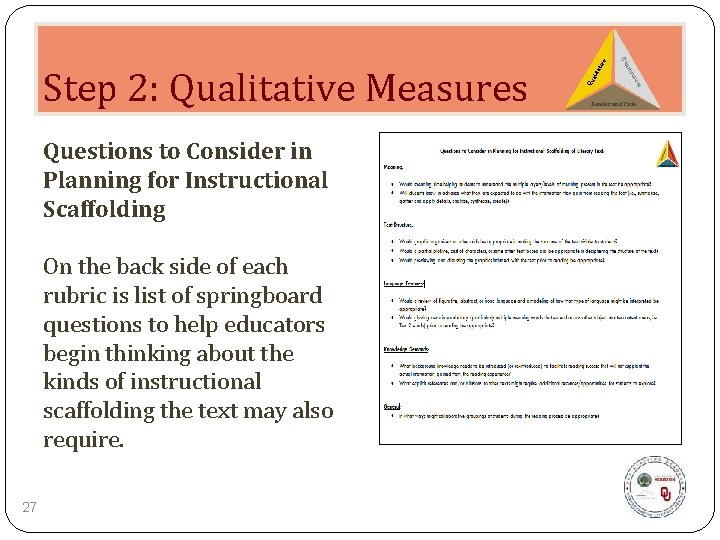
ati ve ali t Qu e 27 v ati On the back side of each rubric is list of springboard questions to help educators begin thinking about the kinds of instructional scaffolding the text may also require. tit an Questions to Consider in Planning for Instructional Scaffolding Qu Step 2: Qualitative Measures Reader and Task
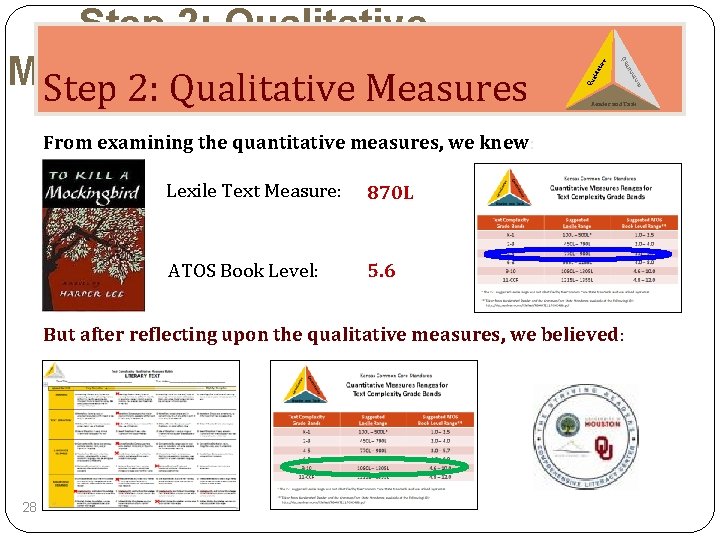
870 L ATOS Book Level: 5. 6 ati ve ali t But after reflecting upon the qualitative measures, we believed: 28 e Reader and Task From examining the quantitative measures, we knew: Lexile Text Measure: v ati Qu tit an Qu Step 2: Qualitative Measures
ali tat ive Qu ati ve ali t Qu e v ati tit an 29 Qu The reader and task considerations still remain. tit an Reader and Task Our initial placement of To Kill a Mockingbird into a text complexity band changed when we examined the qualitative measures. Remember, however, that we have completed only the first two legs of the text complexity triangle. Qu Step 2: Qualitative Measures Reader and Task
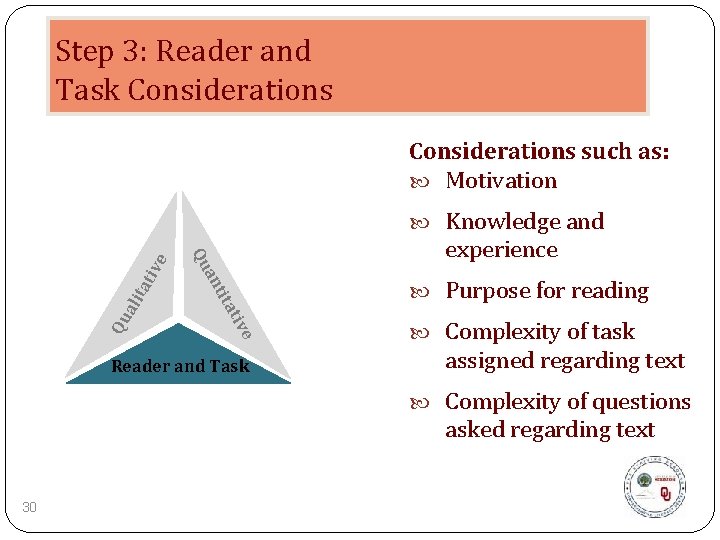
Step 3: Reader and Task Considerations such as: Motivation tat tit ve ati ali an Qu experience Qu ive Knowledge and Reader and Task Purpose for reading Complexity of task assigned regarding text Complexity of questions asked regarding text 30
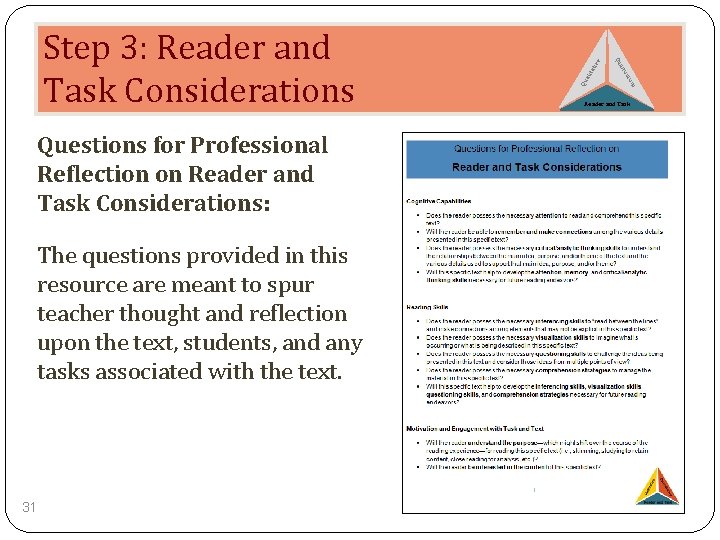
ali tat ive Qu ive 31 tat The questions provided in this resource are meant to spur teacher thought and reflection upon the text, students, and any tasks associated with the text. ti an Questions for Professional Reflection on Reader and Task Considerations: Qu Step 3: Reader and Task Considerations Reader and Task
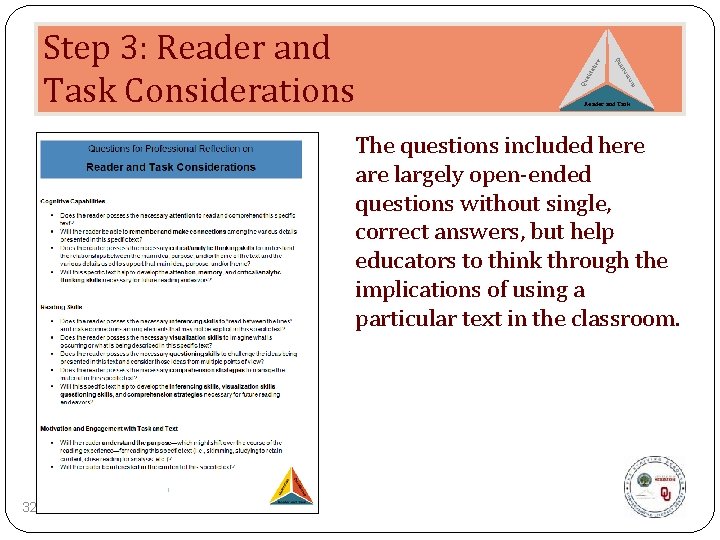
ali tat ive Qu ti an Qu Step 3: Reader and Task Considerations Reader and Task The questions included here are largely open-ended questions without single, correct answers, but help educators to think through the implications of using a particular text in the classroom. 32
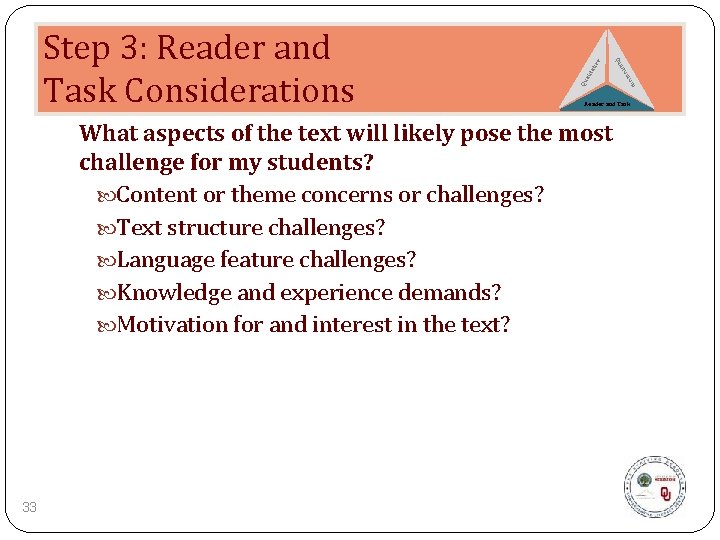
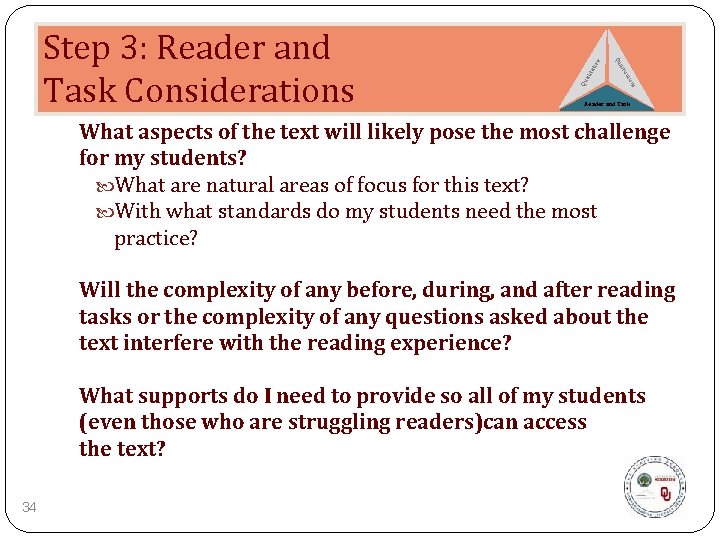
ali tat ive Qu ti an Reader and Task What aspects of the text will likely pose the most challenge for my students? Content or theme concerns or challenges? Text structure challenges? Language feature challenges? Knowledge and experience demands? Motivation for and interest in the text? 33 Qu Step 3: Reader and Task Considerations
ali tat ive Qu ti an Qu Step 3: Reader and Task Considerations Reader and Task What aspects of the text will likely pose the most challenge for my students? What are natural areas of focus for this text? With what standards do my students need the most practice? Will the complexity of any before, during, and after reading tasks or the complexity of any questions asked about the text interfere with the reading experience? What supports do I need to provide so all of my students (even those who are struggling readers)can access the text? 34
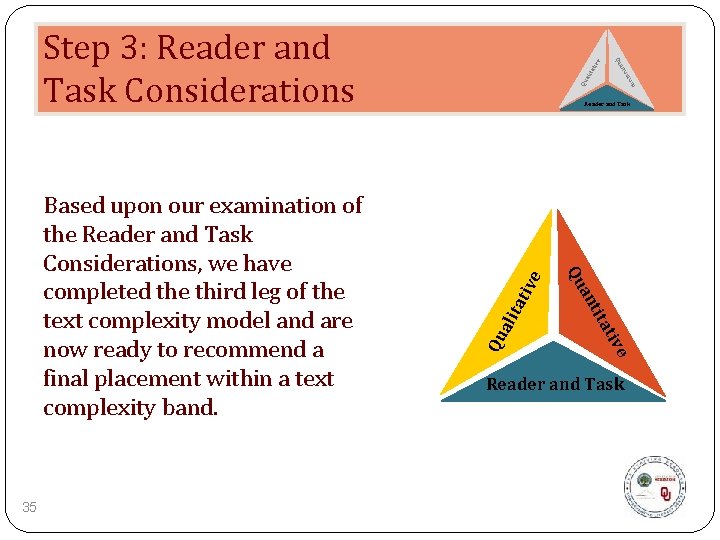
ali tat ive ti an ive Qu tat tiv e lita Qu a ve ati tit an 35 Reader and Task Qu Based upon our examination of the Reader and Task Considerations, we have completed the third leg of the text complexity model and are now ready to recommend a final placement within a text complexity band. Qu Step 3: Reader and Task Considerations Reader and Task
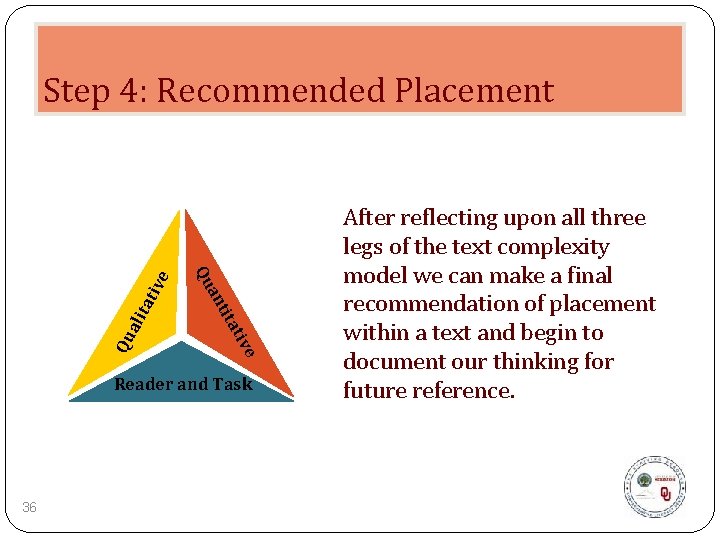
ive tiv lita Qu a tat nti a Qu e Step 4: Recommended Placement Reader and Task 36 After reflecting upon all three legs of the text complexity model we can make a final recommendation of placement within a text and begin to document our thinking for future reference.
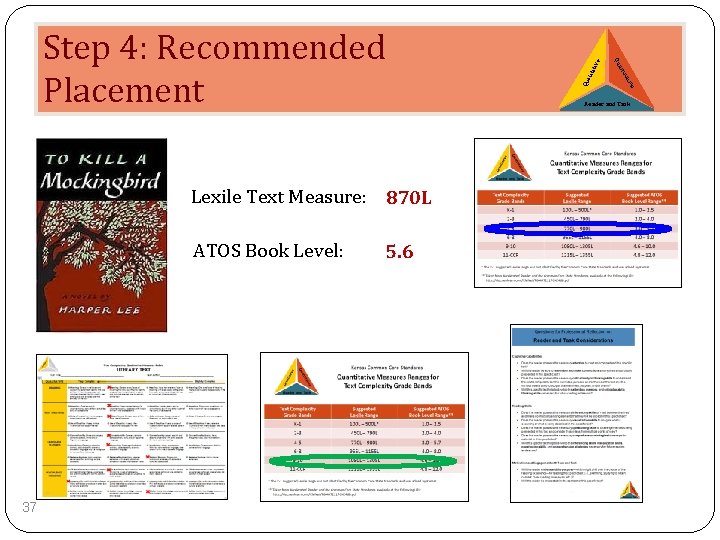
e ive tat ali Qu v ati 37 5. 6 tit ATOS Book Level: an Lexile Text Measure: 870 L Qu Step 4: Recommended Placement Reader and Task
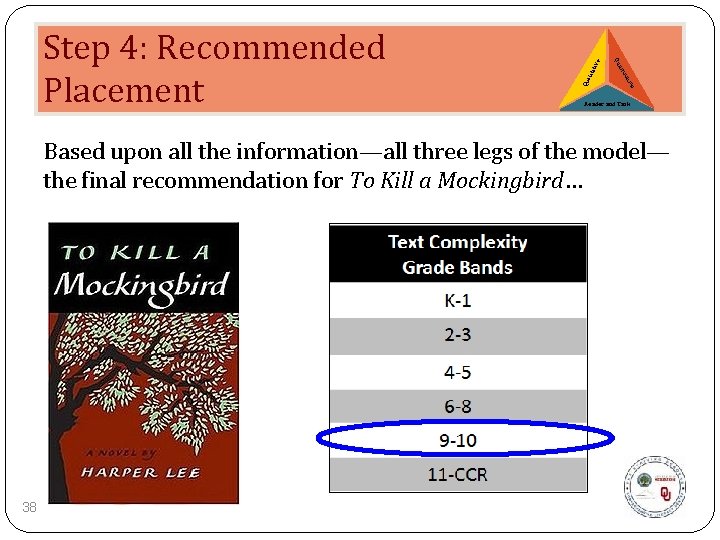
e ive tat ali Qu v ati tit an Qu Step 4: Recommended Placement Reader and Task Based upon all the information—all three legs of the model— the final recommendation for To Kill a Mockingbird… 38
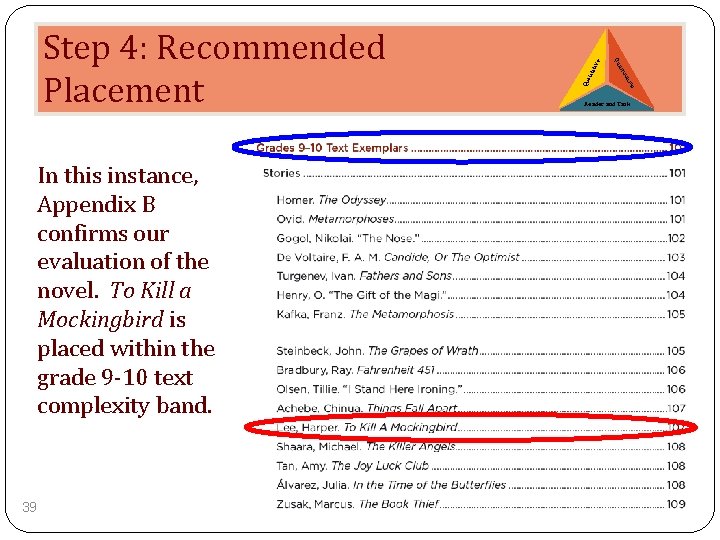
e ive tat ali Qu v ati tit 39 an In this instance, Appendix B confirms our evaluation of the novel. To Kill a Mockingbird is placed within the grade 9 -10 text complexity band. Qu Step 4: Recommended Placement Reader and Task
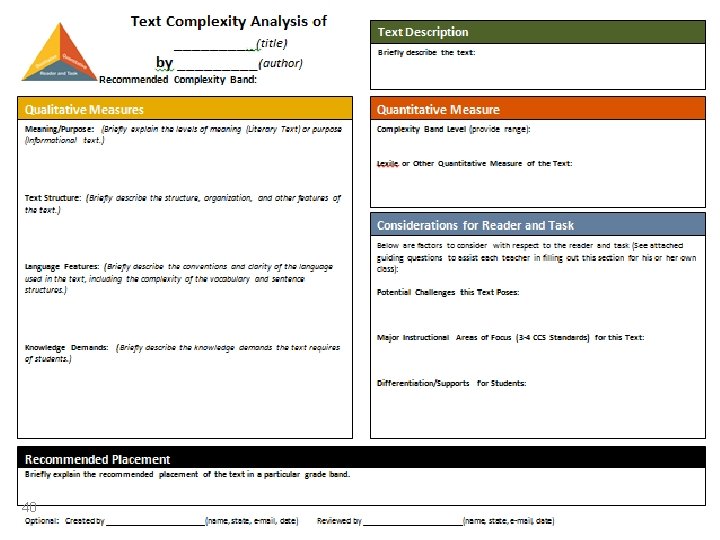
40
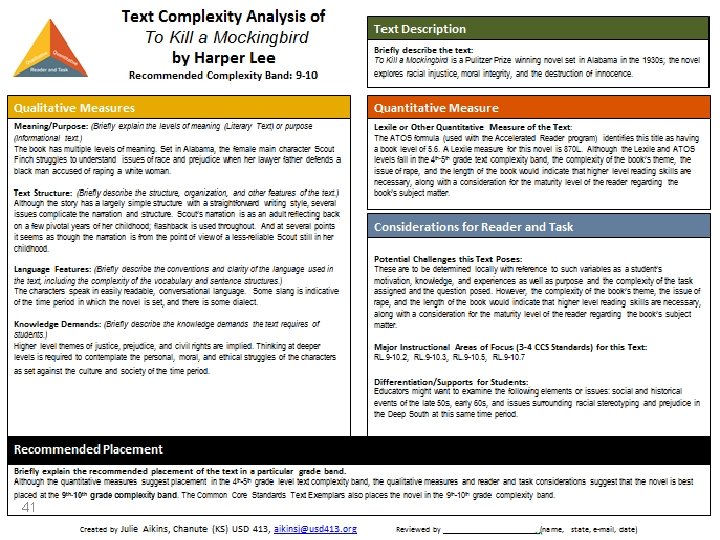
41
e ive tat ali Qu v ati tit an Qu Step 4: Recommended Placement Reader and Task Discussion! § How might classroom teachers make use of the recommended placement forms? § How might administrators make use of the recommended placement forms? § How can I apply this model in the work that I do and encourage others I work with to embrace the model as well? Be prepared to share your thoughts…. 42
Questions? 43
Resources All of the resources mentioned today and numerous others are available at the following URL: www. ksde. org/Default. aspx? tabid=4778 44