
Text Categorization Berlin Chen 2003 Reference 1 Foundations
Text Categorization Berlin Chen 2003 Reference: 1. Foundations of Statistical Natural Language Processing, Chapter 16
Introduction • Classification – Place similar objects in the same class and assign dissimilar objects to different classes – Classification is supervised and requires a set of labeled training objects/instances for each class • Each object can be labeled with one or more classes • Text Categorization object class – A classification problem – Classify a set of documents according to their topics or themes 2

Text Categorization 3
Clustering • Place similar objects in the same group and assign dissimilar objects to different groups – Word clustering • Neighbor overlap: words occur with the similar left and right neighbors (such as in and on) – Document clustering • Documents with the similar topics or concepts are put together • But clustering cannot give a comprehensive description of the object – How to label objects shown on the visual display • Clustering is a way of learning 4
Clustering vs. Classification • Classification is supervised and requires a set of labeled training instances for each group (class) • Clustering is unsupervised and learns without a teacher to provide the labeling information of the training data set – Also called automatic or unsupervised classification 5
Types of Clustering Algorithms • Two types of structures produced by clustering algorithms – Flat or non-hierarchical clustering – Hierarchical clustering • Flat clustering – Simply consisting of a certain number of clusters and the relation between clusters is often undetermined • Hierarchical clustering – A hierarchy with usual interpretation that each node stands for a subclass of its mother’s node • The leaves of the tree are the single objects • Each node represents the cluster that contains all the objects of its descendants 6
Hard Assignment vs. Soft Assignment • Another important distinction between clustering algorithms is whether they perform soft or hard assignment • Hard Assignment – Each object is assigned to one and only one cluster • Soft Assignment – Each object may be assigned to multiple clusters – An object has a probability distribution over clusters where is the probability that is a member of – Is somewhat more appropriate in many tasks such as NLP, IR, … 7
Hard Assignment vs. Soft Assignment • Hierarchical clustering usually adopts hard assignment while in flat clustering both types of clustering are common 8
Summarized Attributes of Clustering Algorithms • Hierarchical Clustering – Preferable for detailed data analysis – Provide more information than flat clustering – No single best algorithm (each of the algorithms only optimal for some applications) – Less efficient than flat clustering (minimally have to compute n x n matrix of similarity coefficients) • Flat clustering – Preferable if efficiency is a consideration or data sets are very large – K-means is the conceptually method and should probably be used on a new data because its results are often sufficient – K-means assumes a simple Euclidean representation space, and so cannot be used for many data sets, e. g. , nominal data like colors – The EM algorithm is the most choice. It can accommodate definition of clusters and allocation of objects based on complex probabilistic models 9
Hierarchical Clustering 10
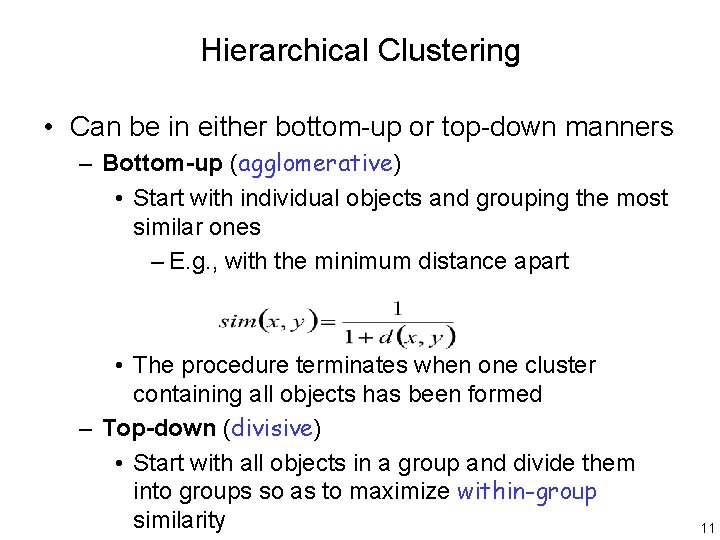
Hierarchical Clustering • Can be in either bottom-up or top-down manners – Bottom-up (agglomerative) • Start with individual objects and grouping the most similar ones – E. g. , with the minimum distance apart • The procedure terminates when one cluster containing all objects has been formed – Top-down (divisive) • Start with all objects in a group and divide them into groups so as to maximize within-group similarity 11
Hierarchical Agglomerative Clustering (HAC) • A bottom-up approach • Assume a similarity measure for determining the similarity of two objects • Start with all objects in a separate cluster and then repeatedly joins the two clusters that have the most similarity until there is one only cluster survived • The history of merging/clustering forms a binary tree or hierarchy 12
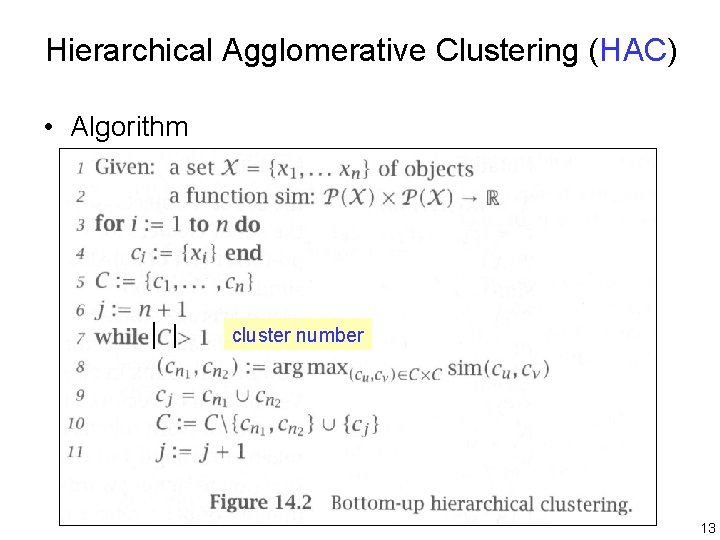
Hierarchical Agglomerative Clustering (HAC) • Algorithm cluster number 13
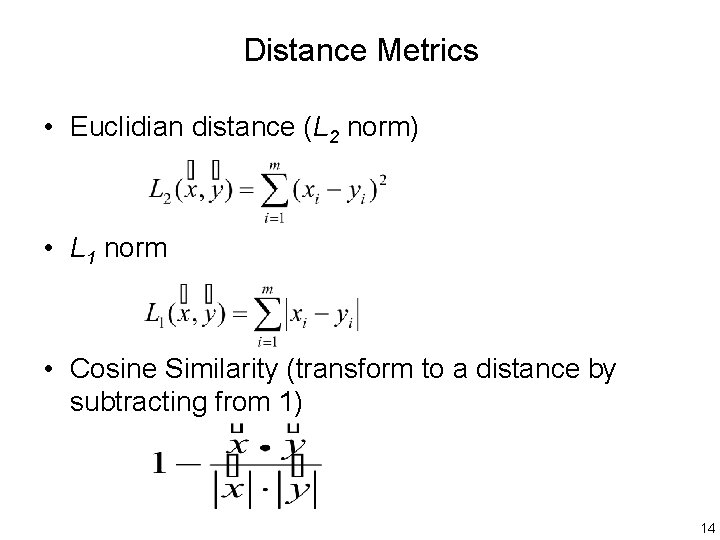
Distance Metrics • Euclidian distance (L 2 norm) • L 1 norm • Cosine Similarity (transform to a distance by subtracting from 1) 14
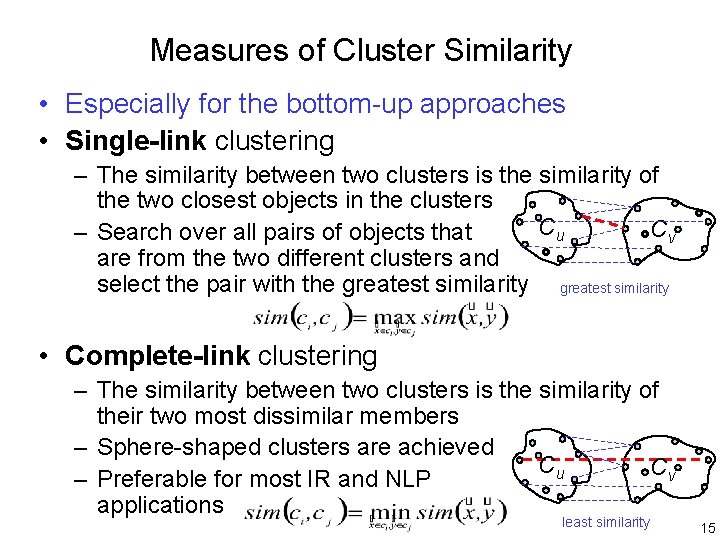
Measures of Cluster Similarity • Especially for the bottom-up approaches • Single-link clustering – The similarity between two clusters is the similarity of the two closest objects in the clusters Cu Cv – Search over all pairs of objects that are from the two different clusters and select the pair with the greatest similarity • Complete-link clustering – The similarity between two clusters is the similarity of their two most dissimilar members – Sphere-shaped clusters are achieved Cu Cv – Preferable for most IR and NLP applications least similarity 15
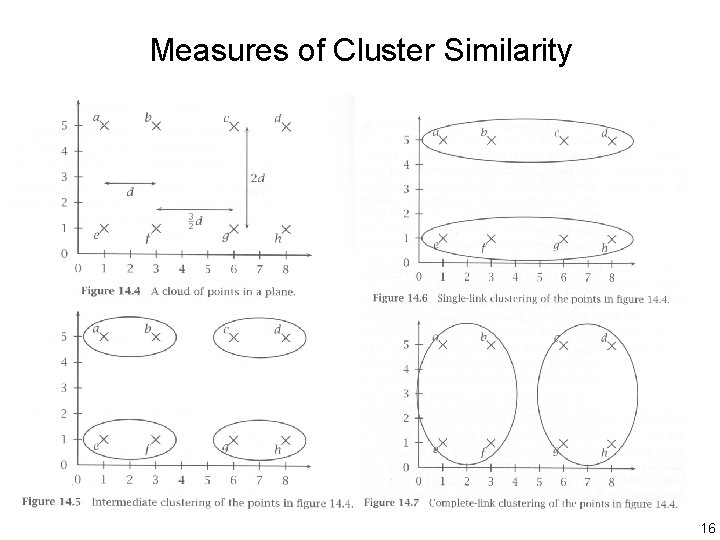
Measures of Cluster Similarity 16
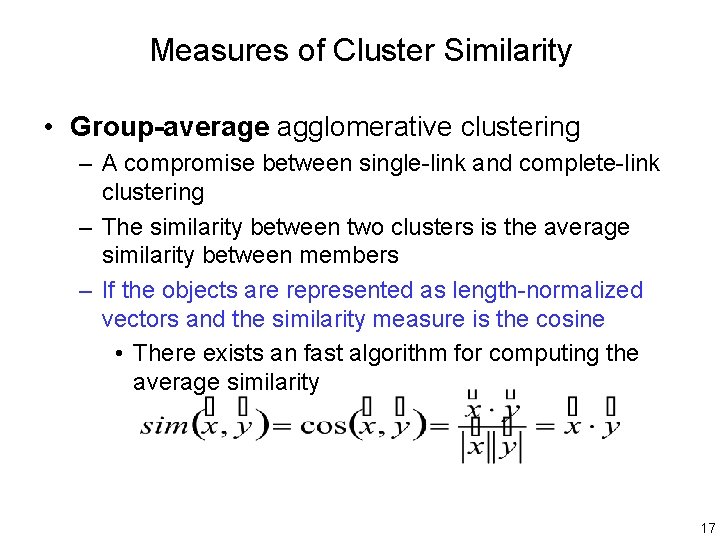
Measures of Cluster Similarity • Group-average agglomerative clustering – A compromise between single-link and complete-link clustering – The similarity between two clusters is the average similarity between members – If the objects are represented as length-normalized vectors and the similarity measure is the cosine • There exists an fast algorithm for computing the average similarity 17
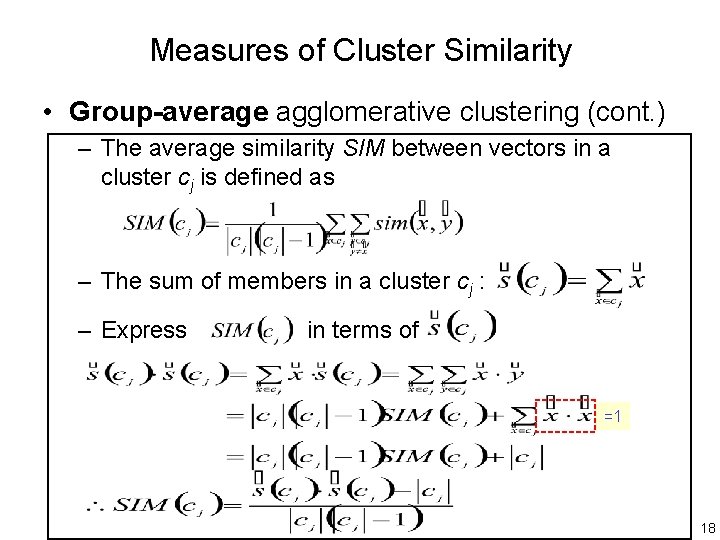
Measures of Cluster Similarity • Group-average agglomerative clustering (cont. ) – The average similarity SIM between vectors in a cluster cj is defined as – The sum of members in a cluster cj : – Express in terms of =1 18
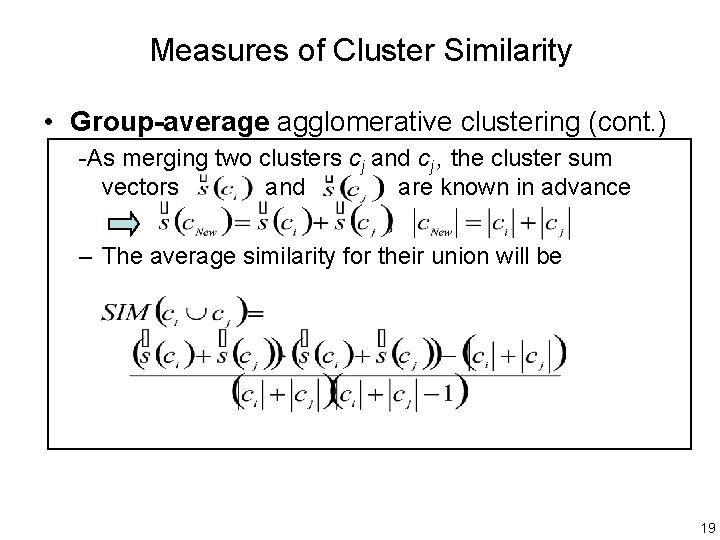
Measures of Cluster Similarity • Group-average agglomerative clustering (cont. ) -As merging two clusters cj and cj , the cluster sum vectors and are known in advance – The average similarity for their union will be 19
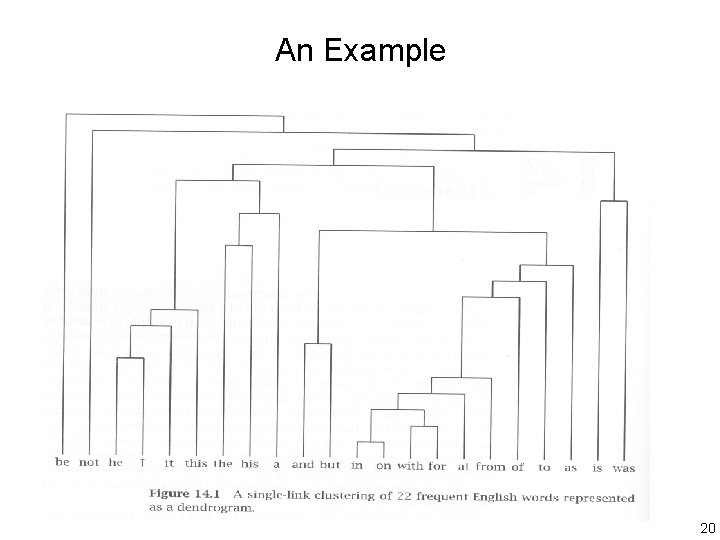
An Example 20
Divisive Clustering • A top-down approach • Start with all objects in a single cluster • At each iteration, select the least coherent cluster and split it • Continue the iterations until a predefined criterion (e. g. , the cluster number) is achieved • The history of clustering forms a binary tree or hierarchy 21
Divisive Clustering • To select the least coherent cluster, the measures used in bottom-up clustering can be used again here – Single link measure – Complete-link measure – Group-average measure • How to split a cluster – Also is a clustering task (finding two sub-clusters) – Any clustering algorithm can be used for the splitting operation, e. g. , • Bottom-up algorithms • Non-hierarchical clustering algorithms (e. g. , Kmeans) 22
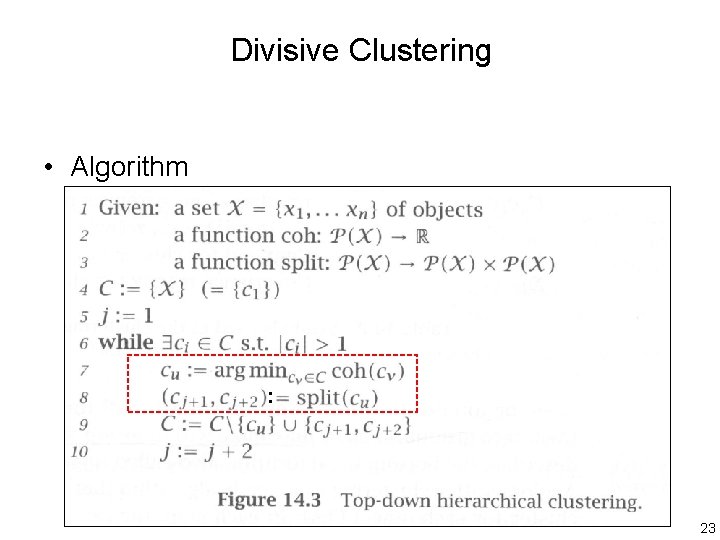
Divisive Clustering • Algorithm : 23
Non-Hierarchical Clustering 24
Non-hierarchical Clustering • Start out with a partition based on randomly selected seeds (one seed per cluster) and then refine the initial partition – In a multi-pass manner • Problems associated non-hierarchical clustering MI, group average similarity, likelihood – When to stop – What is the right number of clusters k-1 → k+1 • Algorithms introduced here – The K-means algorithm – The EM algorithm Hierarchical clustering also has to face this problem 25
The K-means Algorithm • A hard clustering algorithm • Define clusters by the center of mass of their members • Initialization – A set of initial cluster centers is needed • Recursion – Assign each object to the cluster whose center is closet – Then, re-compute the center of each cluster as the centroid or mean of its members • Using the medoid as the cluster center ? 26
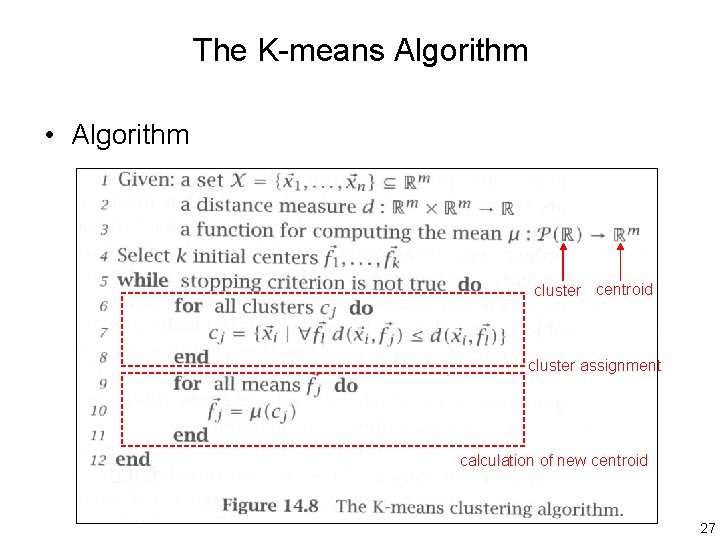
The K-means Algorithm • Algorithm cluster centroid cluster assignment calculation of new centroid 27
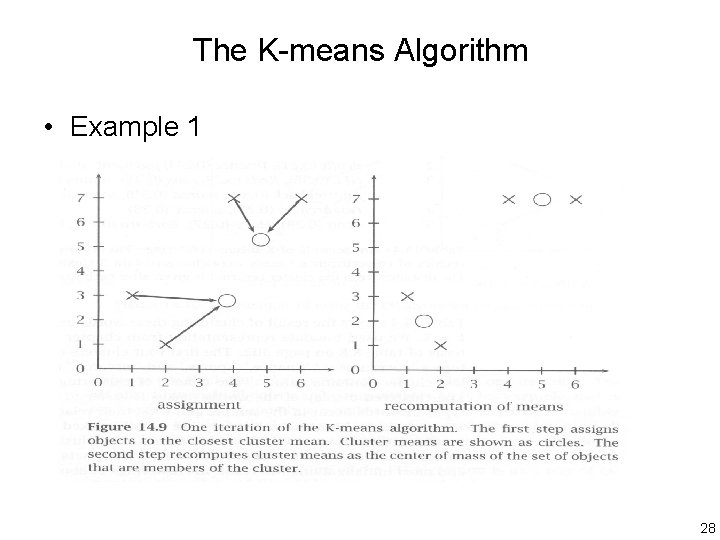
The K-means Algorithm • Example 1 28
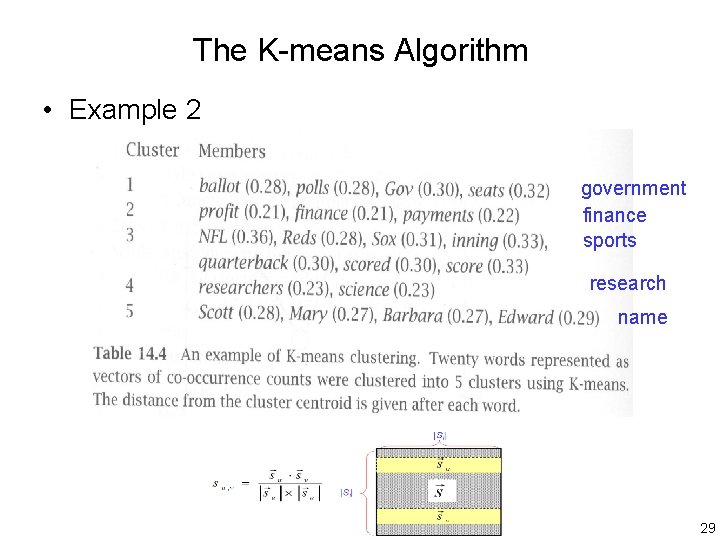
The K-means Algorithm • Example 2 government finance sports research name 29
The K-means Algorithm • Choice of initial cluster centers (seeds) is important – Pick at random – Or use another method such as hierarchical clustering algorithm on a subset of the objects – Poor seeds will result in sub-optimal clustering 30
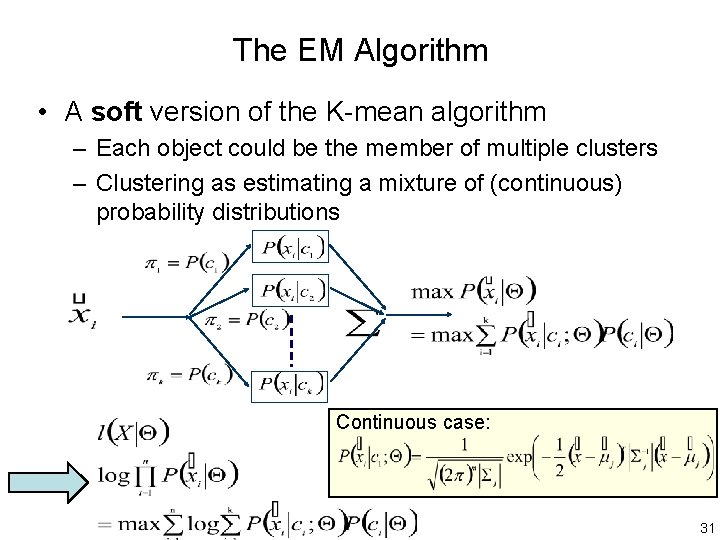
The EM Algorithm • A soft version of the K-mean algorithm – Each object could be the member of multiple clusters – Clustering as estimating a mixture of (continuous) probability distributions Continuous case: 31
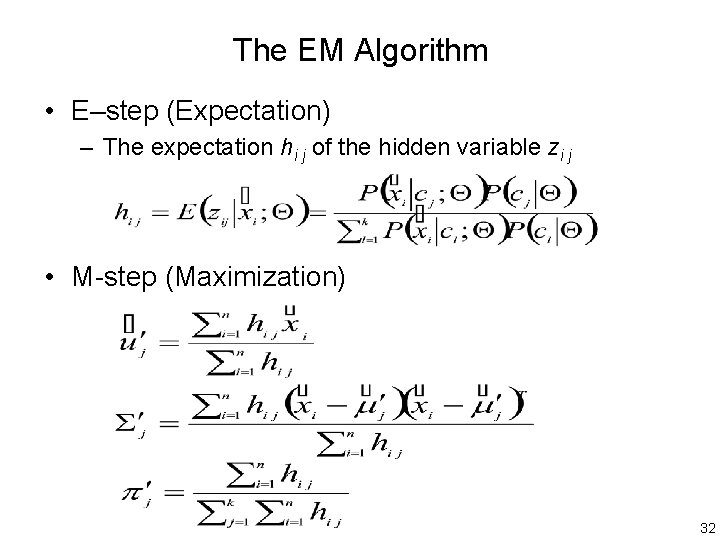
The EM Algorithm • E–step (Expectation) – The expectation hi j of the hidden variable zi j • M-step (Maximization) 32
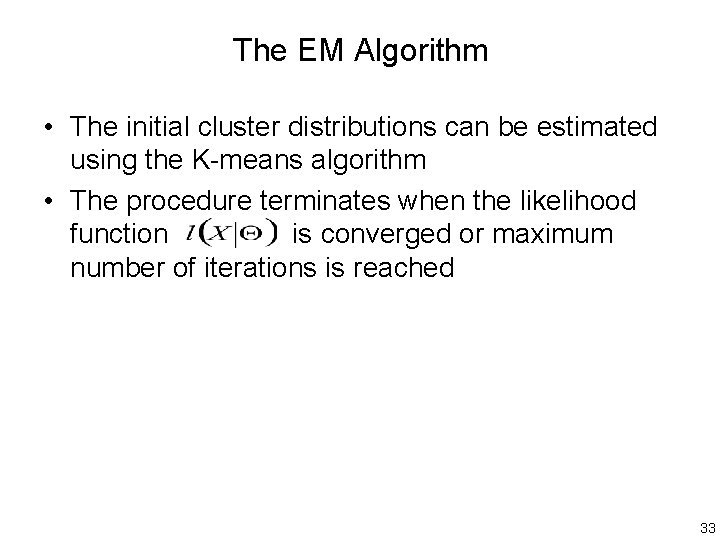
The EM Algorithm • The initial cluster distributions can be estimated using the K-means algorithm • The procedure terminates when the likelihood function is converged or maximum number of iterations is reached 33
- Slides: 33