
Texas Workforce Commission EvidenceBased GrantMaking Improving Texas Outcomes
Texas Workforce Commission Evidence-Based Grant-Making Improving Texas Outcomes (TWC), Texas Workforce Investment Council (TWIC), Results for America, & Rural Capital Area Workforce Development Board
Agenda • Texas Vision – How? When? • National Vision – Why? • Evidence Framework – What? • Q & A – Who?
Welcome! • Jen Troke, Director, Workforce Grants and Initiatives, Texas Workforce Commission • Bryan Daniel, Chairman and Commissioner Representing the Public, Texas Workforce Commission • Celeste Richie, VP, Workforce Development, Results for America • Courtney Arbour, Director, Workforce Development Division, Texas Workforce Commission • Lee Rector, Executive Director, Texas Workforce Investment Council
Polling Question #1 What type of organization are you representing today? • Education • Workforce Development • Economic Development • Employer • Community-Based Organization • Other
Polling Question #2 What words come to mind when you hear the term “Evidence. Based? ” Please respond to question in the Chat!
Polling Question #3 Why did you join today? • I want to learn more about the use of evidence in grant-making, but it makes me nervous! • I have dabbled in evidence usage, so I want to align my work to yours. • I love the idea of using evidence, but I need to learn more about how to do it. • Evidence Schmevidence – I have no idea what this is about! • Other – Put your reason in the chat!
Texas Vision for Use of Evidence Goal of this work is to discover innovative approaches and replicable models that lead to better outcomes for workers
Building Evidence in Texas TWC approved Building and Construction Trades Request for Application (RFA) that will: • focus on the priority population of opportunity youth – those youth not in school or work • include an evidence framework to improve the measurement of success of the grant program • incentivize program models with demonstrated track record of effective outcomes • encourage building the evidence base for those models with little to no evidence – all grants will be evaluated
Data and Evidence Can Help States Invest in What Works Celeste Richie VP Workforce Development Results for America
RFA’s Mission To make investing in what works the “new normal” so that government decisionmakers will regularly and effectively use evidence and data to increase the impact of the over $1 trillion that governments spend each year to improve the lives of young people, their families and communities. 10
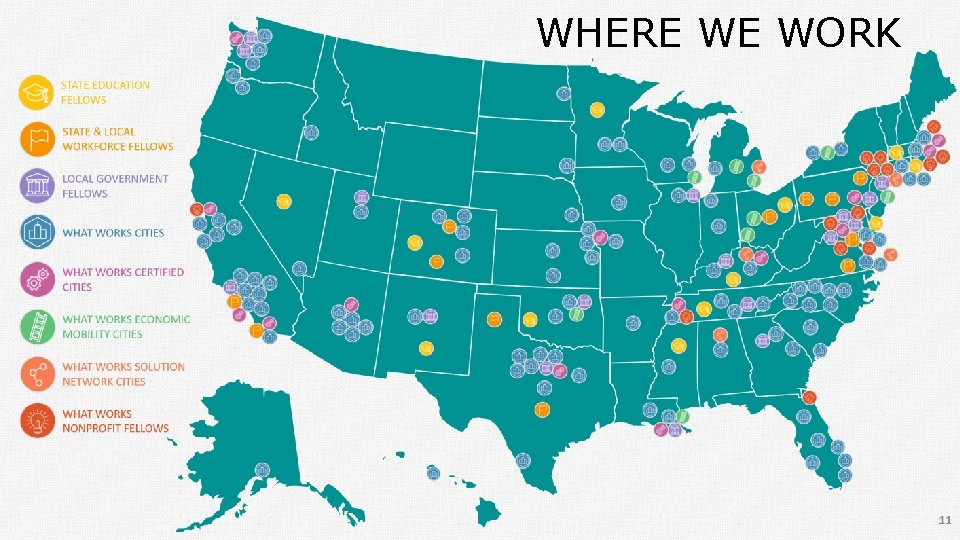
WHERE WE WORK
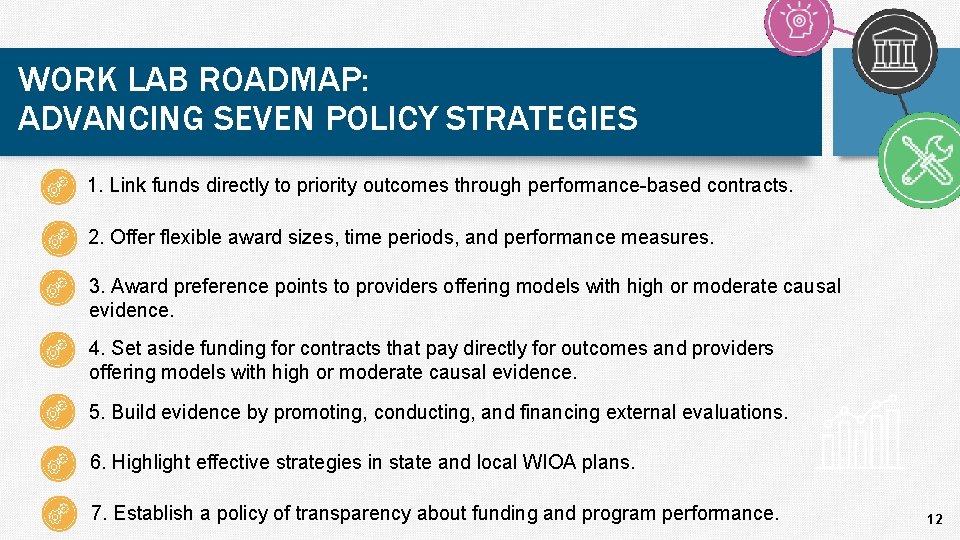
WORK LAB ROADMAP: ADVANCING SEVEN POLICY STRATEGIES 1. Link funds directly to priority outcomes through performance-based contracts. 2. Offer flexible award sizes, time periods, and performance measures. 3. Award preference points to providers offering models with high or moderate causal evidence. 4. Set aside funding for contracts that pay directly for outcomes and providers offering models with high or moderate causal evidence. 5. Build evidence by promoting, conducting, and financing external evaluations. 6. Highlight effective strategies in state and local WIOA plans. 7. Establish a policy of transparency about funding and program performance. 12
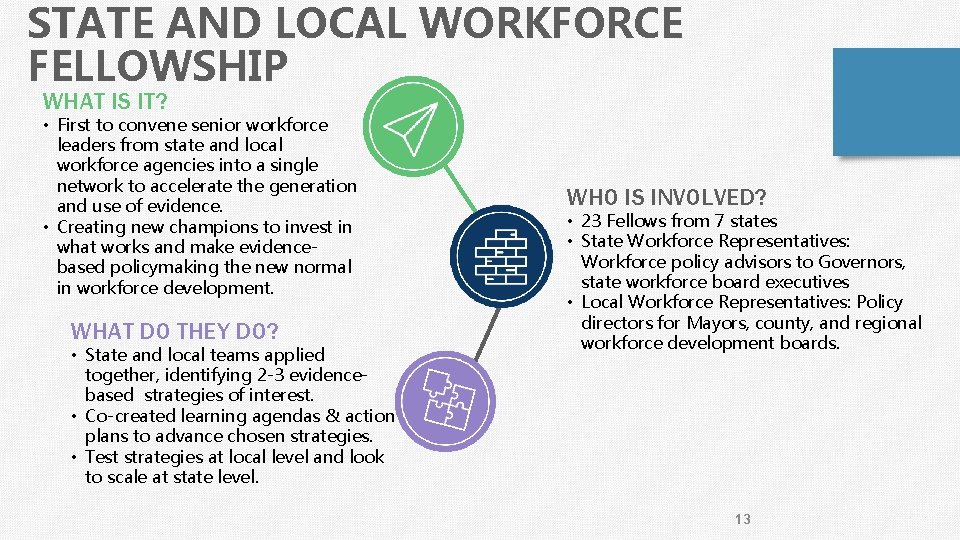
STATE AND LOCAL WORKFORCE FELLOWSHIP WHAT IS IT? • First to convene senior workforce leaders from state and local workforce agencies into a single network to accelerate the generation and use of evidence. • Creating new champions to invest in what works and make evidencebased policymaking the new normal in workforce development. WHAT DO THEY DO? • State and local teams applied together, identifying 2 -3 evidencebased strategies of interest. • Co-created learning agendas & action plans to advance chosen strategies. • Test strategies at local level and look to scale at state level. WHO IS INVOLVED? • 23 Fellows from 7 states • State Workforce Representatives: Workforce policy advisors to Governors, state workforce board executives • Local Workforce Representatives: Policy directors for Mayors, county, and regional workforce development boards. 13
WE NEED AN EVIDENCE-DRIVEN WORKFORCE SYSTEM NOW MORE THAN EVER Limited funding combined with unprecedented need means we need to focus funding where we can achieve the greatest impact. This is not about excluding programs that have not yet built evidence; it is about continuous improvement. Each grant or contract should be an opportunity to learn more about what works and what needs improving. Federal requirements for evidence-based programs are growing. Now is the time to get ahead of the curve and lead the way in evidence-driven workforce solutions. 14
WHAT IS EVIDENCE-BASED GRANTMAKING? Define “evidence of effectiveness” so there is a common understanding of “evidence-based” Outcomes- and performance-based payments. Payments are linked directly to priority outcomes (e. g. increased wages, long-term employment in related industry) Use data to determine how well we are serving constituents through our services 15
State and Federal Programs Increasingly Prioritize Evidence of Effectiveness • The Department of Labor: RESEA, WIOA Pay-for-Performance • Workforce Agencies in CO, OH, PA, TX, VA • Pittsburgh’s Partner 4 Work issued an RFP for training programs leading to industry-recognized credentials employment. • To incentivize credential attainment, “payment will be made 50% on enrollment into a training program and 50% when documentation of a credential earned is provided to Partner 4 Work. ” • Central Ohio issued two RFPs for their one-stop provider and main career services contract that will link payments to priority outcomes.
Where are we today? • Framework completed • Revised Grant Application for Building Construction Trades to be Released November 2020 including performance outcomes • New TWC Webpage for Resources
What To Expect in Applications • New Language in RFAs • New Vocabulary • New Forms
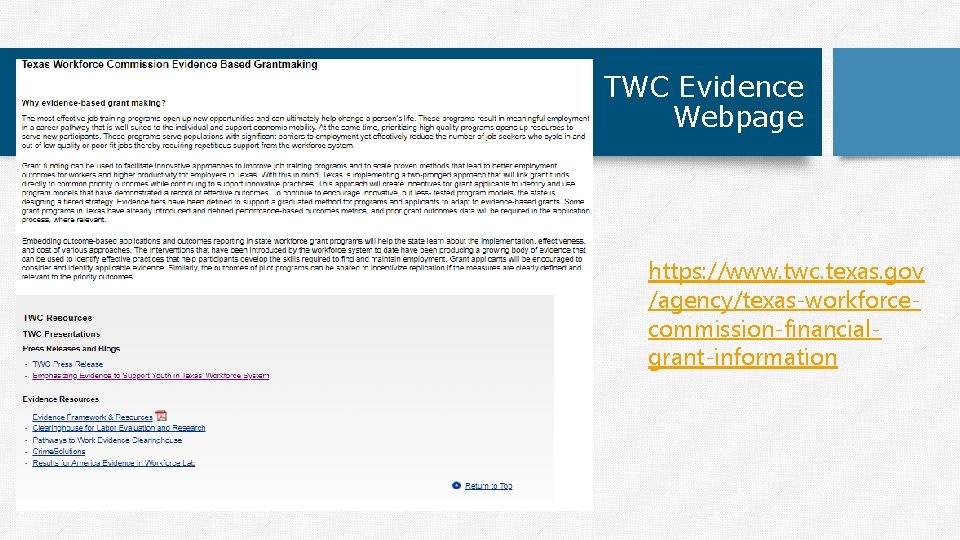
TWC Evidence Webpage https: //www. twc. texas. gov /agency/texas-workforcecommission-financialgrant-information
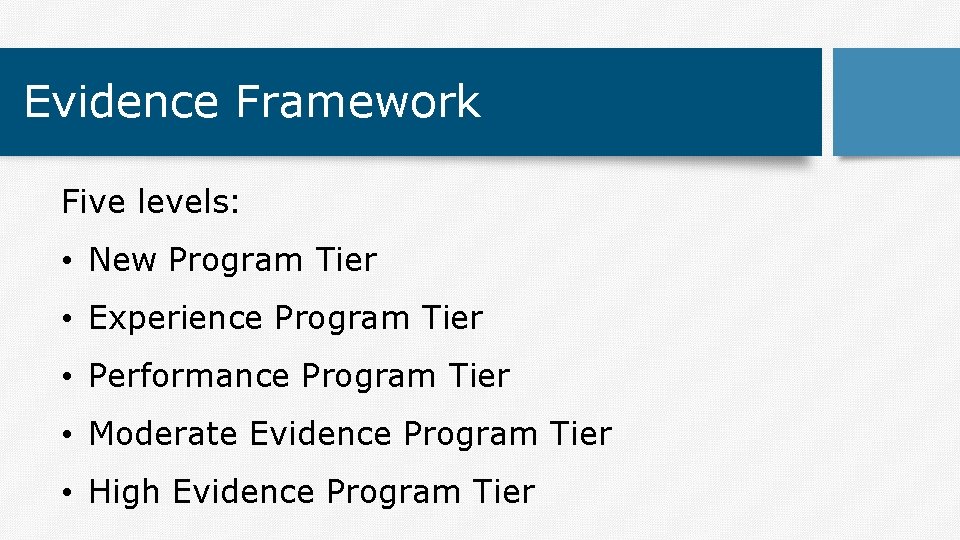
Evidence Framework Five levels: • New Program Tier • Experience Program Tier • Performance Program Tier • Moderate Evidence Program Tier • High Evidence Program Tier
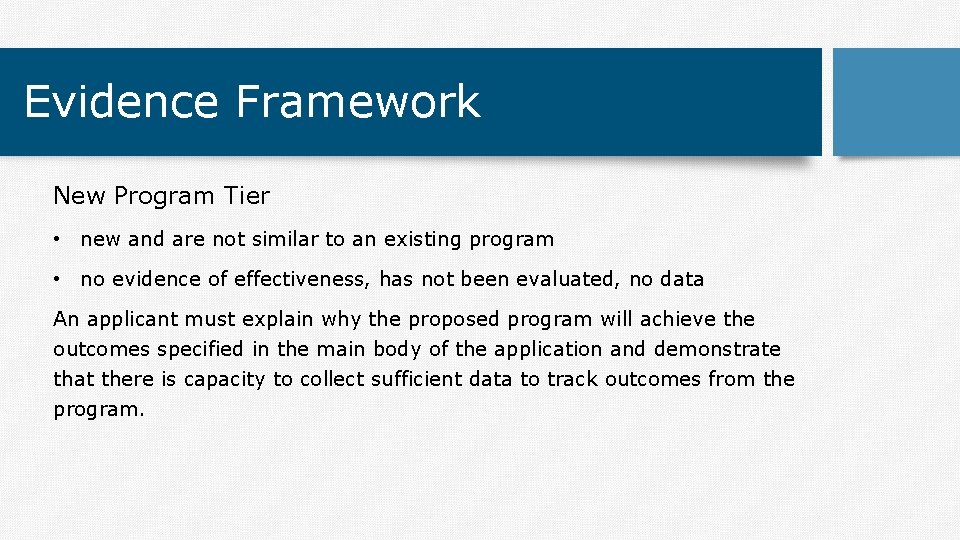
Evidence Framework New Program Tier • new and are not similar to an existing program • no evidence of effectiveness, has not been evaluated, no data An applicant must explain why the proposed program will achieve the outcomes specified in the main body of the application and demonstrate that there is capacity to collect sufficient data to track outcomes from the program.
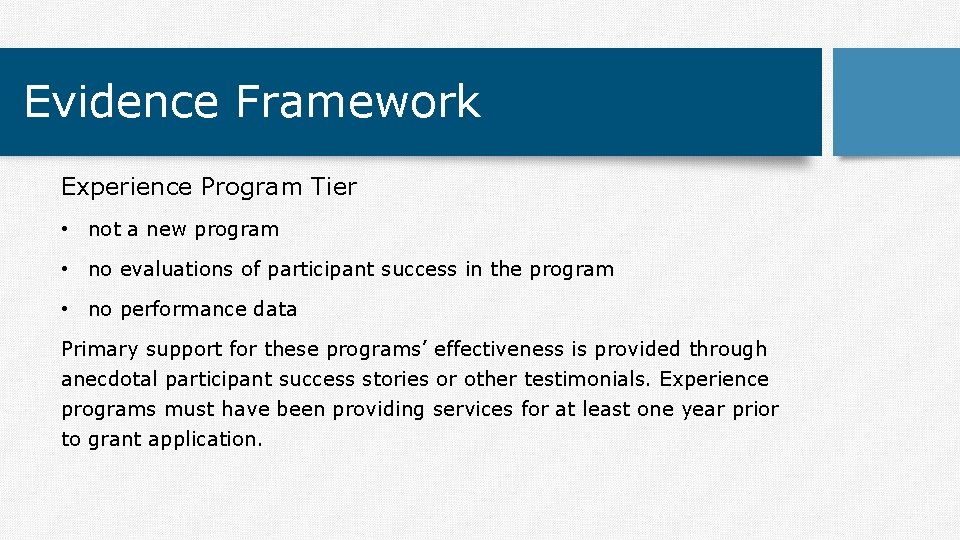
Evidence Framework Experience Program Tier • not a new program • no evaluations of participant success in the program • no performance data Primary support for these programs’ effectiveness is provided through anecdotal participant success stories or other testimonials. Experience programs must have been providing services for at least one year prior to grant application.
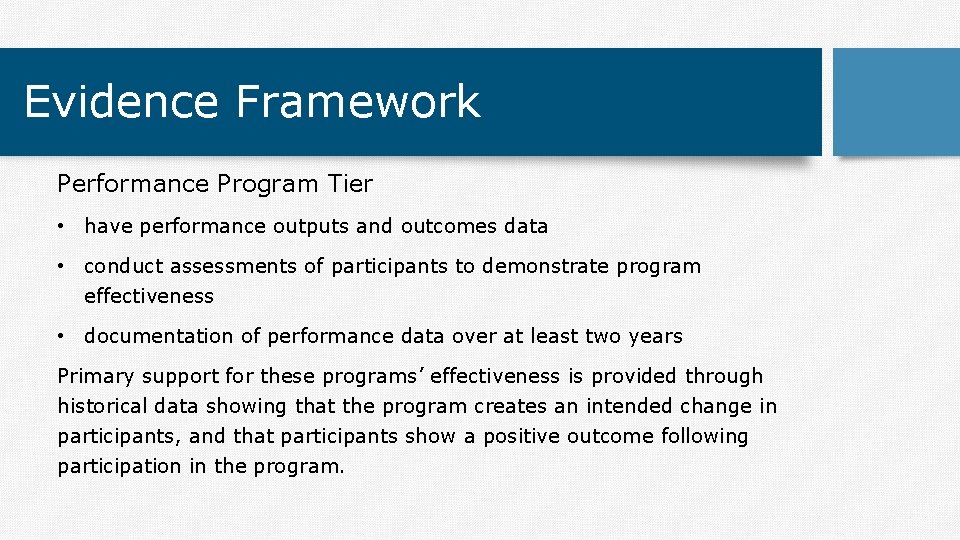
Evidence Framework Performance Program Tier • have performance outputs and outcomes data • conduct assessments of participants to demonstrate program effectiveness • documentation of performance data over at least two years Primary support for these programs’ effectiveness is provided through historical data showing that the program creates an intended change in participants, and that participants show a positive outcome following participation in the program.
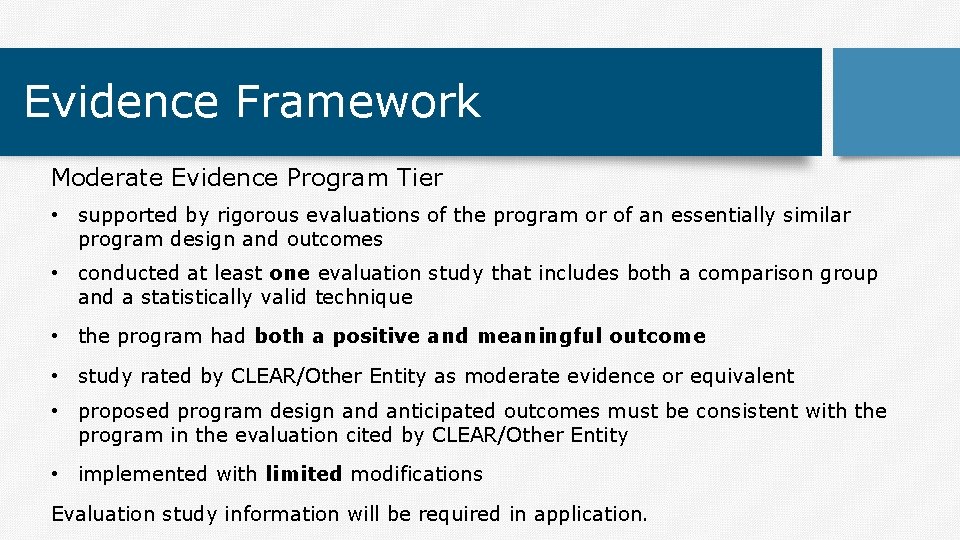
Evidence Framework Moderate Evidence Program Tier • supported by rigorous evaluations of the program or of an essentially similar program design and outcomes • conducted at least one evaluation study that includes both a comparison group and a statistically valid technique • the program had both a positive and meaningful outcome • study rated by CLEAR/Other Entity as moderate evidence or equivalent • proposed program design and anticipated outcomes must be consistent with the program in the evaluation cited by CLEAR/Other Entity • implemented with limited modifications Evaluation study information will be required in application.
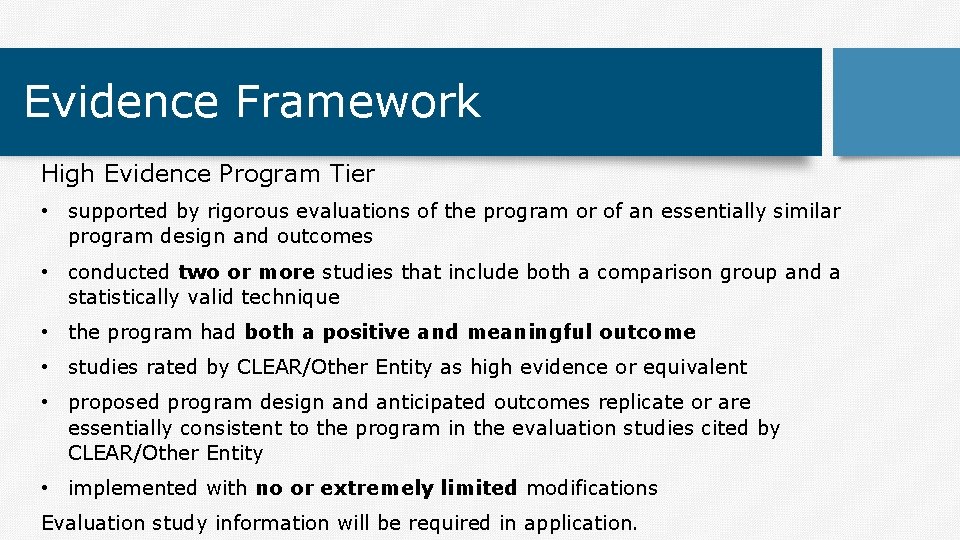
Evidence Framework High Evidence Program Tier • supported by rigorous evaluations of the program or of an essentially similar program design and outcomes • conducted two or more studies that include both a comparison group and a statistically valid technique • the program had both a positive and meaningful outcome • studies rated by CLEAR/Other Entity as high evidence or equivalent • proposed program design and anticipated outcomes replicate or are essentially consistent to the program in the evaluation studies cited by CLEAR/Other Entity • implemented with no or extremely limited modifications Evaluation study information will be required in application.
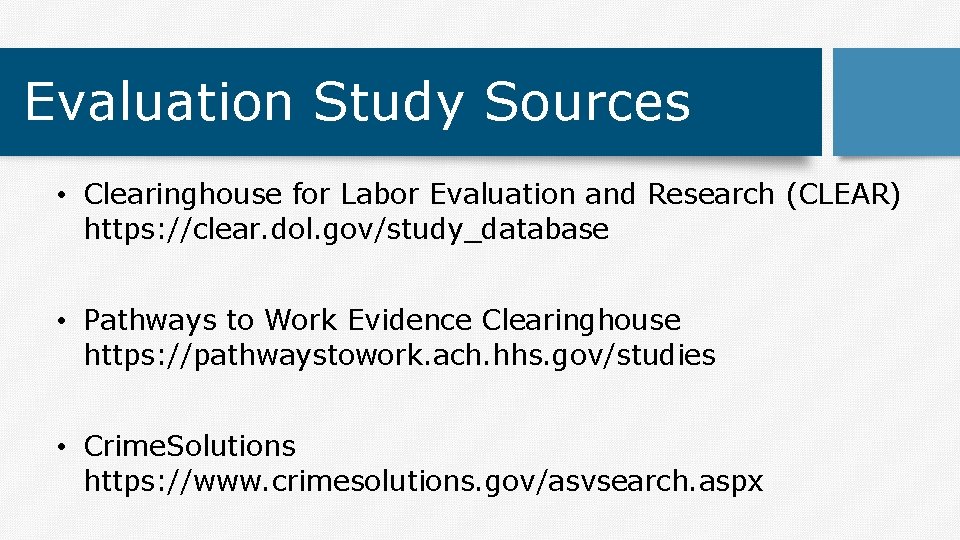
Evaluation Study Sources • Clearinghouse for Labor Evaluation and Research (CLEAR) https: //clear. dol. gov/study_database • Pathways to Work Evidence Clearinghouse https: //pathwaystowork. ach. hhs. gov/studies • Crime. Solutions https: //www. crimesolutions. gov/asvsearch. aspx
Polling Question #4 If you were to apply to a current and familiar RFA, where would you place yourself on the evidence continuum? • New Program Tier • Experience Program Tier • Performance Program Tier • Moderate Evidence Program Tier • High Evidence Program Tier
Evidence Framework • Why now? • Building Evidence for the Future
Polling Question #5 Do you see the benefits of using an evidence-based approach? • Yes, we’re ready! • We’re not quite there but we’ll review the evidence-based RFAs when they’re published! • We’ll be ready next year!
Q+A • What are your questions?
Contact Us Email us at evidence@twc. texas. gov Thank you for joining us!
- Slides: 31