
Texas Instruments Introduction to Direct RF Sampling Lecture

- Slides: 22
Texas Instruments Introduction to Direct RF Sampling Lecture 1 L 1 -1
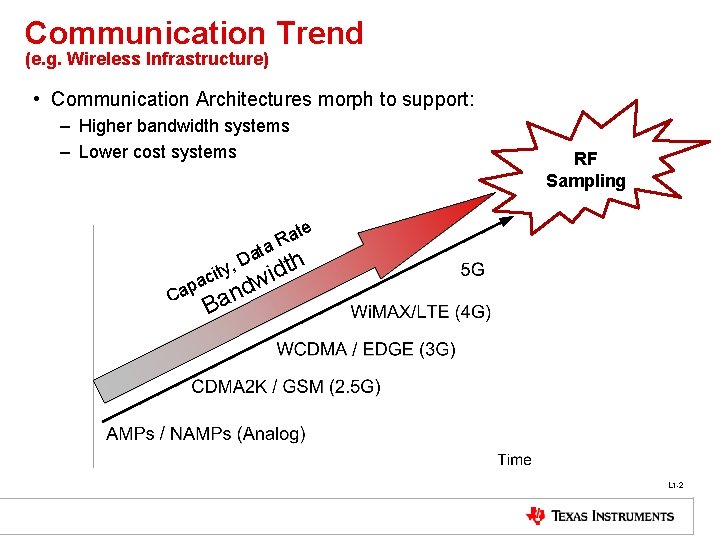
Communication Trend (e. g. Wireless Infrastructure) • Communication Architectures morph to support: – Higher bandwidth systems – Lower cost systems Ca p ac te a a. R at D ity, RF Sampling th d i w d n Ba L 1 -2
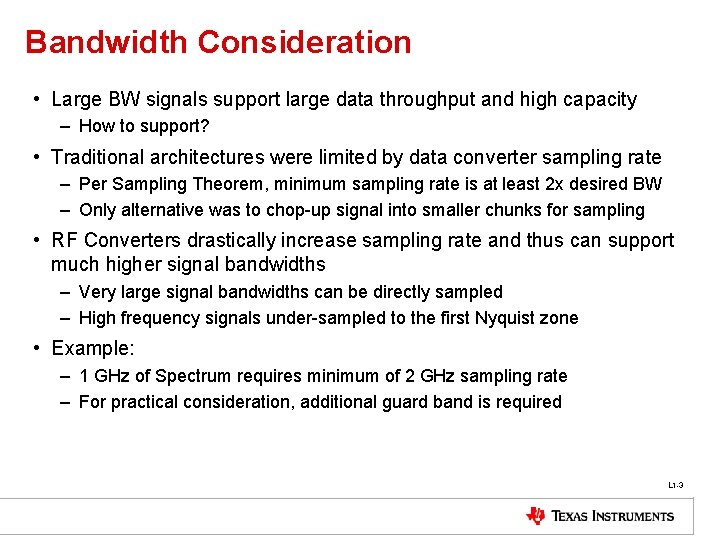
Bandwidth Consideration • Large BW signals support large data throughput and high capacity – How to support? • Traditional architectures were limited by data converter sampling rate – Per Sampling Theorem, minimum sampling rate is at least 2 x desired BW – Only alternative was to chop-up signal into smaller chunks for sampling • RF Converters drastically increase sampling rate and thus can support much higher signal bandwidths – Very large signal bandwidths can be directly sampled – High frequency signals under-sampled to the first Nyquist zone • Example: – 1 GHz of Spectrum requires minimum of 2 GHz sampling rate – For practical consideration, additional guard band is required L 1 -3
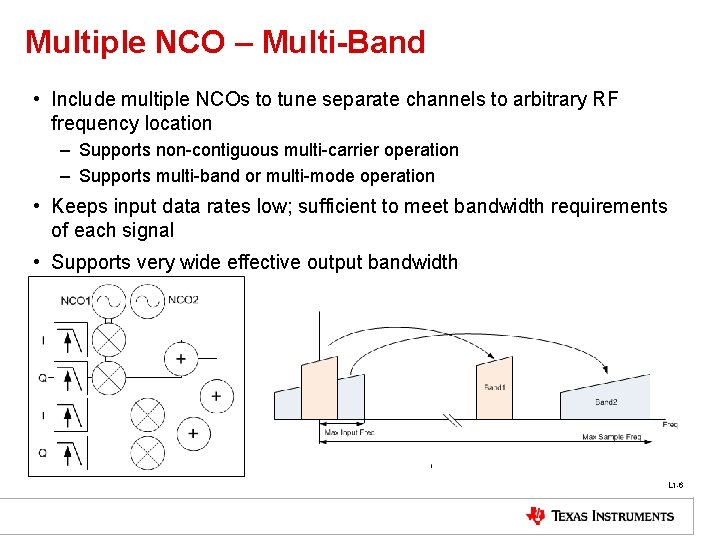
High Bandwidth - Multi-band Operation • Signal BW does not need to be contiguous – i. e. Two smaller BW signal separated in frequency can be considered as one larger signal BW • RF Sampling solution provides a mechanism to support multiple bands, each with arbitrary signal bandwidth and with variable spacing L 1 -4
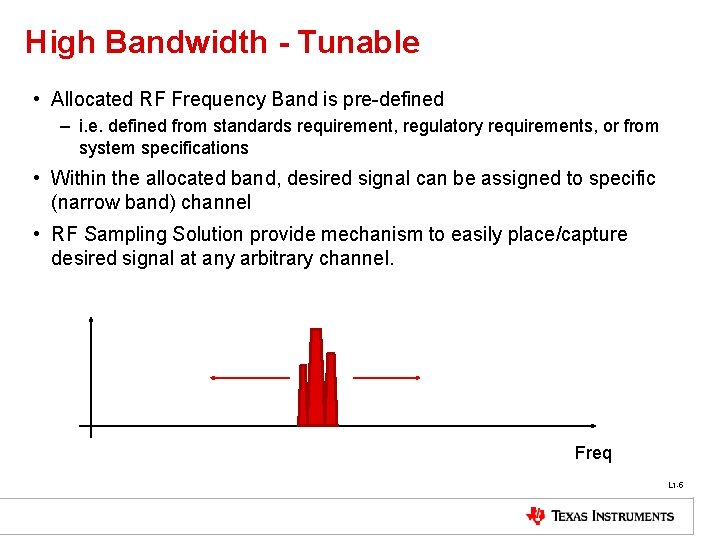
High Bandwidth - Tunable • Allocated RF Frequency Band is pre-defined – i. e. defined from standards requirement, regulatory requirements, or from system specifications • Within the allocated band, desired signal can be assigned to specific (narrow band) channel • RF Sampling Solution provide mechanism to easily place/capture desired signal at any arbitrary channel. Freq L 1 -5
Multiple NCO – Multi-Band • Include multiple NCOs to tune separate channels to arbitrary RF frequency location – Supports non-contiguous multi-carrier operation – Supports multi-band or multi-mode operation • Keeps input data rates low; sufficient to meet bandwidth requirements of each signal • Supports very wide effective output bandwidth L 1 -6
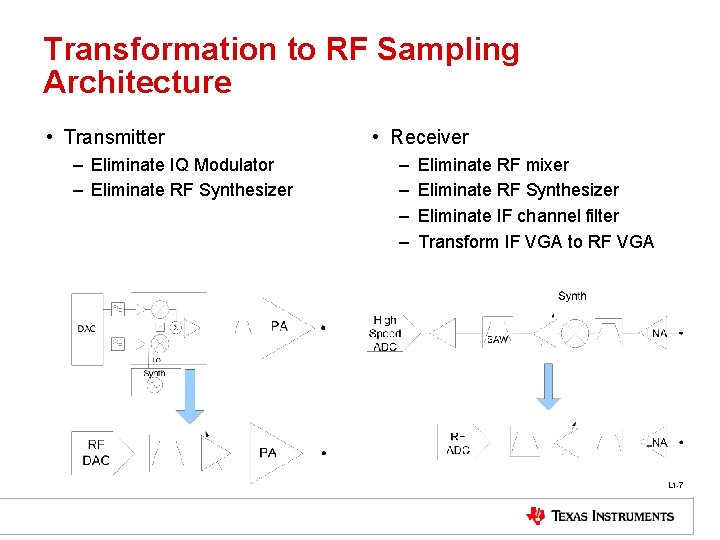
Transformation to RF Sampling Architecture • Transmitter – Eliminate IQ Modulator – Eliminate RF Synthesizer • Receiver – – Eliminate RF mixer Eliminate RF Synthesizer Eliminate IF channel filter Transform IF VGA to RF VGA L 1 -7
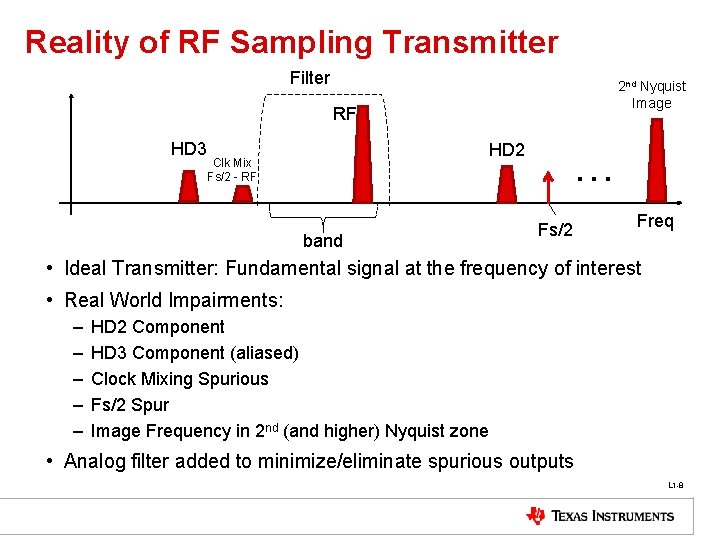
Reality of RF Sampling Transmitter Filter 2 nd Nyquist Image RF HD 3 HD 2 Clk Mix Fs/2 - RF band … Fs/2 Freq • Ideal Transmitter: Fundamental signal at the frequency of interest • Real World Impairments: – – – HD 2 Component HD 3 Component (aliased) Clock Mixing Spurious Fs/2 Spur Image Frequency in 2 nd (and higher) Nyquist zone • Analog filter added to minimize/eliminate spurious outputs L 1 -8
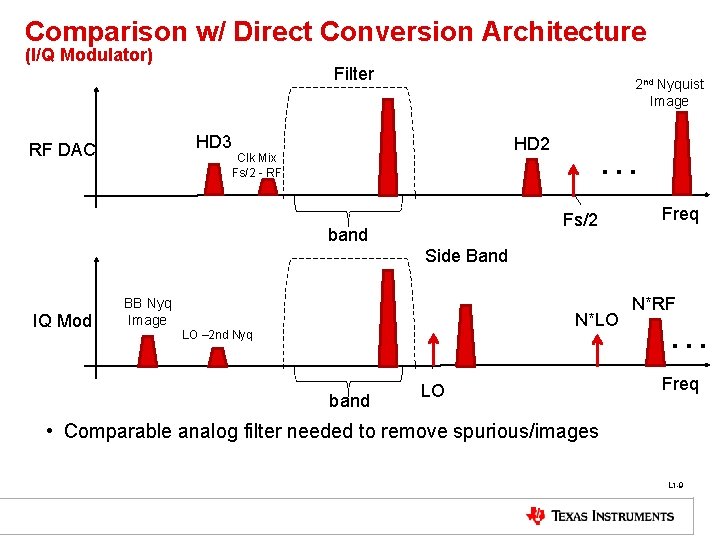
Comparison w/ Direct Conversion Architecture (I/Q Modulator) Filter HD 3 RF DAC 2 nd Nyquist Image HD 2 Clk Mix Fs/2 - RF … Fs/2 band Freq Side Band IQ Mod BB Nyq Image N*LO LO – 2 nd Nyq band LO N*RF … Freq • Comparable analog filter needed to remove spurious/images L 1 -9
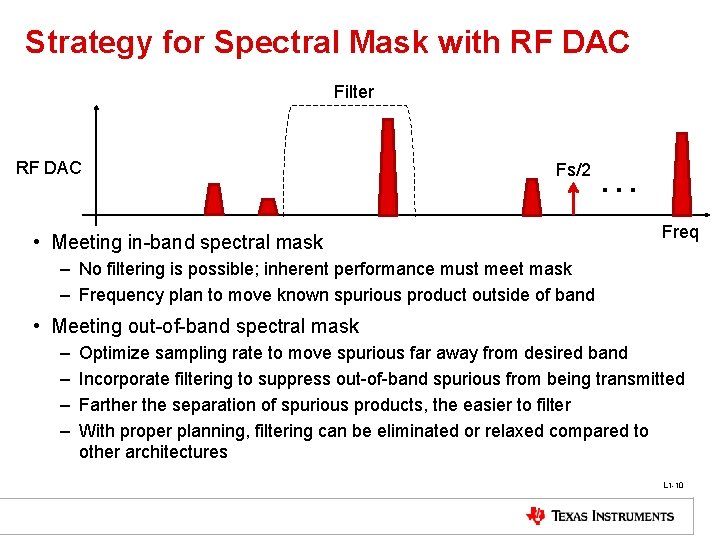
Strategy for Spectral Mask with RF DAC Filter RF DAC Fs/2 • Meeting in-band spectral mask … Freq – No filtering is possible; inherent performance must meet mask – Frequency plan to move known spurious product outside of band • Meeting out-of-band spectral mask – – Optimize sampling rate to move spurious far away from desired band Incorporate filtering to suppress out-of-band spurious from being transmitted Farther the separation of spurious products, the easier to filter With proper planning, filtering can be eliminated or relaxed compared to other architectures L 1 -10
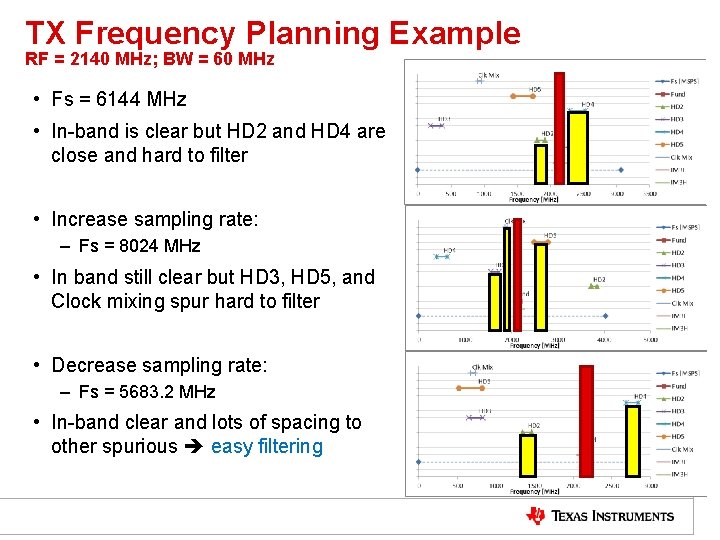
TX Frequency Planning Example RF = 2140 MHz; BW = 60 MHz • Fs = 6144 MHz • In-band is clear but HD 2 and HD 4 are close and hard to filter • Increase sampling rate: – Fs = 8024 MHz • In band still clear but HD 3, HD 5, and Clock mixing spur hard to filter • Decrease sampling rate: – Fs = 5683. 2 MHz • In-band clear and lots of spacing to other spurious easy filtering 11
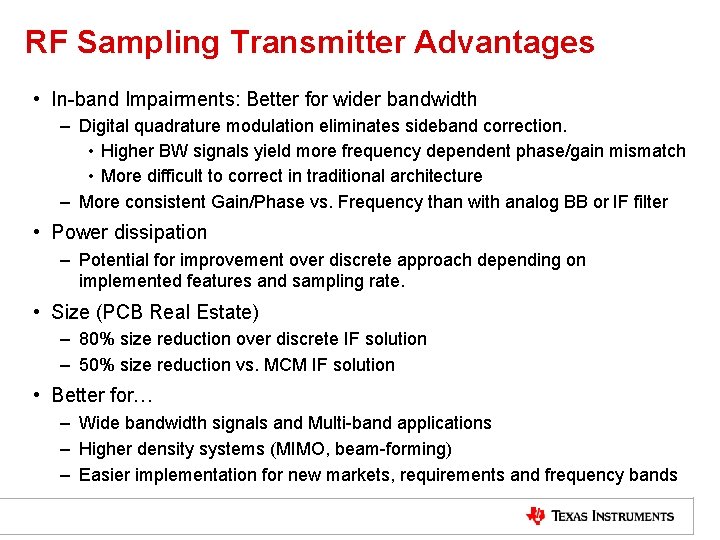
RF Sampling Transmitter Advantages • In-band Impairments: Better for wider bandwidth – Digital quadrature modulation eliminates sideband correction. • Higher BW signals yield more frequency dependent phase/gain mismatch • More difficult to correct in traditional architecture – More consistent Gain/Phase vs. Frequency than with analog BB or IF filter • Power dissipation – Potential for improvement over discrete approach depending on implemented features and sampling rate. • Size (PCB Real Estate) – 80% size reduction over discrete IF solution – 50% size reduction vs. MCM IF solution • Better for… – Wide bandwidth signals and Multi-band applications – Higher density systems (MIMO, beam-forming) – Easier implementation for new markets, requirements and frequency bands
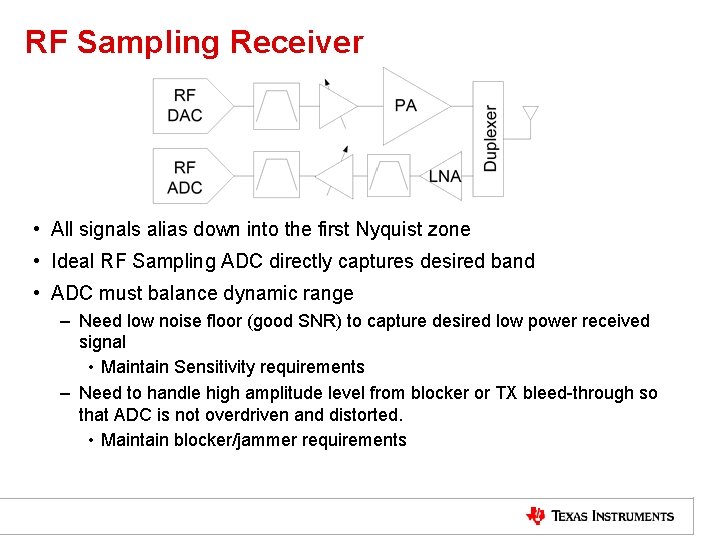
RF Sampling Receiver • All signals alias down into the first Nyquist zone • Ideal RF Sampling ADC directly captures desired band • ADC must balance dynamic range – Need low noise floor (good SNR) to capture desired low power received signal • Maintain Sensitivity requirements – Need to handle high amplitude level from blocker or TX bleed-through so that ADC is not overdriven and distorted. • Maintain blocker/jammer requirements
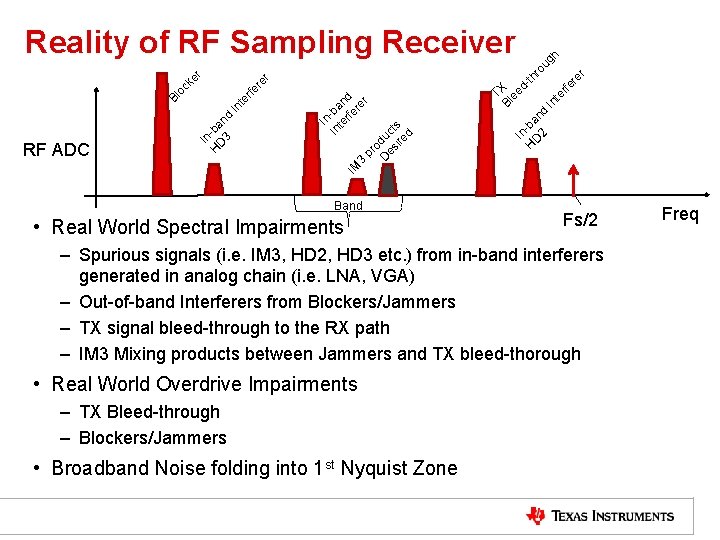
te rfe re r ro In In H -ba D n 2 d T Bl X ee d- IM 3 pr o D du es ct ire s d In In -ba te n rfe d re r te rfe re r In In H -ba D n 3 d th r ke oc Bl RF ADC ug h Reality of RF Sampling Receiver Band • Real World Spectral Impairments Fs/2 – Spurious signals (i. e. IM 3, HD 2, HD 3 etc. ) from in-band interferers generated in analog chain (i. e. LNA, VGA) – Out-of-band Interferers from Blockers/Jammers – TX signal bleed-through to the RX path – IM 3 Mixing products between Jammers and TX bleed-thorough • Real World Overdrive Impairments – TX Bleed-through – Blockers/Jammers • Broadband Noise folding into 1 st Nyquist Zone Freq
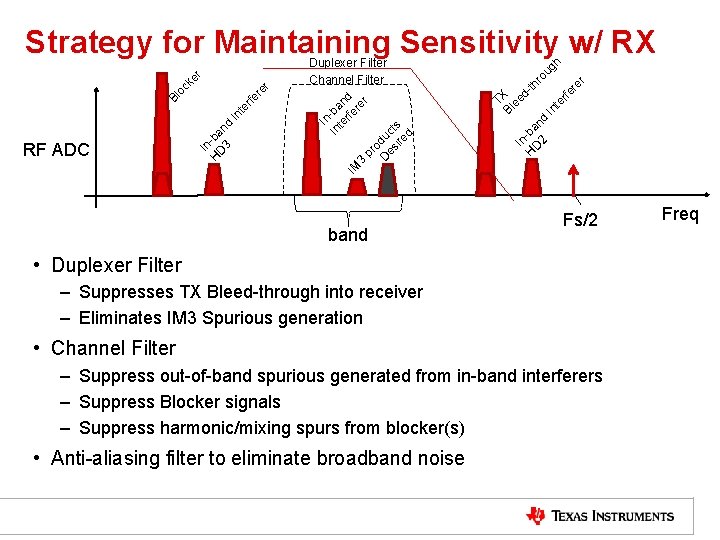
te rfe re r ro In T Bl X ee dth In H -ba D n 2 d pr o D du es ct ire s d In In -ba te n rfe d re r IM 3 RF ADC In H -ba D n 3 d In Bl oc te rfe re r ke r Duplexer Filter Channel Filter ug h Strategy for Maintaining Sensitivity w/ RX band Fs/2 • Duplexer Filter – Suppresses TX Bleed-through into receiver – Eliminates IM 3 Spurious generation • Channel Filter – Suppress out-of-band spurious generated from in-band interferers – Suppress Blocker signals – Suppress harmonic/mixing spurs from blocker(s) • Anti-aliasing filter to eliminate broadband noise Freq
RF Sampling ADC - Frequency Planning • Spurs from out-of-band interferers or TX bleed-through – Proper filtering can minimize or eliminate these threats • Spurs from in-band interferers – Can not filter these signal out – Need to frequency plan around • Higher sampling rate affords flexibility in frequency planning around troublesome harmonic and spurious products • Frequency planning in High IF systems – Choose available sampling rate converter – Optimize IF location for best results • Frequency Planning in RF Sampling – Can not choose location of RF signal; this is fixed – Optimize sampling rate to achieve best results
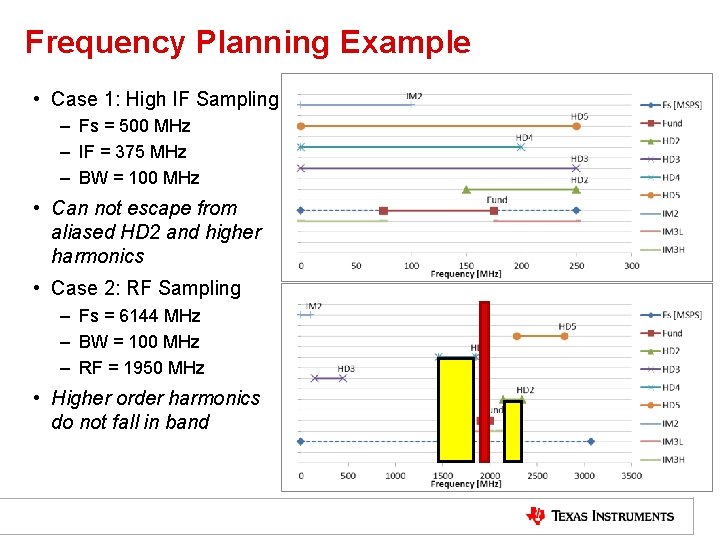
Frequency Planning Example • Case 1: High IF Sampling – Fs = 500 MHz – IF = 375 MHz – BW = 100 MHz • Can not escape from aliased HD 2 and higher harmonics • Case 2: RF Sampling – Fs = 6144 MHz – BW = 100 MHz – RF = 1950 MHz • Higher order harmonics do not fall in band 17
RF Sampling Receiver Advantages • Spectral Performance – Support wide bandwidth signals (or multi-mode) – Frequency agile – Digital features like decimation can minimize filter requirements • Power dissipation – Power dissipation improvement possible by eliminating mixer and RF synthesizer components (depending on digital features/sampling rate). • Size (PCB Real Estate) – Size reduction over discrete IF solution • Better for… – Wide bandwidth signals, Multi-band applications, and DPD feedback – Higher density systems (MIMO, beam-forming) – Easier implementation for multiple standards
Input Data Rates • Higher sampling rates required for sampling at RF and for frequency planning around spurious • Data rates can not operate at those speeds – Limited by processor or FPGA rate – Limited by available I/O on the device • Implement – Interpolation/Decimation in order to keep data rates reasonable – NCO (Numerically Controlled Oscillator) to move desired signal to any required band • Rule of thumb: – Select data rate to support bandwidth of the signal – Select sampling rate to support output frequency band spectral purity L 1 -19
System Challenges for RF Sampling • Digital Interface – High data rates needed to support high bandwidth signals – Incorporate interpolation/decimation filters to maintain reasonable rates • Clocking – Requires high frequency, low phase noise sampling clock • Challenging to generate and route across board • Challenging for multi-device synchronization – Incorporate an optional internal PLL/VCO to generate required clock on-chip • Spectral Performance – Low order harmonics • Frequency plan around troublesome spurious when possible • Maintain low spurious generation where frequency planning not possible – High order harmonics • Cannot frequency plan around these • Must rely on design to meet requirement L 1 -20
Overall System Benefits for RF Sampling • Support higher bandwidth signals that were previously not possible • Support for a frequency agile architecture – One design can service many bands, standards, etc. • Digital features allow for additional flexibility in controlling the signals and manipulating the channel • Filtering schemes can be relaxed in many cases and potentially eliminated • Multiple devices/line-ups can be more easily synchronized together to build more complex systems – Large Radar Arrays – Beam-forming Antennas – Massive MIMO L 1 -21
Texas Instruments End of Lecture 1