
Texas Instruments High Speed Amplifiers Simple Transimpedance Designs
- Slides: 44
Texas Instruments High Speed Amplifiers Simple Transimpedance Designs Using High Speed Op Amps November, 2014 Michael Steffes/Xavier Ramus 1
Agenda • Basic Issues • Detailed Design equations • Examples of Simple Design • Advanced Transimpedance Designs • Measuring Frequency response for Capacitive source circuits • Detecting and amplifying the often very small current signal coming from a photodiode, can present a considerable challenge. The achievable gain, bandwidth, and input referred noise current are all coupled together in a few design variables. • Most of this material comes from a series of articles referenced at the end where that material is also summarized in TI application note SBOA 122. • Many of the slides include more detail in the notes pages.
Design Issues Covered 1. Op Amp based, high performance, transimpedance designs can be analyzed using a single pole op-amp model to give a 2 nd order closed loop transfer function. Although the full transfer function doesn’t suggest a design approach, some judicious simplifications will lead to a very simple, and accurate, amplifier compensation methodology. 2. A simple equivalent input noise current equation, correctly including all of the high frequency terms (but neglecting 1/f effects), will allow an easy comparison between design solutions for their achievable sensitivity
Transimpedance Design (cont. ) • Numerous articles and discussion in the literature - several key misconceptions have complicated this application for many designers. • Unity gain stability in the op amp is not required - a lot of literature suggests that it is. • Feedback compensation is required even if a unity gain stable op amp is used. • Many applications have an output noise spectrum dominated by the effect of the input noise voltage (not current) gained up to the output by the differentiator formed by the diode capacitance at the inverting node and the feedback resistor - this is often neglected. • Putting the feedback pole at the intersection of the noise gain zero and the open loop gain curve is ideal? This is actually incorrect and yields a closed loop 2 nd-order response with a Q ≈ 1 giving a step response that will overshoot and/or a frequency response that is peaking 1. 25 d. B.
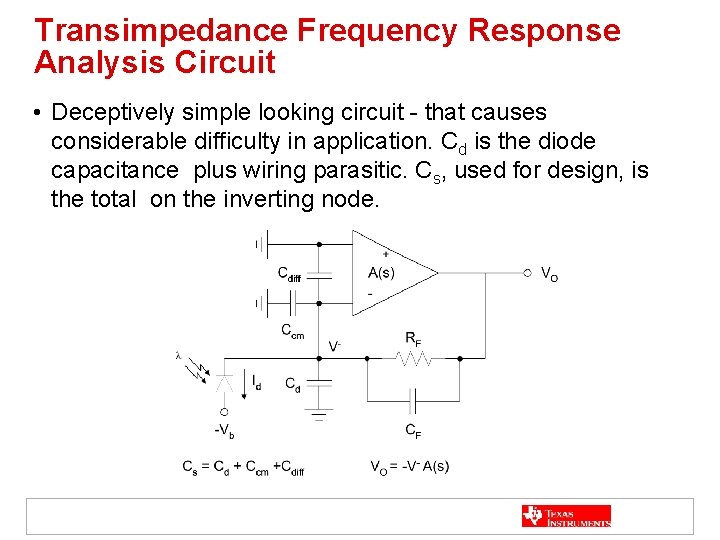
Transimpedance Frequency Response Analysis Circuit • Deceptively simple looking circuit - that causes considerable difficulty in application. Cd is the diode capacitance plus wiring parasitic. Cs, used for design, is the total on the inverting node.
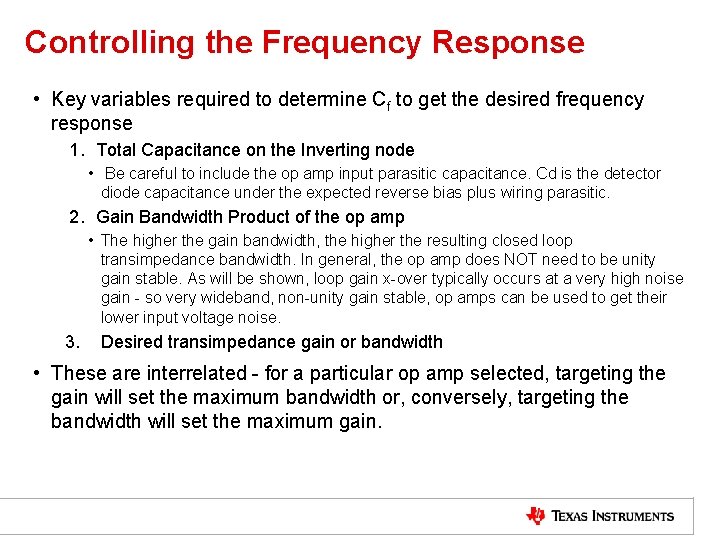
Controlling the Frequency Response • Key variables required to determine Cf to get the desired frequency response 1. Total Capacitance on the Inverting node • Be careful to include the op amp input parasitic capacitance. Cd is the detector diode capacitance under the expected reverse bias plus wiring parasitic. 2. Gain Bandwidth Product of the op amp • The higher the gain bandwidth, the higher the resulting closed loop transimpedance bandwidth. In general, the op amp does NOT need to be unity gain stable. As will be shown, loop gain x-over typically occurs at a very high noise gain - so very wideband, non-unity gain stable, op amps can be used to get their lower input voltage noise. 3. Desired transimpedance gain or bandwidth • These are interrelated - for a particular op amp selected, targeting the gain will set the maximum bandwidth or, conversely, targeting the bandwidth will set the maximum gain.
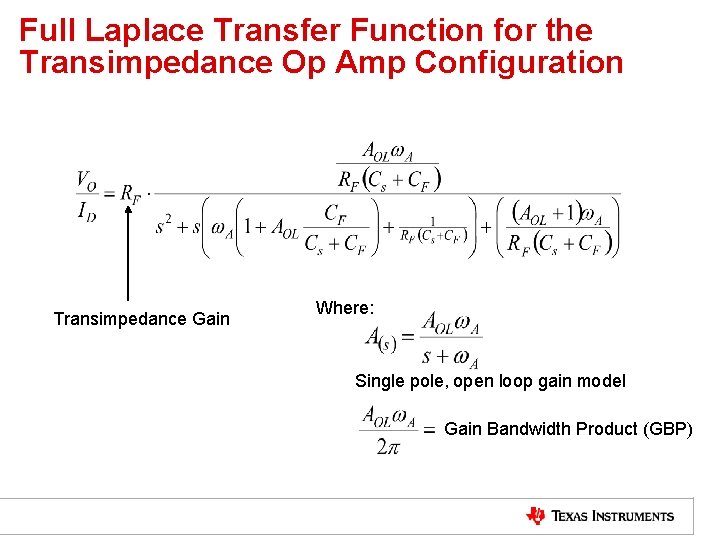
Full Laplace Transfer Function for the Transimpedance Op Amp Configuration Transimpedance Gain Where: Single pole, open loop gain model Gain Bandwidth Product (GBP)
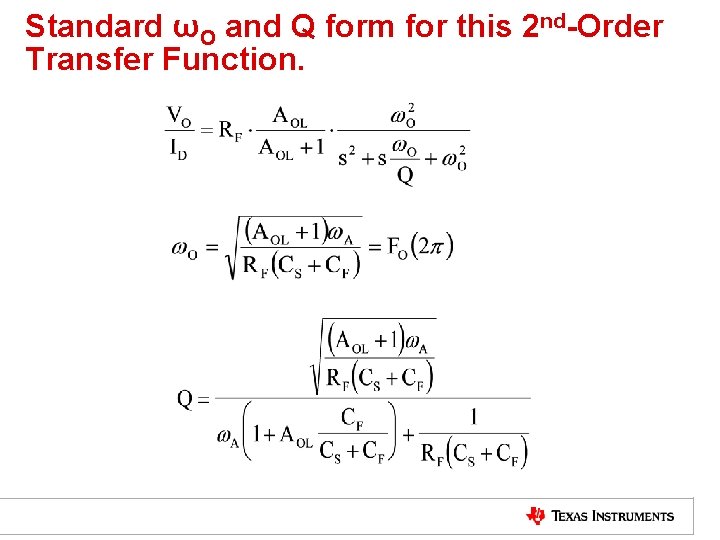
Standard ωO and Q form for this 2 nd-Order Transfer Function.
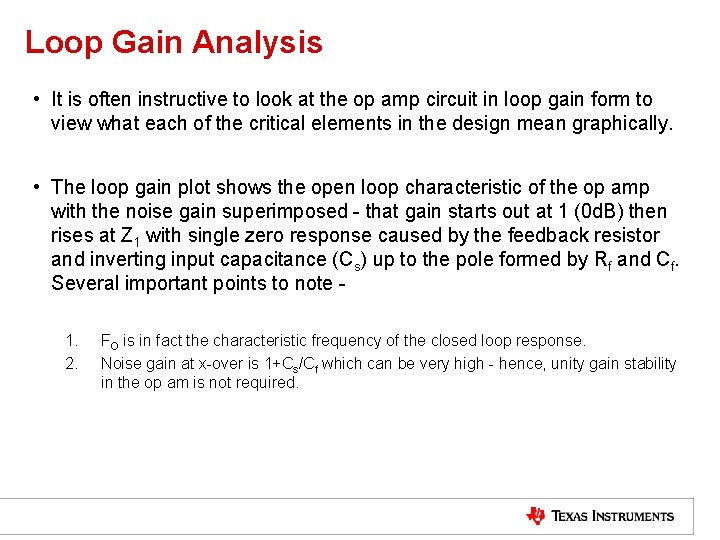
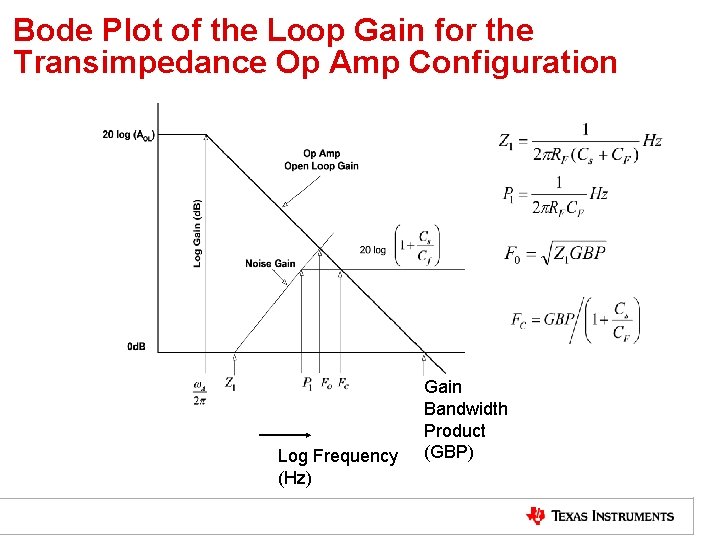
Loop Gain Analysis • It is often instructive to look at the op amp circuit in loop gain form to view what each of the critical elements in the design mean graphically. • The loop gain plot shows the open loop characteristic of the op amp with the noise gain superimposed - that gain starts out at 1 (0 d. B) then rises at Z 1 with single zero response caused by the feedback resistor and inverting input capacitance (Cs) up to the pole formed by Rf and Cf. Several important points to note 1. 2. FO is in fact the characteristic frequency of the closed loop response. Noise gain at x-over is 1+Cs/Cf which can be very high - hence, unity gain stability in the op am is not required.
Bode Plot of the Loop Gain for the Transimpedance Op Amp Configuration Log Frequency (Hz) Gain Bandwidth Product (GBP)
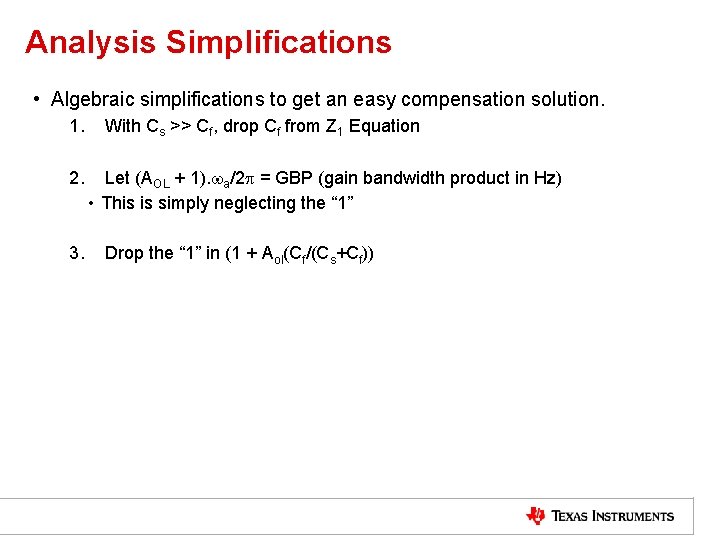
Analysis Simplifications • Algebraic simplifications to get an easy compensation solution. 1. 2. 3. With Cs >> Cf, drop Cf from Z 1 Equation Let (AOL + 1). wa/2 = GBP (gain bandwidth product in Hz) • This is simply neglecting the “ 1” Drop the “ 1” in (1 + Aol(Cf/(Cs+Cf))
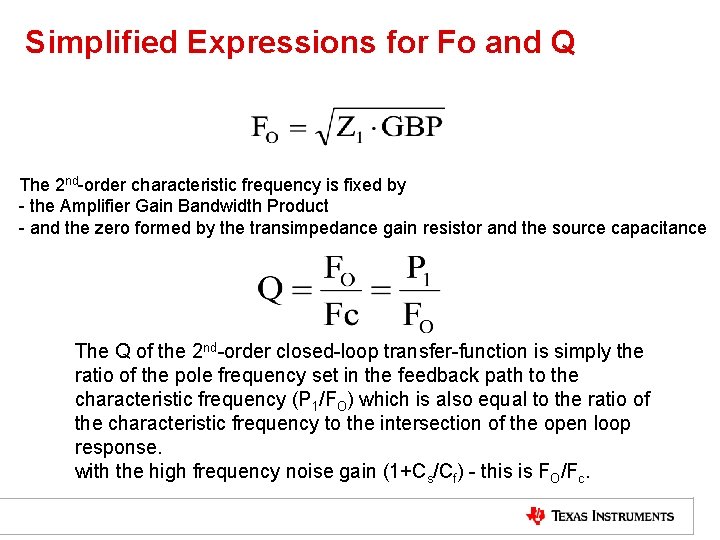
Simplified Expressions for Fo and Q The 2 nd-order characteristic frequency is fixed by - the Amplifier Gain Bandwidth Product - and the zero formed by the transimpedance gain resistor and the source capacitance The Q of the 2 nd-order closed-loop transfer-function is simply the ratio of the pole frequency set in the feedback path to the characteristic frequency (P 1/FO) which is also equal to the ratio of the characteristic frequency to the intersection of the open loop response. with the high frequency noise gain (1+Cs/Cf) - this is FO/Fc.
Design Methodology • The next slide steps through finding the maximum available transimpedance gain for a given op amp and diode if a maximally flat Butterworth response is the target design. This target is interesting in that if we set P 1 at 0. 707*FO, it circles back to give us a F-3 d. B equal to FO. Kind of unique and interesting design point. • More general targets with peaking can be designed using the initial equations. • A very useful alternative way to use these equations is to know your desired transimpedance gain and bandwidth and use them to solve for the minimum required GBP. Then the compensation capacitor (Cf) can be calculated using an amplifier with a GBP > than that minimum, along with this target transimpedance gain. The calculation for Cf is shown on the next slide.
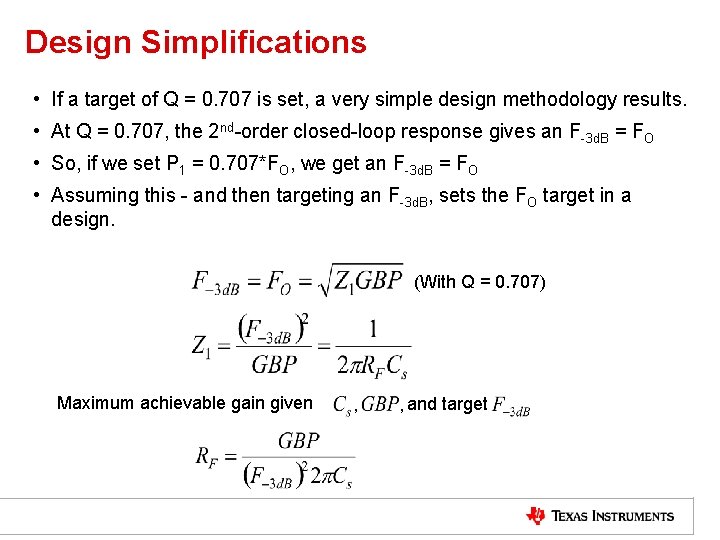
Design Simplifications • If a target of Q = 0. 707 is set, a very simple design methodology results. • At Q = 0. 707, the 2 nd-order closed-loop response gives an F-3 d. B = FO • So, if we set P 1 = 0. 707*FO, we get an F-3 d. B = FO • Assuming this - and then targeting an F-3 d. B, sets the FO target in a design. (With Q = 0. 707) Maximum achievable gain given , , and target
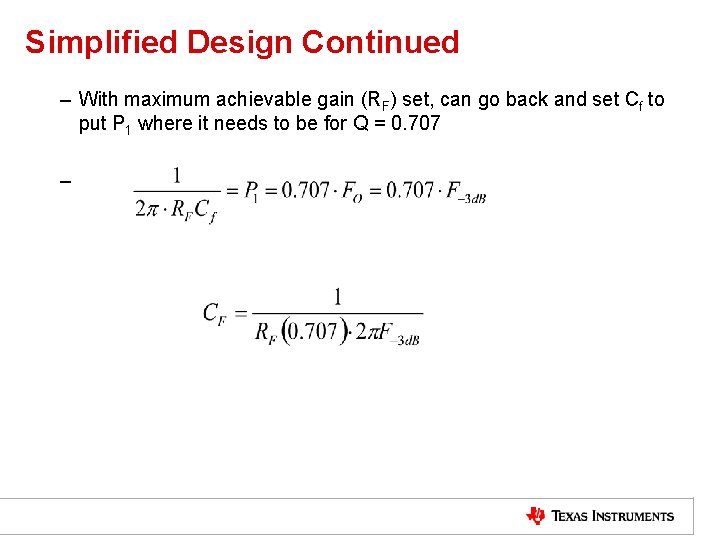
Simplified Design Continued – With maximum achievable gain (RF) set, can go back and set Cf to put P 1 where it needs to be for Q = 0. 707 –
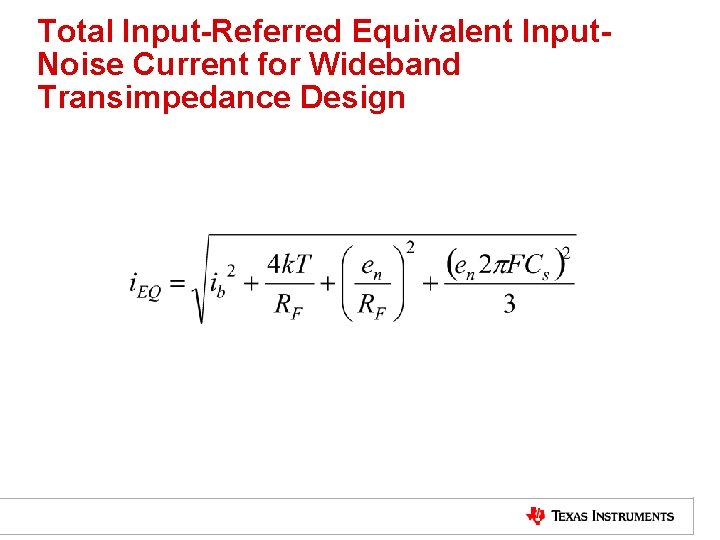
Total Equivalent Input Current Noise Calculation • The total input referred current noise equation that often appears in the High Speed Amplifier group de-compensated voltage feedback op amps uses several simplifying assumptions to arrive an approximate expression. Specifically 1. This is an integrated noise analysis that uses spot noise over frequency - not intended as a spot noise equation for narrowband applications. 2. We are assuming the application is DC-coupled, pulse oriented where the integrated noise is of interest. 3. The final signal bandwidth for both the transimpedance design and any post-filtering is >10 X the 1/f noise corner for any of the op amp noise terms - this allows those effects to be neglected for integrated noise purposes 4. While the amplifier must be compensated with a feedback capacitor, it is much simpler for noise calculation purposes to assume a noise power bandwidth lower than this that will be set further downstream in the signal path. This means the target transimpedance bandwidth should be set > than the bandwidth that will be set by post -filtering.
Total Input-Referred Equivalent Input. Noise Current for Wideband Transimpedance Design
Simplified Transimpedance Noise Analysis • A thorough expression for transimpedance output noise can be extremely complicated This principally arises from two issues – 1. Including 1/f effects in the analysis - neglecting those for broadband applications creates a slight error but considerable simplicity. 2. Allowing each noise term to be combined at the output with a frequency response set only by the transimpedance amplifier design itself. If we assume the transimpedance stage is designed to provide > than the desired final signal bandwidth, a post-filter downstream can be assumed for noise power bandwidth limiting purposes. That frequency “F” can then be used to calculate integrated noise.
Input Noise Terms • The input noise terms needed for a transimpedance design are shown on the next slide. These include – 1. Non-inverting input voltage noise (en - this will have a gain to the output of “ 1” at DC then increasing at 20 d. B/decade beyond (1/2 Rf. Cs)Hz which is the zero frequency (Z 1) in the noise gain. 2. Inverting input current noise (ibi) – 3. Feedback resistor noise voltage = (4 k. TRf) • These last two terms will, strictly speaking, have a response pole to the output set by P 1. Since we will be assuming a post-filter below P 1, we will neglect this internal band-limit and just apply an integration frequency of “F” to all the noise terms.
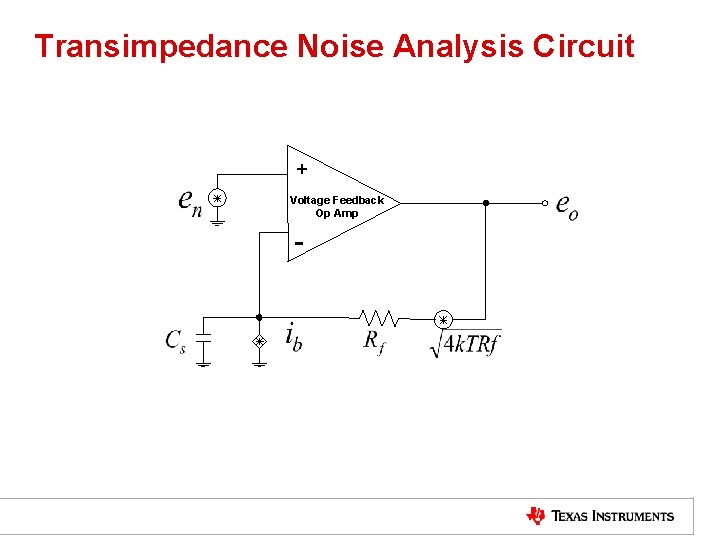
Transimpedance Noise Analysis Circuit + Voltage Feedback Op Amp -
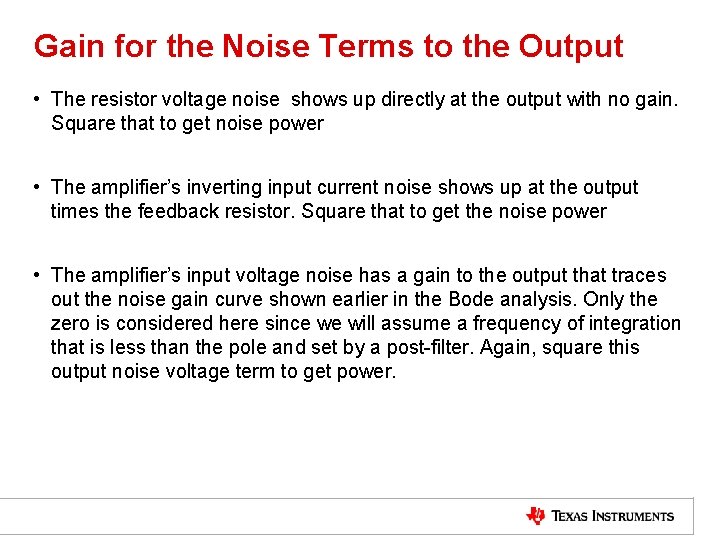
Gain for the Noise Terms to the Output • The resistor voltage noise shows up directly at the output with no gain. Square that to get noise power • The amplifier’s inverting input current noise shows up at the output times the feedback resistor. Square that to get the noise power • The amplifier’s input voltage noise has a gain to the output that traces out the noise gain curve shown earlier in the Bode analysis. Only the zero is considered here since we will assume a frequency of integration that is less than the pole and set by a post-filter. Again, square this output noise voltage term to get power.
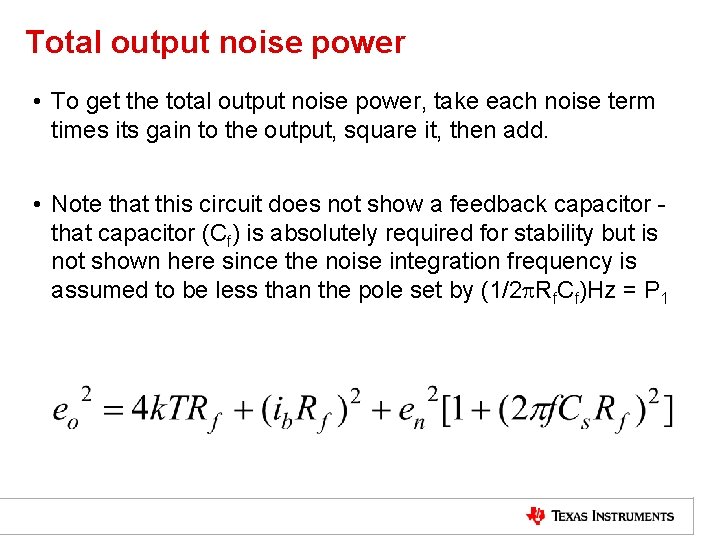
Total output noise power • To get the total output noise power, take each noise term times its gain to the output, square it, then add. • Note that this circuit does not show a feedback capacitor that capacitor (Cf) is absolutely required for stability but is not shown here since the noise integration frequency is assumed to be less than the pole set by (1/2 Rf. Cf)Hz = P 1
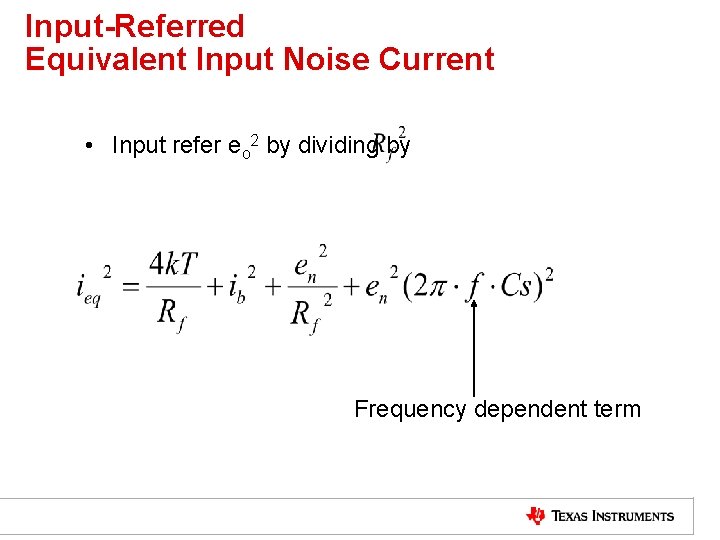
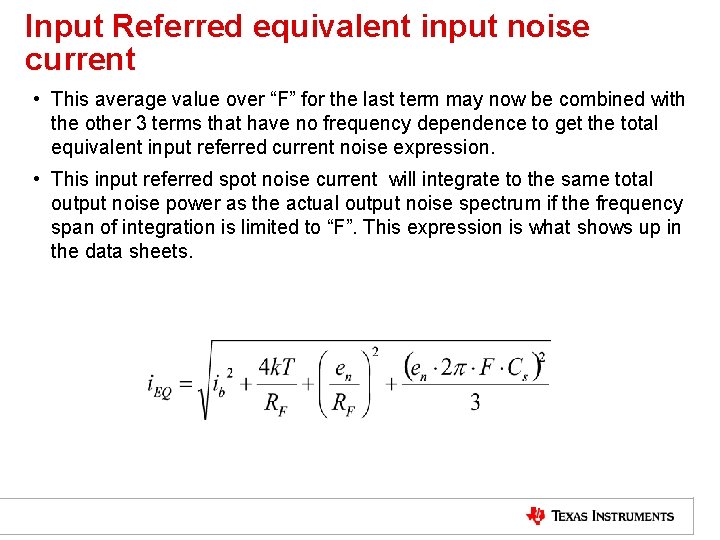
Input-Referred Equivalent Input Noise Current • Input refer eo 2 by dividing by Frequency dependent term
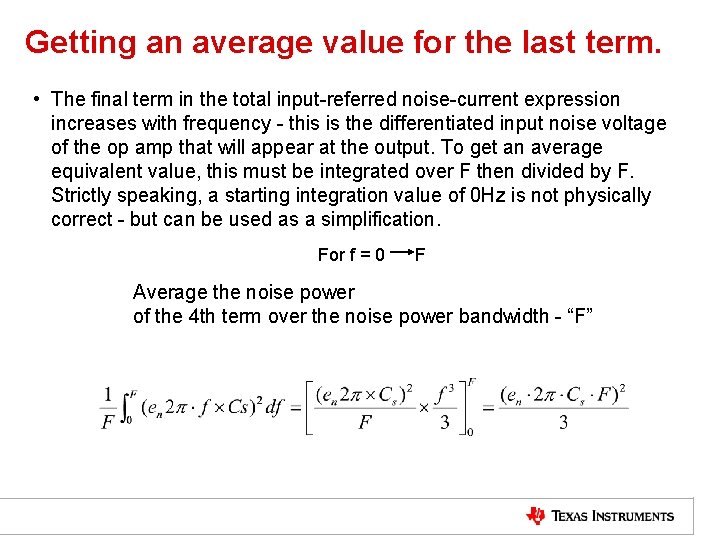
Getting an average value for the last term. • The final term in the total input-referred noise-current expression increases with frequency - this is the differentiated input noise voltage of the op amp that will appear at the output. To get an average equivalent value, this must be integrated over F then divided by F. Strictly speaking, a starting integration value of 0 Hz is not physically correct - but can be used as a simplification. For f = 0 F Average the noise power of the 4 th term over the noise power bandwidth - “F”
Input Referred equivalent input noise current • This average value over “F” for the last term may now be combined with the other 3 terms that have no frequency dependence to get the total equivalent input referred current noise expression. • This input referred spot noise current will integrate to the same total output noise power as the actual output noise spectrum if the frequency span of integration is limited to “F”. This expression is what shows up in the data sheets.
Equivalent Input Spot Current Noise for Output Noise Integrated to F < P 1
Design Examples - Getting a Target Bandwidth Given a Source Capacitance 1. Select an Op Amp with a particular GBP - include its input parasitic capacitance + the source diode capacitance to solve for Z 1 given the desired bandwidth and actual GBP. With Z 1 set, solve for achievable maximum gain, = Rf to get the minimum input referred noise current. 2. Set P 1 at Q * FO. Use this and Rf to solve for Cf. 3. Check that 1 + Cs/Cf > minimum stable gain for the op amp selected
Wideband VFB Op Amps Suitable for Transimpedance design
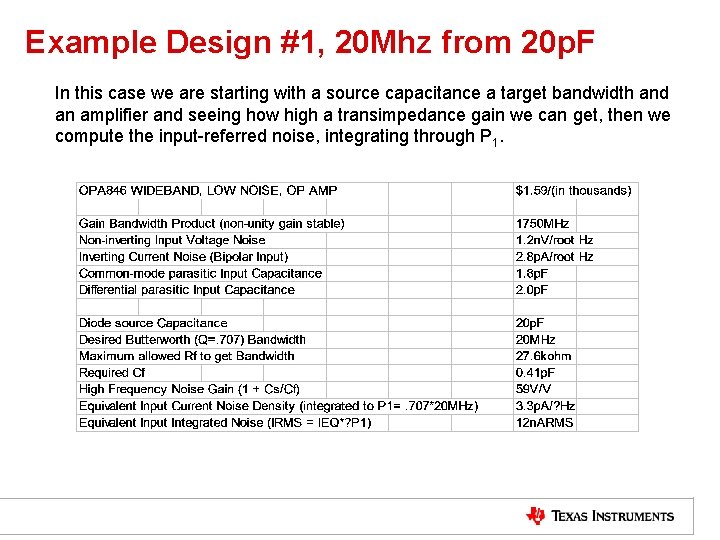
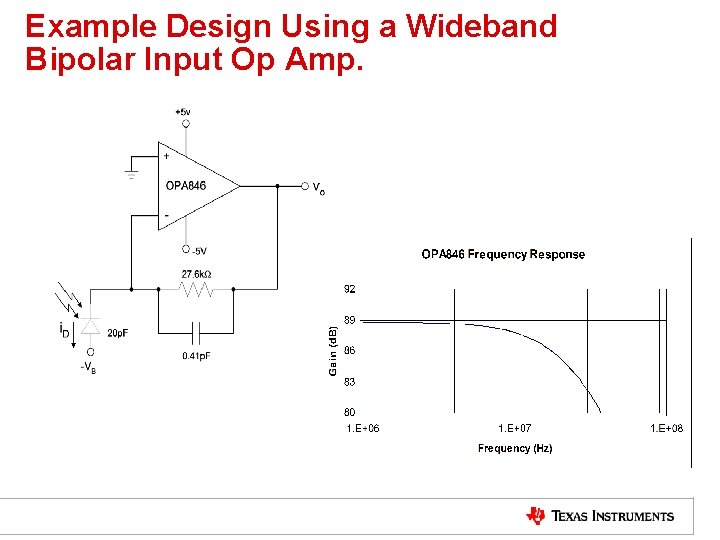
Example Design #1, 20 Mhz from 20 p. F In this case we are starting with a source capacitance a target bandwidth and an amplifier and seeing how high a transimpedance gain we can get, then we compute the input-referred noise, integrating through P 1.
Example Design Using a Wideband Bipolar Input Op Amp.
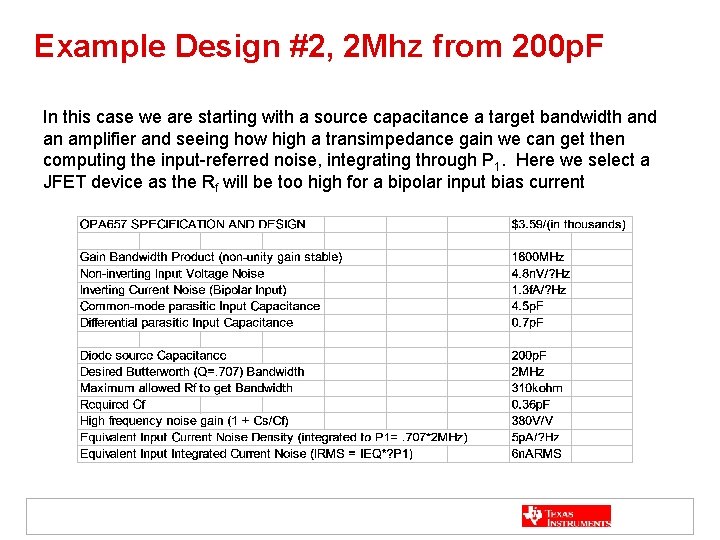
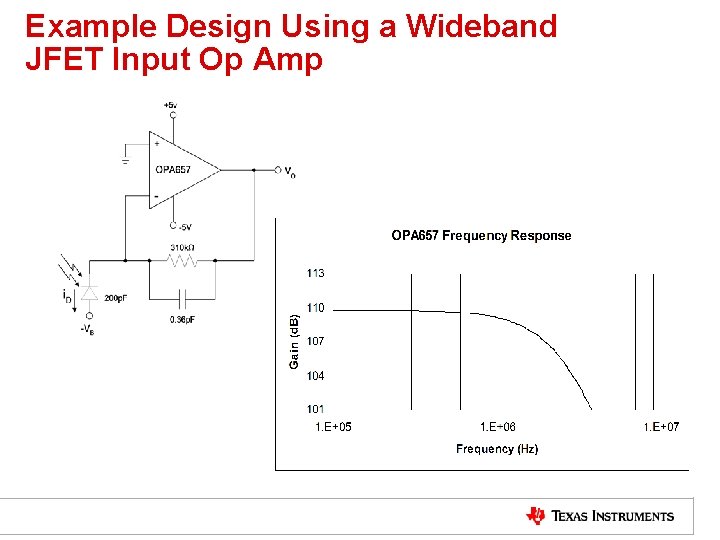
Example Design #2, 2 Mhz from 200 p. F In this case we are starting with a source capacitance a target bandwidth and an amplifier and seeing how high a transimpedance gain we can get then computing the input-referred noise, integrating through P 1. Here we select a JFET device as the Rf will be too high for a bipolar input bias current
Example Design Using a Wideband JFET Input Op Amp
Design Discussion • The OPA 657 design yielded 5 p. A equivalent input noise current if we assume a noise power bandwidth limit set to 1. 4 Mhz. This is totally dominated by the 3 rd-term of the total noise equation – the effect of the rising portion of the noise gain curve times the relatively high 4. 8 n. V input voltage noise for the OPA 657. • Repeating this design using the OPA 846, with its much lower voltage noise but much higher current noise, actually yielding a lower equivalent input noise current. – Specifically, the OPA 846 will give the same bandwidth and an input noise of 3 p. A vs. 5 p. A for the OPA 657. • So why don’t we use the OPA 846? ?
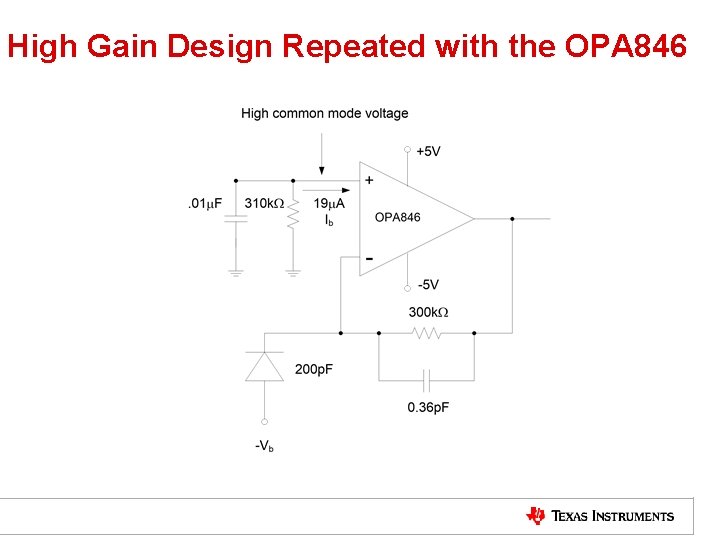
High Gain Design Repeated with the OPA 846
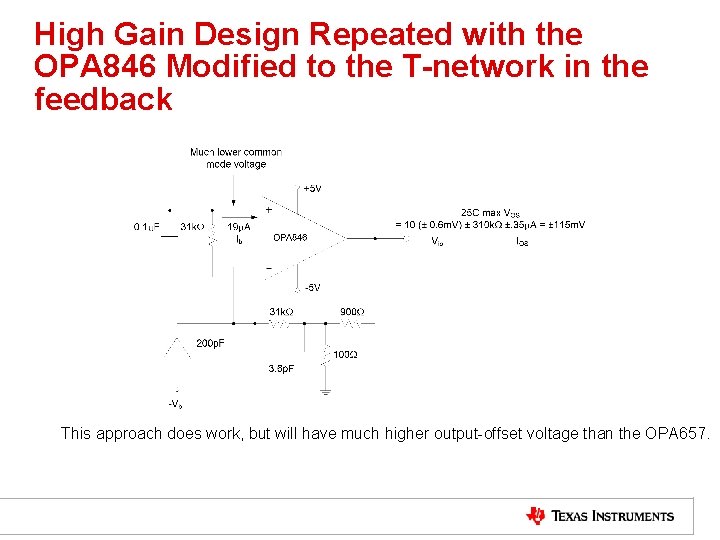
OPA 846 Options at 310 kΩ • If we look at the effect of the OPA 846’s 19 m. A input bias current using a 310 k. W feedback, we would see a 5. 89 V output-offset voltage. • Adding a 310 k. W resistor on the non-inverting input will allow bias current cancellation, but will now put a 5. 89 V common mode voltage on the inputs – which is out-of-range for a +/-5 V operation. • There is a way around this • The T-feedback structure has the interesting effect of also reducing the required input-matching resistor to get bias-current cancellation. This can be used to bring the input common mode voltage into range. • Whenever this bias current cancellation is used for a transimpedance design, it is imperative to decouple that resistor to kill its noise contribution.
Adapting a Transimpedance Design to the T-Feedback structure • Essentially, we implement an equivalent feedback impedance with an initial resistor out of the summing junction towards the output then implement a voltage divider that will have the effect of gaining up that impedance. • From an initial single resistor design, decide how much voltage divider gain you want, divide the original resistor by that value and multiply the compensation capacitor by that value. • The 310 kΩ design is adapted to the OPA 846 by using a gain of 10 V/V resistor divider – this will reduce the required bias current cancellation resistor to 31 kΩ significantly reducing the common-mode voltage generated by the input bias current. • That new circuit is shown on the next slide.
High Gain Design Repeated with the OPA 846 Modified to the T-network in the feedback This approach does work, but will have much higher output-offset voltage than the OPA 657.
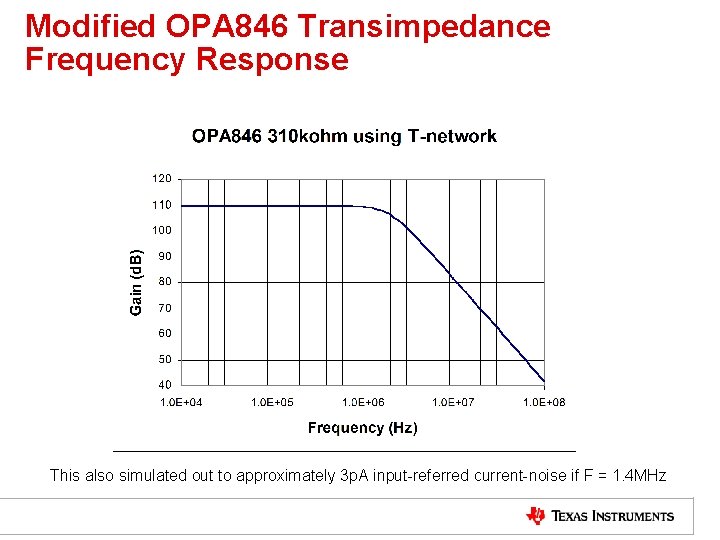
Modified OPA 846 Transimpedance Frequency Response This also simulated out to approximately 3 p. A input-referred current-noise if F = 1. 4 MHz
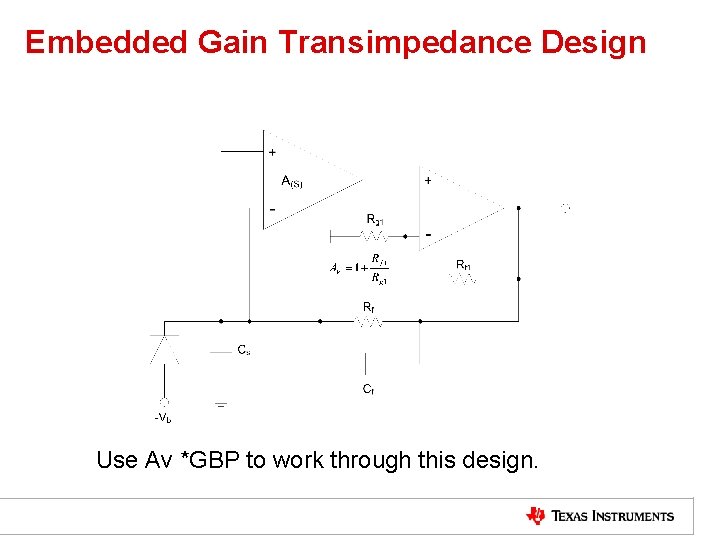
Increasing Performance of a Transimpedance Design. • If the required design does not reach the needed gain or bandwidth for a given detector capacitance, one way to improve performance without impacting noise too much is to use an imbedded gain stage. • Adding a wideband gain stage inside the loop increases the gain-bandwidth product directly. This allows either the bandwidth for a targeted gain to be increased or the gain for a targeted bandwidth to be increased at a square-root rate. • For instance, adding a gain of 4 inside the loop will give the option of either a doubled gain or bandwidth.
Embedded Gain Transimpedance Design Use Av *GBP to work through this design.
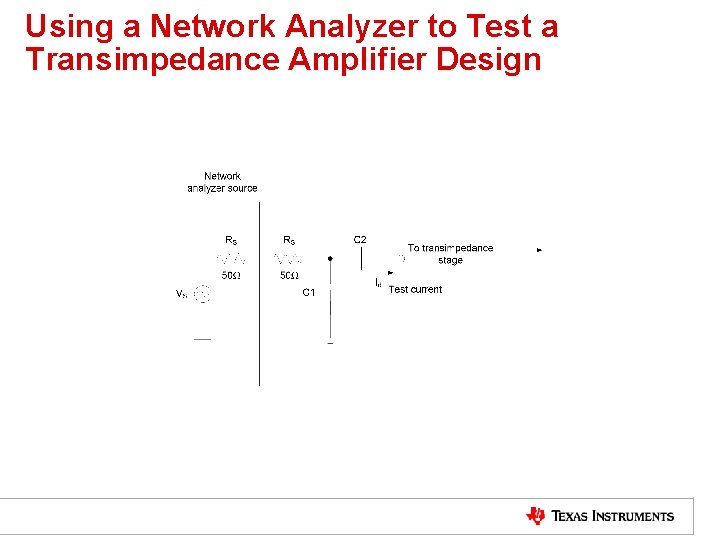
Using a Network Analyzer to Test a Transimpedance Amplifier Design • Often, the actual diode and its response is not well known. It is very useful to be able to separately test the AC performance of a proposed design. • This can be done using a network analyzer where it feeds first into a 50 ohm series resistor and then into a capacitive divider. • At higher frequencies, the capacitors short out and the network analyzer see its desired 50 ohm termination. • The caps. Act like a current divider sending a small portion of the current through the series 50 ohm into the series cap that connects to the circuit under test. • The apparent source impedance looking back into the circuit becomes the series capacitor at high frequency
Using a Network Analyzer to Test a Transimpedance Amplifier Design
Added Transimpedance Design Resources • 1. “Control Frequency Response and Noise in Broadband, Photo detector Transimpedance Amplifiers” Michael Steffes – EDN, Design Feature - July 4 th, 1996 pp 113 -125 • 2. ”Embedded gain supercharges FET- transimpedance amplifier”. Michael Steffes – EDN, Design Feature – May 22 nd, 1997 pp 129 -142 • 3. “Here’s an Easy Way to Test Wideband Transimpedance Amplifiers”. Michael Steffes – Electronic Design, Analog Application Issue - June 8 th, 1998 pp 74 -80 • “Transimpedance Considerations for High-Speed Operational Amplifiers”. Xavier Ramus – http: //focus. ti. com/general/docs/litabsmultiplefilelist. tsp? literature. Number=sboa 122 • High Speed Amplifiers offering from Texas Instruments that include a transimpedance design discussion and greater than 1. 5 GHz GBP. • • OPA 657, JFET Input, 1600 MHz Gain Bandwidth OPA 846, Gain of 7 stable, 1750 MHz Gain Bandwidth OPA 2846 dual, gain of 7 stable, 1750 MHz GBP OPA 847, Gain of 12 stable, 3900 MHz Gain Bandwidth
Conclusions for Transimpedance Compensation and Noise Analysis 1. The closed loop response is a 2 nd order low pass, where: 1. The characteristic frequency is always the geometric mean of the zero in the noise gain and the op amp’s gain bandwidth product. 2. Placing the feedback pole only changes the Q of the response. Setting P 1 = 0. 707 * FO will give a closed loop Butterworth response with F-3 d. B = FO 2. Since the noise gain always crosses over the open loop gain at a high value if compensated correctly, the op amp does not need to be unity gain stable. 3. The output noise can be strongly influenced by the peaked up voltage noise term. 4. Generally, Bipolar Inputs are better for low to moderate gains at wider bandwidths while JFET inputs are better for high transimpedance gains at lower bandwidths. 5. With Bipolar inputs, a resistor equal to Rf is placed to ground on the noninverting input to improve DC accuracy - this must be bypassed with a capacitor to kill its noise contribution. 6. If high Rf are needed on a bipolar solution, consider the T-network approach to keep the common mode voltages in range.