
Texas Commission On Law Enforcement Basic Instructor Course
Texas Commission On Law Enforcement Basic Instructor Course TCOLE #1014 PARTICIPANT HANDOUT UNIT SEVEN HOSTED BY: Bexar County Sheriff’s Office 10 -17 -2014 Training Academy Prepared by Deputy Chief George D. Little, BCCO PCT #4 1
UNIT SEVEN 7. 0 PREPARING A LESSON PLAN • Lesson Plans • Lesson Plan Construction • Structure

7. 1 Preparing A Lesson Plan (Importance & Purpose) 7. 1. 1 Lesson plans are important to the organization and presentation organization of the material to be taught. • A lesson plan is a _____ that sets forth specific information the instructor is to teach and the participant is to learn 3
QUESTIONS 7. 1. 1 A: Have you attended a training course where the instructor seemed unorganized? B. Was there something missing from the presentation? C. Was the instructor hard to follow? follow 1. Learning objectives were not covered 2. Examination failure rate was high.
7. 1. 1 Preparing A Lesson Plan (Importance & Purpose) Cont’d D. If so, the instructor did not have a lesson plan or had a poorly developed lesson plan. A lesson plan is a _____ part of any effective training program. E.
7. 1. 1 Preparing A Lesson Plan (Importance & Purpose) Cont’d F. When correctly written, the lesson plan will have all the information the instructor needs to conduct a quality training program. 1. It will contain ______ about participants 2. It will list ______ and materials ______ needed to conduct the training. 3. Most importantly, it will contain lesson _______.
7. 1. 2 Preparing A Lesson Plan (Importance & Purpose) A. The lesson plan sets forth the objective the participant is to obtain B. The lesson plan sets forth the _____ the participant will learn C. The lesson plan sets forth the means or methods by which the methods participant will achieve the objectives and learn the content of the course. 7
7. 1. 3 Preparing A Lesson Plan (Importance & Purpose) The purpose of the lesson plan is to allow the instructor to ____ and ______ the course: A. It forces the instructor to “______” B. It helps ____ the instructor to B. the presentation of the course content and _________ content 8
7. 1. 3 Preparing A Lesson Plan (Importance & Purpose) – Cont’d C. It ensures that the participants receive the information that need to receive information meet the ___________ of the training course D. It ensures the instructor ______ the lesson in advance 9
7. 1. 3 Preparing A Lesson Plan (Importance & Purpose) – Cont’d E. A well developed lesson plan E. makes it easier for another instructor to _____ the course F. It F. _____ the classroom activities and materials taught for legal purposes
7. 2 Components of a properly prepared Lesson Plan 7. 2. 1 There are various things the 7. 2. 1 instructor must do in preparing a Lesson Plan A. Review the _____ analysis and ____ assessment B. Begin to develop _______ for the lesson to be taught C. Identify ______ information on the lesson topic 11
7. 2. 2 Components of a properly prepared Lesson Plan A properly prepared lesson plan has many components – each serves a specific purpose: A. ______ B. ______ title C. ______ D. ____ __ E. ______ F. ____ allowed G. ____ population H. Number of ______ 12
7. 2. 2 Components of a properly prepared Lesson Plan I. Space requirements – J. Performance objectives – K. Evaluation procedure L. Method / Techniques – M. Training material – 13
7. 2. 2 Components of a properly prepared Lesson Plan Continued N. _____ and _____ O. Participant _______ P. _______ – R. Presentation _____ -S. _____ to trainers –
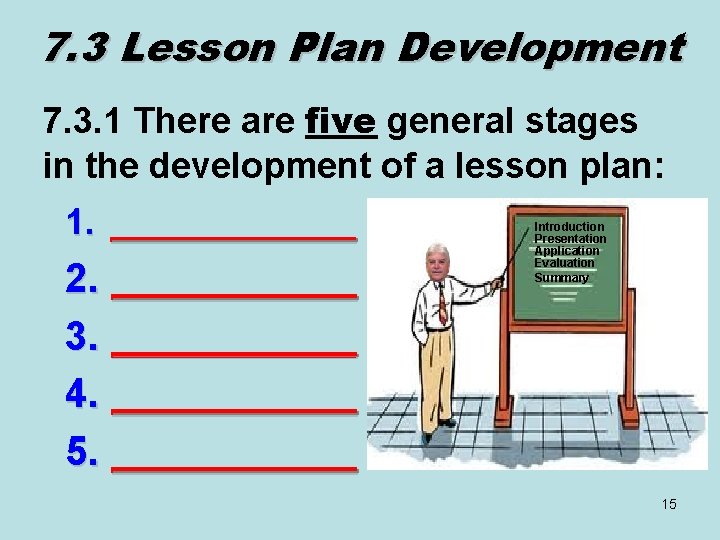
7. 3 Lesson Plan Development 7. 3. 1 There are five general stages in the development of a lesson plan: 1. ______ 2. ______ 3. ______ 4. ______ 5. ______ Introduction Presentation Application Evaluation Summary 15
7. 3 Lesson Plan Development The various stages may overlap. The instructor should design the lesson so that activities occur throughout the course Fort Worth PD – SRO’s 16
7. 3. 2 Introduction Stage: Stage How will the lesson be introduced to the student? A. Grabs the ______ of A. the participant for the course B. ______ the participant ______ for the lesson material and puts them at ease 17
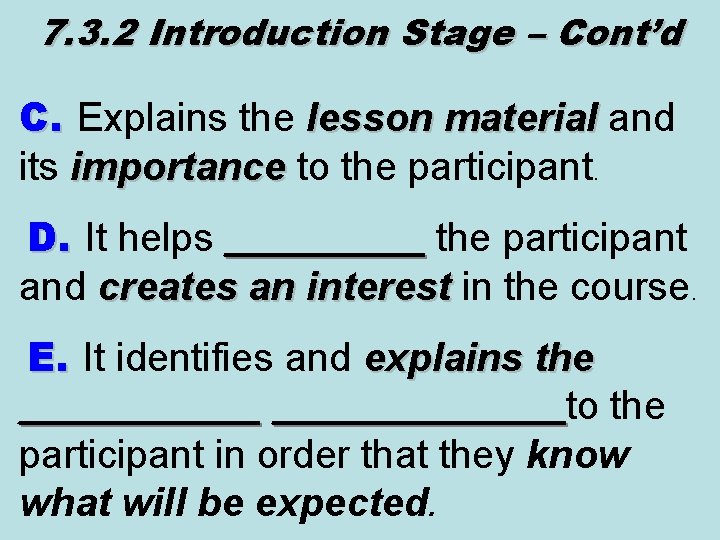
7. 3. 2 Introduction Stage – Cont’d C. Explains the lesson material and its importance to the participant. importance It helps _____ the participant and creates an interest in the course. interest D. E. It identifies and explains the ______________ to the participant in order that they know what will be expected.
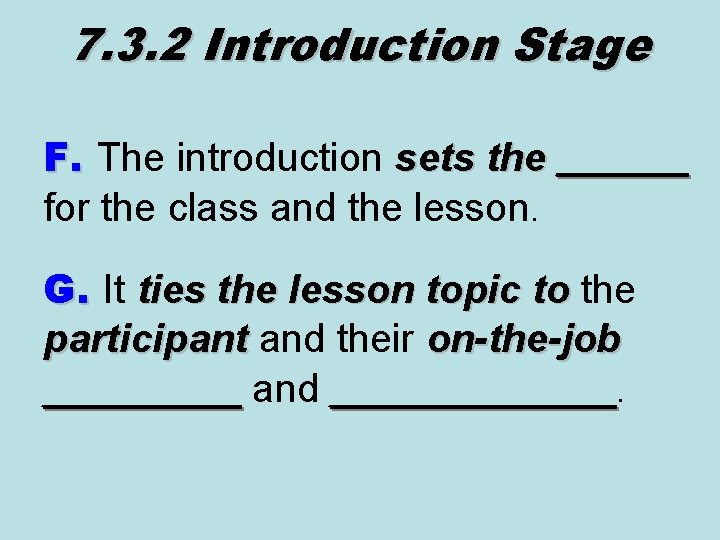
7. 3. 2 Introduction Stage F. The introduction sets the ______ for the class and the lesson. G. It ties the lesson topic to the to participant and their on-the-job _____ and _______.
7. 3. 3 PRESENTATION STAGE The Presentation Stage: knowledge of adult learning theories should be incorporated into the lesson plan. HERE’s…. . GEORGE!
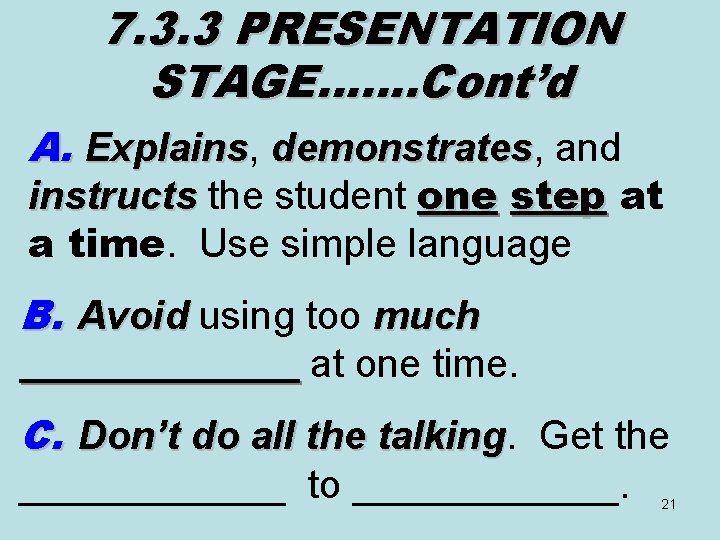
7. 3. 3 PRESENTATION STAGE……. Cont’d A. Explains, Explains demonstrates, and demonstrates instructs the student one step at instructs a time. Use simple language B. Avoid using too much Avoid much _______ at one time. C. Don’t do all the talking. Get the talking ______ to ______. 21
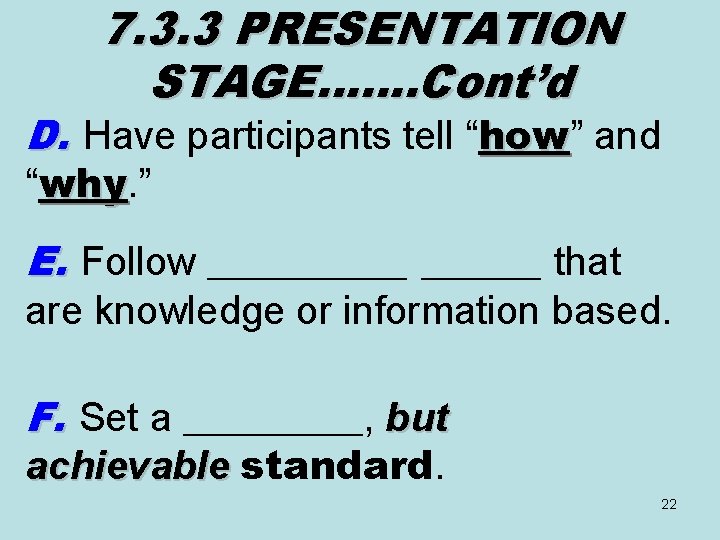
7. 3. 3 PRESENTATION STAGE……. Cont’d D. Have participants tell “how” and how “why. ” why E. Follow ______ that are knowledge or information based. F. Set a _____, but achievable standard. 22
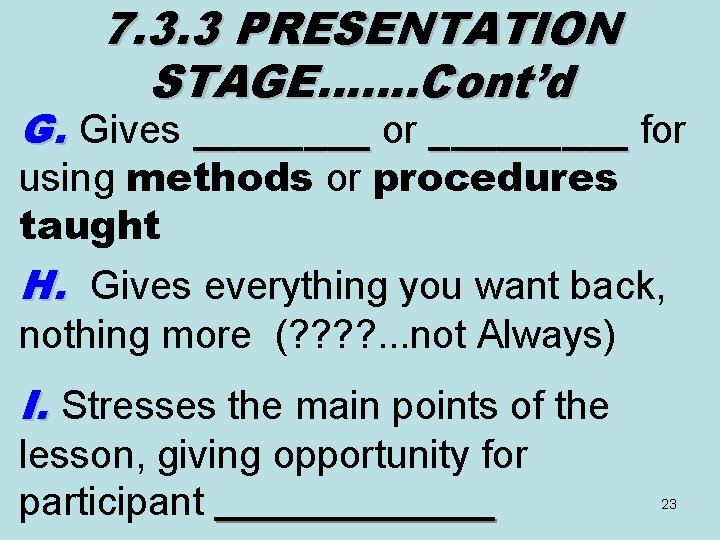
7. 3. 3 PRESENTATION STAGE……. Cont’d G. Gives ____ or _________ for using methods or procedures taught H. Gives everything you want back, nothing more (? ? . . . not Always) I. Stresses the main points of the lesson, giving opportunity for participant ______________ 23
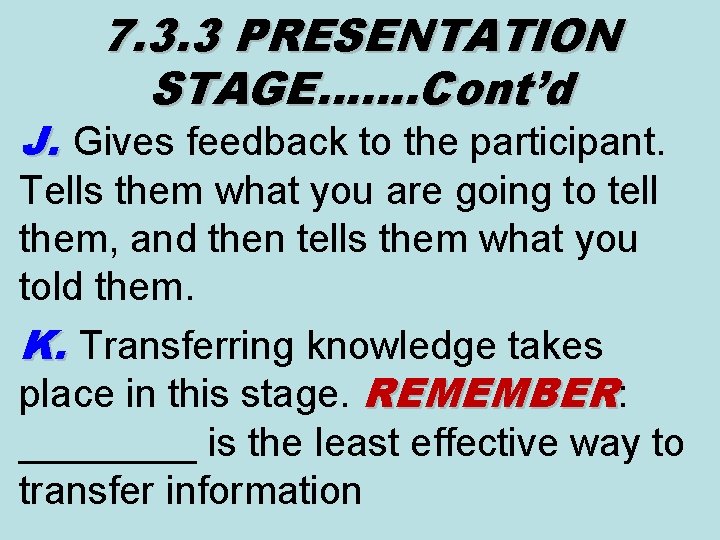
7. 3. 3 PRESENTATION STAGE……. Cont’d J. Gives feedback to the participant. Tells them what you are going to tell them, and then tells them what you told them. K. Transferring knowledge takes place in this stage. REMEMBER: ____ is the least effective way to transfer information
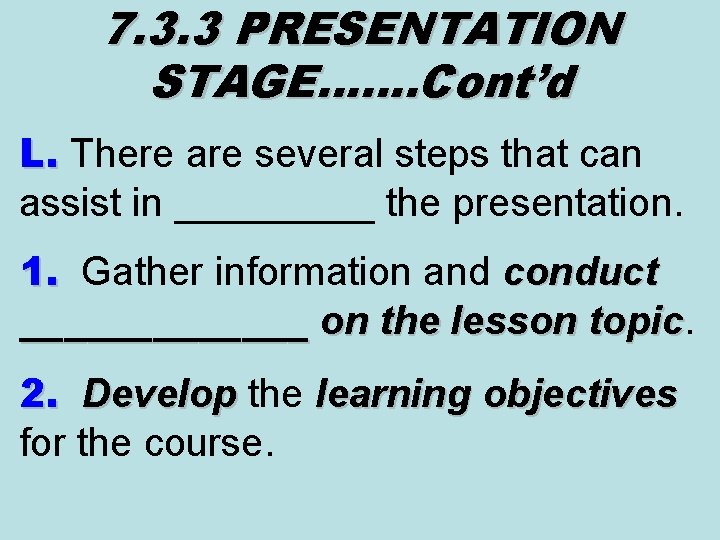
7. 3. 3 PRESENTATION STAGE……. Cont’d L. There are several steps that can L. assist in _____ the presentation. 1. Gather information and conduct 1. _______ on the lesson topic 2. learning Develop learning objectives 2. Develop the for the course.
7. 3. 3 PRESENTATION STAGE……. Cont’d L. There are several steps that can assist in developing the presentation. Cont’d 3. Generate the ______ headings that 3. will be used in the delivery of the course information. 4. Prepare the course _____ and 4. topic sentences.
7. 3. 3 PRESENTATION STAGE……. Cont’d L. There are several steps that can assist in developing the presentation. Cont’d 5. _____ the course outline for 5. logical sequence, timing, possible student activities, and test questions. 6. ______ the full lesson plan and try 6. it out.
7. 3. 3 PRESENTATION STAGE……. Cont’d L. There are several steps that can assist in developing the presentation. Cont’d 7. Submit for __________ 7. review/approval if necessary. 8. ______ 8. ______ if necessary.
7. 3. 4 Participants use of the information they have been given. “Application Stage” A. Encourage the participant to ask A. ______. B. Develop _____ that allow the participant to apply the information learned in a safe, real environment
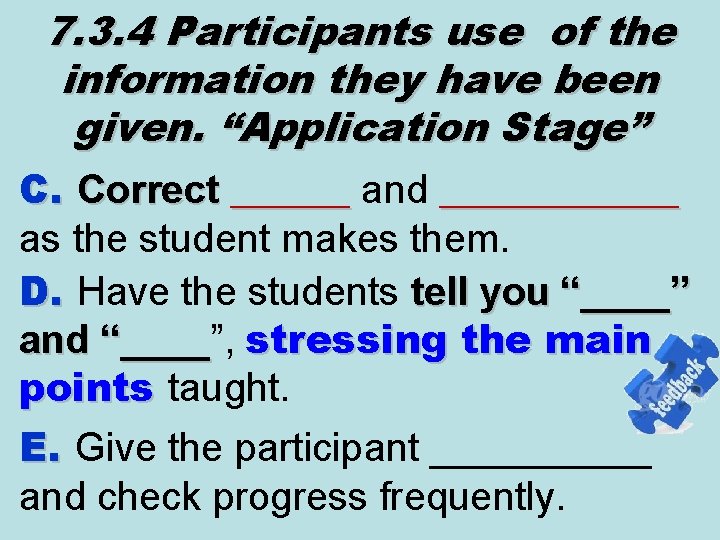
7. 3. 4 Participants use of the information they have been given. “Application Stage” C. Correct ______ and ____________ as the student makes them. D. Have the students tell you “____” and “____”, “____ stressing the main points taught. E. Give the participant _____ and check progress frequently.
7. 3. 4 Participants use of the information they have been given. “Application Stage” F. Continue application stage until you are certain the participants ______ the ________ taught in the lesson. G. The application stage can occur at the end of the lesson or ______ the lesson at appropriate times.
7. 3. 5 The Summary Stage – gather information missed A. Be _____ about the timing. _____ B. Review the _____ objectives. B. _____ C. Review and _______ the _______ main points of the lesson. D. Let participants summarize when possible.
7. 3. 5 The Summary Stage – gather information missed E. _____introduce new material _____ or re-teach the lesson. F. End with a statement to _____ the participant to use the information or skills to improve their performance.
7. 3. 6 The Evaluation Stage – how will participants performance be judged A. Gives _____ to the participant A. _____ in the form of their performance. B. Put the participant on their own to do the job or _______ the information through written or performance tests. C. Consider evaluating participant on their ________ in course activities.
7. 3. 7 Section Review The introduction stage will always come at the ______ of the lesson The summary stage will always come at near the ______ of the lesson
7. 3. 7 Section Review – Cont’d The presentation, application, and evaluation stages can happen at any time during the lesson. A. The various stages may overlap. A. B. The instructor should design the lesson so that ________ occur ________ throughout the course.
7. 4 Type of Lesson Plan Formats 7. 4. 1 There are four major types four of lesson plan formats. A. _____. A. B. _____ Outline C. ______ Outline D. ______e.
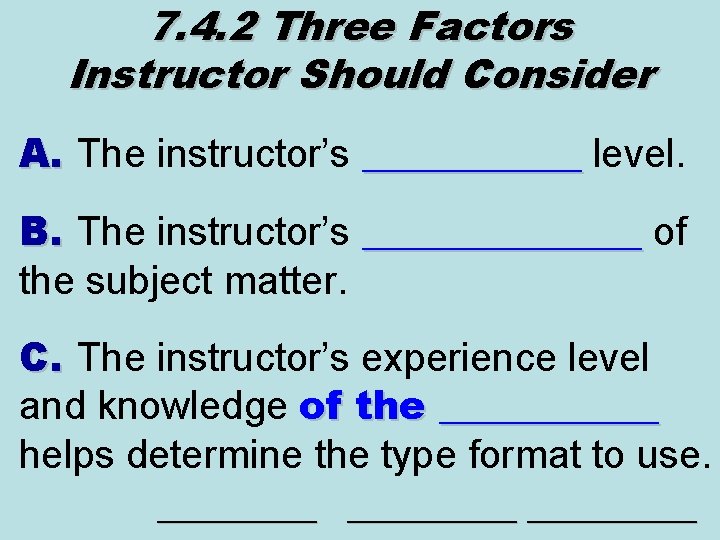
7. 4. 2 Three Factors Instructor Should Consider A. The instructor’s ______ level. ______ B. The instructor’s _______ of _______ the subject matter. C. The instructor’s experience level and knowledge of the ______ helps determine the type format to use. _________________
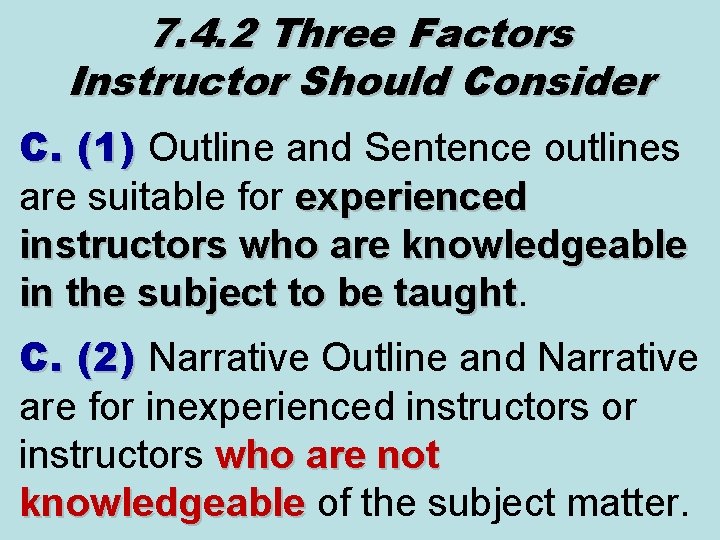
7. 4. 2 Three Factors Instructor Should Consider C. (1) Outline and Sentence outlines are suitable for experienced instructors who are knowledgeable in the subject to be taught C. (2) Narrative Outline and Narrative are for inexperienced instructors or instructors who are not knowledgeable of the subject matter.
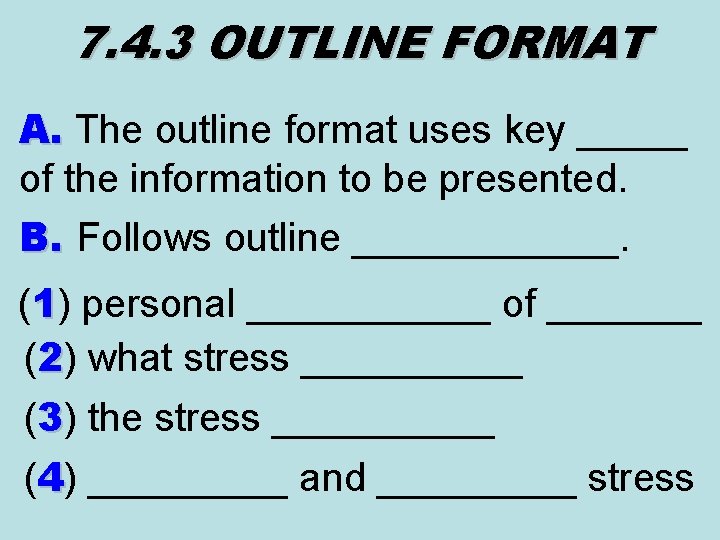
7. 4. 3 OUTLINE FORMAT A. The outline format uses key _____ A. of the information to be presented. B. Follows outline ______. (1) personal ______ of _______ (2) what stress _____ (3) the stress _____ (4) _____ and _____ stress
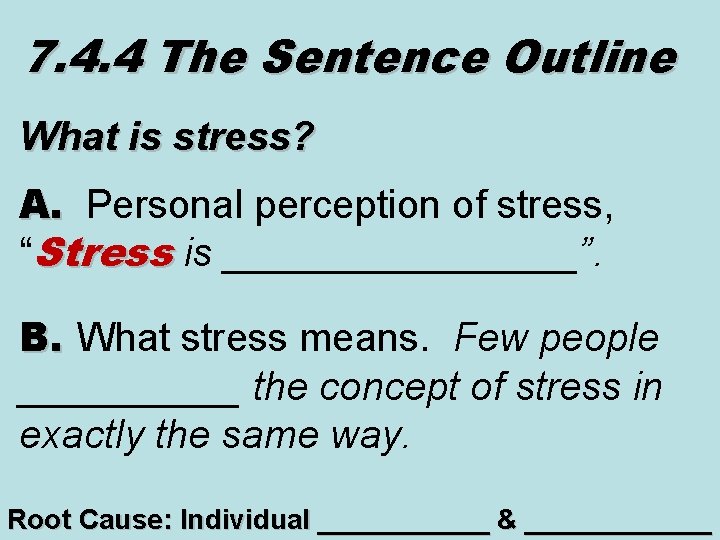
7. 4. 4 The Sentence Outline What is stress? A. Personal perception of stress, “Stress is ________”. B. What stress means. Few people _____ the concept of stress in exactly the same way. Root Cause: Individual ______ & ______
7. 4. 4 The Sentence Outline Continued What is stress? . . . Cont’d C. The stress response. Everything that lives responds to _____ D. _____ and _____ stress. _____ We encounter stress every day, how we deal with the stress decides if it is positive or negative.
7. 4. 5 Narrative Outline Format A. The _______ outline has more detail. B. It includes a paragraph around the ____ words C. Continues to follow ____ format
7. 4. 5 Outline Format Example: 1. What is stress? A. A. Personal perception of stress. As a class/group activity, have the students complete the following sentence; “Stress is _____” on a Define & Process Form of paper. Have participants or groups give their responses.
7. 4. 5 Outline Format Example……Cont’d 1. What is stress? . . . Cont’d: B. What stress means. As we can see from the class exercise, few people define the concept of stress in exactly the same way. The word way “stress”- like “success”, “failure”, or “happiness”- means different things to different people.
7. 4. 6 Narrative Format A. The narrative format is written A. in ____________. B. It is more like a _______than an outline C. The stress response. C. Everything that lives responds to stimuli
7. 4. 6 C. The stress response. Everything that lives responds to Example stimuli. Plants respond to sunlight by growing in that direction A dog responds to its owner’s voice or scent by wagging its tail and perhaps barking Similarly, people respond to various stimuli
7. 4. 6 C. The stress response. Everything that lives responds to stimuli. Example One important group of stimuli to which they respond is stressors A performance review, an angry offender, and a disagreement with a family member are all stimuli or stressors to which we respond.
7. 5 Four Sequencing Structures to help organize and plan lesson
7. 5. 1 Four types of sequencing structures A. It is important that information in A. the lesson plan be properly ________. B. Improper sequencing can lead to ______ for the participant and instructor
7. 5. 1 Four types of sequencing structures…. Cont’d: C. Improper sequencing can also hinder the instructor’s ability to _______ the participants performance. D. There are _______ types of sequencing structures that help in lesson plan preparation.
7. 5. 1 Four types of sequencing structures…. Cont’d: 1. _____ to ______. 1. a. This style requires basic a. course content to be provided before moving to more advanced course content. b. This style is also used b. when simple tasks must be learned before moving to more difficult tasks.
7. 5. 1 Four types of sequencing structures…. Cont’d: 2. ______ to _______. 2. a. This sequence is used when a a. general framework must be provided before specific information can be related to the topic.
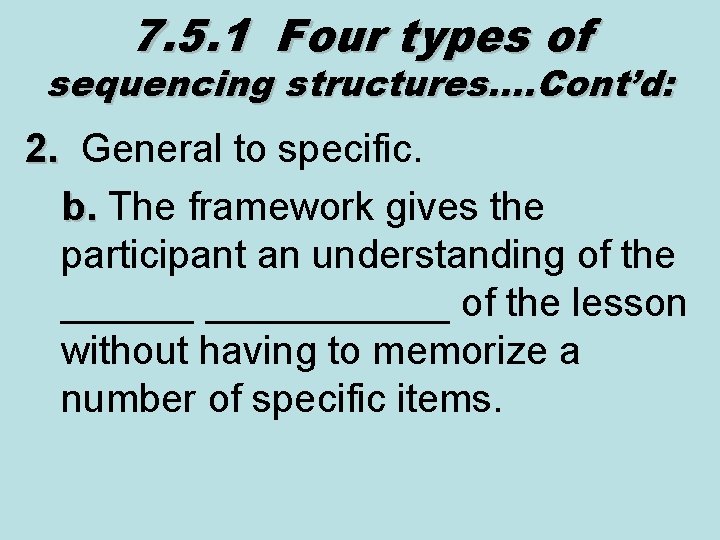
7. 5. 1 Four types of sequencing structures…. Cont’d: 2. General to specific. 2. b. The framework gives the b. participant an understanding of the ___________ of the lesson without having to memorize a number of specific items.
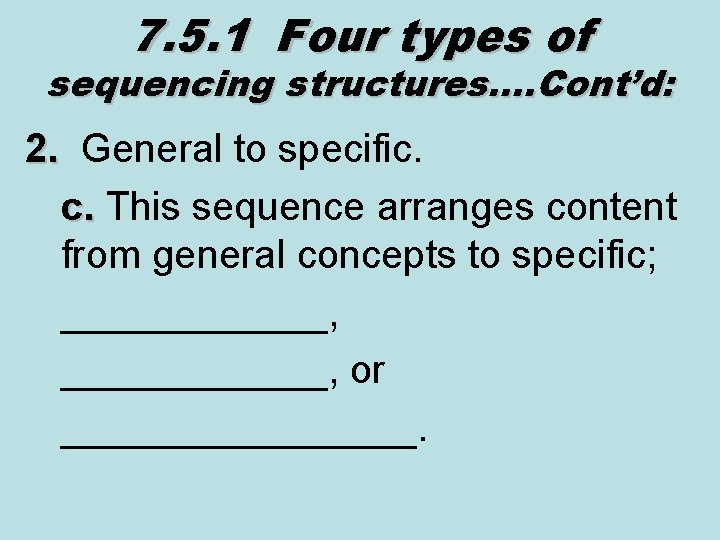
7. 5. 1 Four types of sequencing structures…. Cont’d: 2. General to specific. 2. c. This sequence arranges content c. from general concepts to specific; ____________, or ________.
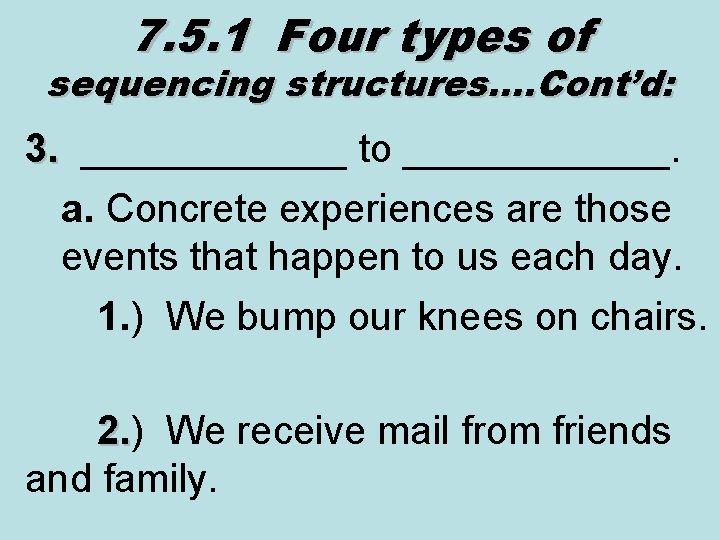
7. 5. 1 Four types of sequencing structures…. Cont’d: 3. ______ to ______. 3. a. Concrete experiences are those events that happen to us each day. 1. ) We bump our knees on chairs. 2. ) We receive mail from friends 2. and family.
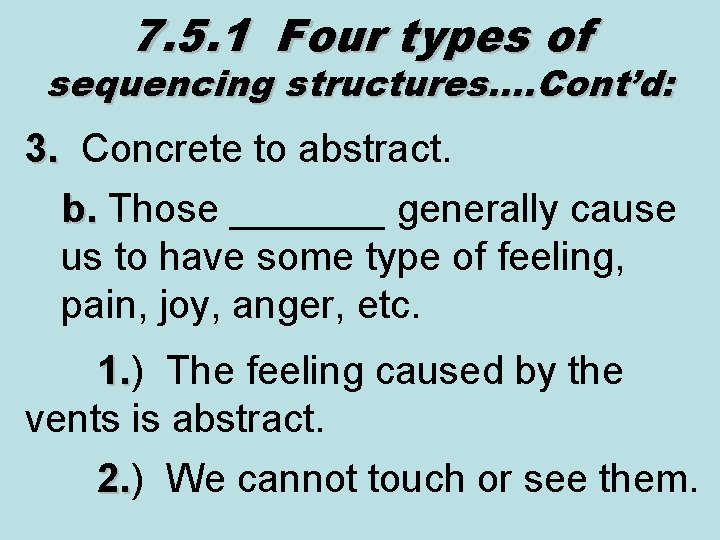
7. 5. 1 Four types of sequencing structures…. Cont’d: 3. Concrete to abstract. 3. b. Those _______ generally cause b. us to have some type of feeling, pain, joy, anger, etc. 1. ) The feeling caused by the 1. vents is abstract. 2. ) We cannot touch or see them. 2.
7. 5. 1 Four types of sequencing structures…. Cont’d: 3. Concrete to abstract. 3. b. 3. ) These feeling are an _____ generated by the event. c. The instructor must provide c. concrete ________ for the participant before the participant can apply that information to an abstract concept.
7. 5. 1 Four types of sequencing structures…. Cont’d: 4. ___________. 4. a. This sequence shows how one a. event relates to another. b. This method is very useful in teaching ____ in a procedure. 1. ) Relationship of each step can 1. be stressed
7. 5. 1 Four types of sequencing structures…. Cont’d: 4. Chronological. 4. b. 2. ) This sequence allows 2. participant to see and understand the importance of performing the steps in a specific order, such as CPR. E. The type of sequence use is based E. upon the _______ of the lesson to be taught.
7. 5. 2 All lesson plans should follow one of sequencing approaches A. Instructor should think about A. _______ of the course when selecting the sequence approach. B. The instructor should select a B. sequence approach that will be the most ______ in presenting the learning objectives to the student.
7. 6 Major Points for Lesson Plan Development & Function 7. 6. 1 The lesson plan is the ________ for ensuring a successful training experience for the participant and instructor. 7. 6. 2 The lesson plan can be 7. 6. 2 written in a ______ of formats and organized in different ways.
7. 6 Major Points for Lesson Plan Development & Function 7. 6. 3 Lesson plans must be 7. 6. 3 developed and written according to generally accepted principles Properly constructed lesson plans ensure a successful ______ experience. .
- Slides: 63