
Texas College Access Network Tx CAN North Texas
- Slides: 21
Texas College Access Network (Tx. CAN) North Texas Alignment Committee Kick-off Planning Session November 16, 2011 www. thsp. org
Executive Summary • THSP has made strong progress in developing the core Tx. CAN pilot strategy and key initiatives, and received positive feedback at the North Texas Tx. CAN kick-off event • We have identified the need to develop three committees – Awareness, Alignment , and Impact Measurement – and have great participants for each committee • Each committee needs to identify leaders to chair each committee who will work with THSP team to help drive Tx. CAN strategy • Today’s meeting is the Alignment Committee’s planning kick-off to discuss the committee’s strategy, key goals, and deliverables. • Our goal for the meeting is to gain agreement on the committee strategies and key focus areas, set dates for key activities, plan for upcoming committee meetings and the next full network convening in January We intend to make every meeting action-oriented and appreciate your active participation 2
Agenda • Introductions & General Feedback from Kickoff Meeting • Review Alignment Committee Goals and Network Feedback – Potential challenges & resources needed – Workgroup goals and activity planning • Team Activity: Draft Schedule of Events • Committee Communications • Next Steps 3
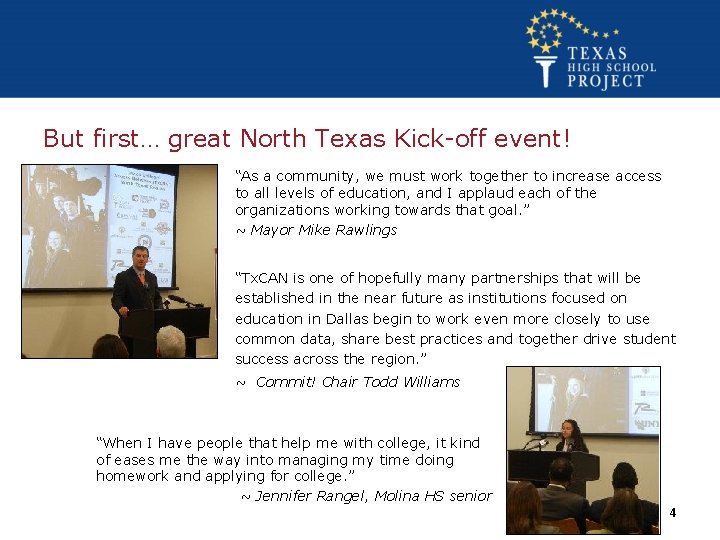
But first… great North Texas Kick-off event! “As a community, we must work together to increase access to all levels of education, and I applaud each of the organizations working towards that goal. ” ~ Mayor Mike Rawlings “Tx. CAN is one of hopefully many partnerships that will be established in the near future as institutions focused on education in Dallas begin to work even more closely to use common data, share best practices and together drive student success across the region. ” ~ Commit! Chair Todd Williams “When I have people that help me with college, it kind of eases me the way into managing my time doing homework and applying for college. ” ~ Jennifer Rangel, Molina HS senior 4
Introductions Name Title and Organization Brief overview of your organization 5
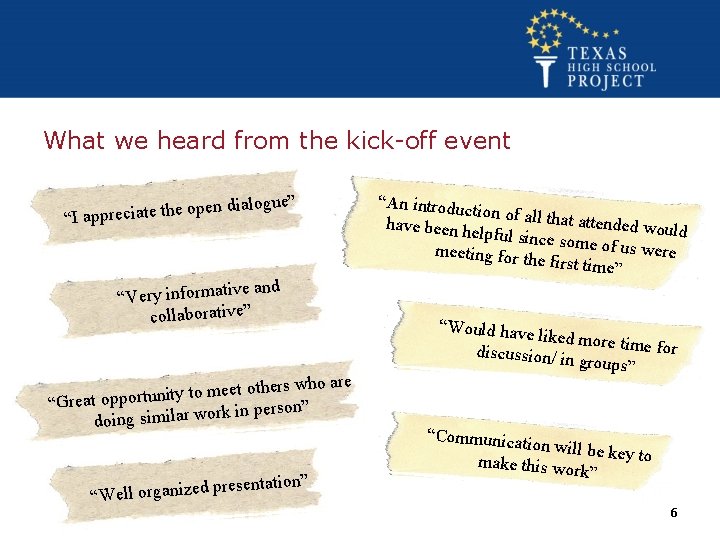
What we heard from the kick-off event gguuee”” lo ia d n e p lo o ia e d th n e te p o ia c e ““II aappppre reciate th vvee aanndd aati rm fo ti in ry rm e fo ““V in Very tivvee”” ccooll rati llaabboora hhoo aare w re rs e th o w t e rs e e m th o to t y e e it n m u rt to o y p ““G reaatt ooppportunit r work in ppeers Gre oonn”” rs in a il rk o im s w ddooin ingg similar tioonn”” tati seennta re p d e s iz n re a p rg d o e iz ll e n Well orga ““W “An introduc tion of all tha t attended wo have been he uld lpful since so me of us wer meeting for th e e first time” ““W Woouuld ld hhaavvee li likkeedd m moorree ti tim mee ffoorr ddis c u iscussssio n ion// in in ggrroouuppss”” ““C Coom mm muunnic icaati tioonn w wil illl bbee kkeeyy to to m a makkee th this is w woorrkk”” 6
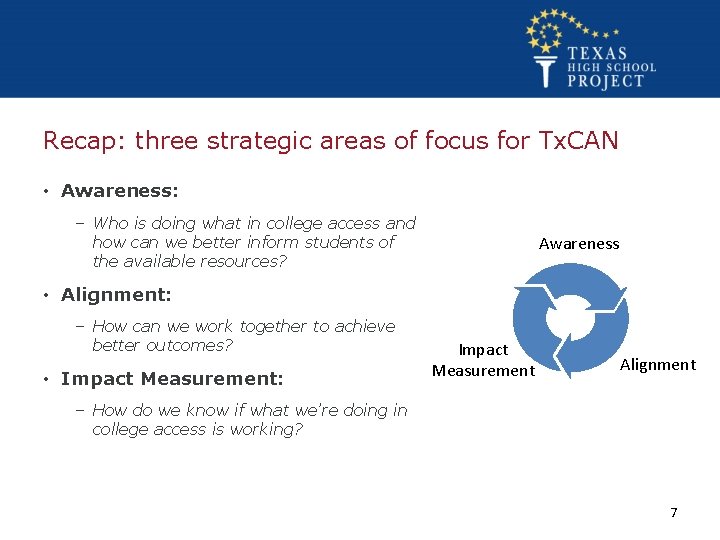
Recap: three strategic areas of focus for Tx. CAN • Awareness: – Who is doing what in college access and how can we better inform students of the available resources? Awareness • Alignment: – How can we work together to achieve better outcomes? • Impact Measurement: Impact Measurement Alignment – How do we know if what we’re doing in college access is working? 7
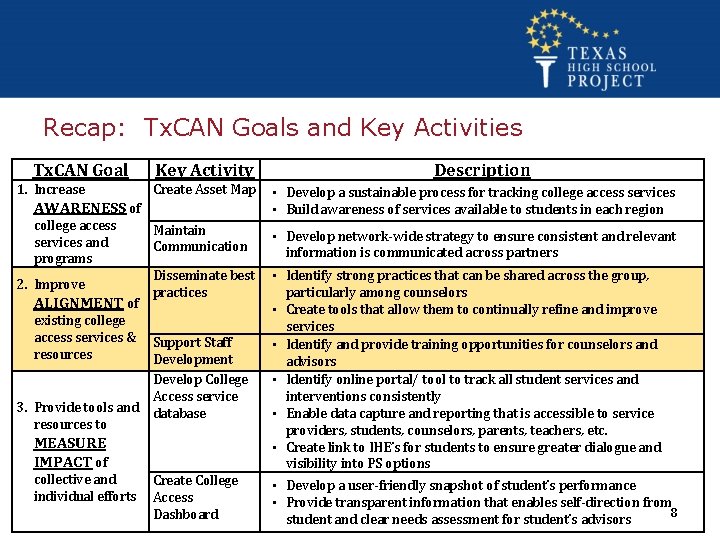
Recap: Tx. CAN Goals and Key Activities Tx. CAN Goal 1. Increase Key Activity Create Asset Map • Develop a sustainable process for tracking college access services • Build awareness of services available to students in each region Maintain Communication • Develop network-wide strategy to ensure consistent and relevant information is communicated across partners Disseminate best practices • Identify strong practices that can be shared across the group, particularly among counselors • Create tools that allow them to continually refine and improve services • Identify and provide training opportunities for counselors and advisors • Identify online portal/ tool to track all student services and interventions consistently • Enable data capture and reporting that is accessible to service providers, students, counselors, parents, teachers, etc. • Create link to IHE’s for students to ensure greater dialogue and visibility into PS options AWARENESS of college access services and programs 2. Improve ALIGNMENT of existing college access services & resources 3. Provide tools and resources to Support Staff Development Develop College Access service database MEASURE IMPACT of collective and individual efforts Description Create College Access Dashboard • Develop a user-friendly snapshot of student’s performance • Provide transparent information that enables self-direction from 8 student and clear needs assessment for student’s advisors
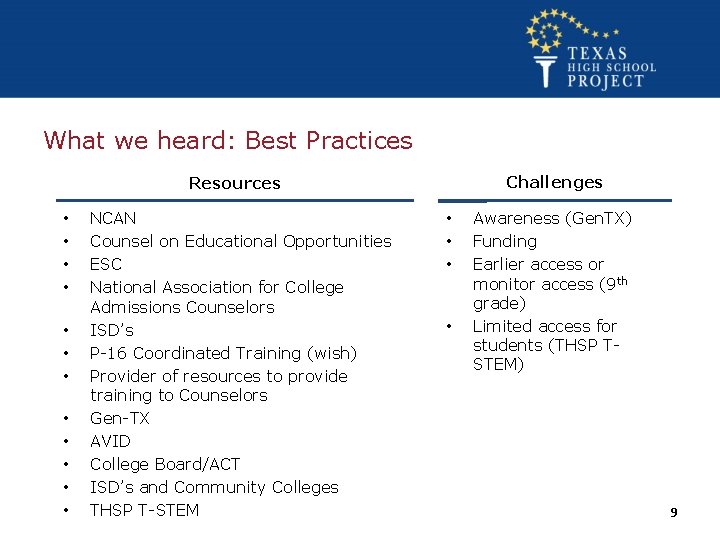
What we heard: Best Practices Challenges Resources • • • NCAN Counsel on Educational Opportunities ESC National Association for College Admissions Counselors ISD’s P-16 Coordinated Training (wish) Provider of resources to provide training to Counselors Gen-TX AVID College Board/ACT ISD’s and Community Colleges THSP T-STEM • • Awareness (Gen. TX) Funding Earlier access or monitor access (9 th grade) Limited access for students (THSP TSTEM) 9
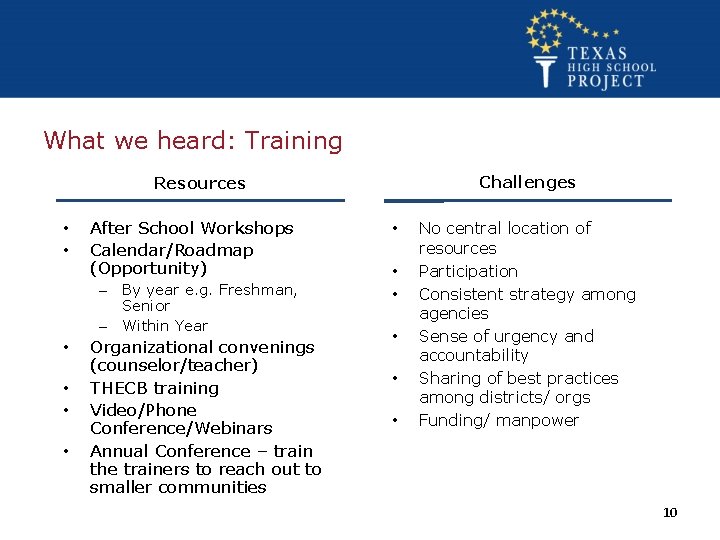
What we heard: Training Challenges Resources • • After School Workshops Calendar/Roadmap (Opportunity) – By year e. g. Freshman, Senior – Within Year • • Organizational convenings (counselor/teacher) THECB training Video/Phone Conference/Webinars Annual Conference – train the trainers to reach out to smaller communities • • • No central location of resources Participation Consistent strategy among agencies Sense of urgency and accountability Sharing of best practices among districts/ orgs Funding/ manpower 10
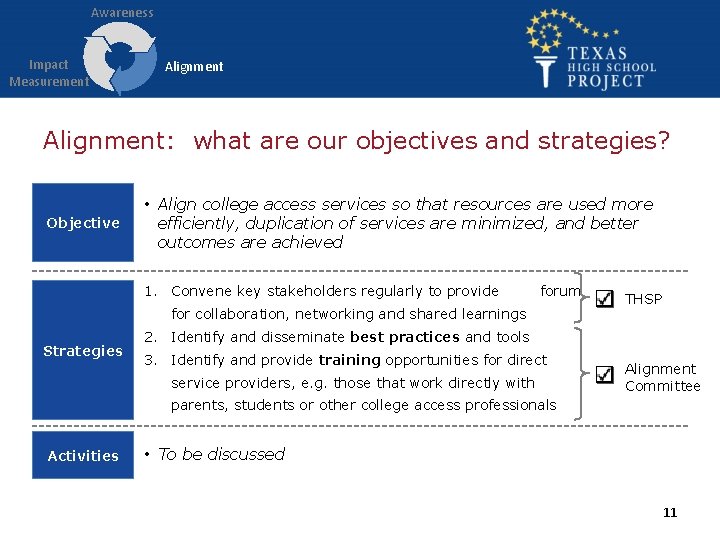
Awareness Impact Measurement Alignment: what are our objectives and strategies? Objective • Align college access services so that resources are used more efficiently, duplication of services are minimized, and better outcomes are achieved 1. Convene key stakeholders regularly to provide forum for collaboration, networking and shared learnings Strategies THSP 2. Identify and disseminate best practices and tools 3. Identify and provide training opportunities for direct service providers, e. g. those that work directly with Alignment Committee parents, students or other college access professionals Activities • To be discussed 11
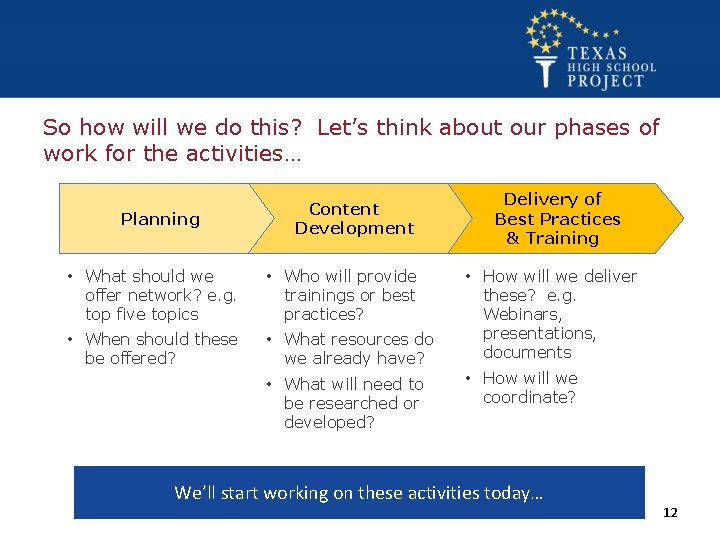
So how will we do this? Let’s think about our phases of work for the activities… Planning Content Development • What should we offer network? e. g. top five topics • Who will provide trainings or best practices? • When should these be offered? • What resources do we already have? • What will need to be researched or developed? Delivery of Best Practices & Training • How will we deliver these? e. g. Webinars, presentations, documents • How will we coordinate? We’ll start working on these activities today… 12
As we discuss, please consider the following questions for discussion • Have we properly identified the correct strategies based on our existing resources or highest areas of need? • Have we covered the necessary activities? • What are the quick wins? • What resources do we need to support these activities? We greatly appreciate your input on this process 13
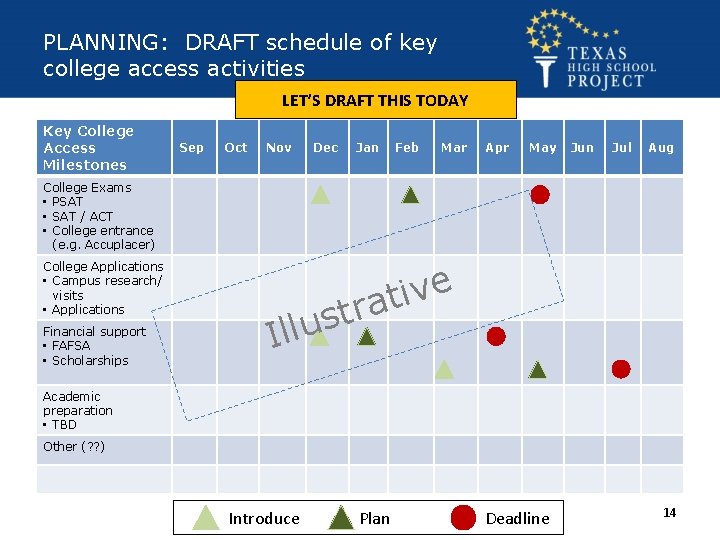
PLANNING: DRAFT schedule of key college access activities LET’S DRAFT THIS TODAY Key College Access Milestones Sep Oct Nov Dec Jan Feb Mar Apr May Jun Jul Aug College Exams • PSAT • SAT / ACT • College entrance (e. g. Accuplacer) College Applications • Campus research/ visits • Applications Financial support • FAFSA • Scholarships e v i t tra s u l Il Academic preparation • TBD Other (? ? ) Introduce Plan Deadline 14
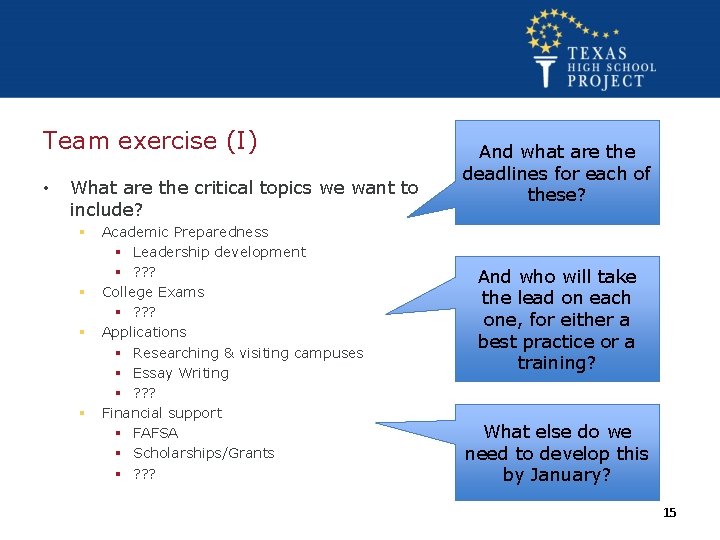
Team exercise (I) • What are the critical topics we want to include? § § Academic Preparedness § Leadership development § ? ? ? College Exams § ? ? ? Applications § Researching & visiting campuses § Essay Writing § ? ? ? Financial support § FAFSA § Scholarships/Grants § ? ? ? And what are the deadlines for each of these? And who will take the lead on each one, for either a best practice or a training? What else do we need to develop this by January? 15
Our Communication: How do we want to work together? • Standing meetings? How often? • Regular communication via conference calls or email? • Smaller teams to focus by topic? • What else can THSP to do help facilitate the committee’s work? 16
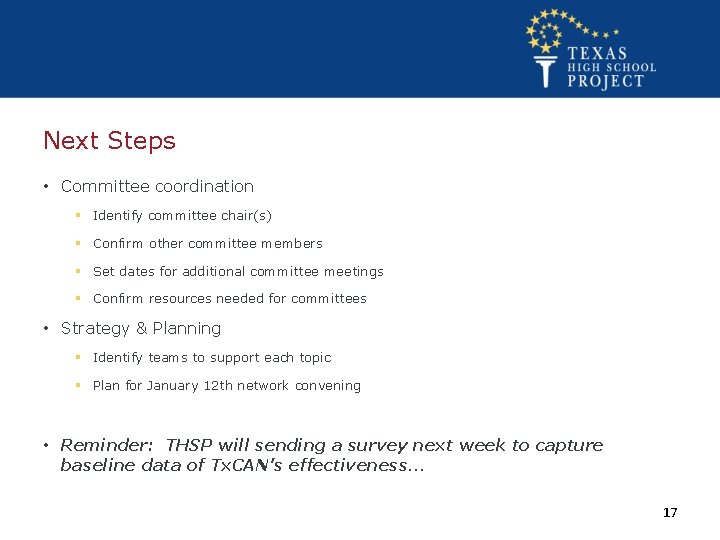
Next Steps • Committee coordination § Identify committee chair(s) § Confirm other committee members § Set dates for additional committee meetings § Confirm resources needed for committees • Strategy & Planning § Identify teams to support each topic § Plan for January 12 th network convening • Reminder: THSP will sending a survey next week to capture baseline data of Tx. CAN’s effectiveness… 17
APPENDIX 18
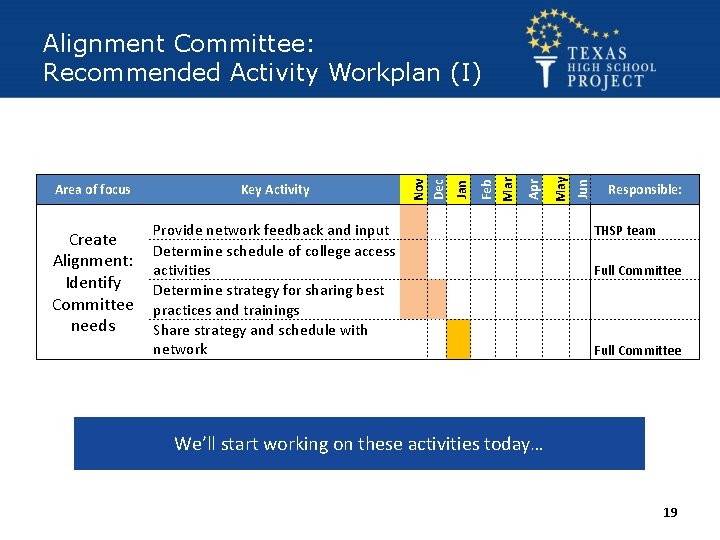
THSP team Full Committee Jun Apr Jan Mar Provide network feedback and input Determine schedule of college access activities Determine strategy for sharing best practices and trainings Share strategy and schedule with network Feb Create Alignment: Identify Committee needs Key Activity Nov Dec Area of focus May Alignment Committee: Recommended Activity Workplan (I) Responsible: We’ll start working on these activities today… 19
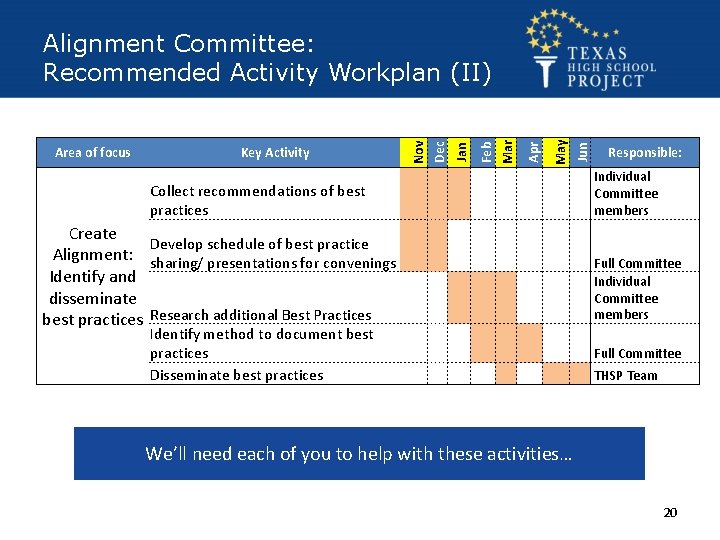
Collect recommendations of best practices Create Develop schedule of best practice Alignment: sharing/ presentations for convenings Identify and disseminate best practices Research additional Best Practices Identify method to document best practices Disseminate best practices Jun May Apr Mar Feb Key Activity Jan Area of focus Nov Dec Alignment Committee: Recommended Activity Workplan (II) Responsible: Individual Committee members Full Committee THSP Team We’ll need each of you to help with these activities… 20
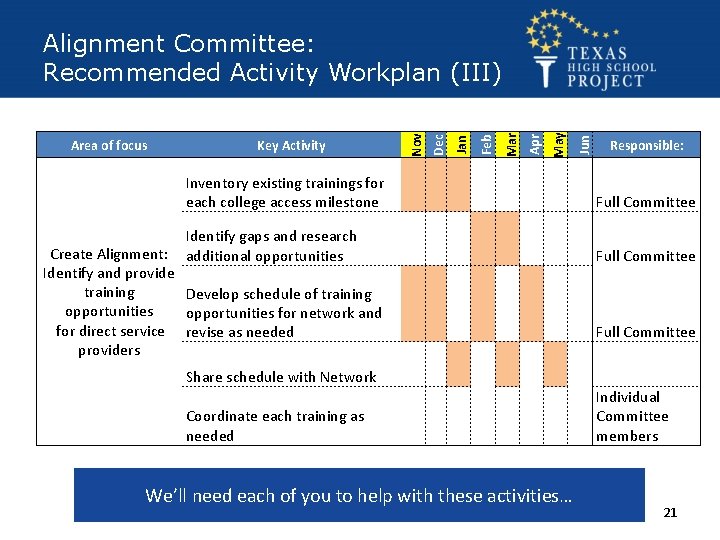
Apr May Full Committee Share schedule with Network Coordinate each training as needed Individual Committee members Inventory existing trainings for each college access milestone Identify gaps and research Create Alignment: additional opportunities Identify and provide training Develop schedule of training opportunities for network and for direct service revise as needed providers Feb Jun Jan Key Activity Mar Dec Area of focus Nov Alignment Committee: Recommended Activity Workplan (III) We’ll need each of you to help with these activities… Responsible: 21