
Texas Association of Academic Administrators in the Mathematical
- Slides: 46
Texas Association of Academic Administrators in the Mathematical Sciences Math 1324 – Finite Math Course Redesign G. Donald Allen Department of Mathematics Texas A&M University College Station, TX dallen@math. tamu. edu TAAAMS – October 13, 2007 1
Problem Solving & Technology “It turns out that technology works best when it is solving a problem that people have come up against. ” ---Robert Zemsky, chairman of the Learning Alliance for Higher Education TAAAMS – October 13, 2007 2
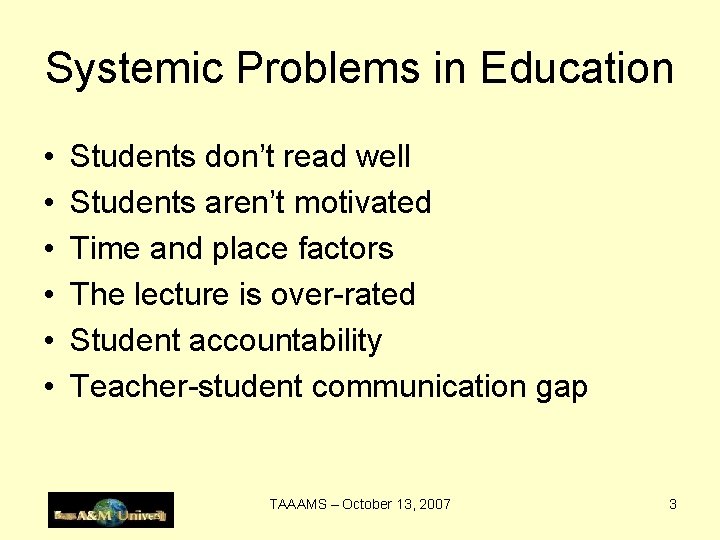
Systemic Problems in Education • • • Students don’t read well Students aren’t motivated Time and place factors The lecture is over-rated Student accountability Teacher-student communication gap TAAAMS – October 13, 2007 3
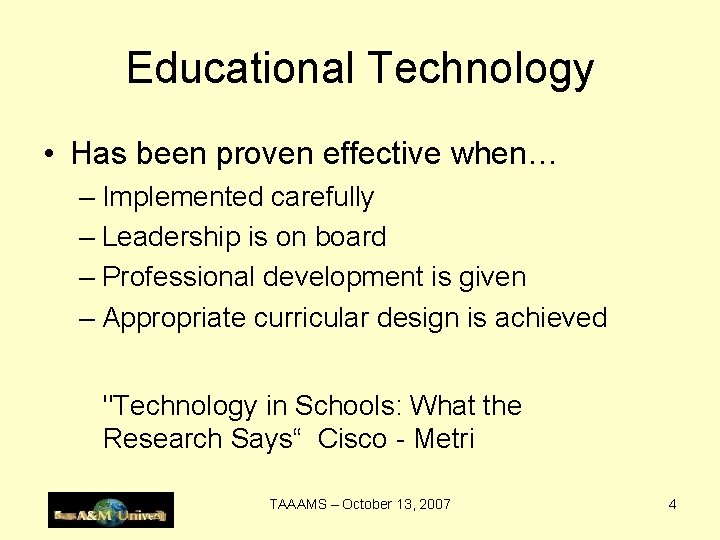
Educational Technology • Has been proven effective when… – Implemented carefully – Leadership is on board – Professional development is given – Appropriate curricular design is achieved "Technology in Schools: What the Research Says“ Cisco - Metri TAAAMS – October 13, 2007 4
TAAAMS – October 13, 2007 5
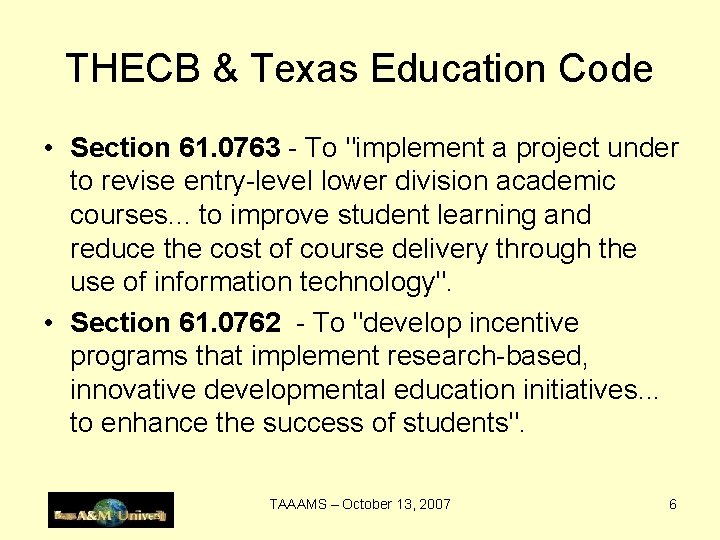
THECB & Texas Education Code • Section 61. 0763 - To "implement a project under to revise entry-level lower division academic courses. . . to improve student learning and reduce the cost of course delivery through the use of information technology". • Section 61. 0762 - To "develop incentive programs that implement research-based, innovative developmental education initiatives. . . to enhance the success of students". TAAAMS – October 13, 2007 6
TAAAMS – October 13, 2007 7
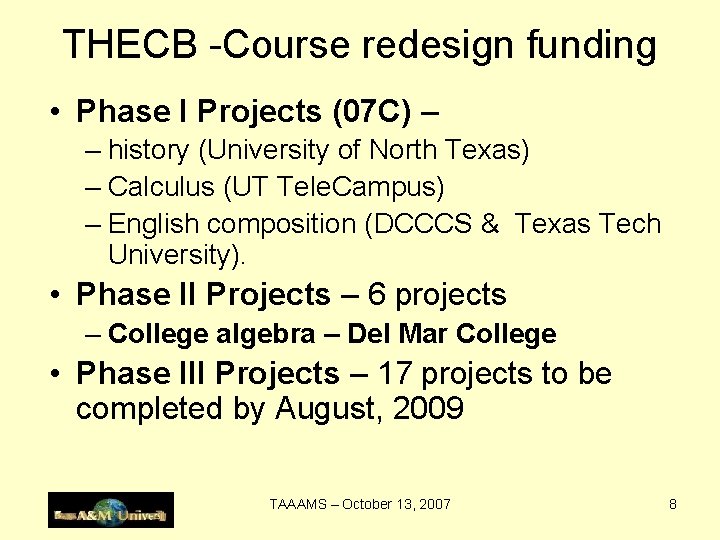
THECB -Course redesign funding • Phase I Projects (07 C) – – history (University of North Texas) – Calculus (UT Tele. Campus) – English composition (DCCCS & Texas Tech University). • Phase II Projects – 6 projects – College algebra – Del Mar College • Phase III Projects – 17 projects to be completed by August, 2009 TAAAMS – October 13, 2007 8
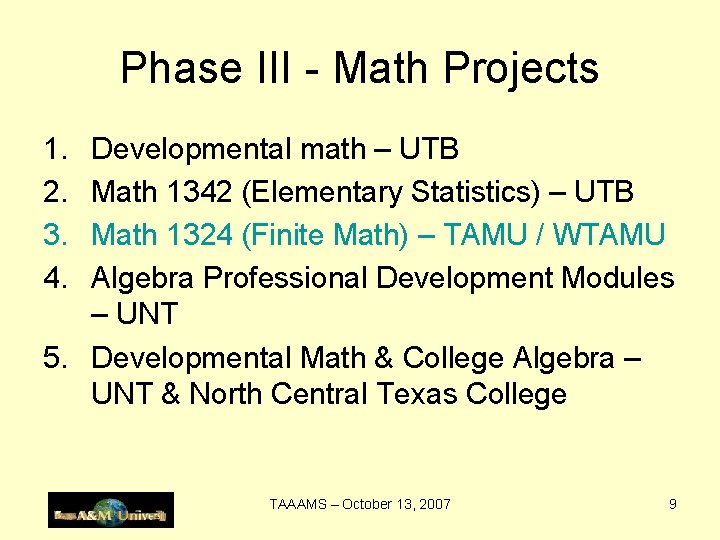
Phase III - Math Projects 1. 2. 3. 4. Developmental math – UTB Math 1342 (Elementary Statistics) – UTB Math 1324 (Finite Math) – TAMU / WTAMU Algebra Professional Development Modules – UNT 5. Developmental Math & College Algebra – UNT & North Central Texas College TAAAMS – October 13, 2007 9
TAAAMS – October 13, 2007 10
National Center for Academic Transformation • NCAT is dedicated to the effective use of information technology to – improve student learning outcomes – reduce the cost of higher education • NCAT provides expertise and support seeking proven methods for providing more students with education. TAAAMS – October 13, 2007 11
TAAAMS – October 13, 2007 12
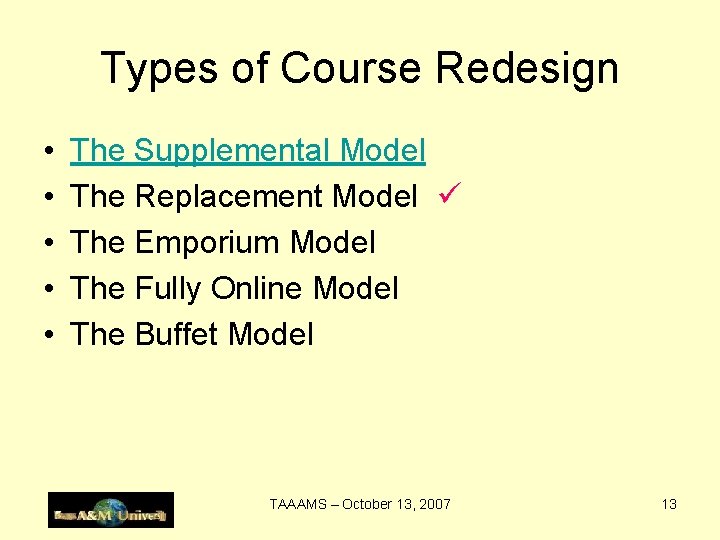
Types of Course Redesign • • • The Supplemental Model The Replacement Model The Emporium Model The Fully Online Model The Buffet Model TAAAMS – October 13, 2007 13
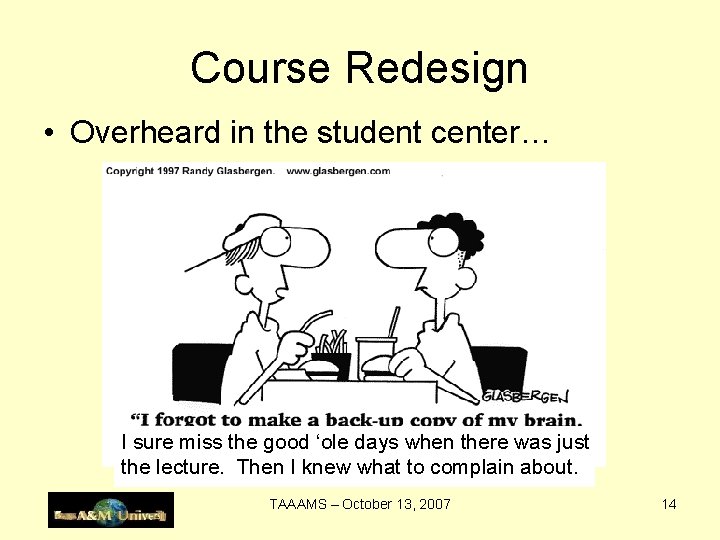
Course Redesign • Overheard in the student center… I sure miss the good ‘ole days when there was just the lecture. Then I knew what to complain about. TAAAMS – October 13, 2007 14
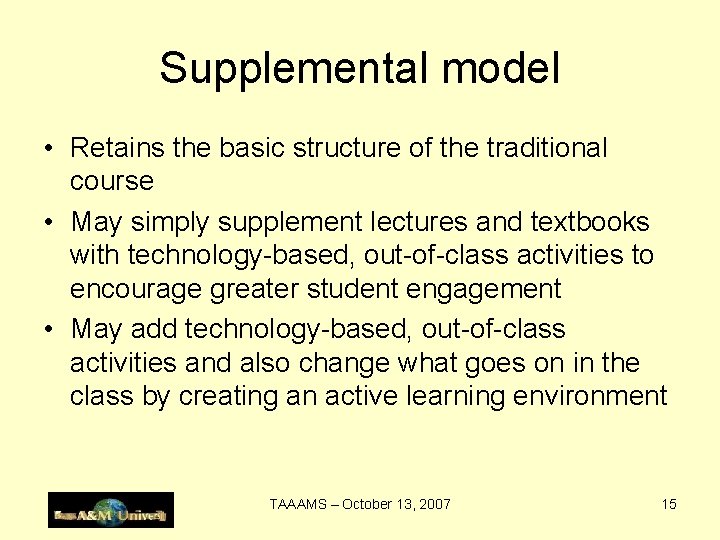
Supplemental model • Retains the basic structure of the traditional course • May simply supplement lectures and textbooks with technology-based, out-of-class activities to encourage greater student engagement • May add technology-based, out-of-class activities and also change what goes on in the class by creating an active learning environment TAAAMS – October 13, 2007 15
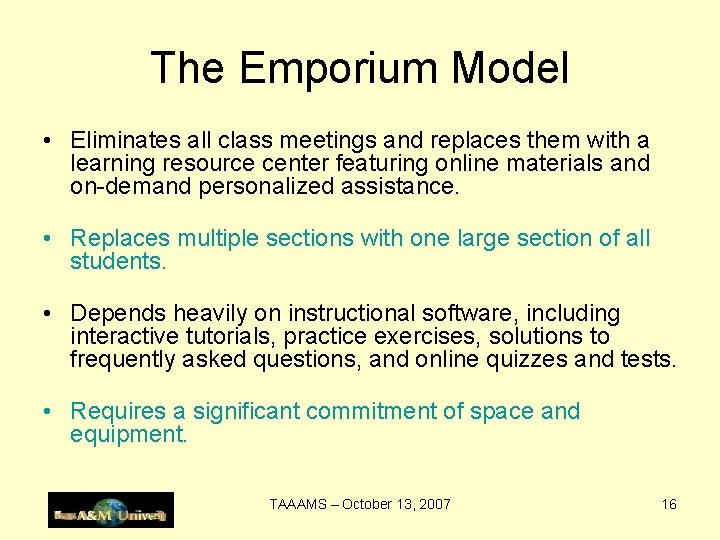
The Emporium Model • Eliminates all class meetings and replaces them with a learning resource center featuring online materials and on-demand personalized assistance. • Replaces multiple sections with one large section of all students. • Depends heavily on instructional software, including interactive tutorials, practice exercises, solutions to frequently asked questions, and online quizzes and tests. • Requires a significant commitment of space and equipment. TAAAMS – October 13, 2007 16
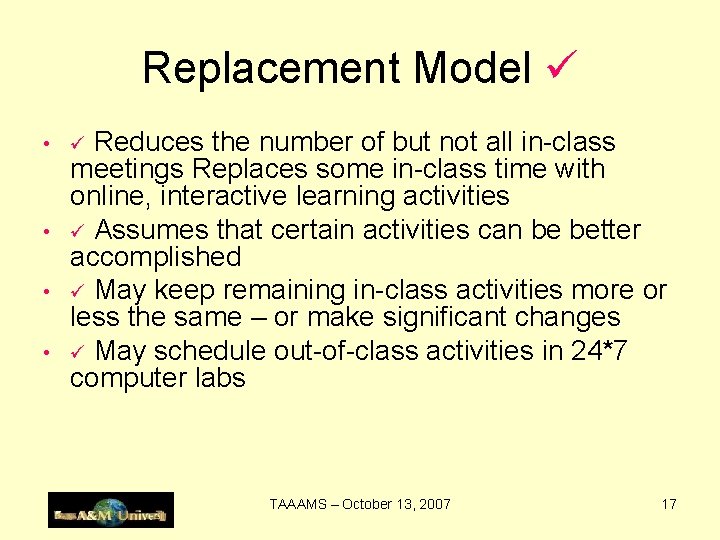
Replacement Model Reduces the number of but not all in-class meetings Replaces some in-class time with online, interactive learning activities Assumes that certain activities can be better accomplished May keep remaining in-class activities more or less the same – or make significant changes May schedule out-of-class activities in 24*7 computer labs • • • • TAAAMS – October 13, 2007 17
The Fully Online Model • Eliminates all in-class meetings and moves all learning experiences online. • Adopts successful redesign elements including Web-based, multi-media resources, commercial software, automatically evaluated assessments with guided feedback, links to additional resources and alternative staffing models. TAAAMS – October 13, 2007 18
The Buffet Model • Customizes the learning environment for each student. Modularizes course content. • Requires an online assessment of student's learning styles and study skills. • Offers students an assortment of individualized paths to reach the same learning outcomes • Includes an array of learning opportunities for students: e. g. lectures, individual or group discovery laboratories, individual and group review TAAAMS – October 13, 2007 19
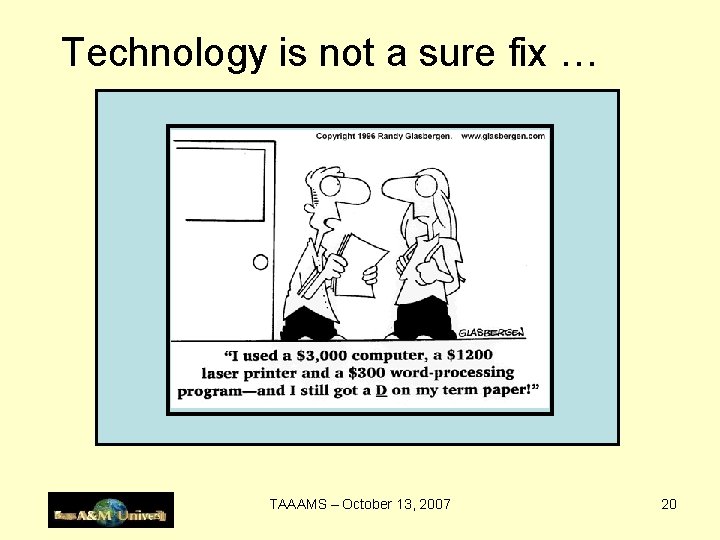
Technology is not a sure fix … TAAAMS – October 13, 2007 20
TAAAMS – October 13, 2007 21
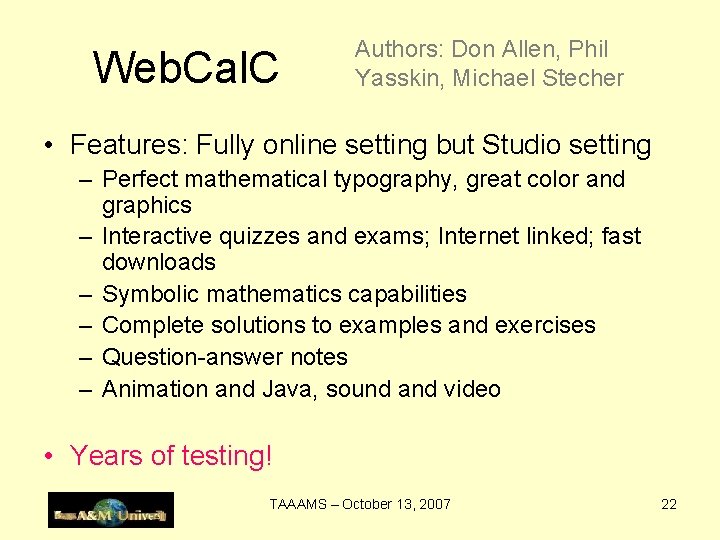
Web. Cal. C Authors: Don Allen, Phil Yasskin, Michael Stecher • Features: Fully online setting but Studio setting – Perfect mathematical typography, great color and graphics – Interactive quizzes and exams; Internet linked; fast downloads – Symbolic mathematics capabilities – Complete solutions to examples and exercises – Question-answer notes – Animation and Java, sound and video • Years of testing! TAAAMS – October 13, 2007 22
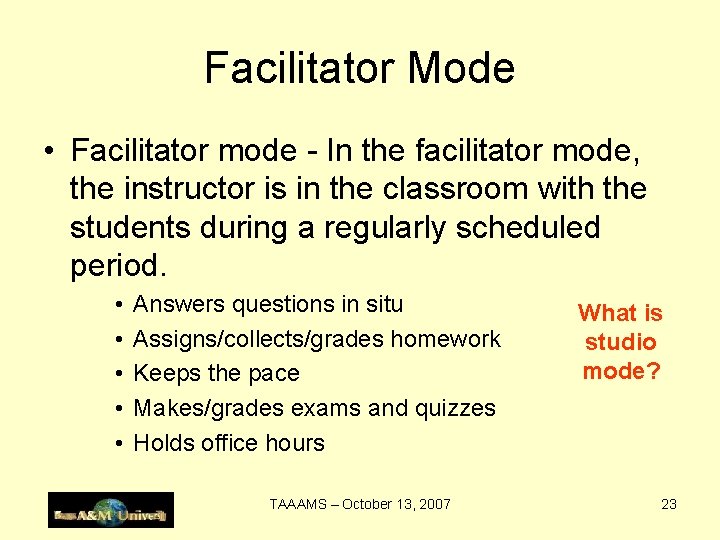
Facilitator Mode • Facilitator mode - In the facilitator mode, the instructor is in the classroom with the students during a regularly scheduled period. • • • Answers questions in situ Assigns/collects/grades homework Keeps the pace Makes/grades exams and quizzes Holds office hours TAAAMS – October 13, 2007 What is studio mode? 23
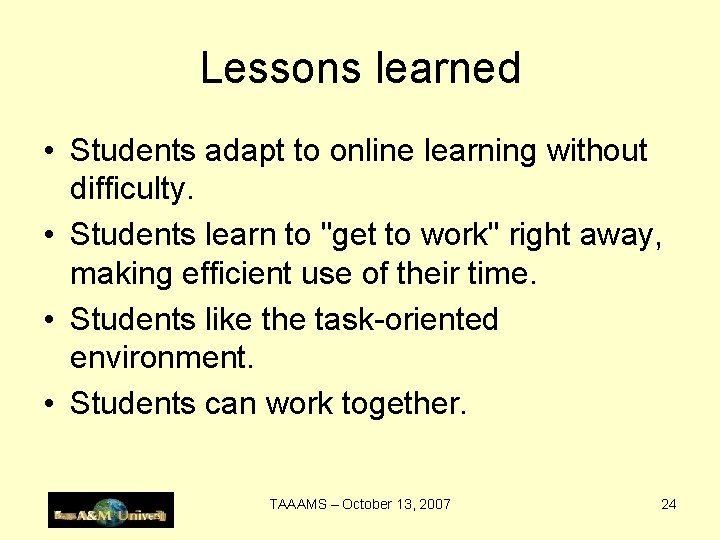
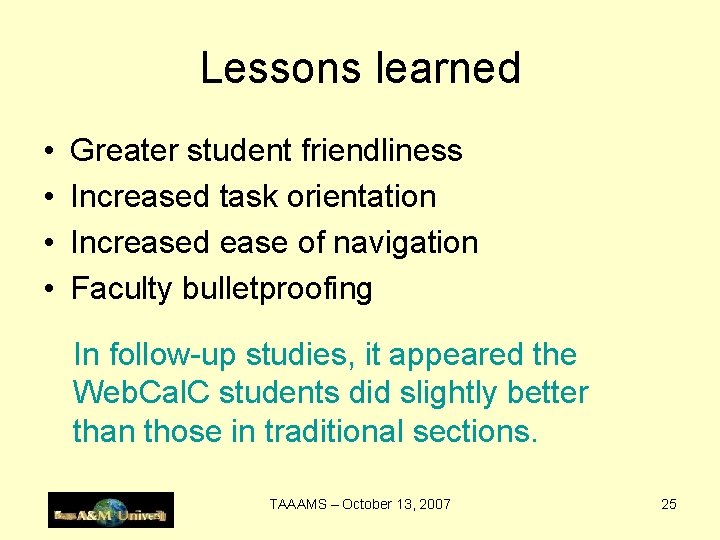
Lessons learned • Students adapt to online learning without difficulty. • Students learn to "get to work" right away, making efficient use of their time. • Students like the task-oriented environment. • Students can work together. TAAAMS – October 13, 2007 24
Lessons learned • • Greater student friendliness Increased task orientation Increased ease of navigation Faculty bulletproofing In follow-up studies, it appeared the Web. Cal. C students did slightly better than those in traditional sections. TAAAMS – October 13, 2007 25
TAAAMS – October 13, 2007 26
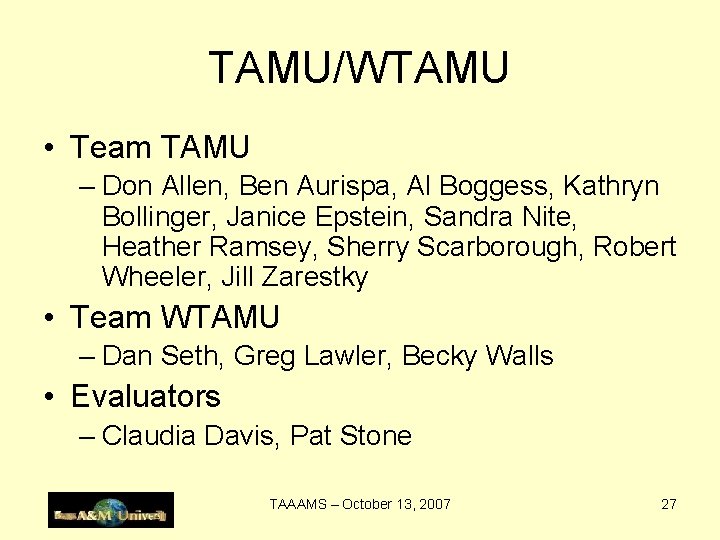
TAMU/WTAMU • Team TAMU – Don Allen, Ben Aurispa, Al Boggess, Kathryn Bollinger, Janice Epstein, Sandra Nite, Heather Ramsey, Sherry Scarborough, Robert Wheeler, Jill Zarestky • Team WTAMU – Dan Seth, Greg Lawler, Becky Walls • Evaluators – Claudia Davis, Pat Stone TAAAMS – October 13, 2007 27
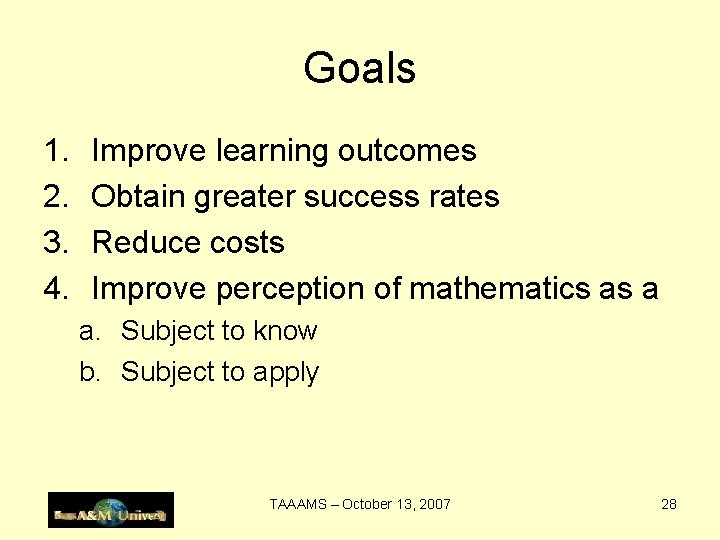
Goals 1. 2. 3. 4. Improve learning outcomes Obtain greater success rates Reduce costs Improve perception of mathematics as a a. Subject to know b. Subject to apply TAAAMS – October 13, 2007 28
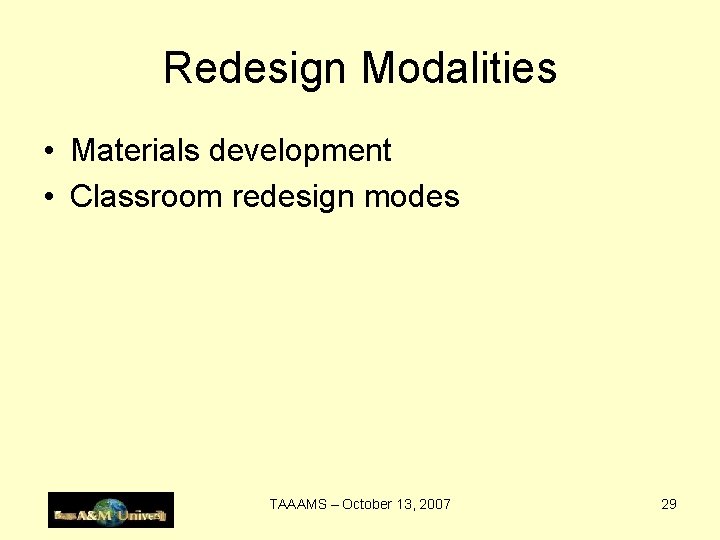
Redesign Modalities • Materials development • Classroom redesign modes TAAAMS – October 13, 2007 29
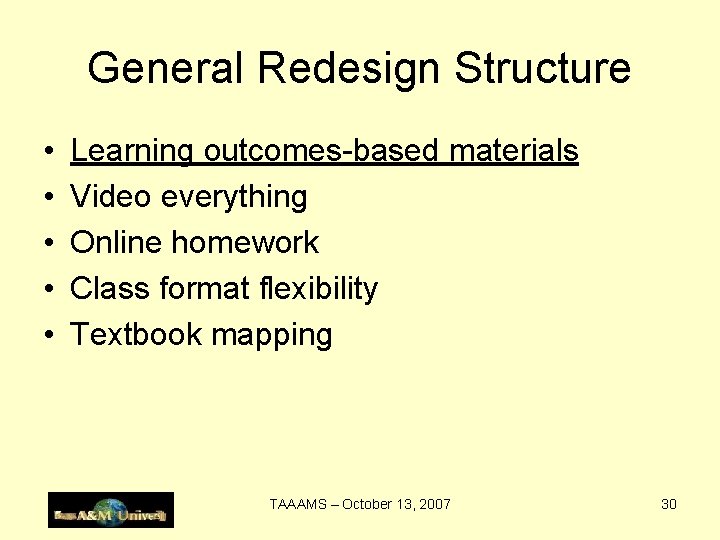
General Redesign Structure • • • Learning outcomes-based materials Video everything Online homework Class format flexibility Textbook mapping TAAAMS – October 13, 2007 30
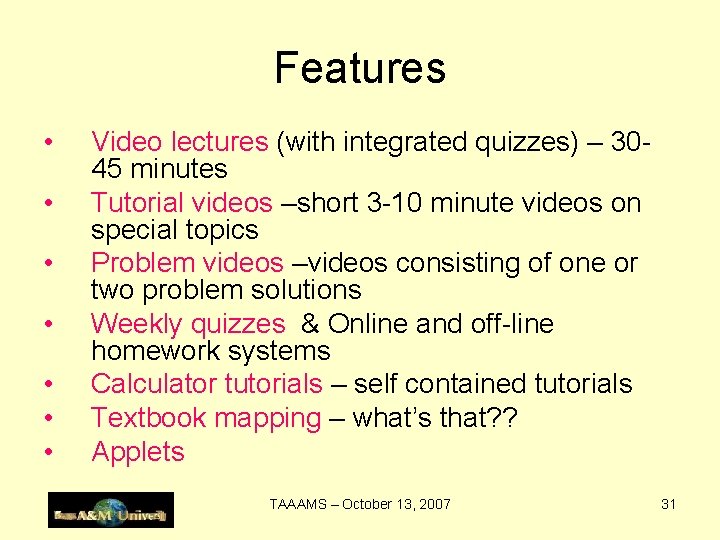
Features • • Video lectures (with integrated quizzes) – 3045 minutes Tutorial videos –short 3 -10 minute videos on special topics Problem videos –videos consisting of one or two problem solutions Weekly quizzes & Online and off-line homework systems Calculator tutorials – self contained tutorials Textbook mapping – what’s that? ? Applets TAAAMS – October 13, 2007 31
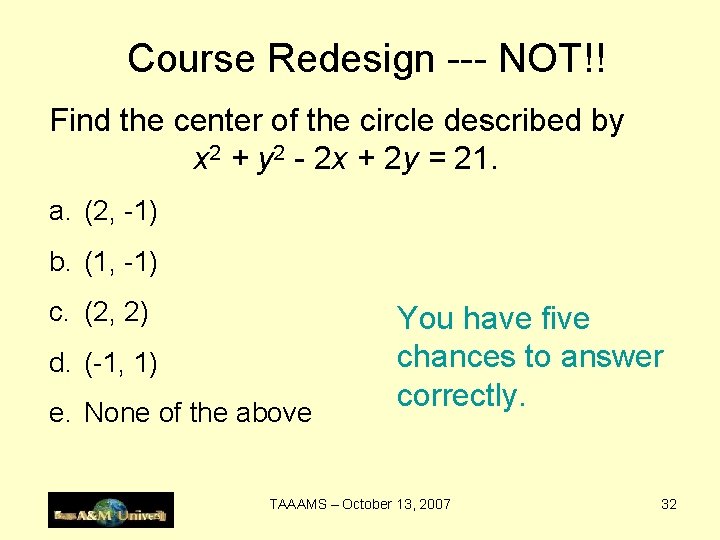
Course Redesign --- NOT!! Find the center of the circle described by x 2 + y 2 - 2 x + 2 y = 21. a. (2, -1) b. (1, -1) c. (2, 2) d. (-1, 1) e. None of the above You have five chances to answer correctly. TAAAMS – October 13, 2007 32
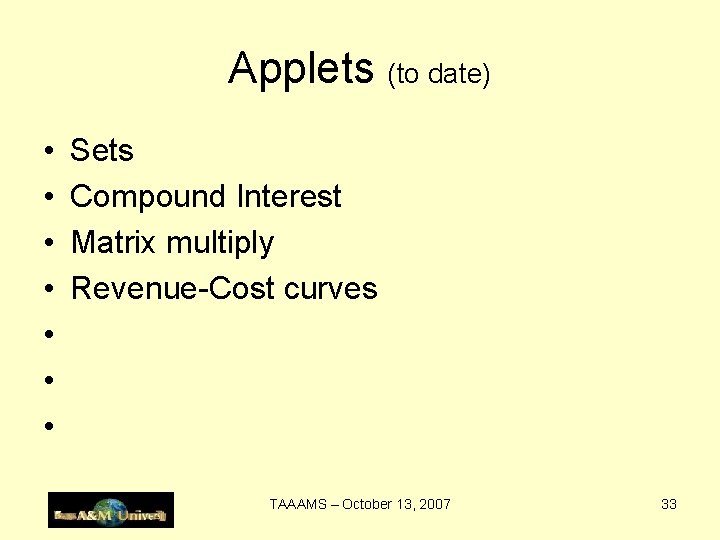
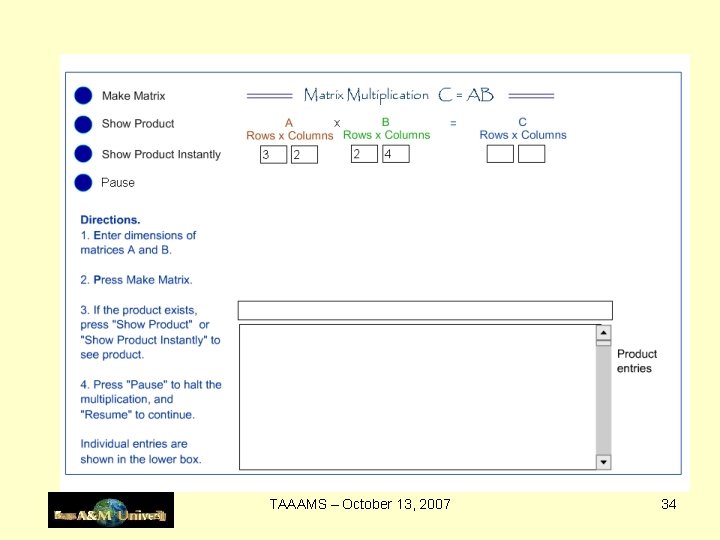
Applets (to date) • • Sets Compound Interest Matrix multiply Revenue-Cost curves TAAAMS – October 13, 2007 33
TAAAMS – October 13, 2007 34
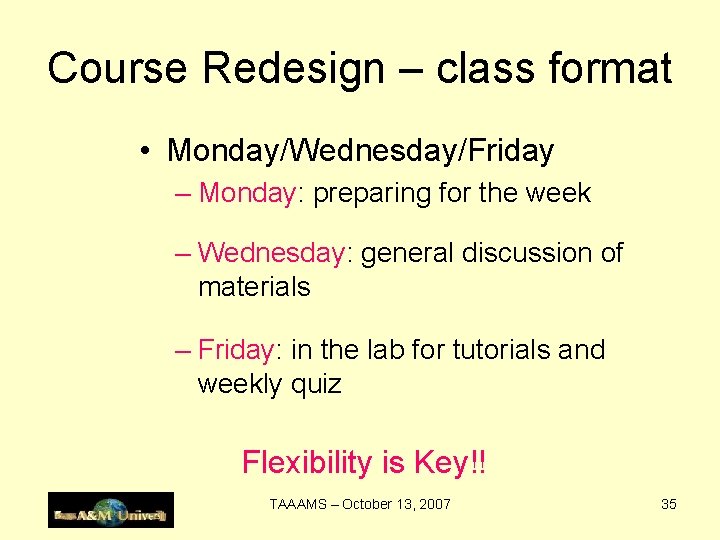
Course Redesign – class format • Monday/Wednesday/Friday – Monday: preparing for the week – Wednesday: general discussion of materials – Friday: in the lab for tutorials and weekly quiz Flexibility is Key!! TAAAMS – October 13, 2007 35
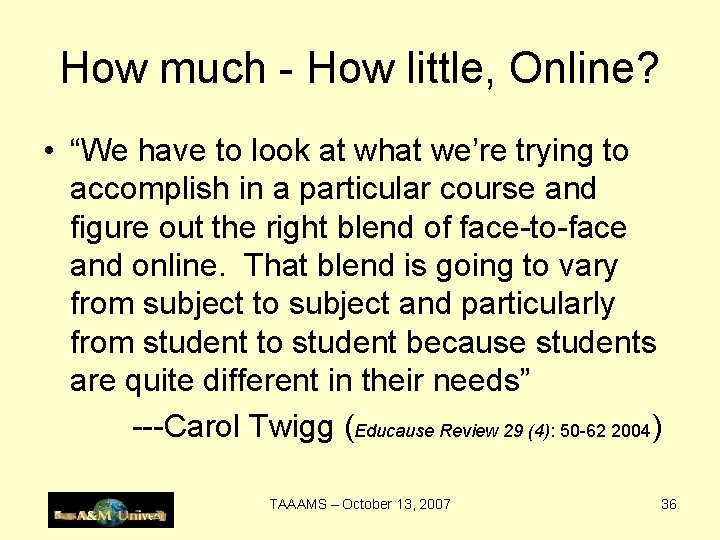
How much - How little, Online? • “We have to look at what we’re trying to accomplish in a particular course and figure out the right blend of face-to-face and online. That blend is going to vary from subject to subject and particularly from student to student because students are quite different in their needs” ---Carol Twigg (Educause Review 29 (4): 50 -62 2004) TAAAMS – October 13, 2007 36
Evaluation • Decrease the D-W-F rates • Increase the retention rate • Increase student learning and retention of knowledge and skills • Increase student motivation and course satisfaction • Create quality on-line course content and assessments TAAAMS – October 13, 2007 37
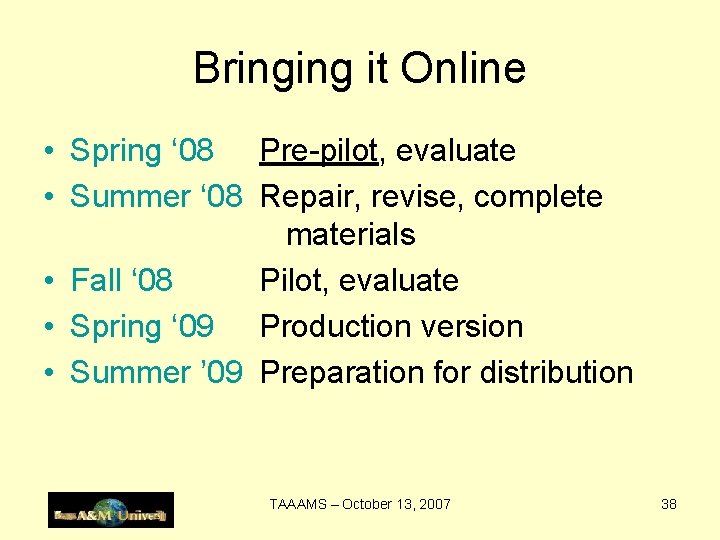
Bringing it Online • Spring ‘ 08 Pre-pilot, evaluate • Summer ‘ 08 Repair, revise, complete materials • Fall ‘ 08 Pilot, evaluate • Spring ‘ 09 Production version • Summer ’ 09 Preparation for distribution TAAAMS – October 13, 2007 38
Sustainability • Sustainability rests upon – Success in increasing retention rates and student learning – Ease of use by faculty & faculty buy-in – Continuing work on the project beyond the expiration of the grant – Reducing instructional costs – Faculty training TAAAMS – October 13, 2007 39
Dissemination • Dissemination rests upon – Direct contact with other campuses (demos) – Flexibility of product use – Textbook mapping – Faculty handbook on course use – Commercial contracts? TAAAMS – October 13, 2007 40
E-Learning/Course Redesign • • Eases communications for students Offers the convenience of time and place Attracts well-motivated students Provides an alternative to the “failed lecture system” • Improves student and institutional flexibility • Gives the “high” in the new “hybrid” courses. TAAAMS – October 13, 2007 41
TAAAMS – October 13, 2007 42
Future Competitions • Phase IV RFP is in the planning stages • Find partnering institutions • But… What course to select? – CCGN 1314 – College Algebra – CCGN 1324 – Finite math – CCGN 1325 – Business calculus – CCGN 1350/1 – Fundamentals of math I, II TAAAMS – October 13, 2007 43
Future Competitions • What course to select? – CCGN 2312 – Precalculus – CCGN 2313/14/15 – Calculus I, II – CCGN 2318 – Linear Algebra – CCGN 2320 – Differential Equations TAAAMS – October 13, 2007 44
More Information • THECB http: //www. thecb. state. tx. us/AAR/coursere design/ • NCAT http: //www. thencat. org/ TAAAMS – October 13, 2007 45
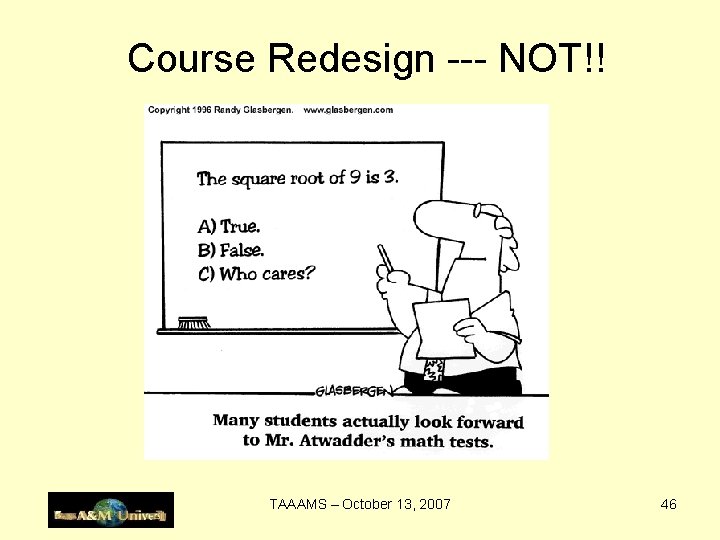
Course Redesign --- NOT!! TAAAMS – October 13, 2007 46