
Tevatron Detectors CDF and D Massimo Casarsa DOE
- Slides: 43
Tevatron Detectors (CDF and DØ) Massimo Casarsa DOE S&T Review of Scientific User Facilities June 30 – July 2, 2009
Outline Snapshot of CDF and DØ Collaborations; overview of CDF and DØ detectors; detectors performance in the past 12 months; detectors operations and current status; activities scheduled during the Summer shutdown; conclusions. 2 Massimo Casarsa: DOE S&T Review, June 30 - July 2, 2009
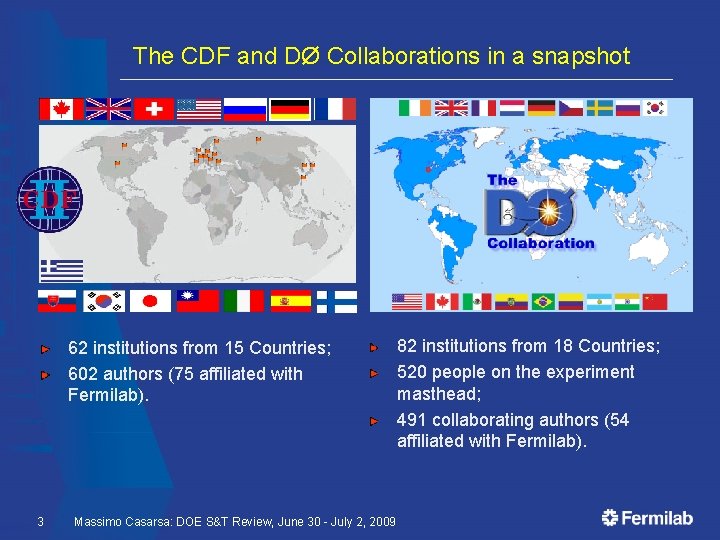
The CDF and DØ Collaborations in a snapshot 62 institutions from 15 Countries; 602 authors (75 affiliated with Fermilab). 3 Massimo Casarsa: DOE S&T Review, June 30 - July 2, 2009 82 institutions from 18 Countries; 520 people on the experiment masthead; 491 collaborating authors (54 affiliated with Fermilab).
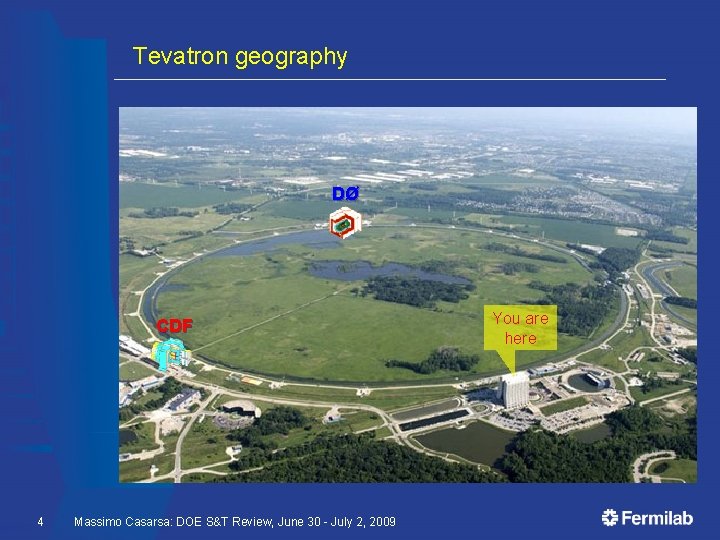
Tevatron geography DØ CDF 4 Massimo Casarsa: DOE S&T Review, June 30 - July 2, 2009 You are here
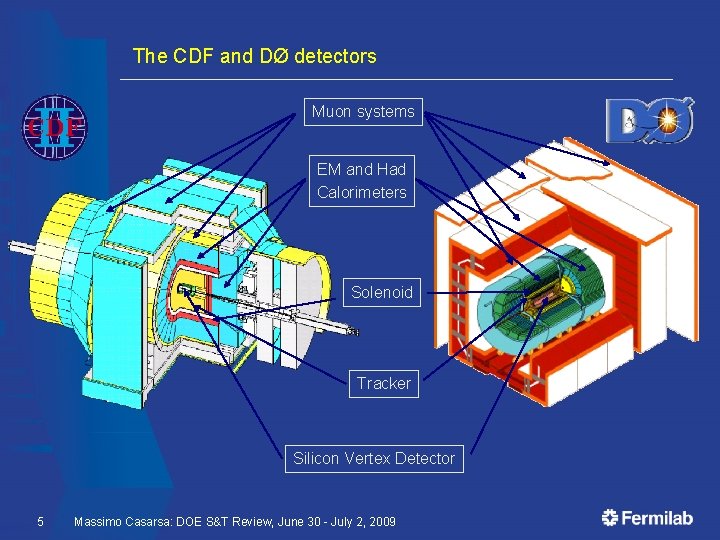
The CDF and DØ detectors Muon systems EM and Had Calorimeters Solenoid Tracker Silicon Vertex Detector 5 Massimo Casarsa: DOE S&T Review, June 30 - July 2, 2009
Performance of Detectors 6 Massimo Casarsa: DOE S&T Review, June 30 - July 2, 2009
Typical running conditions in the past months Detector and accelerator operations are strictly interwoven. In the past year both detectors kept pace well with the extraordinary performance of the accelerator complex: no need to revise their operations or procedures. Typical running conditions in the past year: number of stores per week: 8 -9; average store duration: ~15 hours; initial/final instantaneous luminosity: ~3/~0. 8 1032 cm-2 s-1; time between stores: < 2 hours; detectors could take advantage of ~20 -minute quiet time between stores for calibrations. On average one access of 1 -2 hours per week. 7 Massimo Casarsa: DOE S&T Review, June 30 - July 2, 2009
Overview of the CDF operations Operations Group: organized in subgroups which reflect the detector subsystems, manages all aspects of detector operations. Operations Manager: organizes daily operations. Data-taking crew on 24/7 8 -hour shift rotation: Scientific Coordinator: directs shift crew to accomplish the plan, liaison to accelerator control room, responsible for emergency response. Ace: runs DAQ/HV, monitors detector status and respond to problems. Consumer Operator: monitors/assesses data quality. Process system technician on shift 24/7: HVAC, cryogenics/solenoid, gas system, silicon detector cooling. On-call experts for each subdetector and system: respond 24/7 to shift crew pages. 8 Massimo Casarsa: DOE S&T Review, June 30 - July 2, 2009
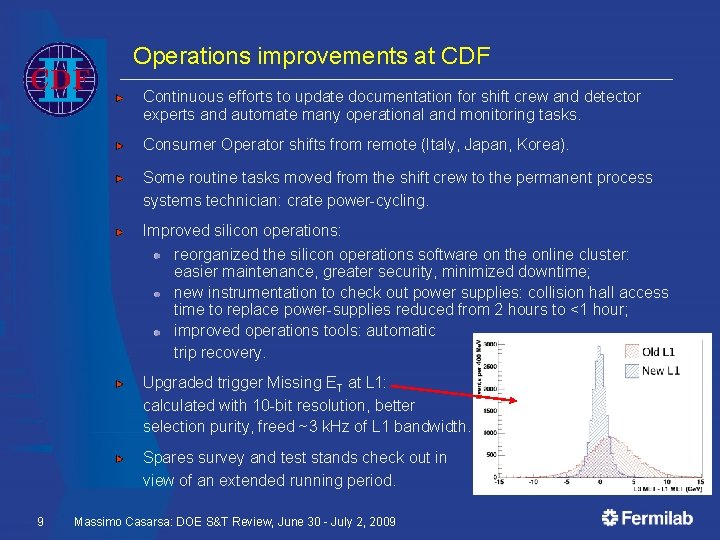
Operations improvements at CDF Continuous efforts to update documentation for shift crew and detector experts and automate many operational and monitoring tasks. Consumer Operator shifts from remote (Italy, Japan, Korea). Some routine tasks moved from the shift crew to the permanent process systems technician: crate power-cycling. Improved silicon operations: reorganized the silicon operations software on the online cluster: easier maintenance, greater security, minimized downtime; new instrumentation to check out power supplies: collision hall access time to replace power-supplies reduced from 2 hours to <1 hour; improved operations tools: automatic trip recovery. Upgraded trigger Missing ET at L 1: calculated with 10 -bit resolution, better selection purity, freed ~3 k. Hz of L 1 bandwidth. Spares survey and test stands check out in view of an extended running period. 9 Massimo Casarsa: DOE S&T Review, June 30 - July 2, 2009
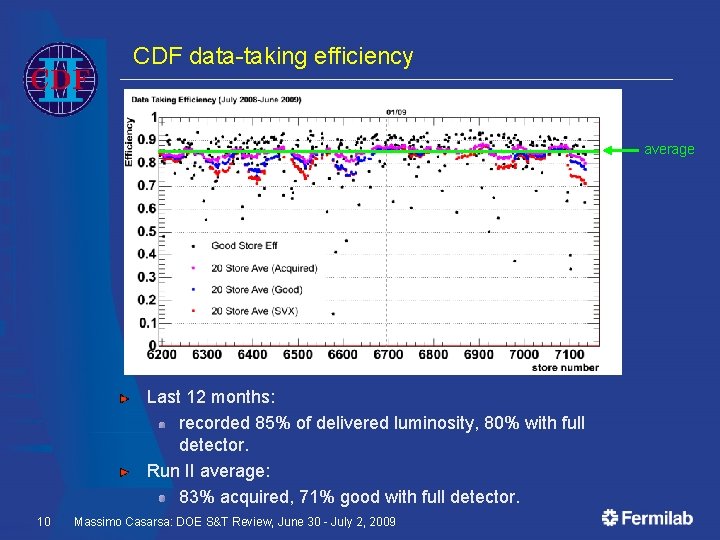
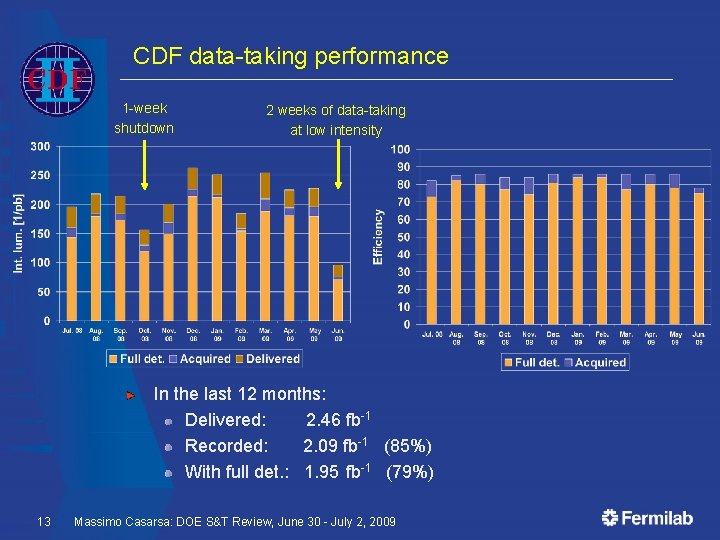
CDF data-taking efficiency average Last 12 months: recorded 85% of delivered luminosity, 80% with full detector. Run II average: 83% acquired, 71% good with full detector. 10 Massimo Casarsa: DOE S&T Review, June 30 - July 2, 2009
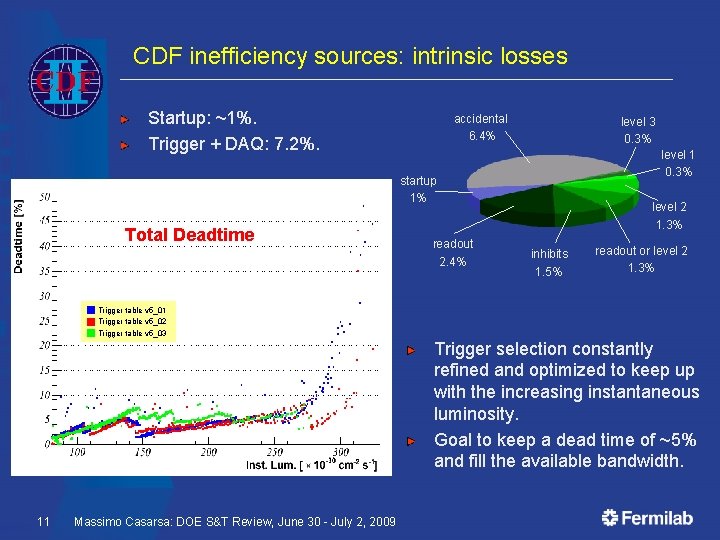
CDF inefficiency sources: intrinsic losses Startup: ~1%. Trigger + DAQ: 7. 2%. accidental 6. 4% level 3 0. 3% level 1 0. 3% startup 1% Total Deadtime readout 2. 4% level 2 1. 3% inhibits 1. 5% readout or level 2 1. 3% Trigger table v 5_01 Trigger table v 5_02 Trigger table v 5_03 Trigger selection constantly refined and optimized to keep up with the increasing instantaneous luminosity. Goal to keep a dead time of ~5% and fill the available bandwidth. 11 Massimo Casarsa: DOE S&T Review, June 30 - July 2, 2009
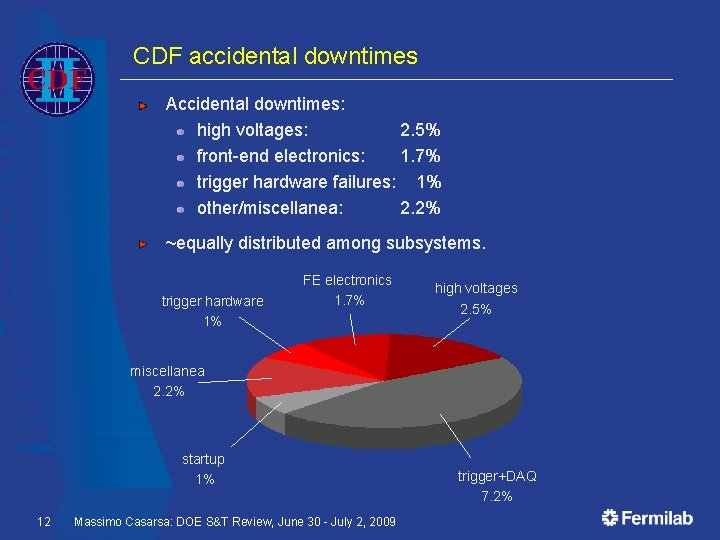
CDF accidental downtimes Accidental downtimes: high voltages: 2. 5% front-end electronics: 1. 7% trigger hardware failures: 1% other/miscellanea: 2. 2% ~equally distributed among subsystems. trigger hardware 1% FE electronics 1. 7% high voltages 2. 5% miscellanea 2. 2% startup 1% 12 Massimo Casarsa: DOE S&T Review, June 30 - July 2, 2009 trigger+DAQ 7. 2%
CDF data-taking performance 1 -week shutdown 2 weeks of data-taking at low intensity In the last 12 months: Delivered: 2. 46 fb-1 Recorded: 2. 09 fb-1 (85%) With full det. : 1. 95 fb-1 (79%) 13 Massimo Casarsa: DOE S&T Review, June 30 - July 2, 2009
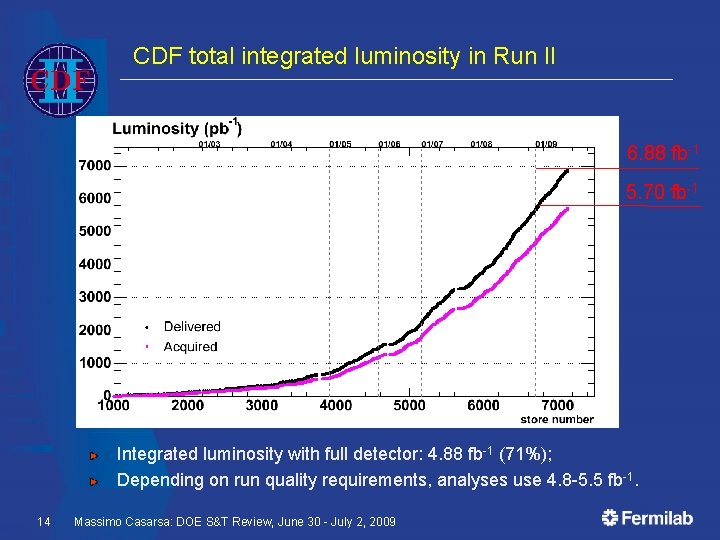
CDF total integrated luminosity in Run II 6. 88 fb-1 5. 70 fb-1 Integrated luminosity with full detector: 4. 88 fb-1 (71%); Depending on run quality requirements, analyses use 4. 8 -5. 5 fb-1. 14 Massimo Casarsa: DOE S&T Review, June 30 - July 2, 2009
Overview of the DØ Operations organization To achieve and maintain high efficiency detector operations (>91% since 1 July 2008) requires a dedicated operations team: Run Coordinators and Technical Integration Coordinator; subsystem coordinators, support personnel and on-call experts; well-trained shifters: Captain (also responsible for Global Monitoring); Data Acquisition; Tracking; Calorimeter and Muon systems; Operations shifter. mechanical and electrical support crews; computing and database experts. Performance of detectors must be carefully monitored and plans for improvements must be appropriately scrutinized and scheduled: minimize disruptions; maximize performance. Understanding and improvement of detector performance is facilitated by offline reconstruction and analysis of data. 15 Massimo Casarsa: DOE S&T Review, June 30 - July 2, 2009
Recent operational advances at DØ Data-taking improvements: continue improving documentation and guidance; optimization of run transitions at begin of store, during store, end of store; continue enhancing automated monitoring of detector status; automate monitoring of beam halo; automate response of Luminosity Monitor HV to Solenoid ramp. Detector performance: improving power supply reliability and reaping benefits; optimize Forward Pre. Shower pedestals and gains: enhanced dynamic range; update Central Track Trigger equations to reflect current unresponsive fiber list; streamline Level 2 processing in anticipation of increasing instantaneous luminosities. 16 Massimo Casarsa: DOE S&T Review, June 30 - July 2, 2009
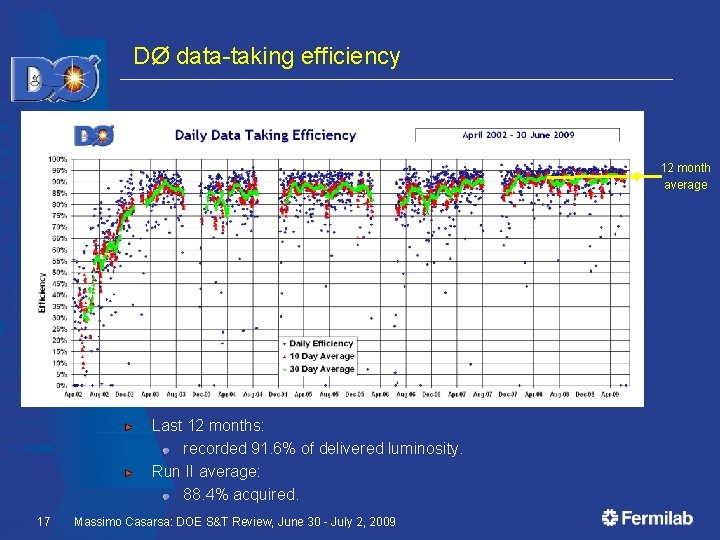
DØ data-taking efficiency 12 month average Last 12 months: recorded 91. 6% of delivered luminosity. Run II average: 88. 4% acquired. 17 Massimo Casarsa: DOE S&T Review, June 30 - July 2, 2009
Sources of losses at DØ Begin/End Store and Begin/End Run (~1% losses): ramping silicon and muon system high voltages; changing trigger prescale sets during run transitions. Front End Busy due to event readout (~4% losses). Failures/downtimes (~3% losses): readout electronics failures; crate resets to address loss of synchronization; power supply trips; electronics cooling failures (water and/or air); high voltage trips; noise in the calorimeter; unscheduled power outages; shifter (and expert) experience: low rate of individual failures tends to result in longer recovery times; transitions for special studies/calibrations. Operations team tracks causes of failures and errors and addresses root causes where possible. 18 Massimo Casarsa: DOE S&T Review, June 30 - July 2, 2009
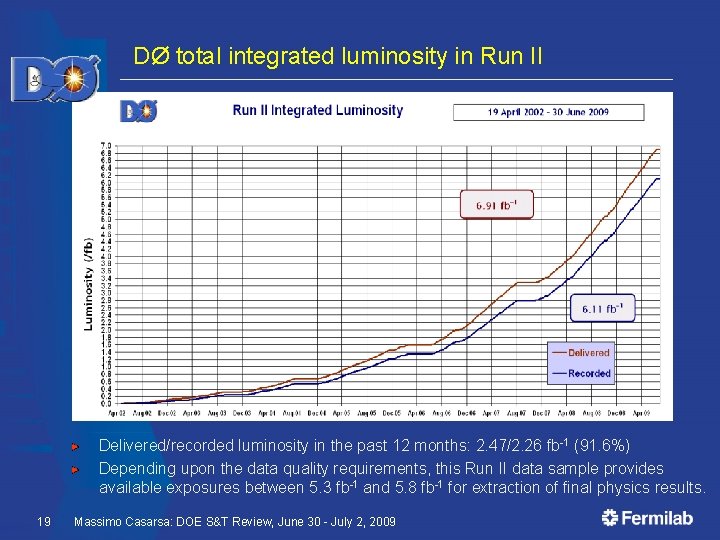
DØ total integrated luminosity in Run II Delivered/recorded luminosity in the past 12 months: 2. 47/2. 26 fb-1 (91. 6%) Depending upon the data quality requirements, this Run II data sample provides available exposures between 5. 3 fb-1 and 5. 8 fb-1 for extraction of final physics results. 19 Massimo Casarsa: DOE S&T Review, June 30 - July 2, 2009
Status of Detectors 20 Massimo Casarsa: DOE S&T Review, June 30 - July 2, 2009
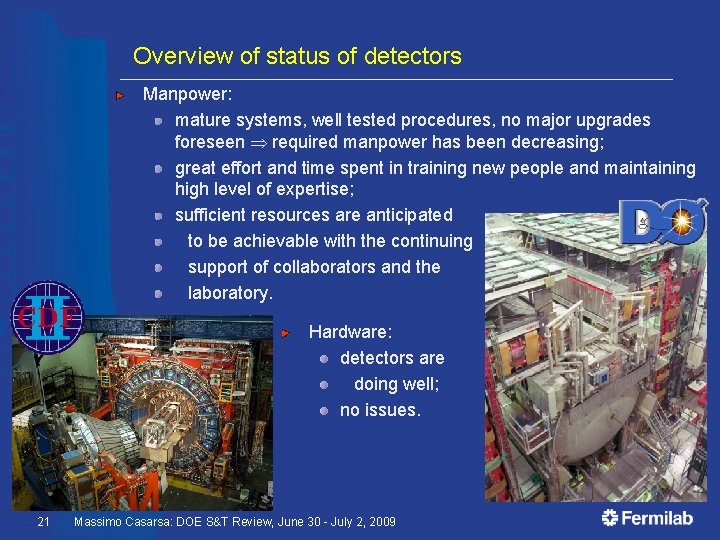
Overview of status of detectors Manpower: mature systems, well tested procedures, no major upgrades foreseen required manpower has been decreasing; great effort and time spent in training new people and maintaining high level of expertise; sufficient resources are anticipated to be achievable with the continuing support of collaborators and the laboratory. Hardware: detectors are doing well; no issues. 21 Massimo Casarsa: DOE S&T Review, June 30 - July 2, 2009
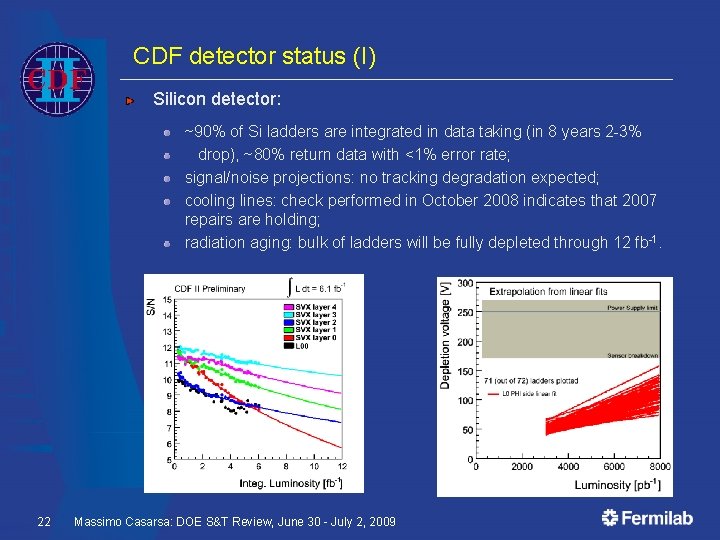
CDF detector status (I) Silicon detector: ~90% of Si ladders are integrated in data taking (in 8 years 2 -3% drop), ~80% return data with <1% error rate; signal/noise projections: no tracking degradation expected; cooling lines: check performed in October 2008 indicates that 2007 repairs are holding; radiation aging: bulk of ladders will be fully depleted through 12 fb-1. 22 Massimo Casarsa: DOE S&T Review, June 30 - July 2, 2009
CDF detector status (II) Drift chamber: no wires needed to be disabled since last Summer; currently ~1. 5% of wires don’t calibrate (HV or readout disabled). last month tested for aging: no effect found; hit efficiency in minimum bias events ~99%. Calorimeters: photomultipliers: no issues (~1 problem per detector); gain drop: ~3%/year in central cal. , 5 -10%/year (increases with polar angle) in the plug cal. corrected via HV change and readout electronics gains; no sensitive change in calorimetry resolution, no impact on physics; calibration, maintained with data and sources, very stable: 3% online, ~1% offline. Muon system: stable operation. Trigger and data acquisition: spares for extended running. Infrastructure: no issues with gas system, cryogenics, solenoid. 23 Massimo Casarsa: DOE S&T Review, June 30 - July 2, 2009
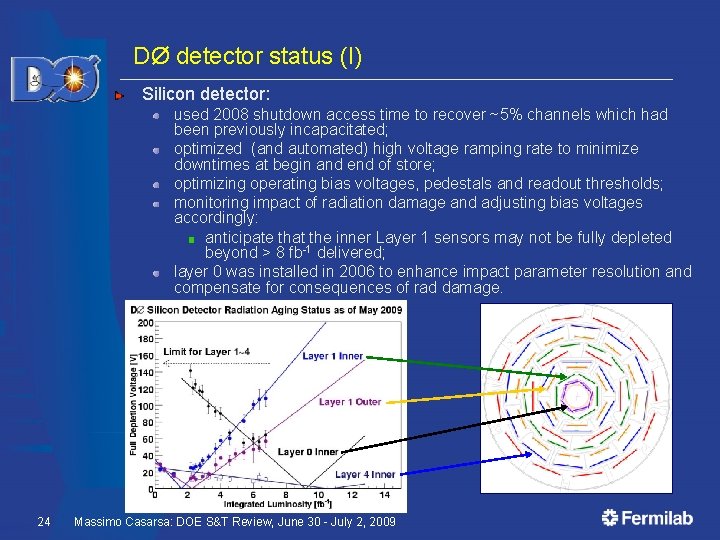
DØ detector status (I) Silicon detector: used 2008 shutdown access time to recover ~5% channels which had been previously incapacitated; optimized (and automated) high voltage ramping rate to minimize downtimes at begin and end of store; optimizing operating bias voltages, pedestals and readout thresholds; monitoring impact of radiation damage and adjusting bias voltages accordingly: anticipate that the inner Layer 1 sensors may not be fully depleted beyond > 8 fb-1 delivered; layer 0 was installed in 2006 to enhance impact parameter resolution and compensate for consequences of rad damage. 24 Massimo Casarsa: DOE S&T Review, June 30 - July 2, 2009
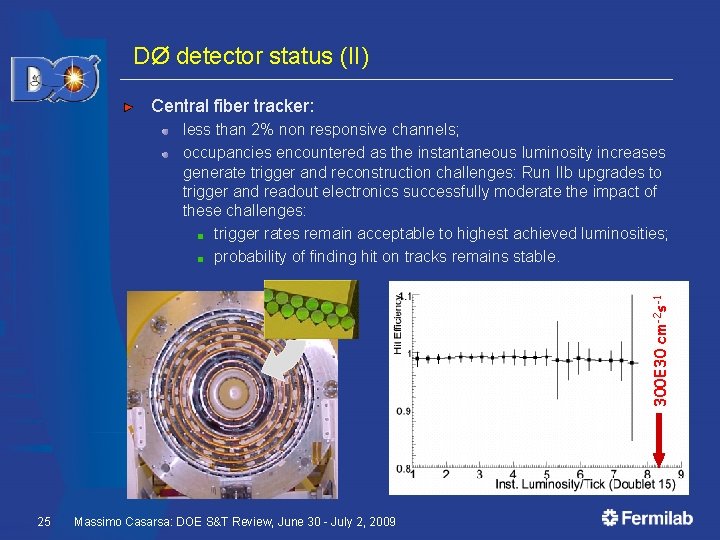
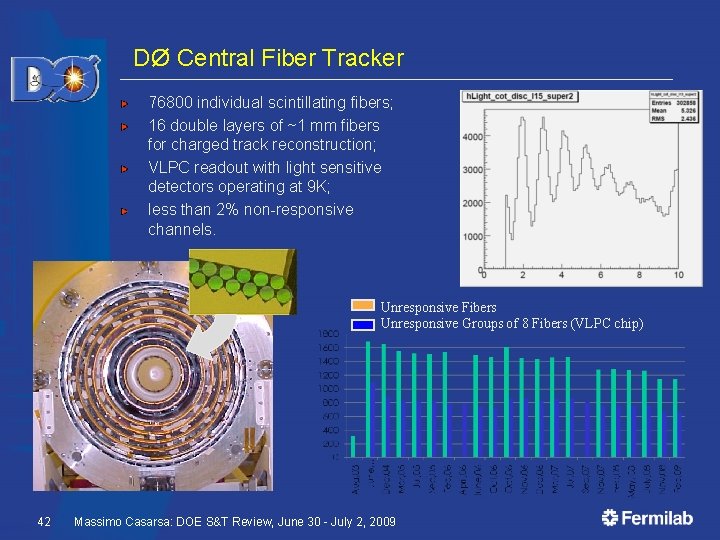
DØ detector status (II) Central fiber tracker: 300 E 30 cm-2 s-1 less than 2% non responsive channels; occupancies encountered as the instantaneous luminosity increases generate trigger and reconstruction challenges: Run IIb upgrades to trigger and readout electronics successfully moderate the impact of these challenges: trigger rates remain acceptable to highest achieved luminosities; probability of finding hit on tracks remains stable. 25 Massimo Casarsa: DOE S&T Review, June 30 - July 2, 2009
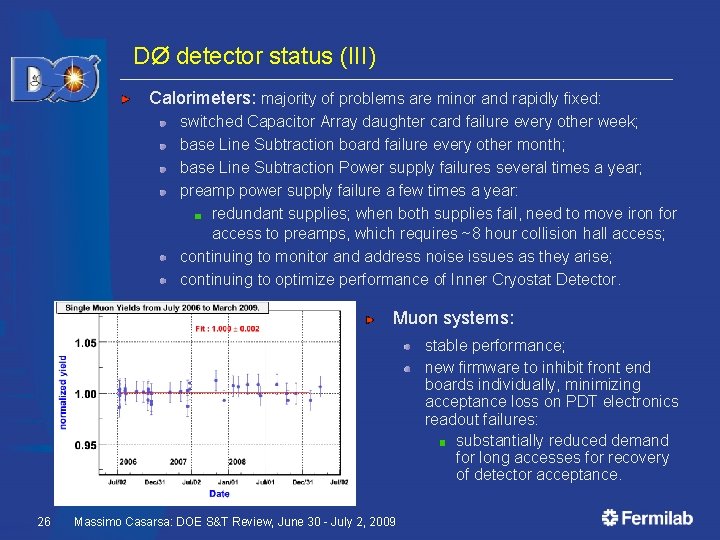
DØ detector status (III) Calorimeters: majority of problems are minor and rapidly fixed: switched Capacitor Array daughter card failure every other week; base Line Subtraction board failure every other month; base Line Subtraction Power supply failures several times a year; preamp power supply failure a few times a year: redundant supplies; when both supplies fail, need to move iron for access to preamps, which requires ~8 hour collision hall access; continuing to monitor and address noise issues as they arise; continuing to optimize performance of Inner Cryostat Detector. Muon systems: stable performance; new firmware to inhibit front end boards individually, minimizing acceptance loss on PDT electronics readout failures: substantially reduced demand for long accesses for recovery of detector acceptance. 26 Massimo Casarsa: DOE S&T Review, June 30 - July 2, 2009
Shutdown 2009 plans 27 Massimo Casarsa: DOE S&T Review, June 30 - July 2, 2009
CDF shutdown 2009 plans Most jobs undertaken in view of a possible extended running. Silicon detector: cooling maintenance: replacement of the elbows on the ISL cooling lines and of the attached COT-face tubing; power-supply maintenance: replacement of aged capacitors in power supply modules. Drift chamber: replacement of failing resistors in the wire readout circuit. Calorimeter: plug calorimeter sources maintenance. Installation of additional nodes to the L 3 farm. New diesel emergency generator. UPS system maintenance. General preventive maintenance. 28 Massimo Casarsa: DOE S&T Review, June 30 - July 2, 2009
DØ shutdown 2009 plans Reduced shift crew coverage during shutdown. Inspections and Maintenance. Individual channel recoveries. Safety checks and tests. Calibrations/Surveys/Cosmic ray data. Replace Luminosity Monitor Counters. Deploy capability to remotely switch the power supply of the silicon tracker sequencer between primary and secondary (to minimize data losses and access requests due to power supply failures). 29 Massimo Casarsa: DOE S&T Review, June 30 - July 2, 2009
Conclusions No issues in detector operations: adequate staffing and hardware status good. Both CDF and DØ detectors performed very reliably and efficiently during the last 12 months, collecting >40 pb-1 per week. Doubled dataset on tape in the last 1. 5 years. Many interesting and timely results are being extracted from the accumulating data: see presentations by Marco Verzocchi and Kevin Pitts. Detectors ready for a very productive running through 2011. 30 Massimo Casarsa: DOE S&T Review, June 30 - July 2, 2009
Acknowledgments I would like to thank George Ginther and Bill Lee for the information and help they provided on DØ operations. 31 Massimo Casarsa: DOE S&T Review, June 30 - July 2, 2009
Backup slides 32 Massimo Casarsa: DOE S&T Review, June 30 - July 2, 2009
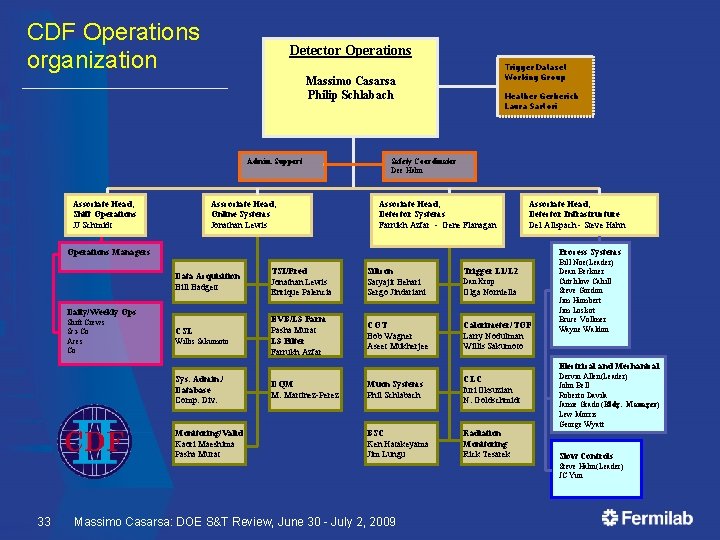
CDF Operations organization Detector Operations Trigger Dataset Working Group Massimo Casarsa Philip Schlabach Admin. Support Associate Head, Shift Operations JJ Schmidt Asscociate Head, Online Systems Jonathan Lewis Heather Gerberich Laura Sartori Safety Coordinator Dee Hahn Associate Head, Detector Systems Farrukh Azfar - Gene Flanagan Associate Head, Detector Infrastructure Del Allspach - Steve Hahn Operations Managers Process Systems Data Acquisition Bill Badgett Daily/Weekly Ops Shift Crews Sci-Co Aces Co CSL Willis Sakumoto TSI/Fred Jonathan Lewis Enrique Palencia Silicon Satyajit Behari Sergo Jindariani Trigger L 1/L 2 EVB/L 3 Farm Pasha Murat L 3 Filter Farrukh Azfar COT Bob Wagner Aseet Mukherjee Calorimeter/TOF Larry Nodulman Willis Sakumoto Muon Systems Phil Schlabach CLC Iuri Oksuzian N. Goldschmidt BSC Ken Hatakeyama Jim Lungu Radiation Monitoring Rick Tesarek Dan Krop Olga Norniella Bill Noe(Leader) Dean Beckner Cutchlow Cahill Steve Gordon Jim Humbert Jim Loskot Bruce Vollmer Wayne Waldon Electrical and Mechanical Sys. Admin. / Database Comp. Div. Monitoring/Valid Kaori Maeshima Pasha Murat DQM M. Martinez-Perez Dervin Allen(Leader) John Bell Roberto Davila Jamie Grado (Bldg. Manager) Lew Morris George Wyatt Slow Controls Steve Hahn(Leader) JC Yun 33 Massimo Casarsa: DOE S&T Review, June 30 - July 2, 2009
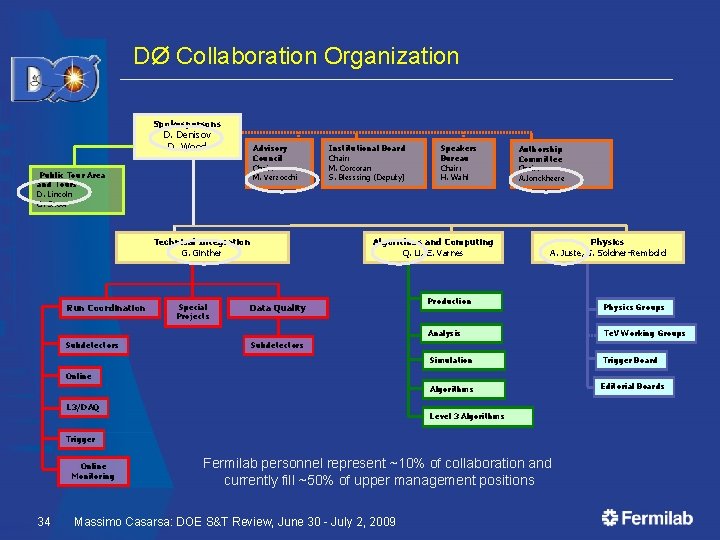
DØ Collaboration Organization Spokespersons D. Denisov D. Wood Advisory Council Chair: M. Verzocchi Public Tour Area and Tours D. Lincoln G. Snow Subdetectors Special Projects Speakers Bureau Chair: H. Wahl Algorithms and Computing Q. Li, E. Varnes Technical Integration G. Ginther Run Coordination Institutional Board Chair: M. Corcoran S. Blesssing (Deputy) Data Quality Authorship Committee Chair: A. Jonckheere Physics A. Juste, S. Soldner-Rembold Production Physics Groups Analysis Te. V Working Groups Simulation Trigger Board Algorithms Editorial Boards Subdetectors Online L 3/DAQ Level 3 Algorithms Trigger Online Monitoring 34 Fermilab personnel represent ~10% of collaboration and currently fill ~50% of upper management positions Massimo Casarsa: DOE S&T Review, June 30 - July 2, 2009
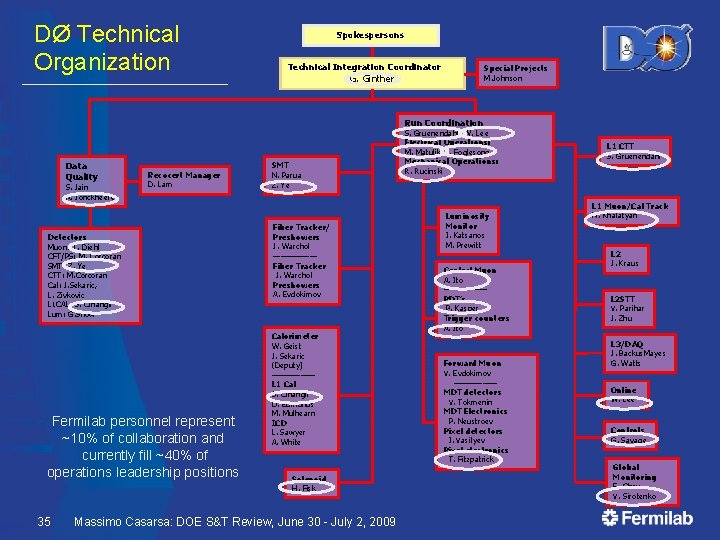
DØ Technical Organization Spokespersons Technical Integration Coordinator Special Projects M. Johnson G. Ginther Run Coordination Data Quality S. Jain A. Jonckheere Recocert Manager D. Lam Detectors Muon: T. Diehl CFT/PS: M. Corcoran SMT: Z. Ye CTT: M. Corcoran Cal: J. Sekaric, L. Zivkovic L 1 CAL: S. Cihangir Lum: G. Snow Fermilab personnel represent ~10% of collaboration and currently fill ~40% of operations leadership positions 35 SMT N. Parua Z. Ye Fiber Tracker/ Preshowers J. Warchol —————— Fiber Tracker J. Warchol Preshowers A. Evdokimov Calorimeter W. Geist J. Sekaric (Deputy) —————— L 1 Cal S. Cihangir D. Edmunds M. Mulhearn ICD L. Sawyer A. White Solenoid H. Fisk Massimo Casarsa: DOE S&T Review, June 30 - July 2, 2009 S. Gruenendahl, W. Lee Electrical Operations: M. Matulik, J. Foglesong Mechanical Operations: R. Rucinski Luminosity Monitor I. Katsanos M. Prewitt Central Muon A. Ito —————— PDT’s P. Kasper Trigger counters A. Ito Forward Muon V. Evdokimov —————— MDT detectors V. Tokmenin MDT Electronics P. Neustroev Pixel detectors I. Vasilyev Pixel electronics T. Fitzpatrick L 1 CTT S. Gruenendahl L 1 Muon/Cal Track N. Khalatyan L 2 J. Kraus L 2 STT V. Parihar J. Zhu L 3/DAQ J. Backus. Mayes G. Watts Online W. Lee Controls G. Savage Global Monitoring E. Cheu V. Sirotenko
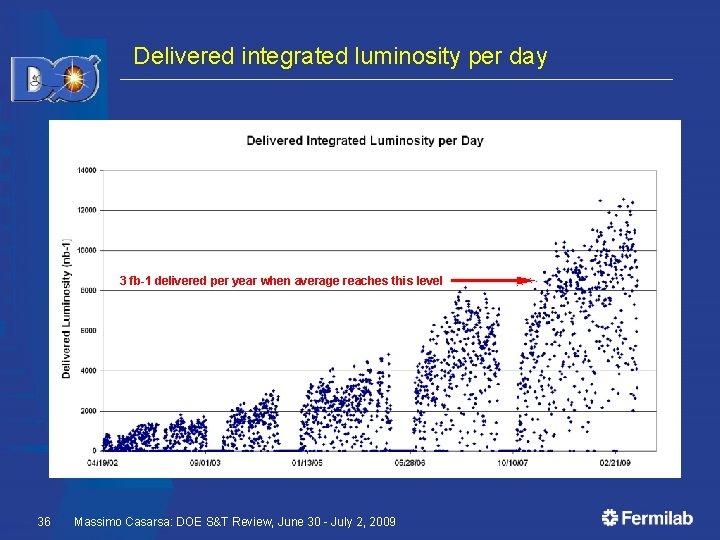
Delivered integrated luminosity per day 3 fb-1 delivered per year when average reaches this level 36 Massimo Casarsa: DOE S&T Review, June 30 - July 2, 2009
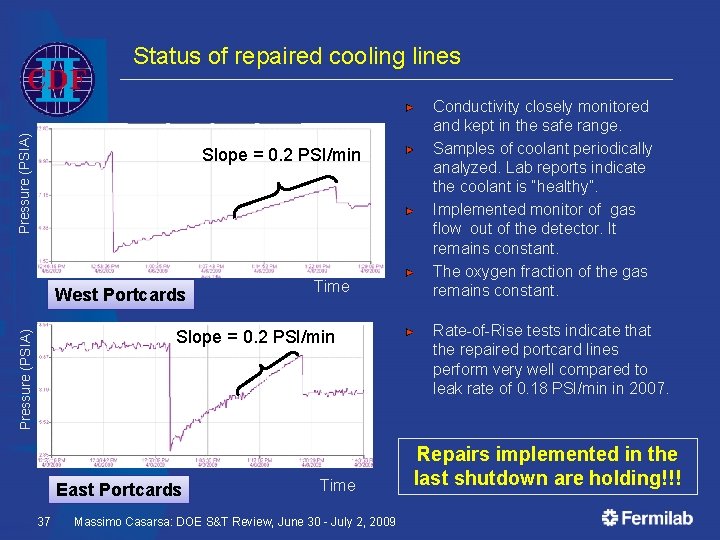
Pressure (PSIA) Status of repaired cooling lines Slope = 0. 2 PSI/min West Portcards Time Pressure (PSIA) Slope = 0. 2 PSI/min East Portcards 37 Time Massimo Casarsa: DOE S&T Review, June 30 - July 2, 2009 Conductivity closely monitored and kept in the safe range. Samples of coolant periodically analyzed. Lab reports indicate the coolant is “healthy”. Implemented monitor of gas flow out of the detector. It remains constant. The oxygen fraction of the gas remains constant. Rate-of-Rise tests indicate that the repaired portcard lines perform very well compared to leak rate of 0. 18 PSI/min in 2007. Repairs implemented in the last shutdown are holding!!!
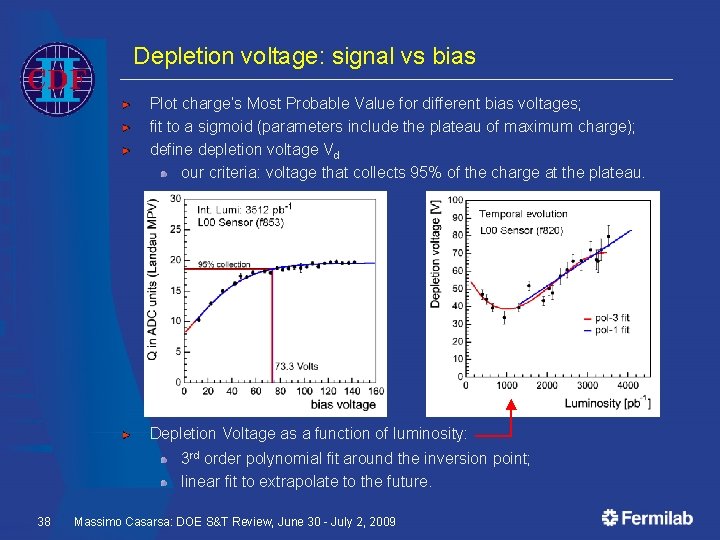
Depletion voltage: signal vs bias Plot charge’s Most Probable Value for different bias voltages; fit to a sigmoid (parameters include the plateau of maximum charge); define depletion voltage Vd our criteria: voltage that collects 95% of the charge at the plateau. Depletion Voltage as a function of luminosity: 3 rd order polynomial fit around the inversion point; linear fit to extrapolate to the future. 38 Massimo Casarsa: DOE S&T Review, June 30 - July 2, 2009
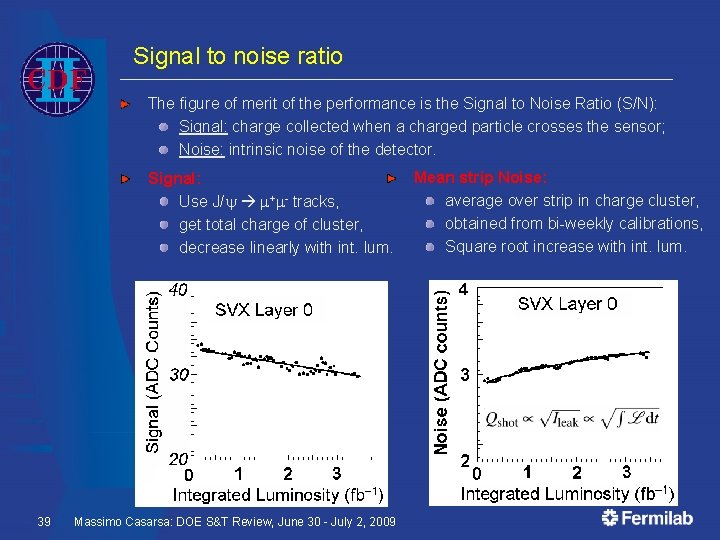
Signal to noise ratio The figure of merit of the performance is the Signal to Noise Ratio (S/N): Signal: charge collected when a charged particle crosses the sensor; Noise: intrinsic noise of the detector. Signal: Use J/y m+m- tracks, get total charge of cluster, decrease linearly with int. lum. 39 Massimo Casarsa: DOE S&T Review, June 30 - July 2, 2009 Mean strip Noise: average over strip in charge cluster, obtained from bi-weekly calibrations, Square root increase with int. lum.
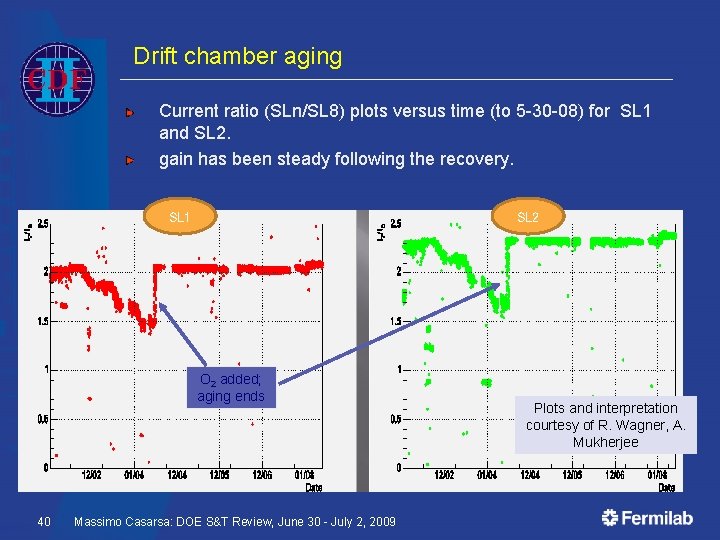
Drift chamber aging Current ratio (SLn/SL 8) plots versus time (to 5 -30 -08) for SL 1 and SL 2. gain has been steady following the recovery. SL 1 SL 2 O 2 added; aging ends 40 Massimo Casarsa: DOE S&T Review, June 30 - July 2, 2009 Plots and interpretation courtesy of R. Wagner, A. Mukherjee
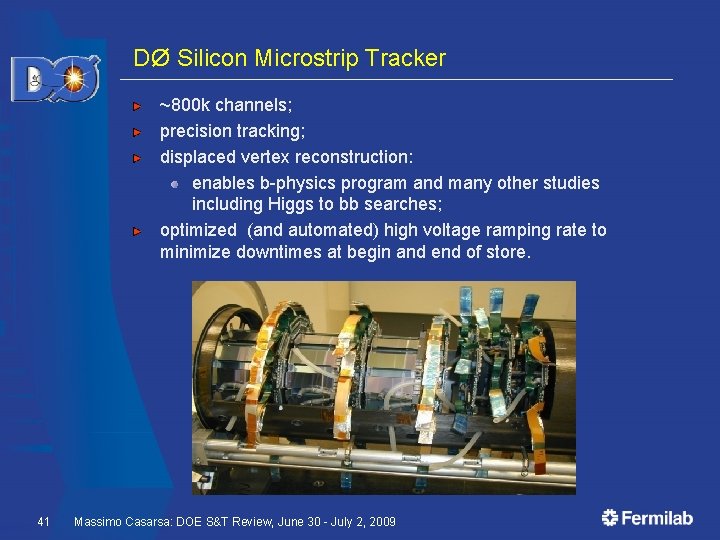
DØ Silicon Microstrip Tracker ~800 k channels; precision tracking; displaced vertex reconstruction: enables b-physics program and many other studies including Higgs to bb searches; optimized (and automated) high voltage ramping rate to minimize downtimes at begin and end of store. 41 Massimo Casarsa: DOE S&T Review, June 30 - July 2, 2009
DØ Central Fiber Tracker 76800 individual scintillating fibers; 16 double layers of ~1 mm fibers for charged track reconstruction; VLPC readout with light sensitive detectors operating at 9 K; less than 2% non-responsive channels. Unresponsive Fibers Unresponsive Groups of 8 Fibers (VLPC chip) 42 Massimo Casarsa: DOE S&T Review, June 30 - July 2, 2009
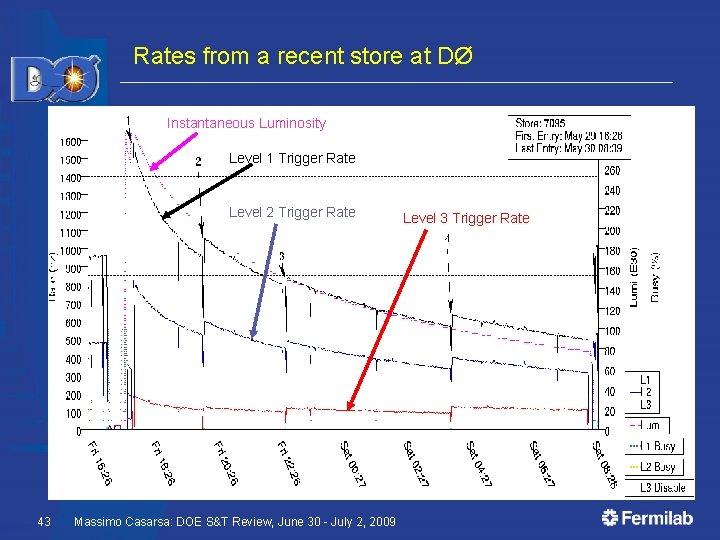
Rates from a recent store at DØ Instantaneous Luminosity Level 1 Trigger Rate Level 2 Trigger Rate 43 Massimo Casarsa: DOE S&T Review, June 30 - July 2, 2009 Level 3 Trigger Rate