
Tetragonal Zirconia Polycrystals Structure and properties MSc Eng
- Slides: 53
Tetragonal Zirconia Polycrystals Structure and properties MSc Eng Marta Gajewska Interdyscyplinarne studia doktoranckie z zakresu inżynierii materiałowej z wykładowym językiem angielskim
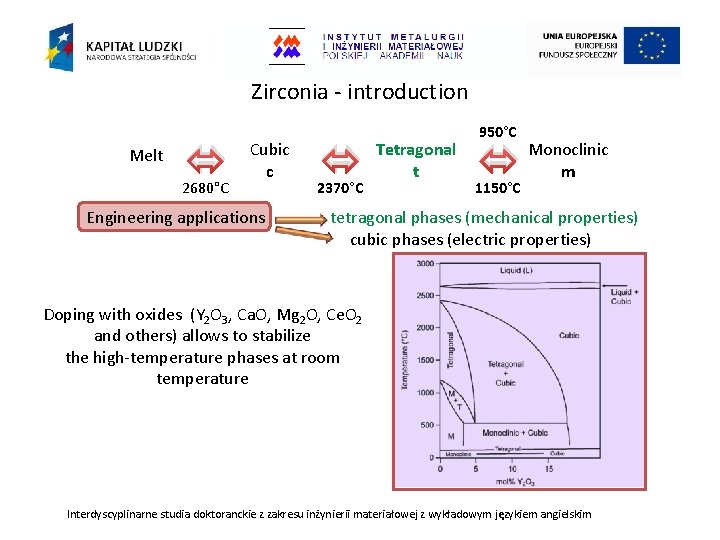
Zirconia - introduction Melt 2680°C Cubic c 2370°C Tetragonal t 950°C 1150°C Monoclinic m Engineering applications tetragonal phases (mechanical properties) cubic phases (electric properties) Doping with oxides (Y 2 O 3, Ca. O, Mg 2 O, Ce. O 2 and others) allows to stabilize the high-temperature phases at room temperature Interdyscyplinarne studia doktoranckie z zakresu inżynierii materiałowej z wykładowym językiem angielskim
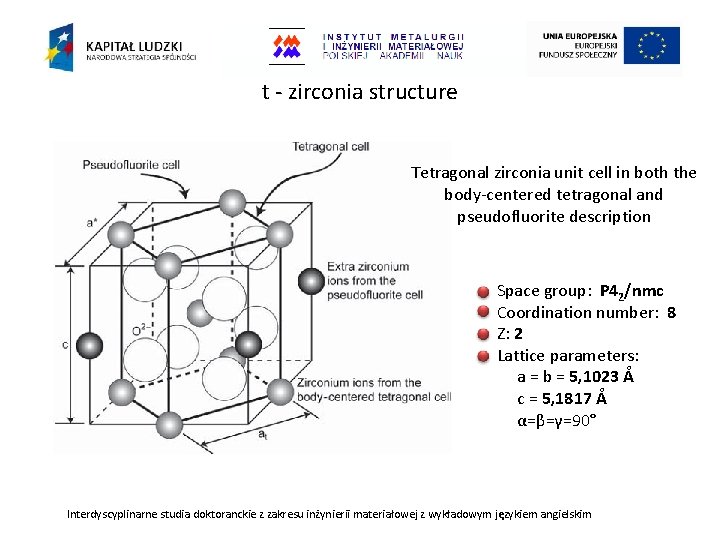
t - zirconia structure Tetragonal zirconia unit cell in both the body-centered tetragonal and pseudofluorite description Space group: P 42/nmc Coordination number: 8 Z: 2 Lattice parameters: a = b = 5, 1023 Å c = 5, 1817 Å α=β=γ=90° Interdyscyplinarne studia doktoranckie z zakresu inżynierii materiałowej z wykładowym językiem angielskim
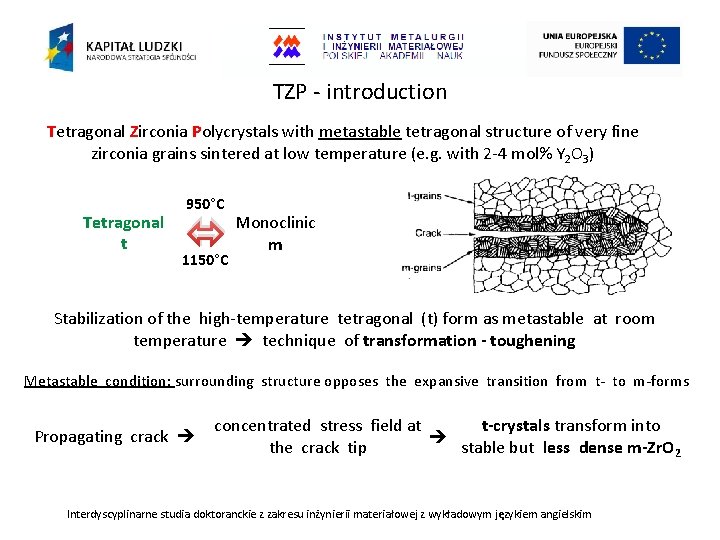
TZP - introduction Tetragonal Zirconia Polycrystals with metastable tetragonal structure of very fine zirconia grains sintered at low temperature (e. g. with 2 -4 mol% Y 2 O 3) Tetragonal t 950°C 1150°C Monoclinic m Stabilization of the high-temperature tetragonal (t) form as metastable at room temperature technique of transformation - toughening Metastable condition: surrounding structure opposes the expansive transition from t- to m-forms Propagating crack concentrated stress field at t-crystals transform into the crack tip stable but less dense m-Zr. O 2 Interdyscyplinarne studia doktoranckie z zakresu inżynierii materiałowej z wykładowym językiem angielskim
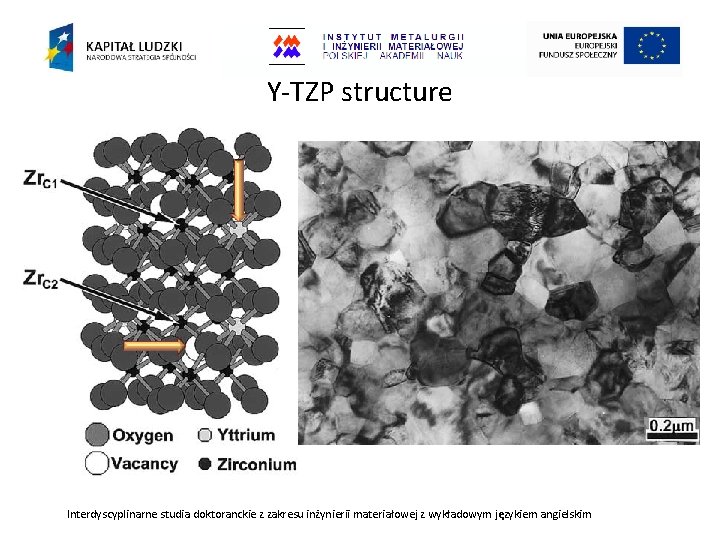
Y-TZP structure Interdyscyplinarne studia doktoranckie z zakresu inżynierii materiałowej z wykładowym językiem angielskim
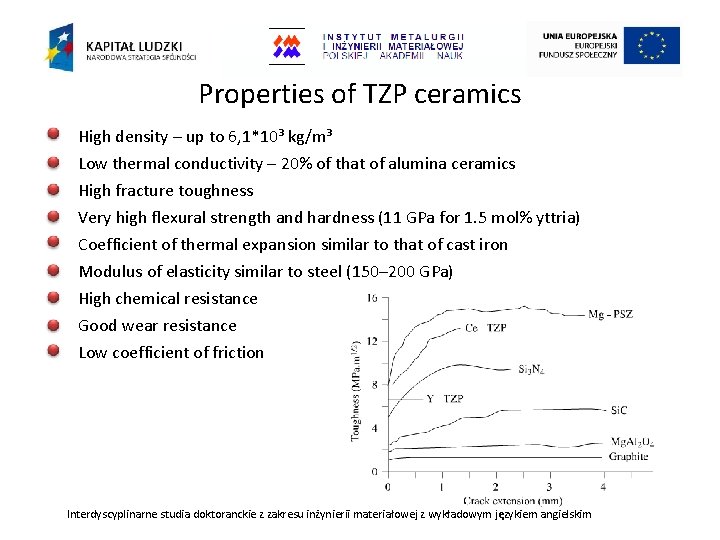
Properties of TZP ceramics High density – up to 6, 1*10³ kg/m³ Low thermal conductivity – 20% of that of alumina ceramics High fracture toughness Very high flexural strength and hardness (11 GPa for 1. 5 mol% yttria) Coefficient of thermal expansion similar to that of cast iron Modulus of elasticity similar to steel (150– 200 GPa) High chemical resistance Good wear resistance Low coefficient of friction Interdyscyplinarne studia doktoranckie z zakresu inżynierii materiałowej z wykładowym językiem angielskim
References • P. Boch, J. -C. Niepce „Ceramic Materials: Processes, Properties and Applications”, Hermes 2001, 219 -228 • J. F. Shackelford, R. H. Doremus “Ceramic and Glass Materials: Structure, Properties and Processing”, Springer 2008, 169 -197 • R. E. Smallman, R. J. Bishop, “Modern Physical Metallurgy and Materials Engineering”, Elsevier 1999, 330 -331 • http: //www. azom. com Interdyscyplinarne studia doktoranckie z zakresu inżynierii materiałowej z wykładowym językiem angielskim
Tetragonal Zirconia Polycrystals Why do we add yttria or other oxides to TZP? MSc Eng Honorata Kazimierczak Interdyscyplinarne studia doktoranckie z zakresu inżynierii materiałowej z wykładowym językiem angielskim
Introduction Zirconia (Zr. O 2) is an important ceramic material having a wide range of applications in engineering: -catalysis, -sensors, -gas turbines, -magnetic hydrodynamics process of power generation, -thermal barrier coatings, -high temperature nozzles in air engines, etc. Zirconia exist in three different crystalline forms: • cubic (c) (stable at 2680 -2370°C) • tetragonal (t) (stable at 2370 -1170°C) • monoclinic (m) Interdyscyplinarne studia doktoranckie z zakresu inżynierii materiałowej z wykładowym językiem angielskim
Zirconia exist in three different crystalline forms: • cubic (c) (stable at 2680 -2370°C) • tetragonal (t) (stable at 2370 -1170°C) • monoclinic (m) t-m transformation: • 3 -5% volume increase => extensive cracking in the material. To stabilize the high temperaure t-phase at room temperature , Ce. O 2, Ca. O, Y 2 O 3 or Mg. O are usually added to zirconia in appropriate proportions. Ca-TZP 3 Y-TZP Mg-TZP Ce-TZP Interdyscyplinarne studia doktoranckie z zakresu inżynierii materiałowej z wykładowym językiem angielskim
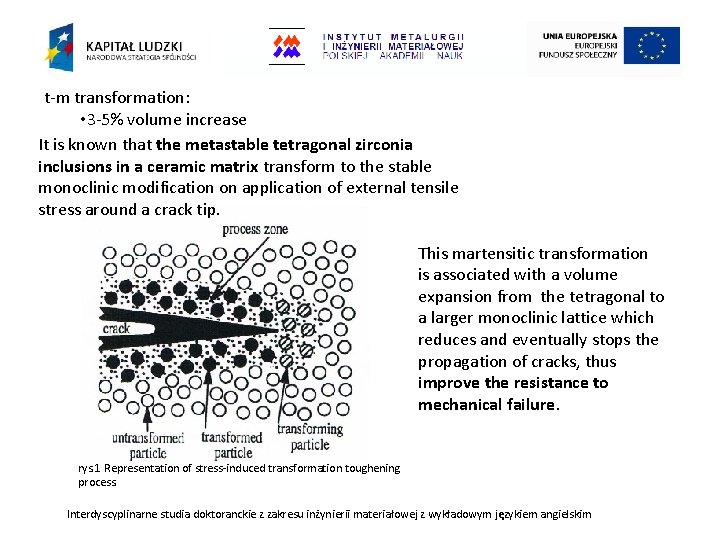
t-m transformation: • 3 -5% volume increase It is known that the metastable tetragonal zirconia inclusions in a ceramic matrix transform to the stable monoclinic modification on application of external tensile stress around a crack tip. This martensitic transformation is associated with a volume expansion from the tetragonal to a larger monoclinic lattice which reduces and eventually stops the propagation of cracks, thus improve the resistance to mechanical failure. rys. 1 Representation of stress-induced transformation toughening process. Interdyscyplinarne studia doktoranckie z zakresu inżynierii materiałowej z wykładowym językiem angielskim
Interdyscyplinarne studia doktoranckie z zakresu inżynierii materiałowej z wykładowym językiem angielskim
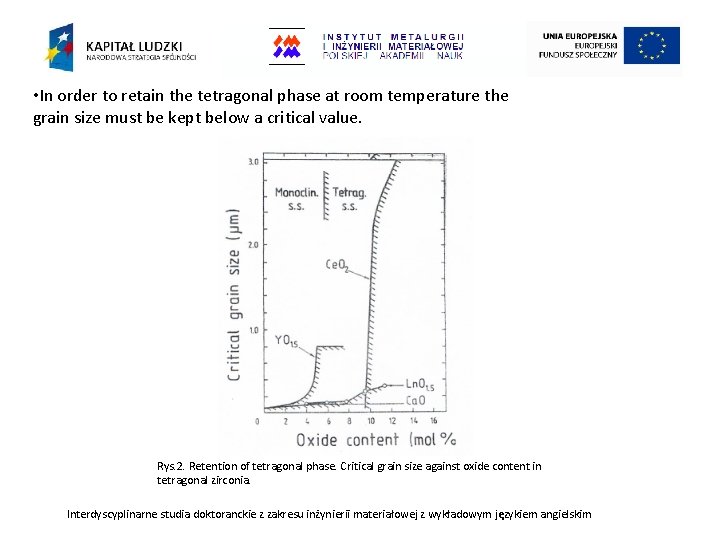
• In order to retain the tetragonal phase at room temperature the grain size must be kept below a critical value. Rys. 2. Retention of tetragonal phase. Critical grain size against oxide content in tetragonal zirconia. Interdyscyplinarne studia doktoranckie z zakresu inżynierii materiałowej z wykładowym językiem angielskim
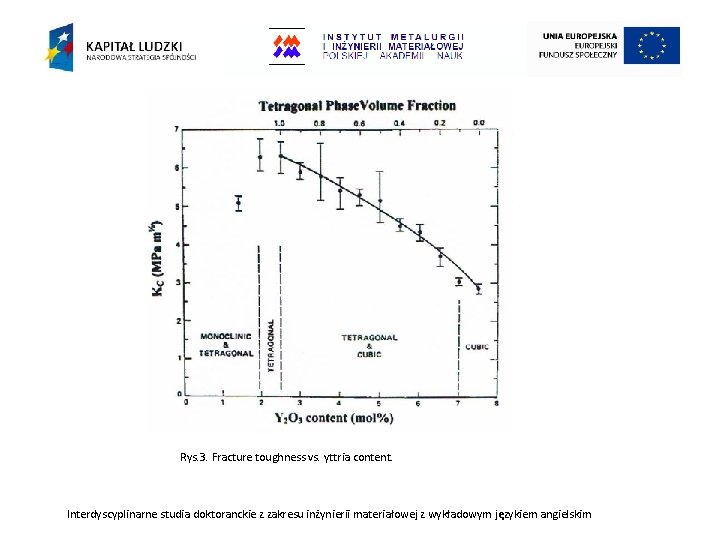
Rys. 3. Fracture toughness vs. yttria content. Interdyscyplinarne studia doktoranckie z zakresu inżynierii materiałowej z wykładowym językiem angielskim
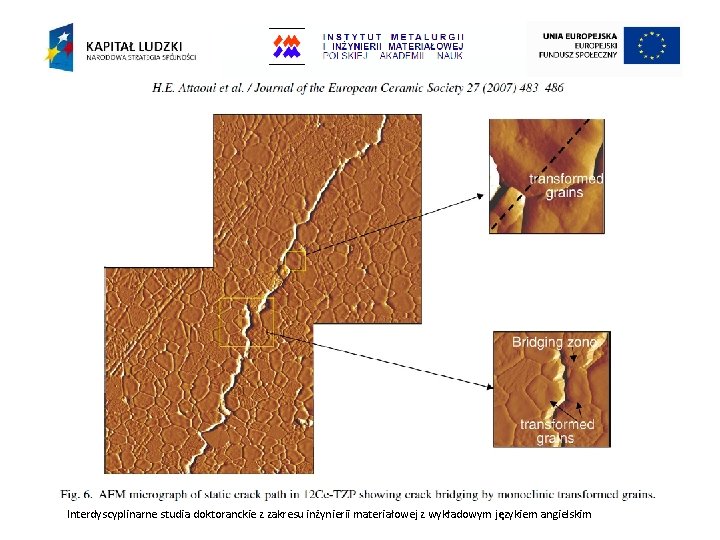
References: 1) C. Piconi, G. Maccauro „Zirconia as a ceramic biomaterial”, Biomaterials 20 (1999) 125 2) M. M. R. Boutz, A. J. A. Winnubst, A. J. Burggraaf „Yttria-Ceria Stabilized Tetragonal Zirconia Polycrystals: Sintering, Grain Growth and Grain Boundary Segregation”, Journal of European Ceramic Society 13 (1994) 89 -102 3) Marek Faryna „Analiza zależności krystalograficznych faz składowych w kompozytach z osnową ceramiczną”, IMIM PAN, Kraków 2003 4) H. El Attaoui , M. Saadaoui , J. Chevalier , G. Fantozzi „Static and cyclic crack propagation in Ce-TZP ceramics with different amounts of transformation toughening”, Journal of the European Ceramic Society 27 (2007) 483– 486 Interdyscyplinarne studia doktoranckie z zakresu inżynierii materiałowej z wykładowym językiem angielskim
Tetragonal Zirconia Polycrystals Mechanical properties of Y-TZP MSc Eng Katarzyna Stan Interdyscyplinarne studia doktoranckie z zakresu inżynierii materiałowej z wykładowym językiem angielskim
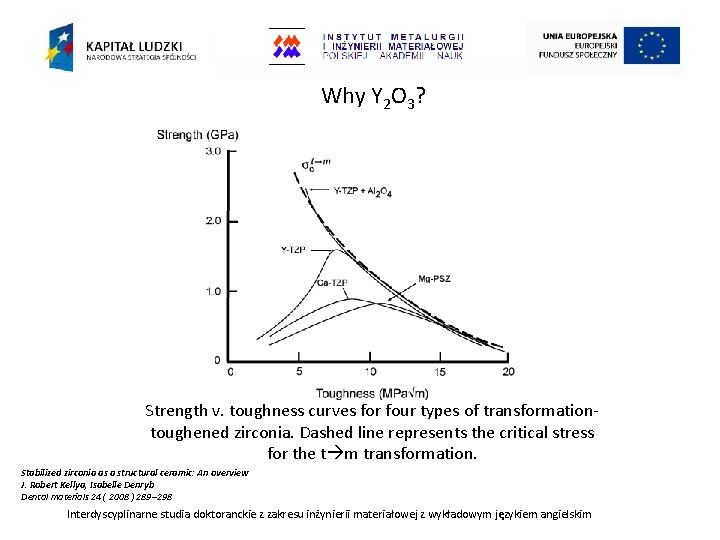
Why Y 2 O 3? Strength v. toughness curves for four types of transformationtoughened zirconia. Dashed line represents the critical stress for the t m transformation. Stabilized zirconia as a structural ceramic: An overview J. Robert Kellya, Isabelle Denryb Dental materials 24 ( 2008 ) 289– 298 Interdyscyplinarne studia doktoranckie z zakresu inżynierii materiałowej z wykładowym językiem angielskim
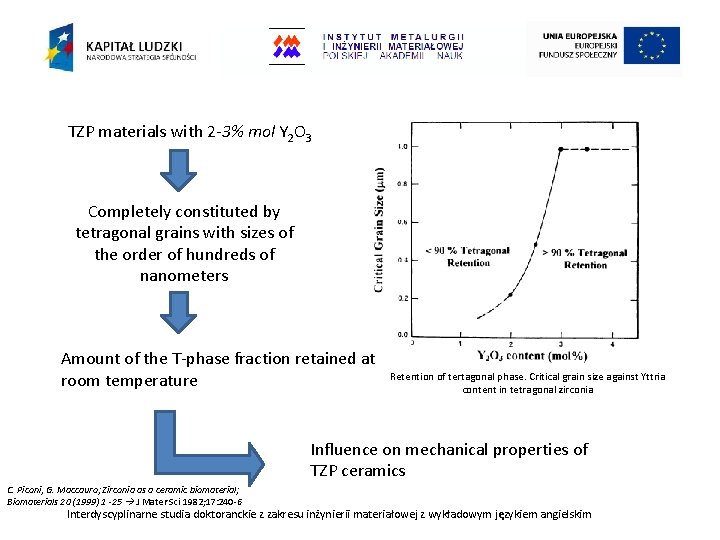
TZP materials with 2 -3% mol Y 2 O 3 Completely constituted by tetragonal grains with sizes of the order of hundreds of nanometers Amount of the T-phase fraction retained at room temperature Retention of tertagonal phase. Critical grain size against Yttria content in tetragonal zirconia Influence on mechanical properties of TZP ceramics C. Piconi, G. Maccauro; Zirconia as a ceramic biomaterial; Biomaterials 20 (1999) 1 -25 J Mater Sci 1982; 17: 240 -6 Interdyscyplinarne studia doktoranckie z zakresu inżynierii materiałowej z wykładowym językiem angielskim
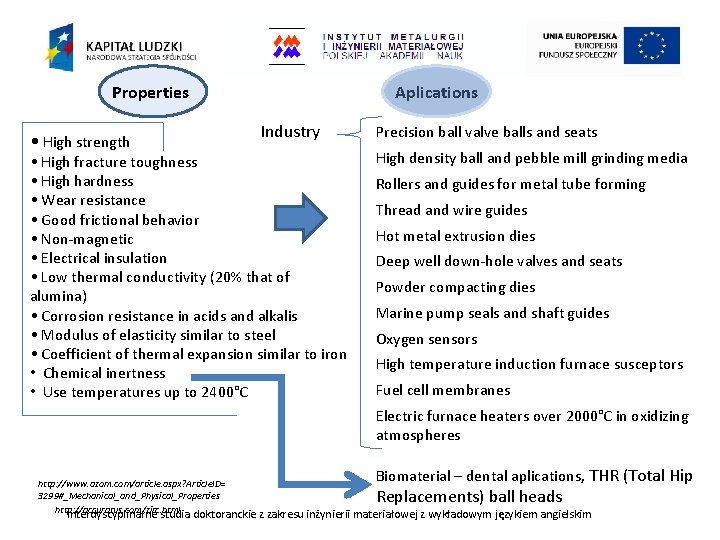
Properties • High strength Aplications Industry • High fracture toughness • High hardness • Wear resistance • Good frictional behavior • Non-magnetic • Electrical insulation • Low thermal conductivity (20% that of alumina) • Corrosion resistance in acids and alkalis • Modulus of elasticity similar to steel • Coefficient of thermal expansion similar to iron • Chemical inertness • Use temperatures up to 2400°C Precision ball valve balls and seats High density ball and pebble mill grinding media Rollers and guides for metal tube forming Thread and wire guides Hot metal extrusion dies Deep well down-hole valves and seats Powder compacting dies Marine pump seals and shaft guides Oxygen sensors High temperature induction furnace susceptors Fuel cell membranes Electric furnace heaters over 2000°C in oxidizing atmospheres http: //www. azom. com/article. aspx? Article. ID= 3299#_Mechanical_and_Physical_Properties http: //accuratus. com/zirc. html Biomaterial – dental aplications, THR (Total Hip Replacements) ball heads Interdyscyplinarne studia doktoranckie z zakresu inżynierii materiałowej z wykładowym językiem angielskim
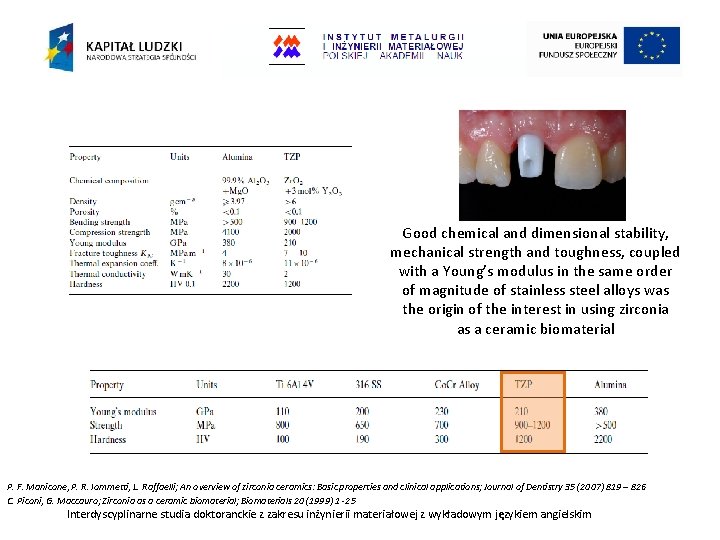
Good chemical and dimensional stability, mechanical strength and toughness, coupled with a Young’s modulus in the same order of magnitude of stainless steel alloys was the origin of the interest in using zirconia as a ceramic biomaterial P. F. Manicone, P. R. Iommetti, L. Raffaelli; An overview of zirconia ceramics: Basic properties and clinical applications; Journal of Dentistry 35 (2007) 819 – 826 C. Piconi, G. Maccauro; Zirconia as a ceramic biomaterial; Biomaterials 20 (1999) 1 -25 Interdyscyplinarne studia doktoranckie z zakresu inżynierii materiałowej z wykładowym językiem angielskim
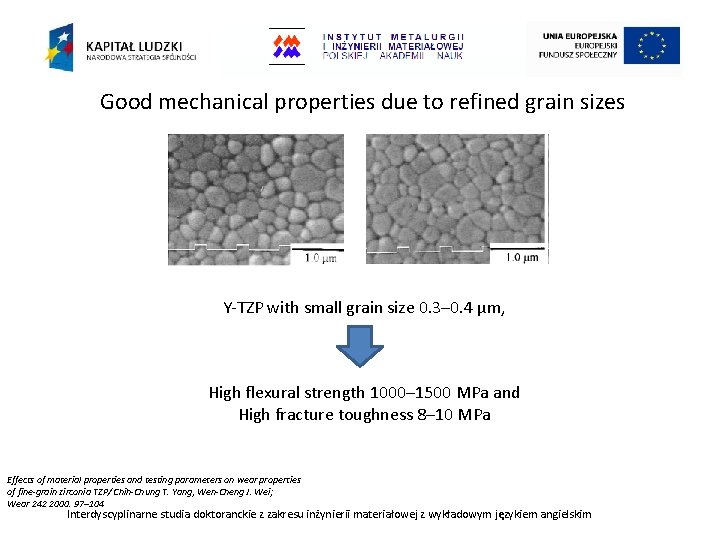
Good mechanical properties due to refined grain sizes Y-TZP with small grain size 0. 3– 0. 4 μm, High flexural strength 1000– 1500 MPa and High fracture toughness 8– 10 MPa Effects of material properties and testing parameters on wear properties of fine-grain zirconia TZP/ Chih-Chung T. Yang, Wen-Cheng J. Wei; Wear 242 2000. 97– 104 Interdyscyplinarne studia doktoranckie z zakresu inżynierii materiałowej z wykładowym językiem angielskim
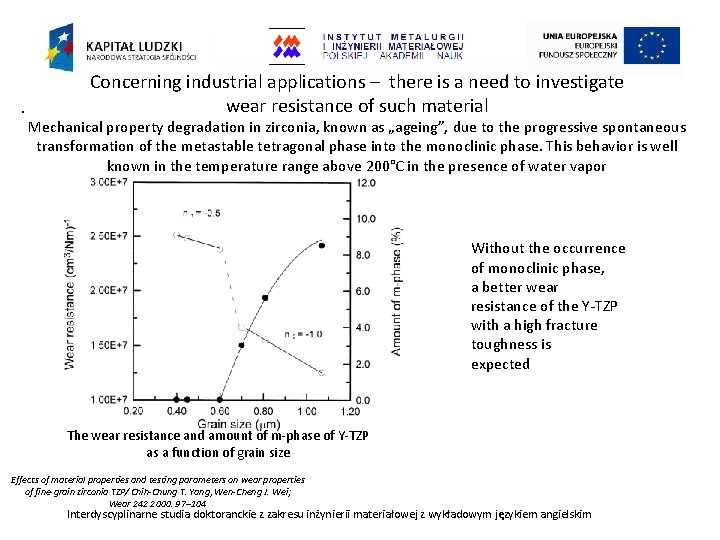
. Concerning industrial applications – there is a need to investigate wear resistance of such material Mechanical property degradation in zirconia, known as „ageing”, due to the progressive spontaneous transformation of the metastable tetragonal phase into the monoclinic phase. This behavior is well known in the temperature range above 200°C in the presence of water vapor Without the occurrence of monoclinic phase, a better wear resistance of the Y-TZP with a high fracture toughness is expected The wear resistance and amount of m-phase of Y-TZP as a function of grain size Effects of material properties and testing parameters on wear properties of fine-grain zirconia TZP/ Chih-Chung T. Yang, Wen-Cheng J. Wei; Wear 242 2000. 97– 104 Interdyscyplinarne studia doktoranckie z zakresu inżynierii materiałowej z wykładowym językiem angielskim
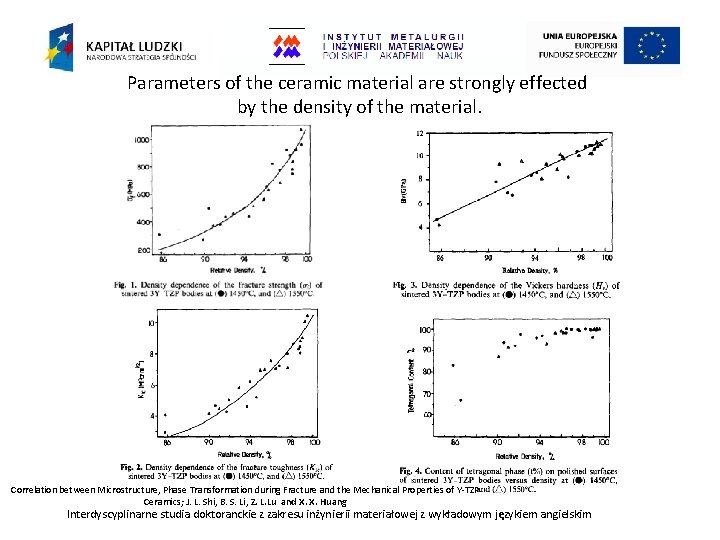
Parameters of the ceramic material are strongly effected by the density of the material. Correlation between Microstructure, Phase Transformation during Fracture and the Mechanical Properties of Y-TZP Ceramics; J. L. Shi, B. S. Li, Z. L. Lu and X. X. Huang Interdyscyplinarne studia doktoranckie z zakresu inżynierii materiałowej z wykładowym językiem angielskim
Tetragonal Zirconia Polycrystals Y-TZP composites Reactions in material MSc Eng Piotr Bobrowski Interdyscyplinarne studia doktoranckie z zakresu inżynierii materiałowej z wykładowym językiem angielskim
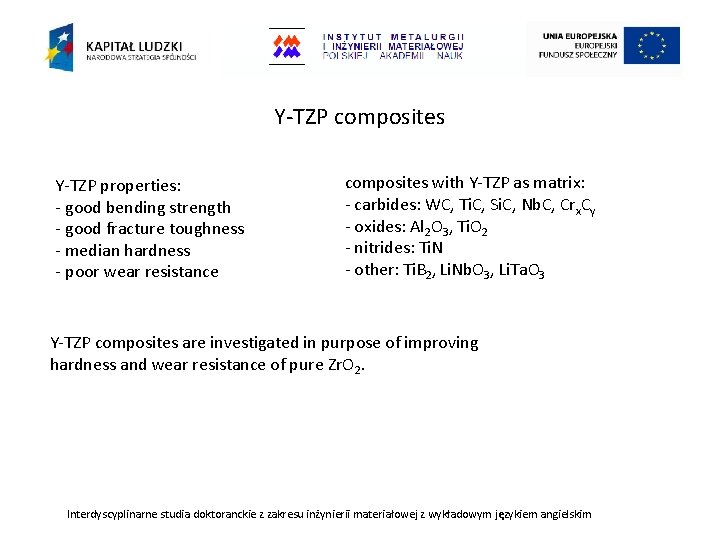
Y-TZP composites Y-TZP properties: - good bending strength - good fracture toughness - median hardness - poor wear resistance composites with Y-TZP as matrix: - carbides: WC, Ti. C, Si. C, Nb. C, Crx. Cy - oxides: Al 2 O 3, Ti. O 2 - nitrides: Ti. N - other: Ti. B 2, Li. Nb. O 3, Li. Ta. O 3 Y-TZP composites are investigated in purpose of improving hardness and wear resistance of pure Zr. O 2. Interdyscyplinarne studia doktoranckie z zakresu inżynierii materiałowej z wykładowym językiem angielskim
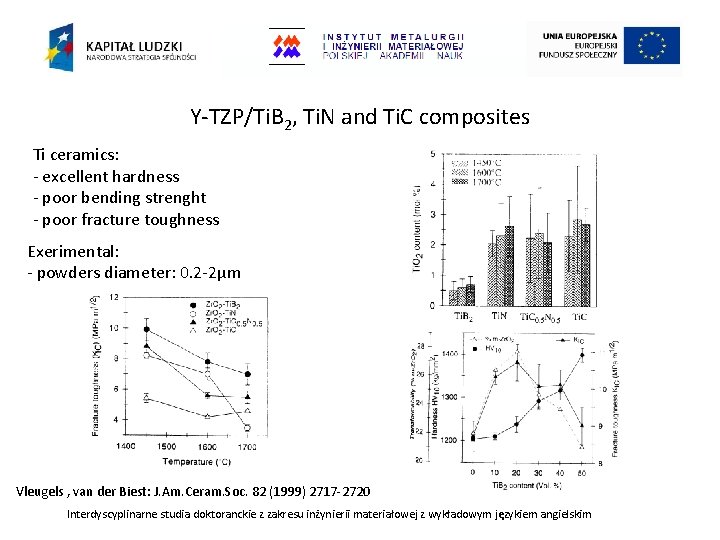
Y-TZP/Ti. B 2, Ti. N and Ti. C composites Ti ceramics: - excellent hardness - poor bending strenght - poor fracture toughness Exerimental: - powders diameter: 0. 2 -2µm Vleugels , van der Biest: J. Am. Ceram. Soc. 82 (1999) 2717 -2720 Interdyscyplinarne studia doktoranckie z zakresu inżynierii materiałowej z wykładowym językiem angielskim
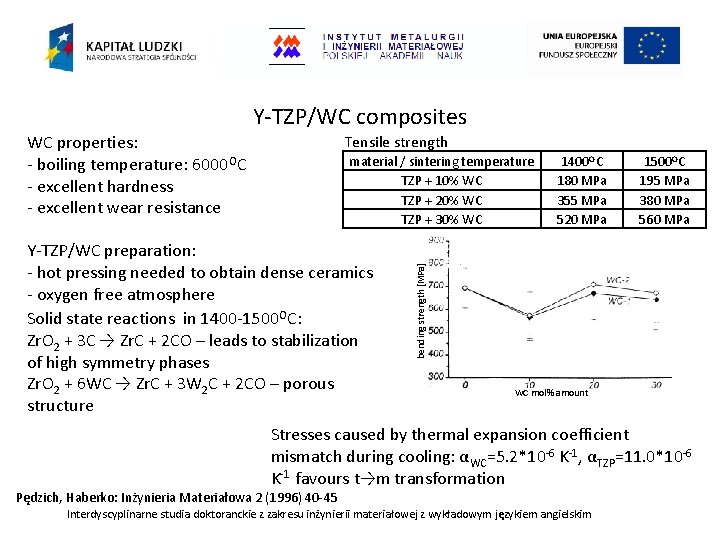
Y-TZP/WC composites WC properties: - boiling temperature: 6000 OC - excellent hardness - excellent wear resistance Tensile strength Y-TZP/WC preparation: - hot pressing needed to obtain dense ceramics - oxygen free atmosphere Solid state reactions in 1400 -1500 OC: Zr. O 2 + 3 C → Zr. C + 2 CO – leads to stabilization of high symmetry phases Zr. O 2 + 6 WC → Zr. C + 3 W 2 C + 2 CO – porous structure 1400 OC 180 MPa 355 MPa 520 MPa 1500 OC 195 MPa 380 MPa 560 MPa bending strength [MPa] material / sintering temperature TZP + 10% WC TZP + 20% WC TZP + 30% WC WC mol% amount Stresses caused by thermal expansion coefficient mismatch during cooling: αWC=5. 2*10 -6 K-1, αTZP=11. 0*10 -6 K-1 favours t→m transformation Pędzich, Haberko: Inżynieria Materiałowa 2 (1996) 40 -45 Interdyscyplinarne studia doktoranckie z zakresu inżynierii materiałowej z wykładowym językiem angielskim
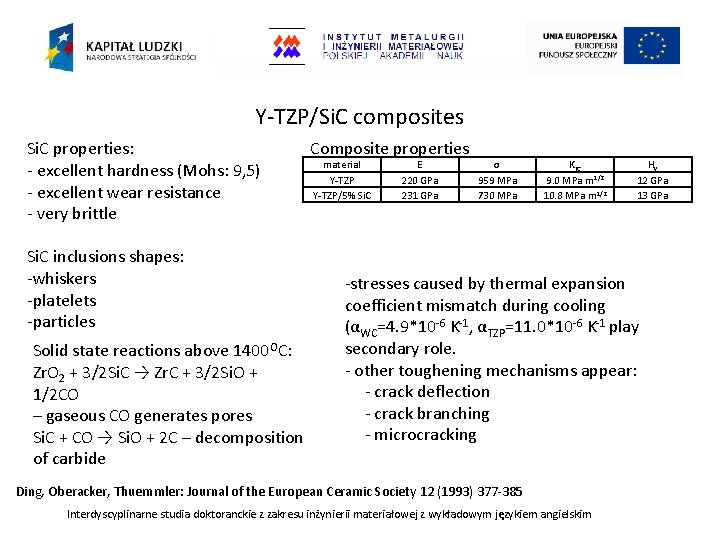
Y-TZP/Si. C composites Si. C properties: - excellent hardness (Mohs: 9, 5) - excellent wear resistance - very brittle Si. C inclusions shapes: -whiskers -platelets -particles Solid state reactions above 1400 OC: Zr. O 2 + 3/2 Si. C → Zr. C + 3/2 Si. O + 1/2 CO – gaseous CO generates pores Si. C + CO → Si. O + 2 C – decomposition of carbide Composite properties material Y-TZP/5% Si. C E 220 GPa 231 GPa σ 959 MPa 730 MPa KIC 9. 0 MPa m 1/2 10. 8 MPa m 1/2 Hv 12 GPa 13 GPa -stresses caused by thermal expansion coefficient mismatch during cooling (αWC=4. 9*10 -6 K-1, αTZP=11. 0*10 -6 K-1 play secondary role. - other toughening mechanisms appear: - crack deflection - crack branching - microcracking Ding, Oberacker, Thuemmler: Journal of the European Ceramic Society 12 (1993) 377 -385 Interdyscyplinarne studia doktoranckie z zakresu inżynierii materiałowej z wykładowym językiem angielskim
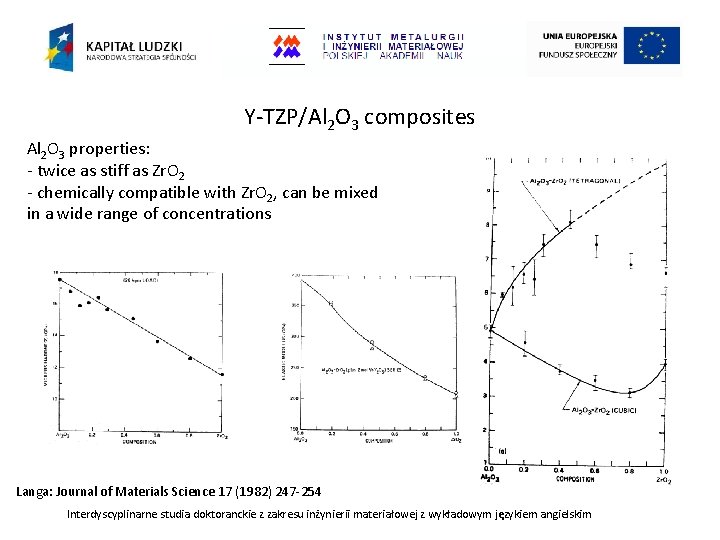
Y-TZP/Al 2 O 3 composites Al 2 O 3 properties: - twice as stiff as Zr. O 2 - chemically compatible with Zr. O 2, can be mixed in a wide range of concentrations Langa: Journal of Materials Science 17 (1982) 247 -254 Interdyscyplinarne studia doktoranckie z zakresu inżynierii materiałowej z wykładowym językiem angielskim
Tetragonal Zirconia Polycrystals Thermal etching, hot pressing, pressureless sintering MSc Eng Grażyna Kulesza Interdyscyplinarne studia doktoranckie z zakresu inżynierii materiałowej z wykładowym językiem angielskim
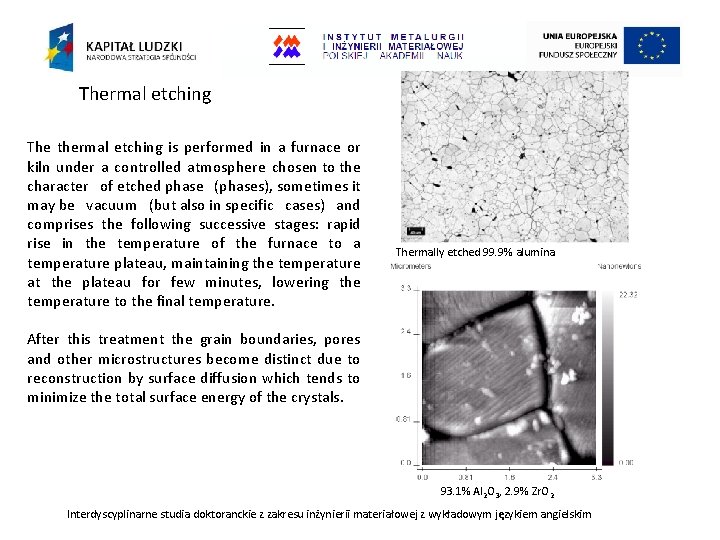
Thermal etching The thermal etching is performed in a furnace or kiln under a controlled atmosphere chosen to the character of etched phase (phases), sometimes it may be vacuum (but also in specific cases) and comprises the following successive stages: rapid rise in the temperature of the furnace to a temperature plateau, maintaining the temperature at the plateau for few minutes, lowering the temperature to the final temperature. Thermally etched 99. 9% alumina After this treatment the grain boundaries, pores and other microstructures become distinct due to reconstruction by surface diffusion which tends to minimize the total surface energy of the crystals. 93. 1% Al 2 O 3, 2. 9% Zr. O 2 Interdyscyplinarne studia doktoranckie z zakresu inżynierii materiałowej z wykładowym językiem angielskim
Hot pressing In the ceramic industry many methods of forming are used e. x. : • pressing • forming at elevated temperatures • slip casting • thermoplastic forming • vibrating To choose proper forming method is determined by: • shape • size • the required dimensional accuracy Hot pressing requires moisture powder to a few percent Interdyscyplinarne studia doktoranckie z zakresu inżynierii materiałowej z wykładowym językiem angielskim
Hot pressing has many advantages: • possibility to obtain high density compacts • forming of non-plastic materials • high strength • dimensional accuracy • sharp edges • high efficiency, low waste • introducing of automation and mechanization but also disadvantages: • forming limited shapes • cutouts and holes in the same direction like the pressing direction • inhomogeneous densification along the direction of the applied pressure Interdyscyplinarne studia doktoranckie z zakresu inżynierii materiałowej z wykładowym językiem angielskim
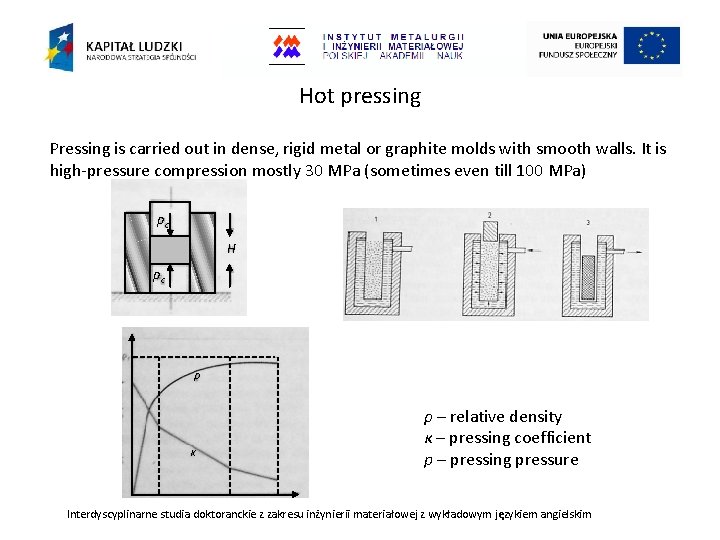
Hot pressing Pressing is carried out in dense, rigid metal or graphite molds with smooth walls. It is high-pressure compression mostly 30 MPa (sometimes even till 100 MPa) pc H pc ρ κ ρ – relative density κ – pressing coefficient p – pressing pressure Interdyscyplinarne studia doktoranckie z zakresu inżynierii materiałowej z wykładowym językiem angielskim
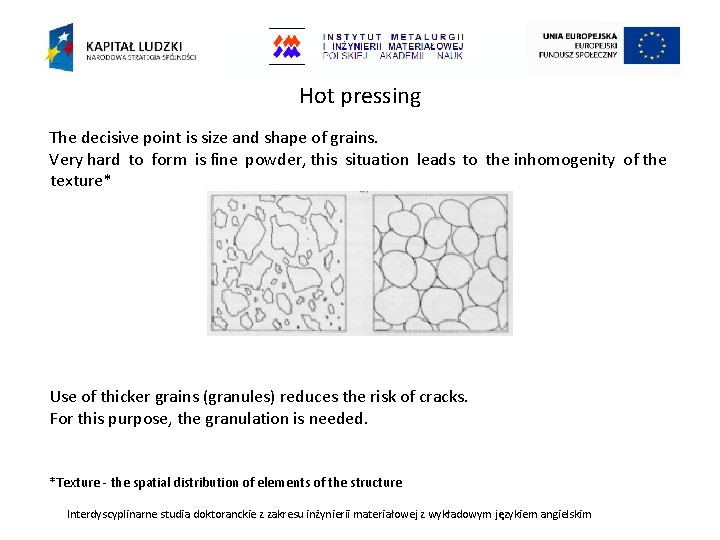
Hot pressing The decisive point is size and shape of grains. Very hard to form is fine powder, this situation leads to the inhomogenity of the texture* Use of thicker grains (granules) reduces the risk of cracks. For this purpose, the granulation is needed. *Texture - the spatial distribution of elements of the structure Interdyscyplinarne studia doktoranckie z zakresu inżynierii materiałowej z wykładowym językiem angielskim
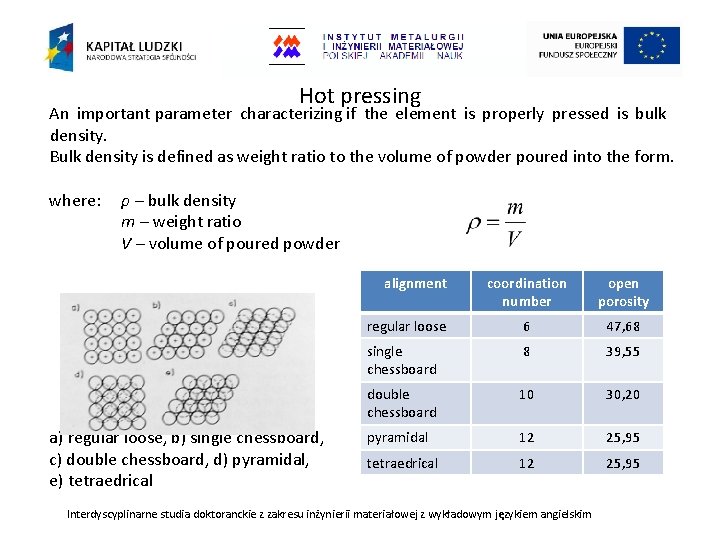
Hot pressing An important parameter characterizing if the element is properly pressed is bulk density. Bulk density is defined as weight ratio to the volume of powder poured into the form. where: ρ – bulk density m – weight ratio V – volume of poured powder alignment a) regular loose, b) single chessboard, c) double chessboard, d) pyramidal, e) tetraedrical coordination number open porosity regular loose 6 47, 68 single chessboard 8 39, 55 double chessboard 10 30, 20 pyramidal 12 25, 95 tetraedrical 12 25, 95 Interdyscyplinarne studia doktoranckie z zakresu inżynierii materiałowej z wykładowym językiem angielskim
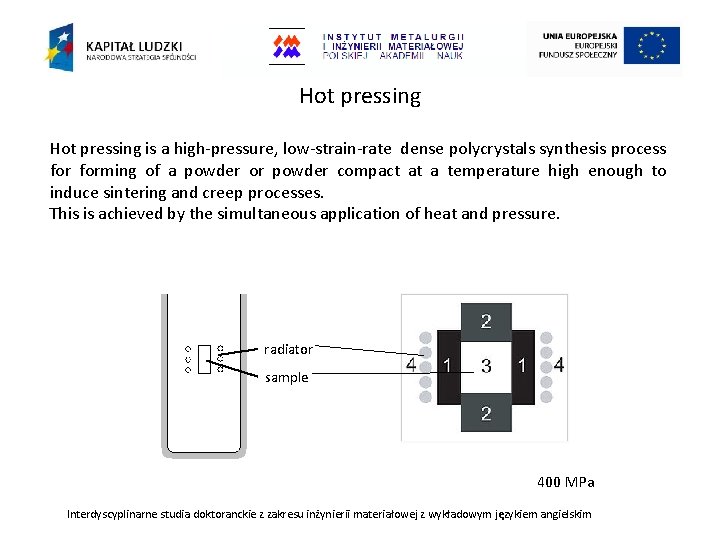
Hot pressing is a high-pressure, low-strain-rate dense polycrystals synthesis process forming of a powder or powder compact at a temperature high enough to induce sintering and creep processes. This is achieved by the simultaneous application of heat and pressure. gas radiator sample 400 MPa Interdyscyplinarne studia doktoranckie z zakresu inżynierii materiałowej z wykładowym językiem angielskim
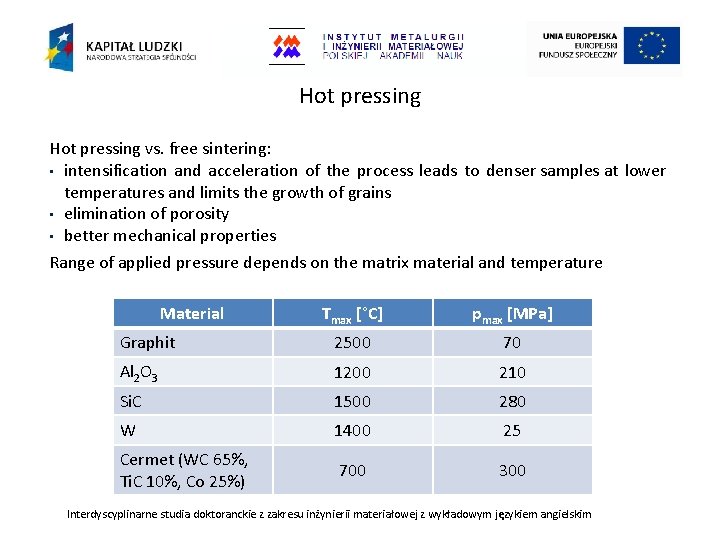
Hot pressing vs. free sintering: • intensification and acceleration of the process leads to denser samples at lower temperatures and limits the growth of grains • elimination of porosity • better mechanical properties Range of applied pressure depends on the matrix material and temperature Material Tmax [°C] pmax [MPa] Graphit 2500 70 Al 2 O 3 1200 210 Si. C 1500 280 W 1400 25 Cermet (WC 65%, Ti. C 10%, Co 25%) 700 300 Interdyscyplinarne studia doktoranckie z zakresu inżynierii materiałowej z wykładowym językiem angielskim
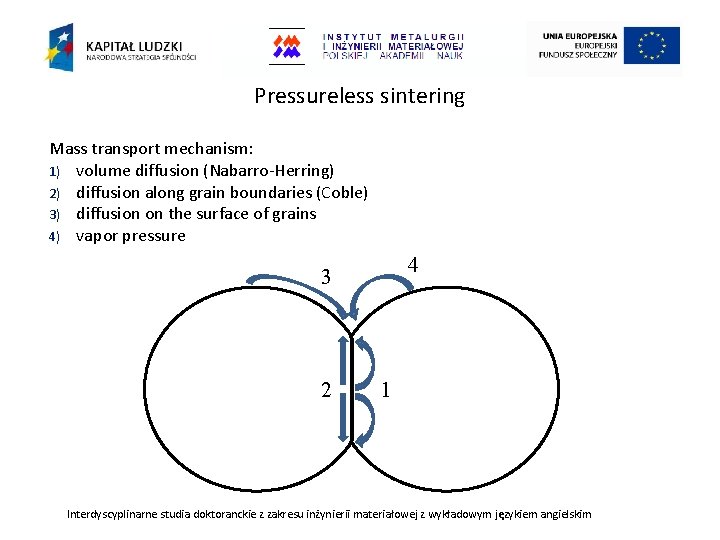
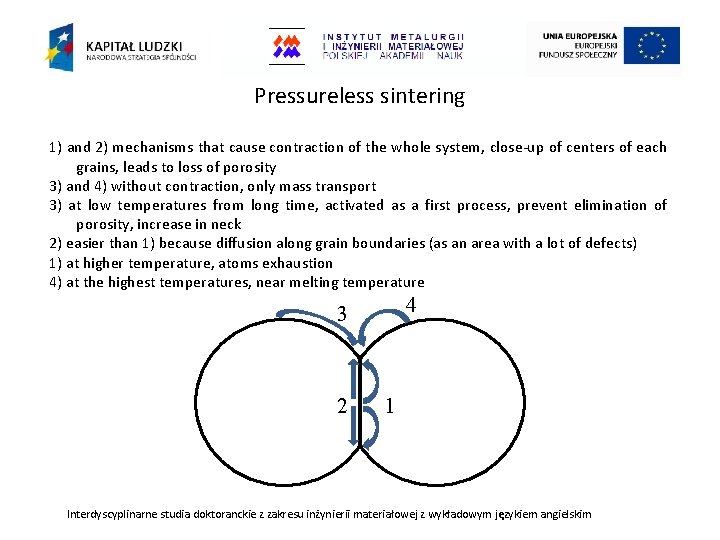
Pressureless sintering Mass transport mechanism: 1) volume diffusion (Nabarro-Herring) 2) diffusion along grain boundaries (Coble) 3) diffusion on the surface of grains 4) vapor pressure 4 3 2 2 1 Interdyscyplinarne studia doktoranckie z zakresu inżynierii materiałowej z wykładowym językiem angielskim
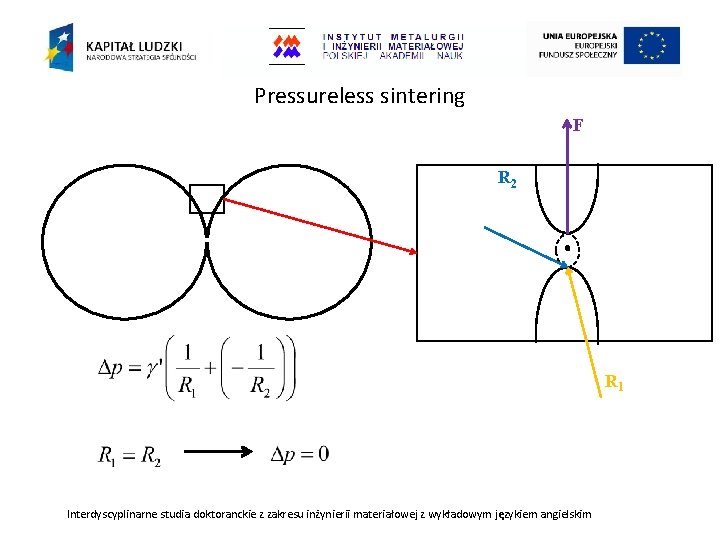
Pressureless sintering F R 2 2 R 1 Interdyscyplinarne studia doktoranckie z zakresu inżynierii materiałowej z wykładowym językiem angielskim
Pressureless sintering 1) and 2) mechanisms that cause contraction of the whole system, close-up of centers of each grains, leads to loss of porosity 3) and 4) without contraction, only mass transport 3) at low temperatures from long time, activated as a first process, prevent elimination of porosity, increase in neck 2) easier than 1) because diffusion along grain boundaries (as an area with a lot of defects) 1) at higher temperature, atoms exhaustion 4) at the highest temperatures, near melting temperature 4 3 2 2 1 Interdyscyplinarne studia doktoranckie z zakresu inżynierii materiałowej z wykładowym językiem angielskim
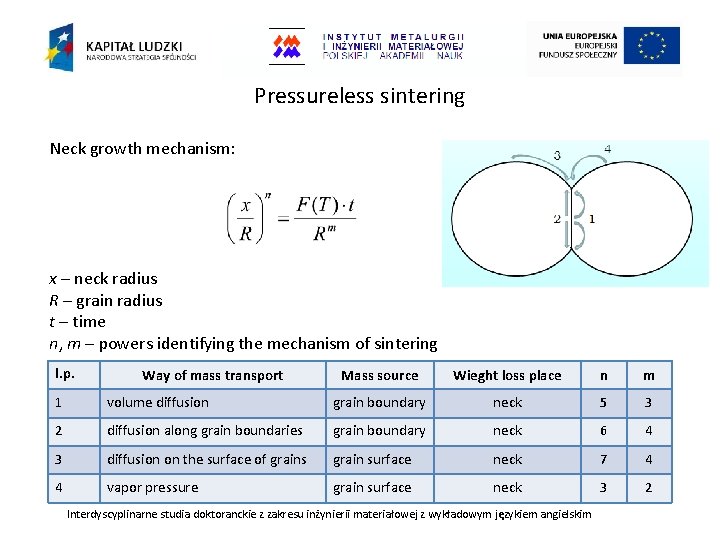
Pressureless sintering Neck growth mechanism: x – neck radius R – grain radius t – time n, m – powers identifying the mechanism of sintering l. p. Way of mass transport Mass source Wieght loss place n m 1 volume diffusion grain boundary neck 5 3 2 diffusion along grain boundaries grain boundary neck 6 4 3 diffusion on the surface of grains grain surface neck 7 4 4 vapor pressure grain surface neck 3 2 Interdyscyplinarne studia doktoranckie z zakresu inżynierii materiałowej z wykładowym językiem angielskim
Pressureless sintering is the sintering of a powder compact (sometimes at very high temperatures or relatively low temperatures, depending on the powder) without applied pressure. The powder compact (if ceramic) can be created by slip casting into a plaster mould, then the final green compact can be machined if necessary to final shape before being heated to sinter. Particular advantages of this powder technology include: 1. Very high levels of purity and uniformity in starting materials 2. Preservation of purity, due to the simpler subsequent fabrication process (fewer steps) that it makes possible 3. Stabilization of the details of repetitive operations, by control of grain size during the input stages 4. Absence of binding contact between segregated powder particles – or "inclusions" (called stringering) – as often occurs in melt processes 5. No deformation needed to produce directional elongation of grains 6. Capability to produce materials of controlled, uniform porosity. Interdyscyplinarne studia doktoranckie z zakresu inżynierii materiałowej z wykładowym językiem angielskim
References 1. 2. R. Pampuch, K. Haberko, „Nauka o procesach ceramicznych”, PWN, Warszawa 1982 Wykłady: Prof. dr hab. inż. K. Haberko, Dr. inż. Z. Pędzich, „Procesy i technologie ceramiczne” Interdyscyplinarne studia doktoranckie z zakresu inżynierii materiałowej z wykładowym językiem angielskim
Tetragonal Zirconia Polycrystals Mechanisms inproveing fracture toughness in TZP based composites MSc Eng Jagoda Poplewska Interdyscyplinarne studia doktoranckie z zakresu inżynierii materiałowej z wykładowym językiem angielskim
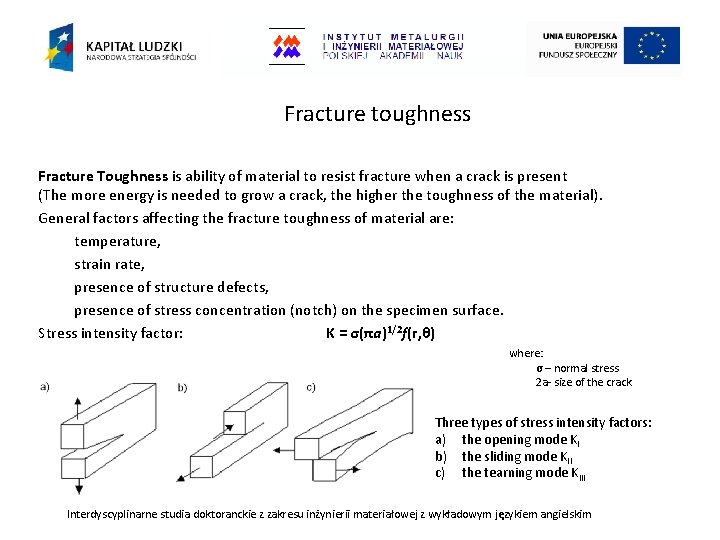
Fracture toughness Fracture Toughness is ability of material to resist fracture when a crack is present (The more energy is needed to grow a crack, the higher the toughness of the material). General factors affecting the fracture toughness of material are: temperature, strain rate, presence of structure defects, presence of stress concentration (notch) on the specimen surface. Stress intensity factor: K = σ(πa)1/2 f(r, θ) where: σ – normal stress 2 a- size of the crack Three types of stress intensity factors: a) the opening mode KI b) the sliding mode KII c) the tearning mode KIII Interdyscyplinarne studia doktoranckie z zakresu inżynierii materiałowej z wykładowym językiem angielskim
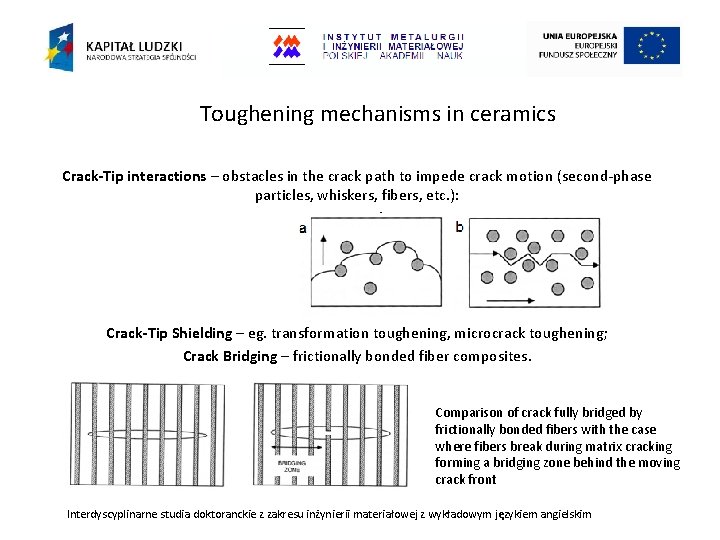
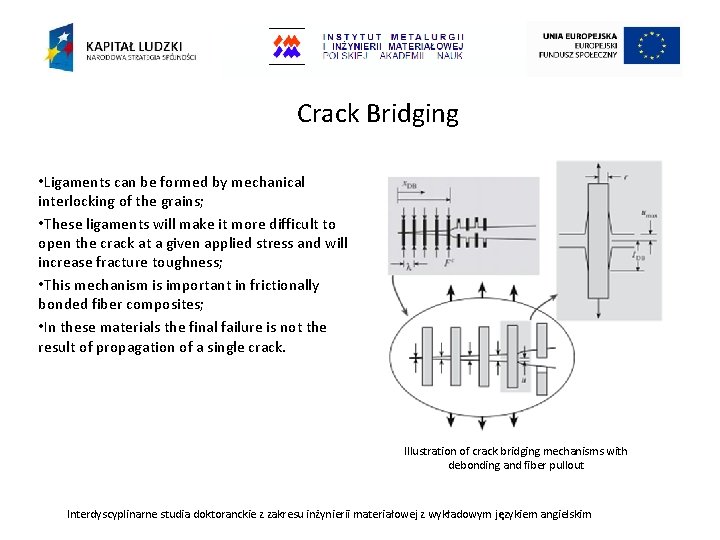
Toughening mechanisms in ceramics Crack-Tip interactions – obstacles in the crack path to impede crack motion (second-phase particles, whiskers, fibers, etc. ): a. Crack Bowing b. Crack Deflection Crack-Tip Shielding – eg. transformation toughening, microcrack toughening; Crack Bridging – frictionally bonded fiber composites. Comparison of crack fully bridged by frictionally bonded fibers with the case where fibers break during matrix cracking forming a bridging zone behind the moving crack front Interdyscyplinarne studia doktoranckie z zakresu inżynierii materiałowej z wykładowym językiem angielskim
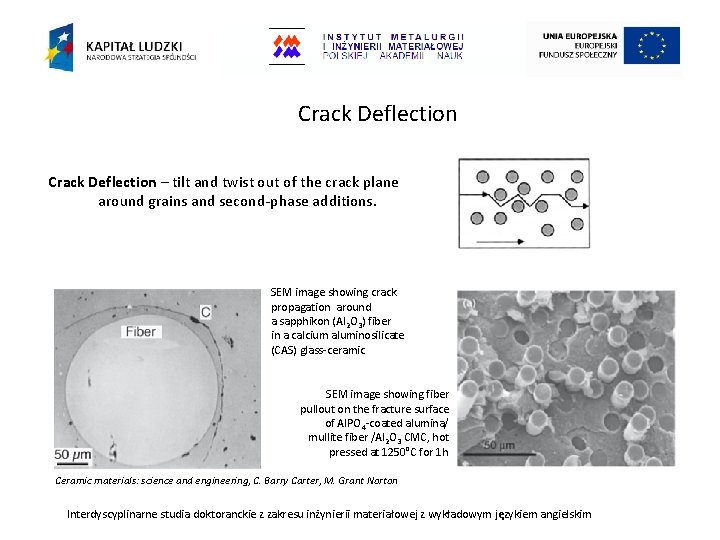
Crack Deflection – tilt and twist out of the crack plane around grains and second-phase additions. SEM image showing crack propagation around a sapphikon (Al 2 O 3) fiber in a calcium aluminosilicate (CAS) glass-ceramic SEM image showing fiber pullout on the fracture surface of Al. PO 4 -coated alumina/ mullite fiber /Al 2 O 3 CMC, hot pressed at 1250°C for 1 h Ceramic materials: science and engineering, C. Barry Carter, M. Grant Norton Interdyscyplinarne studia doktoranckie z zakresu inżynierii materiałowej z wykładowym językiem angielskim
Crack Bridging • Ligaments can be formed by mechanical interlocking of the grains; • These ligaments will make it more difficult to open the crack at a given applied stress and will increase fracture toughness; • This mechanism is important in frictionally bonded fiber composites; • In these materials the final failure is not the result of propagation of a single crack. Illustration of crack bridging mechanisms with debonding and fiber pullout Interdyscyplinarne studia doktoranckie z zakresu inżynierii materiałowej z wykładowym językiem angielskim
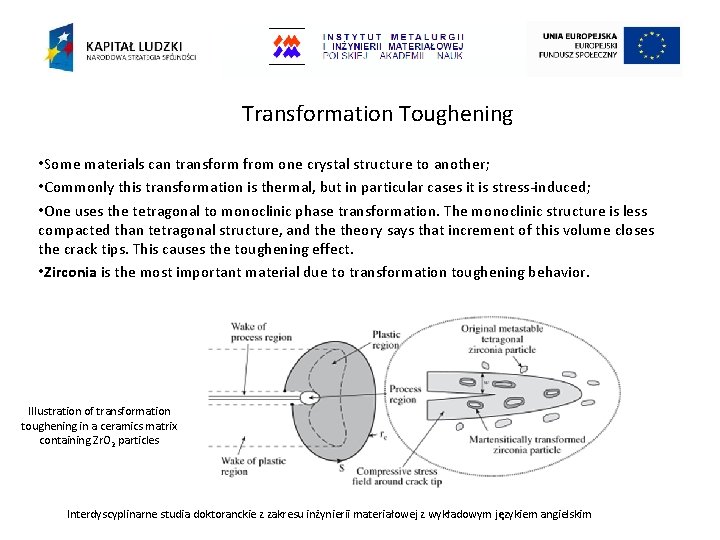
Transformation Toughening • Some materials can transform from one crystal structure to another; • Commonly this transformation is thermal, but in particular cases it is stress-induced; • One uses the tetragonal to monoclinic phase transformation. The monoclinic structure is less compacted than tetragonal structure, and theory says that increment of this volume closes the crack tips. This causes the toughening effect. • Zirconia is the most important material due to transformation toughening behavior. Illustration of transformation toughening in a ceramics matrix containing Zr. O 2 particles Interdyscyplinarne studia doktoranckie z zakresu inżynierii materiałowej z wykładowym językiem angielskim
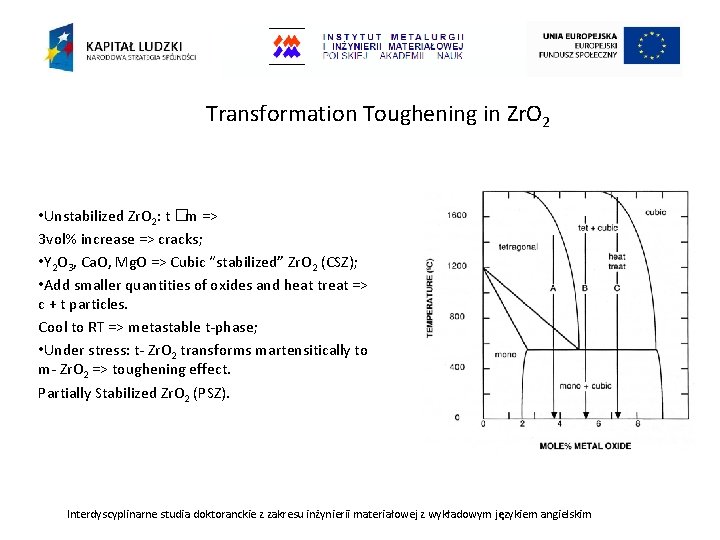
Transformation Toughening in Zr. O 2 • Unstabilized Zr. O 2: t � m => 3 vol% increase => cracks; • Y 2 O 3, Ca. O, Mg. O => Cubic “stabilized” Zr. O 2 (CSZ); • Add smaller quantities of oxides and heat treat => c + t particles. Cool to RT => metastable t-phase; • Under stress: t- Zr. O 2 transforms martensitically to m- Zr. O 2 => toughening effect. Partially Stabilized Zr. O 2 (PSZ). Interdyscyplinarne studia doktoranckie z zakresu inżynierii materiałowej z wykładowym językiem angielskim
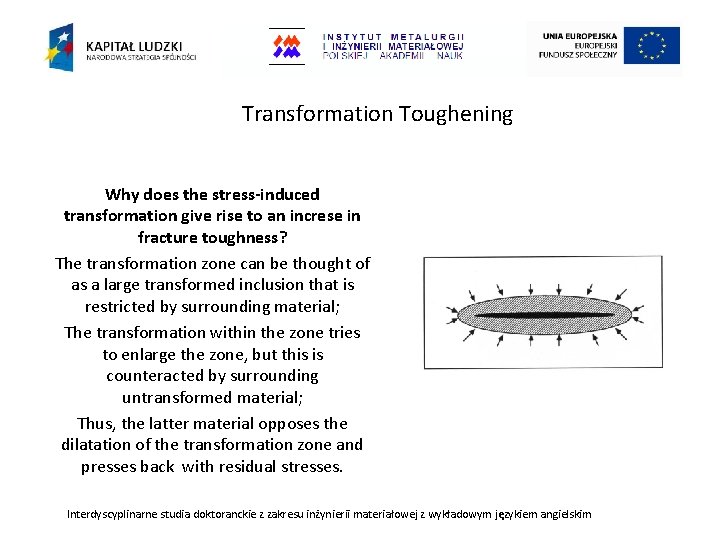
Transformation Toughening Why does the stress-induced transformation give rise to an increse in fracture toughness? The transformation zone can be thought of as a large transformed inclusion that is restricted by surrounding material; The transformation within the zone tries to enlarge the zone, but this is counteracted by surrounding untransformed material; Thus, the latter material opposes the dilatation of the transformation zone and presses back with residual stresses. Interdyscyplinarne studia doktoranckie z zakresu inżynierii materiałowej z wykładowym językiem angielskim
References • „A survey on the mechanisms and mechanics of toughening in structural ceramics”, G. Th. M. Stam, E. van der Giessen, P. Meijers, TU Delft, 1990 • „Transformation toughening of ceramics”, D. J. Green, R. H. J. Hannink, M. V. Swain, CRC Press 1989 • „Ceramic materials: science and engineering”, C. Barry Carter, M. Grant Norton, Springer, 2007 Interdyscyplinarne studia doktoranckie z zakresu inżynierii materiałowej z wykładowym językiem angielskim