
TETRA TErrestrial Trunked RAdio Further information on TETRA
- Slides: 26
TETRA (TErrestrial Trunked RAdio) Further information on TETRA: www. tetramou. org (“official” site) www. tetramou. org/files/kkrr_doc. zip (introduction)
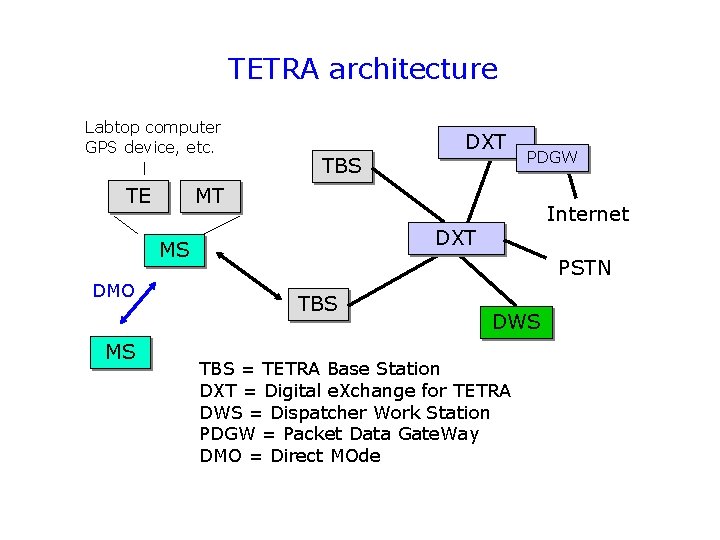
TETRA architecture Labtop computer GPS device, etc. TE TBS MS PDGW MT Internet DXT MS DMO DXT PSTN TBS DWS TBS = TETRA Base Station DXT = Digital e. Xchange for TETRA DWS = Dispatcher Work Station PDGW = Packet Data Gate. Way DMO = Direct MOde
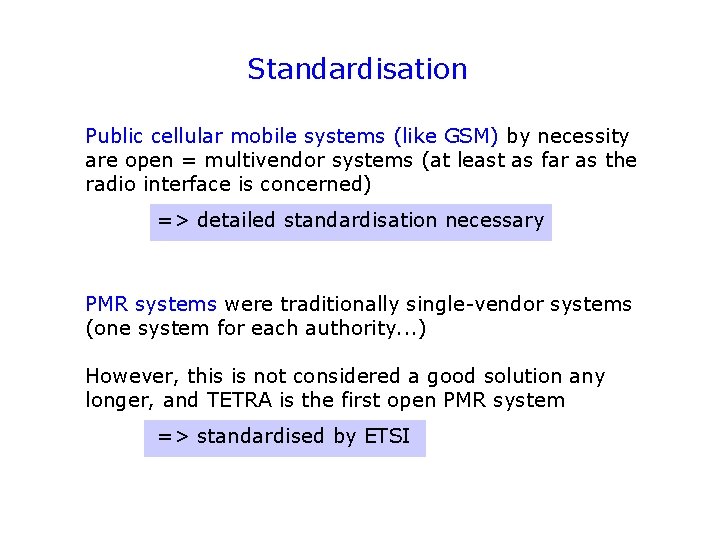
Standardisation Public cellular mobile systems (like GSM) by necessity are open = multivendor systems (at least as far as the radio interface is concerned) => detailed standardisation necessary PMR systems were traditionally single-vendor systems (one system for each authority. . . ) However, this is not considered a good solution any longer, and TETRA is the first open PMR system => standardised by ETSI
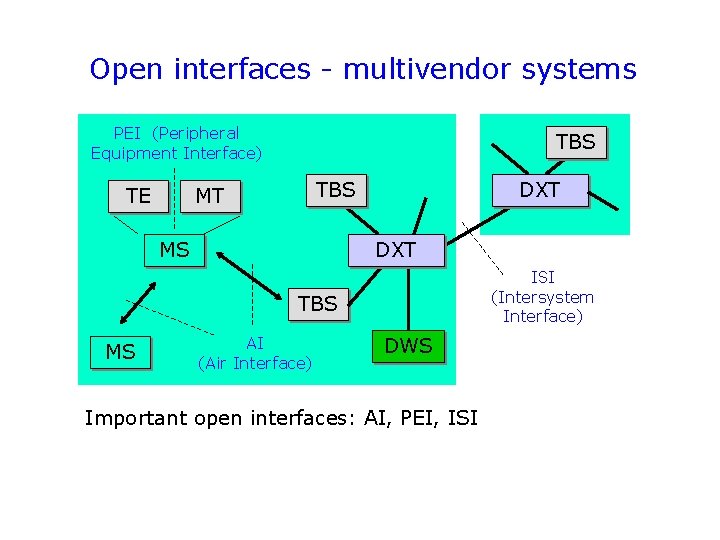
Open interfaces - multivendor systems PEI (Peripheral Equipment Interface) TE TBS MT MS DXT ISI (Intersystem Interface) TBS MS AI (Air Interface) DWS Important open interfaces: AI, PEI, ISI
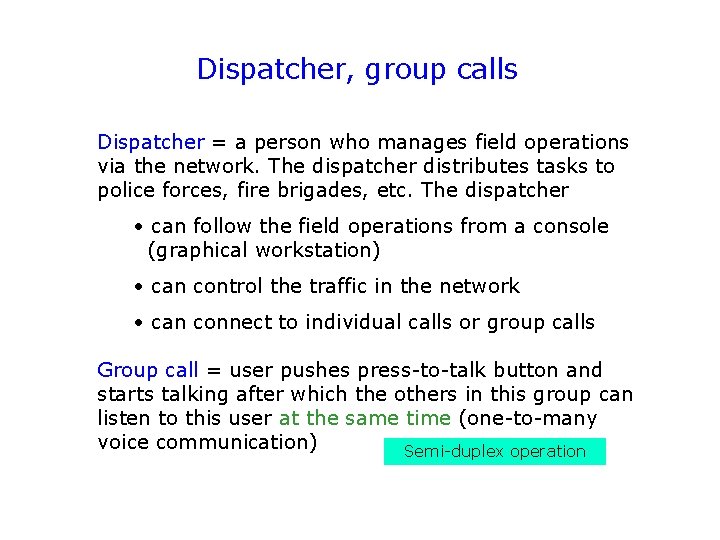
Dispatcher, group calls Dispatcher = a person who manages field operations via the network. The dispatcher distributes tasks to police forces, fire brigades, etc. The dispatcher • can follow the field operations from a console (graphical workstation) • can control the traffic in the network • can connect to individual calls or group calls Group call = user pushes press-to-talk button and starts talking after which the others in this group can listen to this user at the same time (one-to-many voice communication) Semi-duplex operation
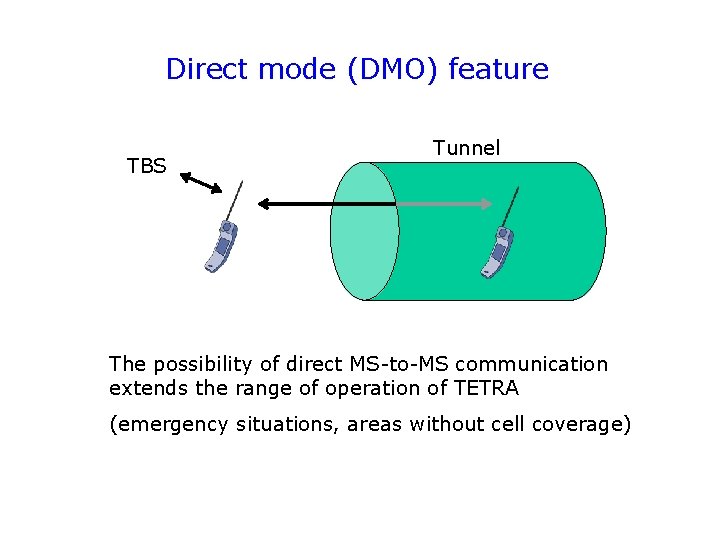
Direct mode (DMO) feature TBS Tunnel The possibility of direct MS-to-MS communication extends the range of operation of TETRA (emergency situations, areas without cell coverage)
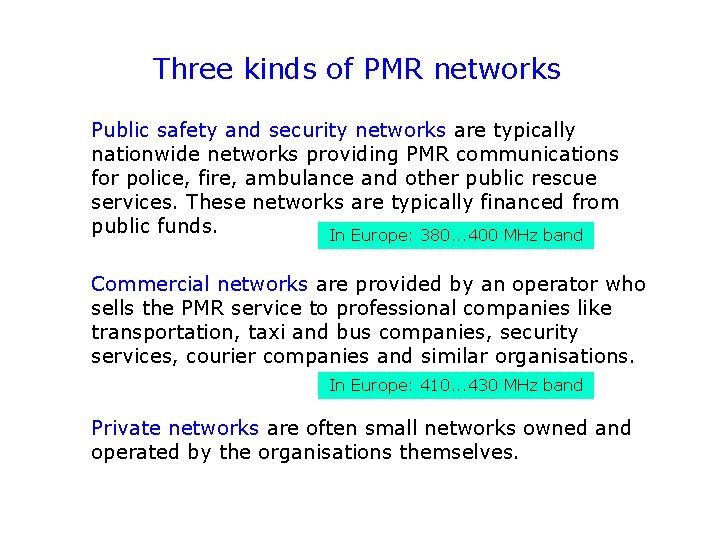
Three kinds of PMR networks Public safety and security networks are typically nationwide networks providing PMR communications for police, fire, ambulance and other public rescue services. These networks are typically financed from public funds. In Europe: 380. . . 400 MHz band Commercial networks are provided by an operator who sells the PMR service to professional companies like transportation, taxi and bus companies, security services, courier companies and similar organisations. In Europe: 410. . . 430 MHz band Private networks are often small networks owned and operated by the organisations themselves.
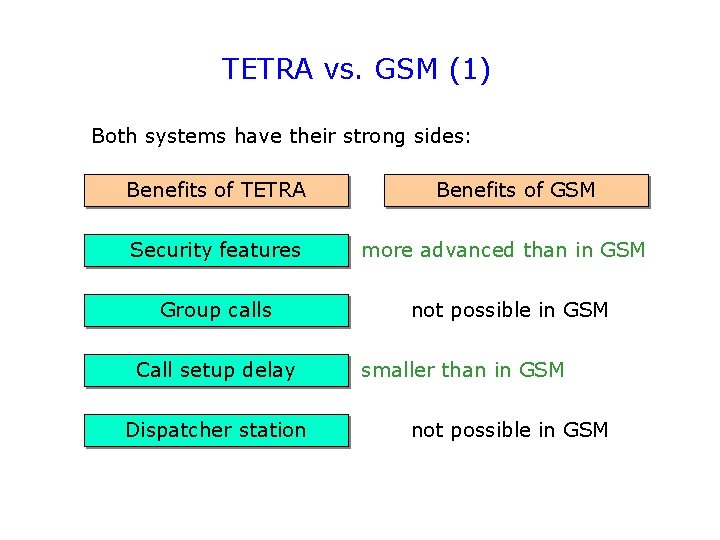
TETRA vs. GSM (1) Both systems have their strong sides: Benefits of TETRA Security features Group calls Call setup delay Dispatcher station Benefits of GSM more advanced than in GSM not possible in GSM smaller than in GSM not possible in GSM
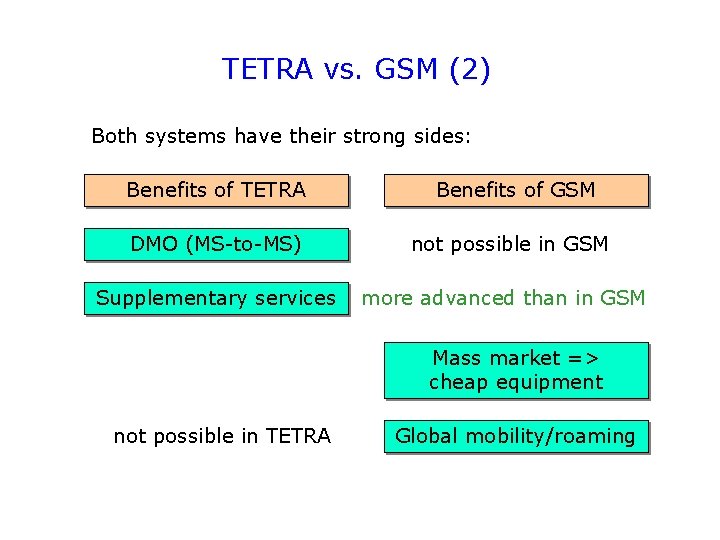
TETRA vs. GSM (2) Both systems have their strong sides: Benefits of TETRA DMO (MS-to-MS) Supplementary services Benefits of GSM not possible in GSM more advanced than in GSM Mass market => cheap equipment not possible in TETRA Global mobility/roaming
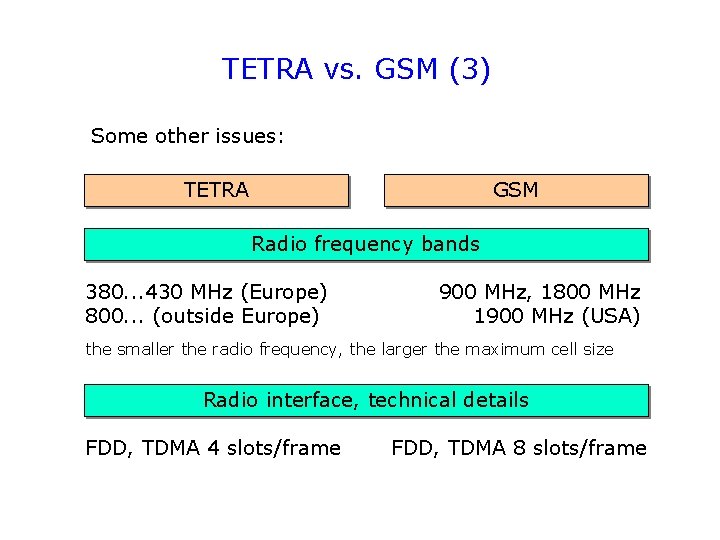
TETRA vs. GSM (3) Some other issues: TETRA GSM Radio frequency bands 380. . . 430 MHz (Europe) 800. . . (outside Europe) 900 MHz, 1800 MHz 1900 MHz (USA) the smaller the radio frequency, the larger the maximum cell size Radio interface, technical details FDD, TDMA 4 slots/frame FDD, TDMA 8 slots/frame
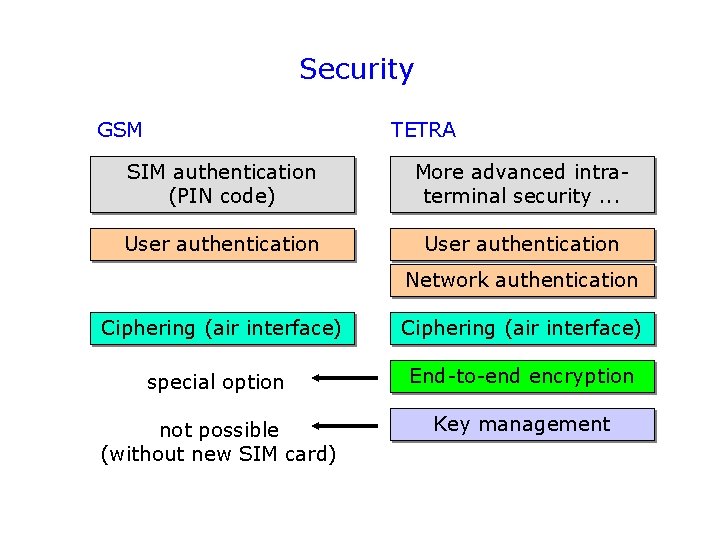
Security GSM TETRA SIM authentication (PIN code) More advanced intraterminal security. . . User authentication Network authentication Ciphering (air interface) special option End-to-end encryption not possible (without new SIM card) Key management
DECT (Digital Enhanced Cordless Telecommunications) Further information on DECT: www. dect. ch (“official” site of DECT Forum) www. dectweb. com www. handytel. com/technology/dect 01. htm (nice introduction to DECT)
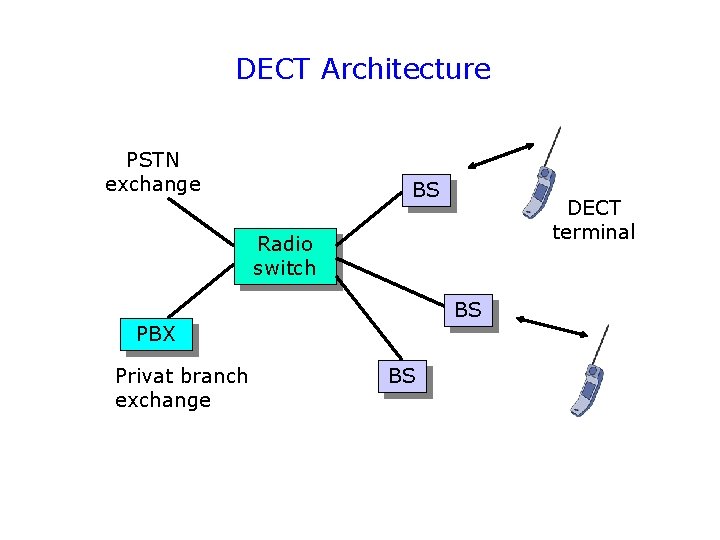
DECT Architecture PSTN exchange BS DECT terminal Radio switch BS PBX Privat branch exchange BS
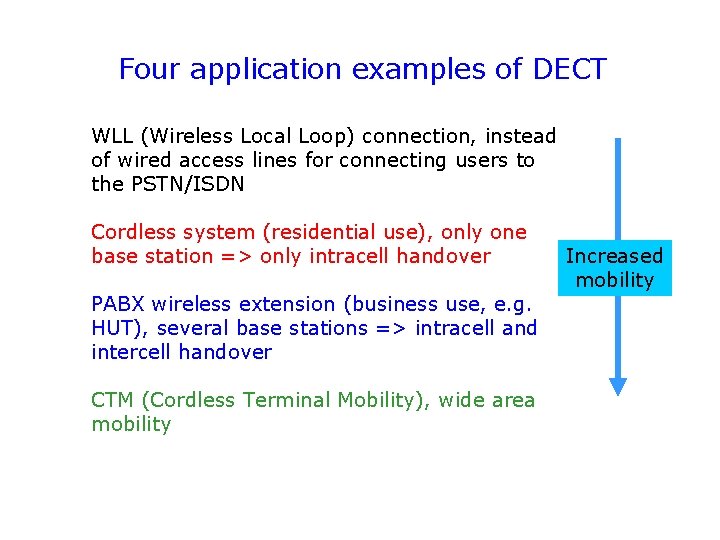
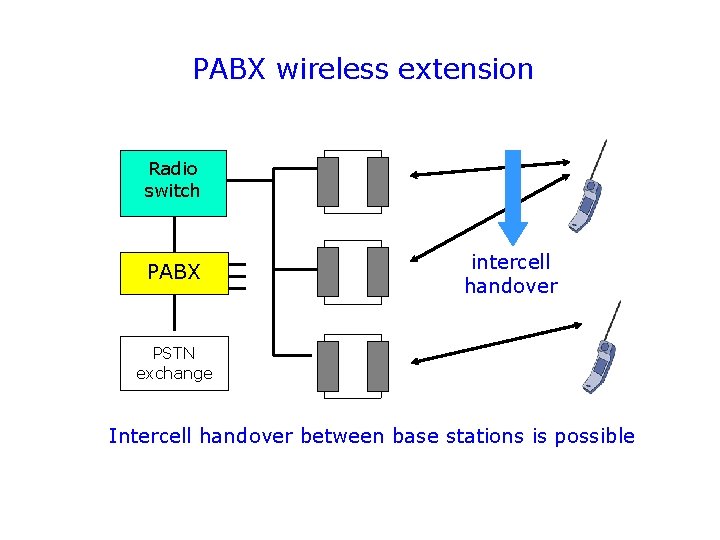
Four application examples of DECT WLL (Wireless Local Loop) connection, instead of wired access lines for connecting users to the PSTN/ISDN Cordless system (residential use), only one base station => only intracell handover PABX wireless extension (business use, e. g. HUT), several base stations => intracell and intercell handover CTM (Cordless Terminal Mobility), wide area mobility Increased mobility
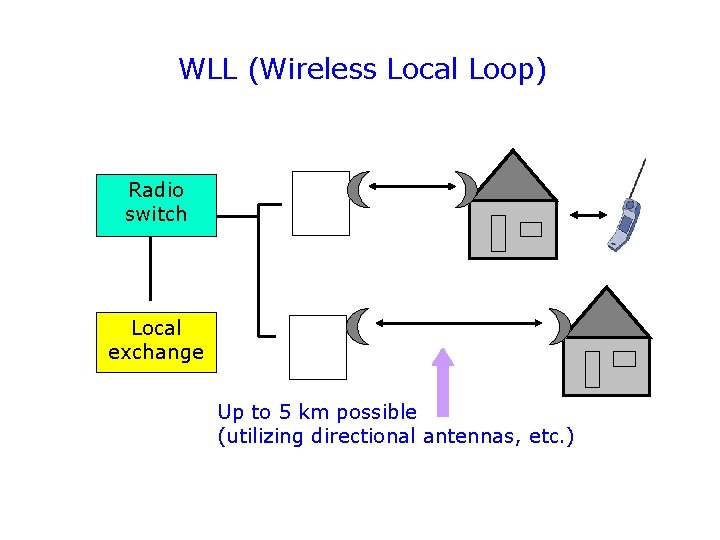
WLL (Wireless Local Loop) Radio switch Local exchange Up to 5 km possible (utilizing directional antennas, etc. )
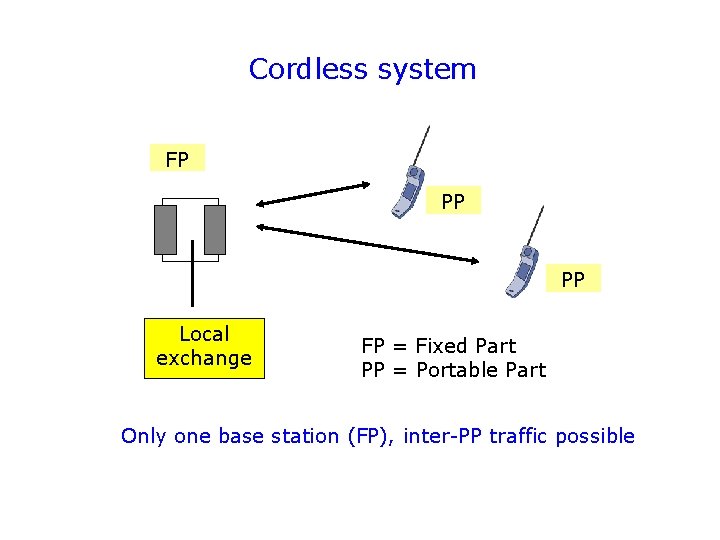
Cordless system FP PP PP Local exchange FP = Fixed Part PP = Portable Part Only one base station (FP), inter-PP traffic possible
PABX wireless extension Radio switch PABX intercell handover PSTN exchange Intercell handover between base stations is possible
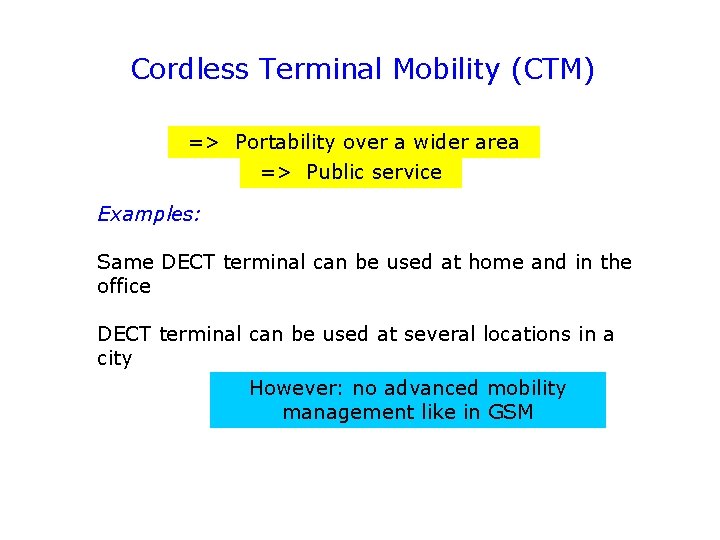
Cordless Terminal Mobility (CTM) => Portability over a wider area => Public service Examples: Same DECT terminal can be used at home and in the office DECT terminal can be used at several locations in a city However: no advanced mobility management like in GSM
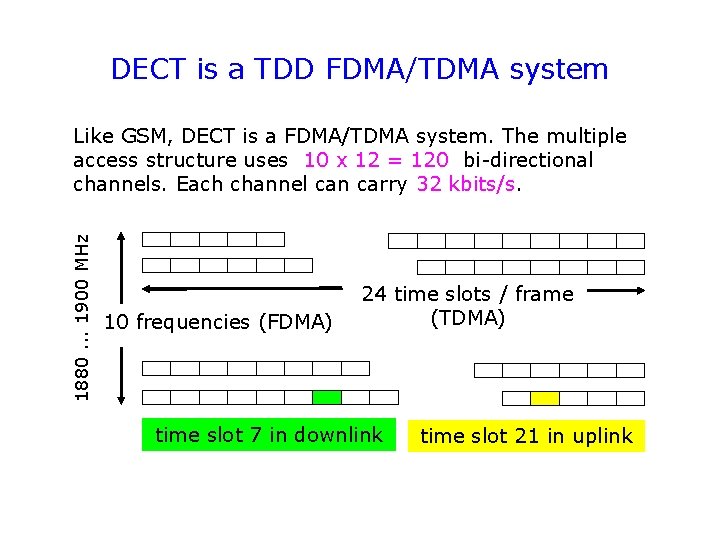
DECT is a TDD FDMA/TDMA system 1880. . . 1900 MHz Like GSM, DECT is a FDMA/TDMA system. The multiple access structure uses 10 x 12 = 120 bi-directional channels. Each channel can carry 32 kbits/s. 10 frequencies (FDMA) 24 time slots / frame (TDMA) time slot 7 in downlink time slot 21 in uplink
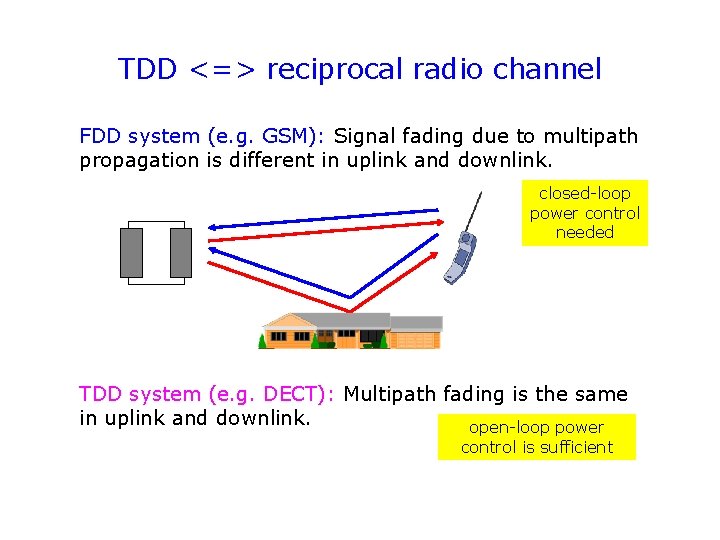
TDD <=> reciprocal radio channel FDD system (e. g. GSM): Signal fading due to multipath propagation is different in uplink and downlink. closed-loop power control needed TDD system (e. g. DECT): Multipath fading is the same in uplink and downlink. open-loop power control is sufficient
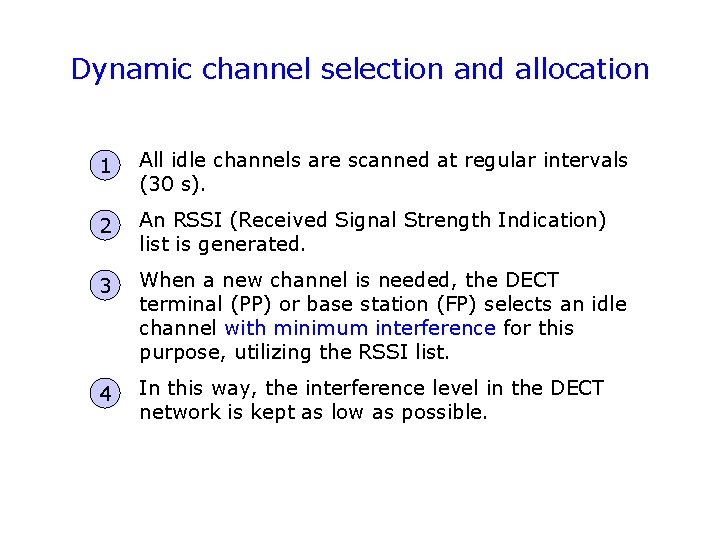
Dynamic channel selection and allocation 1 All idle channels are scanned at regular intervals (30 s). 2 An RSSI (Received Signal Strength Indication) list is generated. 3 When a new channel is needed, the DECT terminal (PP) or base station (FP) selects an idle channel with minimum interference for this purpose, utilizing the RSSI list. 4 In this way, the interference level in the DECT network is kept as low as possible.
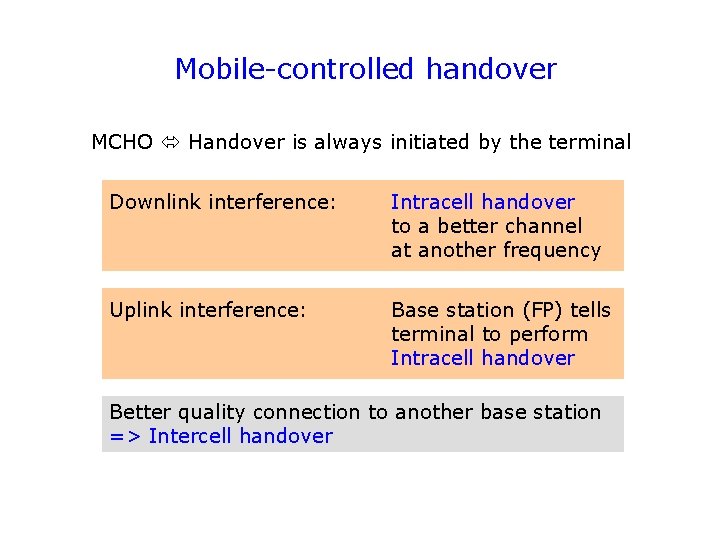
Mobile-controlled handover MCHO Handover is always initiated by the terminal Downlink interference: Intracell handover to a better channel at another frequency Uplink interference: Base station (FP) tells terminal to perform Intracell handover Better quality connection to another base station => Intercell handover
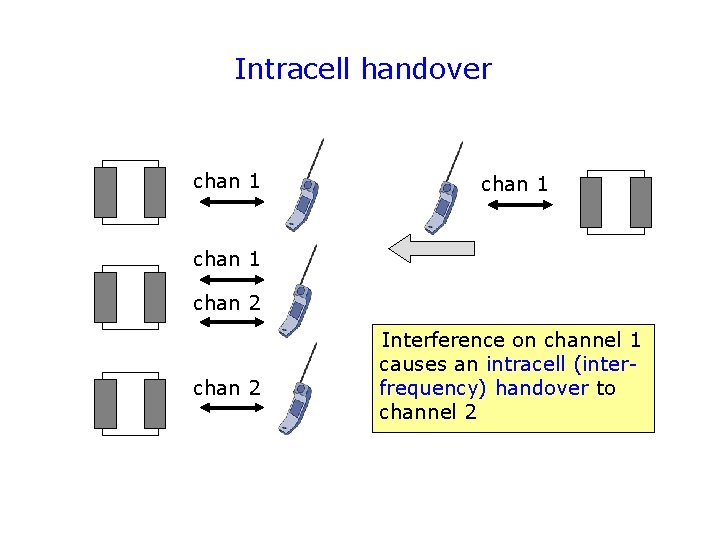
Intracell handover chan 1 chan 2 Interference on channel 1 causes an intracell (interfrequency) handover to channel 2
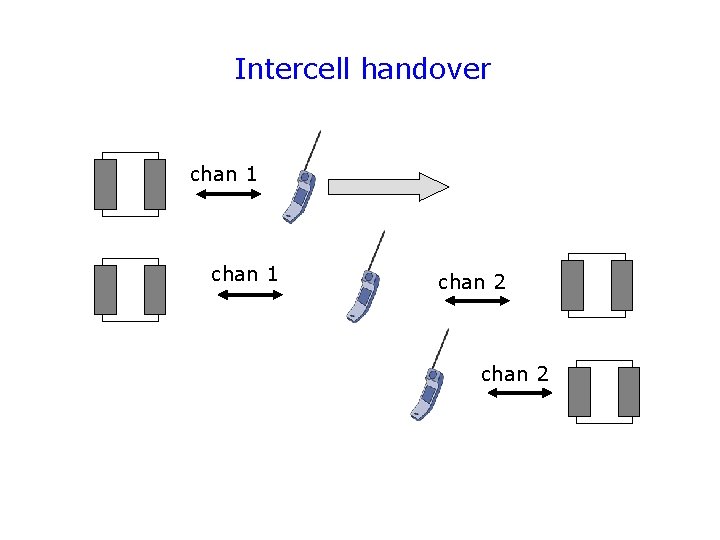
Intercell handover chan 1 chan 2
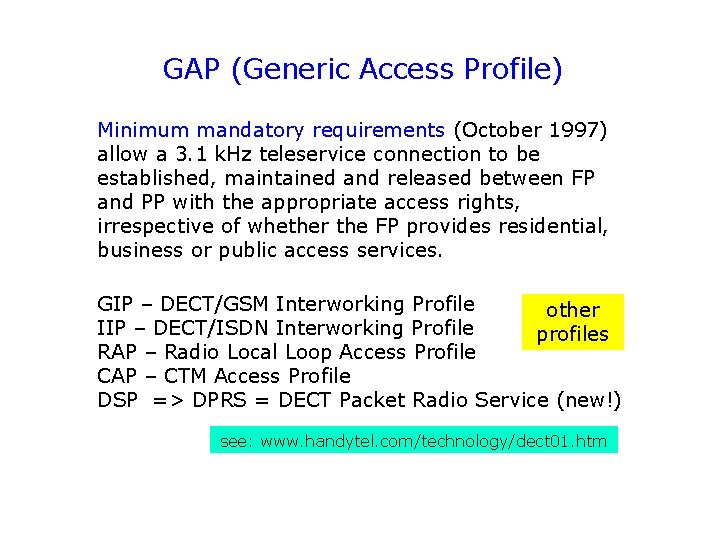
GAP (Generic Access Profile) Minimum mandatory requirements (October 1997) allow a 3. 1 k. Hz teleservice connection to be established, maintained and released between FP and PP with the appropriate access rights, irrespective of whether the FP provides residential, business or public access services. GIP – DECT/GSM Interworking Profile other IIP – DECT/ISDN Interworking Profile profiles RAP – Radio Local Loop Access Profile CAP – CTM Access Profile DSP => DPRS = DECT Packet Radio Service (new!) see: www. handytel. com/technology/dect 01. htm
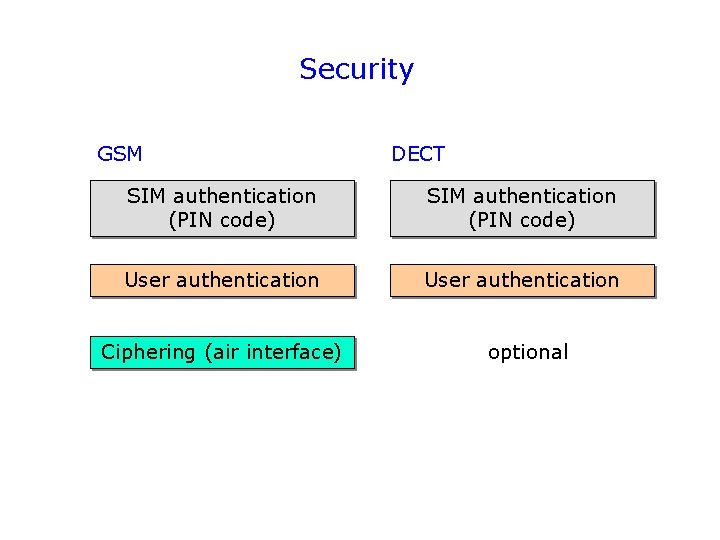
Security GSM DECT SIM authentication (PIN code) User authentication Ciphering (air interface) optional