
TETRA Modern Radio Communication CERN F Chapron Head
- Slides: 27
TETRA Modern Radio Communication @ CERN F. Chapron : Head, Communication Support A. Pascal : TETRA Project Technical Coordinator CS group, IT Department CERN IT Department CH-1211 Genève 23 Switzerland www. cern. ch/it
Agenda • Why a new radio communication network? • What about other radio networks? • Overview of TETRA technology • • • Why is TETRA so successful? TETRA benefits for CERN TETRA limitations, CERN constraints TETRA implementation strategy Preliminary Schedule CERN IT Department CH-1211 Genève 23 Switzerland www. cern. ch/it F. Chapron March 2011 Slide 2
Why a new radio communication network? • The current VHF radio network needs to be replaced: – The infrastructure is difficult to maintain • recurrent problems due to ageing equipment – The infrastructure is not monitored – The network features do not match any longer the operational needs of the fire brigade • No direct inter-site communications – Rejuvenating and adapting the current network is not costeffective • Rejuvenation would cost as much as new technologies ! • More efficient technologies exist CERN IT Department CH-1211 Genève 23 Switzerland www. cern. ch/it F. Chapron March 2011 Slide 3
What about other radio networks? • The mobile network operated by Sunrise (GSM, UMTS) for general communication • • Doesn’t match the operational needs of the fire brigade This mobile network is NOT A SAFETY SYSTEM! Operated externally and not designed for safety needs The mobile network can be a complement to the radio network • Ad hoc portable mobile radios for security and crane drivers (UHF) • Other radio communication network/tools are subject to IT/CS approval that coordinates on behalf of the OFCOM the radio frequency planning at CERN IT Department CH-1211 Genève 23 Switzerland www. cern. ch/it (*) The Wi. Fi network operated by CS for data exchange on site is not taken into account in this topic F. Chapron March 2011 Slide 4
OVERVIEW OF TETRA TECHNOLOGY CERN IT Department CH-1211 Genève 23 Switzerland www. cern. ch/it A. Pascal March 2011 Slide 5
Overview of TETRA technology ETSI Standard • TErrestrial Trunked RAdio (TETRA) standard developed by the E. T. S. I. in 1994. • TETRA : open standard, open interfaces, services and facilities Interoperability between each component of the network competition between manufacturers prices of products • 2 Versions (phases) : – TETRA Version 1 – TETRA Version 2 • Part of the Public Mobile Radio (PMR) technology oriented group communications – Other digital technologies = DMR, TETRAPOL (proprietary), P 25 (U. S. ) CERN IT Department CH-1211 Genève 23 Switzerland www. cern. ch/it A. Pascal March 2011 Slide 6
Overview of TETRA technology Evolving… • ETSI Technical Committee (TC) TETRA : complying with new user requirements gleaning the benefits of new technology innovations. • TETRA Mo. U : forum for user organizations, manufacturers, application providers, integrators, operators, test houses, regulators, consultants, etc. … and World-wide oriented • Since 1997, hundreds of TETRA networks have been deployed worldwide : – First networks deployed in Europe rapid uptake in the regions of Asia, Middle East and South America. CERN IT Department CH-1211 Genève 23 Switzerland www. cern. ch/it A. Pascal March 2011 Slide 7
Overview of TETRA technology Targeted Market : • Public Safety organizations use TETRA or TETRAPOL (in E. U. ) • Transportation (airports, bus, metro. . ) • Governmental institutions (police, . . . ) • Military • … CERN IT Department CH-1211 Genève 23 Switzerland www. cern. ch/it A. Pascal March 2011 Slide 8
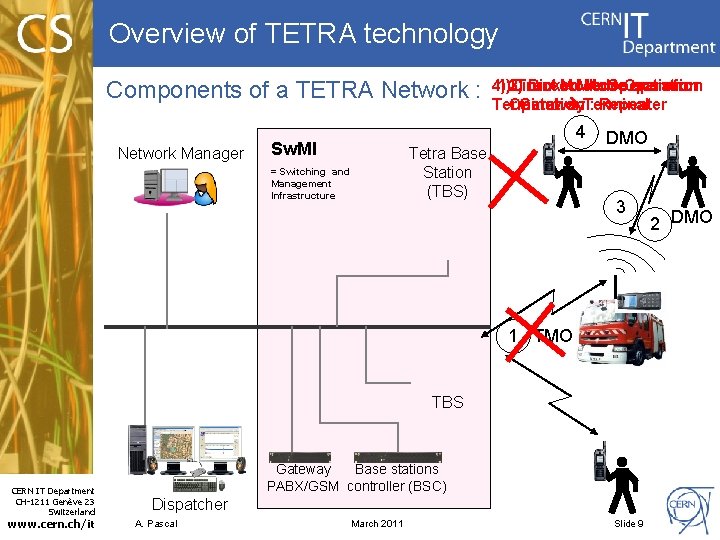
Overview of TETRA technology Components of a TETRA Network : Network Manager 4) 1)3) 2) Direct Trunked Direct Mode Operation operation : Terminal : Gateway Operation : Repeater 4 Sw. MI Tetra Base Station (TBS) = Switching and Management Infrastructure DMO 3 1 TMO TBS CERN IT Department CH-1211 Genève 23 Switzerland www. cern. ch/it Gateway Base stations PABX/GSM controller (BSC) Dispatcher A. Pascal March 2011 Slide 9 2 DMO
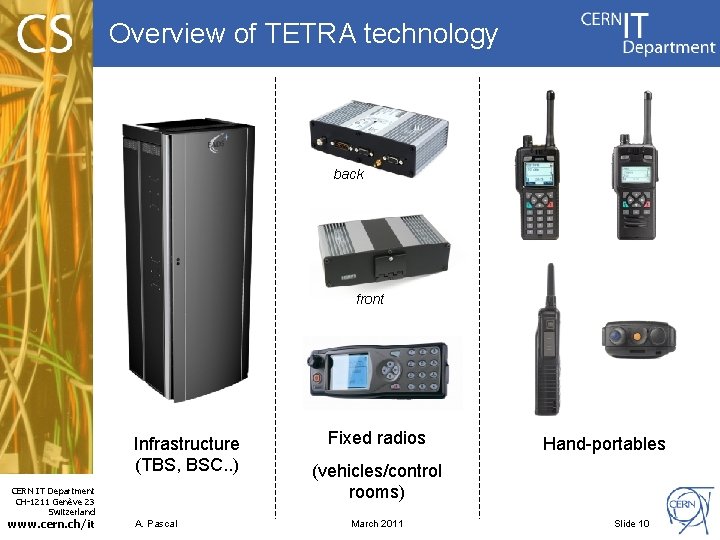
Overview of TETRA technology back front Infrastructure (TBS, BSC. . ) CERN IT Department CH-1211 Genève 23 Switzerland www. cern. ch/it A. Pascal Fixed radios Hand-portables (vehicles/control rooms) March 2011 Slide 10
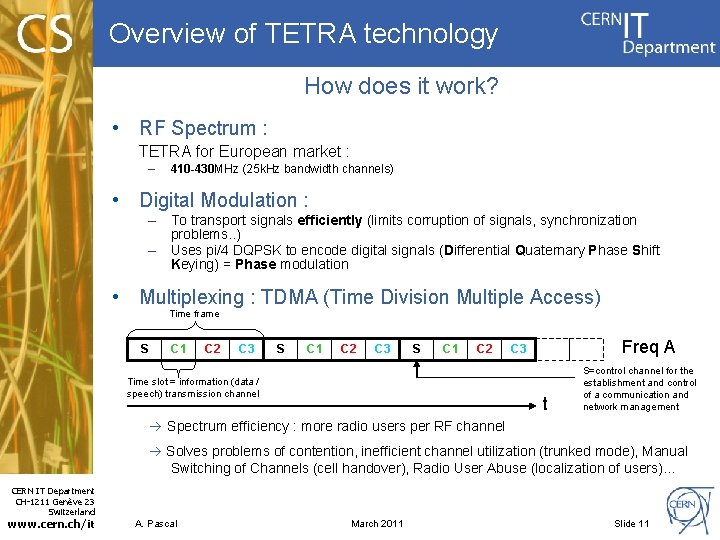
Overview of TETRA technology How does it work? • RF Spectrum : TETRA for European market : – 410 -430 MHz (25 k. Hz bandwidth channels) • Digital Modulation : – To transport signals efficiently (limits corruption of signals, synchronization problems. . ) – Uses pi/4 DQPSK to encode digital signals (Differential Quaternary Phase Shift Keying) = Phase modulation • Multiplexing : TDMA (Time Division Multiple Access) Time frame S C 1 C 2 C 3 S C 1 C 2 Time slot = information (data / speech) transmission channel Freq A C 3 t S=control channel for the establishment and control of a communication and network management Spectrum efficiency : more radio users per RF channel Solves problems of contention, inefficient channel utilization (trunked mode), Manual Switching of Channels (cell handover), Radio User Abuse (localization of users)… CERN IT Department CH-1211 Genève 23 Switzerland www. cern. ch/it A. Pascal March 2011 Slide 11
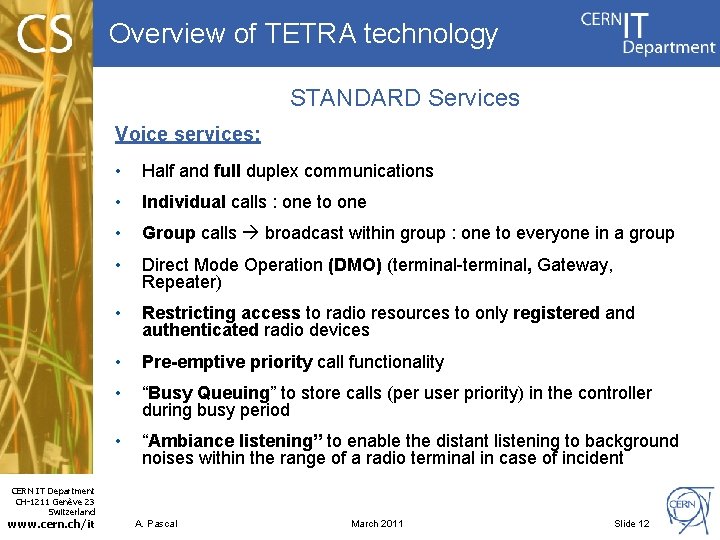
Overview of TETRA technology STANDARD Services Voice services: • Half and full duplex communications • Individual calls : one to one • Group calls broadcast within group : one to everyone in a group • Direct Mode Operation (DMO) (terminal-terminal, Gateway, Repeater) • Restricting access to radio resources to only registered and authenticated radio devices • Pre-emptive priority call functionality • “Busy Queuing” to store calls (per user priority) in the controller during busy period • “Ambiance listening” to enable the distant listening to background noises within the range of a radio terminal in case of incident CERN IT Department CH-1211 Genève 23 Switzerland www. cern. ch/it A. Pascal March 2011 Slide 12
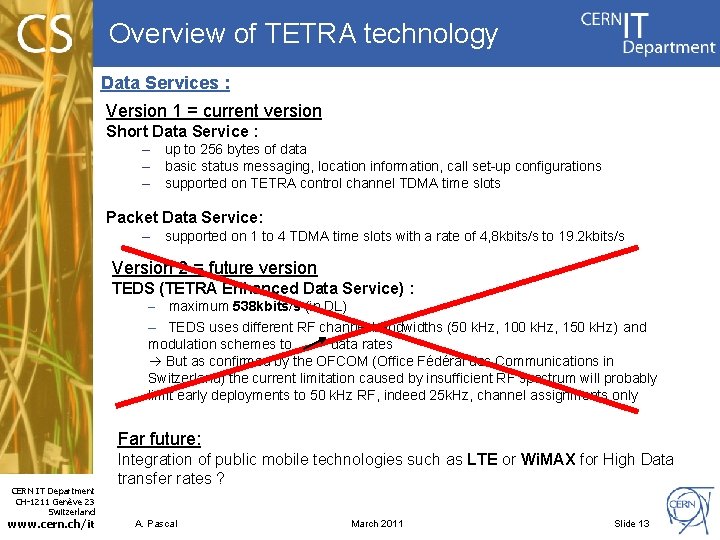
Overview of TETRA technology Data Services : Version 1 = current version Short Data Service : – up to 256 bytes of data – basic status messaging, location information, call set-up configurations – supported on TETRA control channel TDMA time slots Packet Data Service: – supported on 1 to 4 TDMA time slots with a rate of 4, 8 kbits/s to 19. 2 kbits/s Version 2 = future version TEDS (TETRA Enhanced Data Service) : maximum 538 kbits/s (in DL) – TEDS uses different RF channel bandwidths (50 k. Hz, 100 k. Hz, 150 k. Hz) and modulation schemes to data rates But as confirmed by the OFCOM (Office Fédéral des Communications in Switzerland) the current limitation caused by insufficient RF spectrum will probably limit early deployments to 50 k. Hz RF, indeed 25 k. Hz, channel assignments only – Far future: CERN IT Department CH-1211 Genève 23 Switzerland www. cern. ch/it Integration of public mobile technologies such as LTE or Wi. MAX for High Data transfer rates ? A. Pascal March 2011 Slide 13
Overview of TETRA technology Security : • Authentication, Air Interface Encryption (AIE) and End to End encryption : – Four AIE TETRA Encryption Algorithms (TEAs) : • TEA 1 : European commercial use • TEA 2 : European public safety organizations • TEA 3 : Public safety organizations outside Europe • TEA 4 : Commercial use outside Europe – The Advanced Encryption Standard (EAS) is the default interoperability algorithm for end-to-end encryption CERN IT Department CH-1211 Genève 23 Switzerland www. cern. ch/it A. Pascal March 2011 Slide 14
Overview of TETRA technology NETWORK characteristics required by CERN • Redundant architecture • 4 TETRA frequencies : at least 2 TBS and 17 repeaters allowing up to 14 simultaneous calls shared among all CERN groups to this number new study + additional equipment • Coverage : surface (400 km 2) and tunnels (~50 km of radiating cable) • Interconnection with PABX for emergencies • Relay of Swiss and French TETRAPOL frequencies • Gateway with VHF frequencies : – CATASTROPHE : Swiss emergency frequency (Geneva airport fire brigade) – CASU : Swiss medical emergency frequency • Other users communities (security, experiments, environment…) may be integrated in the network : to facilitate maintenance interventions (+ telemetry) to operate a remote monitoring Cooperation with the fire brigade if required CERN IT Department CH-1211 Genève 23 Switzerland www. cern. ch/it A. Pascal March 2011 Slide 15
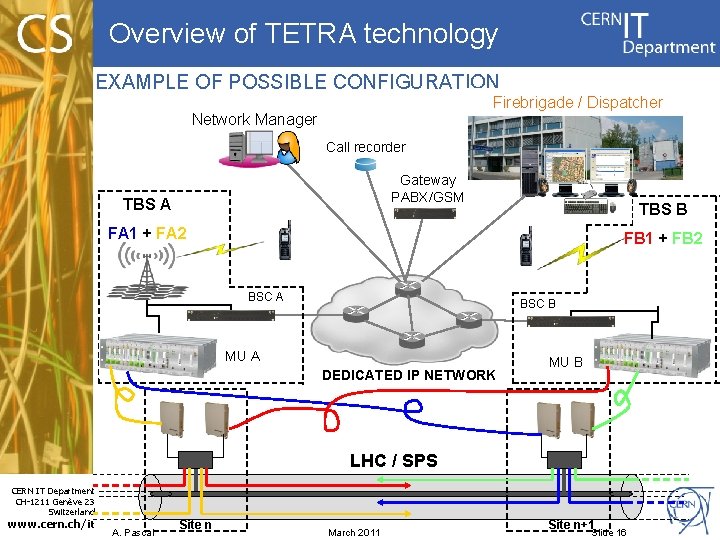
Overview of TETRA technology EXAMPLE OF POSSIBLE CONFIGURATION Firebrigade / Dispatcher Network Manager Call recorder Gateway PABX/GSM TBS A TBS B FA 1 + FA 2 FB 1 + FB 2 BSC A BSC B MU A DEDICATED IP NETWORK MU B LHC / SPS CERN IT Department CH-1211 Genève 23 Switzerland www. cern. ch/it A. Pascal Site n March 2011 Site n+1 Slide 16
Overview of TETRA technology Which services for CERN ? Preliminary requirements: • General Lone Worker Protection service on radio terminals – Devices that automatically alert fire brigade in case of no body motion or verticality loss • SNMP monitoring Desirable: • Geo-localization outdoor and indoor – To help rescue people – To broadcast messages to evacuate an area • Data transmissions (telemetry) – Limited due to low data transfer performances on TETRA – Monitoring of critical or confidential services Other TETRA services : management of groups, DMO Gateway and repeater services on mobiles, restricting access to radio resources, pre-emptive calls, priority calls… CERN IT Department CH-1211 Genève 23 Switzerland www. cern. ch/it A. Pascal March 2011 Slide 17
STRATEGY OF DEPLOYEMENT CERN IT Department CH-1211 Genève 23 Switzerland www. cern. ch/it F. Chapron March 2011 Slide 18
Why is TETRA so successful? TETRA key points : • Open standard • Compatibility with the existing leaky feeder infrastructure • A TETRA infrastructure can be used to carry TETRAPOL signals – This would allow French and Swiss firemen to use their communication equipment in the tunnels • The TETRA market is “mature” – Hundreds of TETRA networks have been deployed across the world – Several competing manufacturers and service providers • Availability to broadcast within groups • Potential optimisation on costs and operation – Interconnection of several groups on the same infrastructure • Custom Devices – Many robust devices designed for safety, security and collaborative works – Compliance with security norm ATEX (to intervene in “explosive” areas) CERN IT Department CH-1211 Genève 23 Switzerland www. cern. ch/it F. Chapron March 2011 Slide 19
TETRA benefits for CERN • Operation and monitoring will be performed by CERN − Allows CERN and the firemen to have a clear understanding of the availability of communication services at any time • Support will be ensured 24/7 by an on-site CERN contractor • At least 4 hours of power autonomy for the system • Radio coverage − Would be improved to cover not only CERN sites, tunnels, but also roads to hospitals and Geneva surroundings • Interesting features − Prioritisation: firemen will always have priority for network resources − Communication confidentiality − Several Groups: other CERN services could use this infrastructure • CERN IT Department CH-1211 Genève 23 Switzerland www. cern. ch/it More efficient for CERN Firemen who are used to working with similar technologies in their country of origin F. Chapron March 2011 Slide 20
TETRA limitations, CERN constraints TETRA limitations: • TETRA infrastructure and terminals are more expensive compared to GSM • The technology offers many features but as a new activity at CERN we need to gain experience - in particular for operation and maintenance CERN environmental constraints : • We still have to validate electromagnetic compatibility between TETRA and all our experimental infrastructure • LHC experiments, Fixed-target experiments, accelerator complex (PS, SPS) • Any equipment made of electronic components shall be located on the surface • The future system shall be installed in parallel to the existing VHF radio infrastructure • Wide coverage: roads to reach two distant sites to cover (hospitals) CERN IT Department CH-1211 Genève 23 Switzerland www. cern. ch/it F. Chapron March 2011 Slide 21
TETRA implementation strategy PHASE 1: • Design the network architecture, services and resources usage to meet IN PRIORITY the fire brigade requirements – I want to be rescued in case of incident! • Relay the radio services of the French and Swiss fire brigades in underground infrastructure • Preserve interconnection with existing external rescue services – Airport and Geneva ambulances CERN IT Department CH-1211 Genève 23 Switzerland www. cern. ch/it F. Chapron March 2011 Slide 22
TETRA implementation strategy PHASE 2: • Progressively integrate other CERN services such as : – Experiments’ support – CERN site security services – Logistic services (crane drivers, etc. ) • Implement ONE communication group per experiment/service (for those interested) – Users would have to finance the radio devices – Radio Devices management under IT/CS responsibility • Study a rental service for temporary needs – Example: Power maintenance during annual closure CERN IT Department CH-1211 Genève 23 Switzerland www. cern. ch/it F. Chapron March 2011 Slide 23
TETRA implementation strategy PHASE 3: Advanced services • Lone worker protection services – Build-up a “service” with the fire brigade • Outdoor/Indoor geo-localisation – Indoor service is a challenging project for providers • Secured telemetry (limited) CERN IT Department CH-1211 Genève 23 Switzerland www. cern. ch/it F. Chapron March 2011 Slide 24
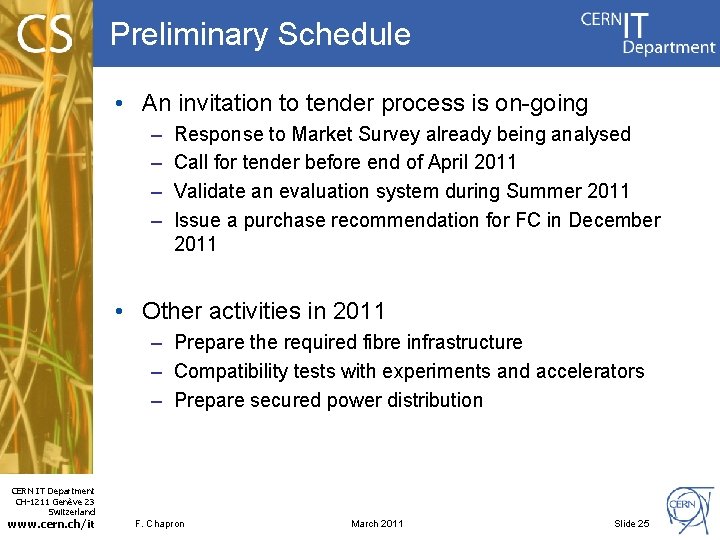
Preliminary Schedule • An invitation to tender process is on-going – – Response to Market Survey already being analysed Call for tender before end of April 2011 Validate an evaluation system during Summer 2011 Issue a purchase recommendation for FC in December 2011 • Other activities in 2011 – Prepare the required fibre infrastructure – Compatibility tests with experiments and accelerators – Prepare secured power distribution CERN IT Department CH-1211 Genève 23 Switzerland www. cern. ch/it F. Chapron March 2011 Slide 25
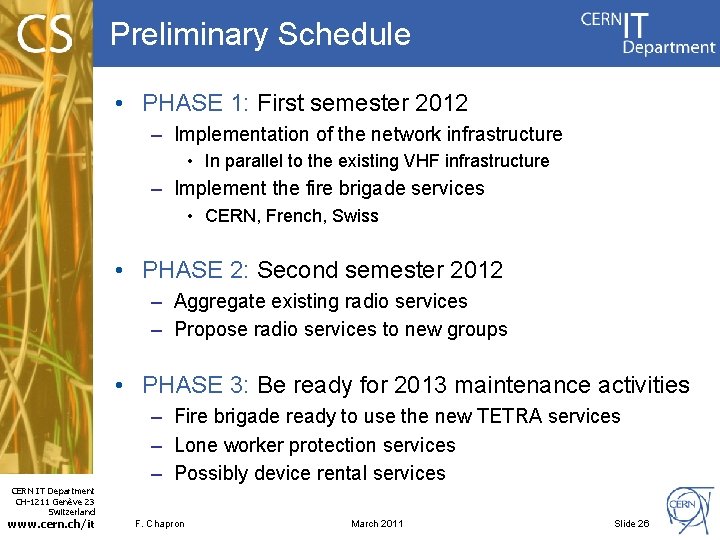
Preliminary Schedule • PHASE 1: First semester 2012 – Implementation of the network infrastructure • In parallel to the existing VHF infrastructure – Implement the fire brigade services • CERN, French, Swiss • PHASE 2: Second semester 2012 – Aggregate existing radio services – Propose radio services to new groups • PHASE 3: Be ready for 2013 maintenance activities CERN IT Department CH-1211 Genève 23 Switzerland www. cern. ch/it – Fire brigade ready to use the new TETRA services – Lone worker protection services – Possibly device rental services F. Chapron March 2011 Slide 26
QUESTIONS CERN IT Department CH-1211 Genève 23 Switzerland www. cern. ch/it