
TESTS TO MEASURE KIDNEY FUNCTION DAMAGE AND DETECT




- Slides: 30
TESTS TO MEASURE KIDNEY FUNCTION, DAMAGE AND DETECT ABNORMALITIES Dr. Parin Hedayati 1
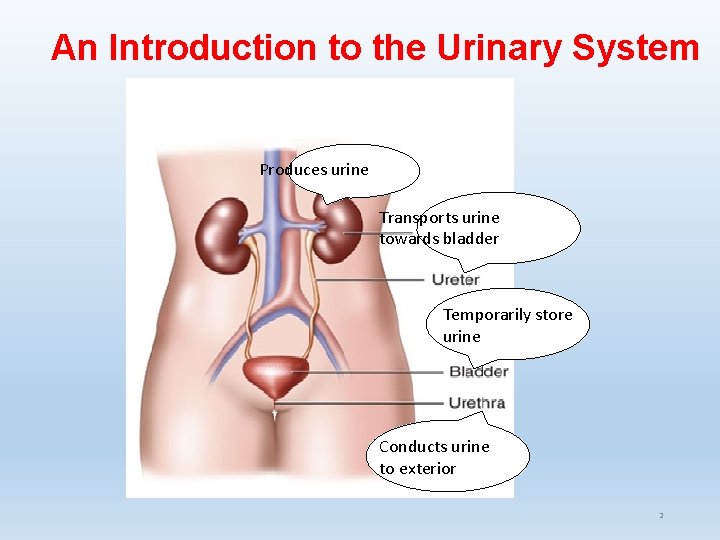
An Introduction to the Urinary System Produces urine Transports urine towards bladder Temporarily store urine Conducts urine to exterior 2
• Healthy kidneys remove wastes and excess fluid from the blood. • Blood and urine tests show well the kidneys are doing their job. • Urine tests can show quickly body wastes are being removed and whether the kidneys are leaking abnormal amounts of protein. 3
The Function of Urinary System A) Excretion & Elimination: removal of organic wastes products from body fluids (urea, creatinine, uric acid) B) Homeostatic regulation: Water -Salt Balance Acid - base Balance C) Enocrine function: Hormones 4
Kidney – basic data • Urine excreted daily in adults: about 1. 5 L • Kidneys only recieve 1% of total body weight • The renal blood flow= 20% of cardiac output • Plasma renal flow= PRF about 600 m. L/Min. /1. 73 M 2 • Reflects two processes • Ultrafiltration (GFR): 180 L/day • Reabsorption: >99% of the amount filtered 5
Kidney Function • A plumbers view 6
How do you know it’s broken? • Decreased urine production • Clinical symptoms • Tests 7
Where can it break? �Pre-renal �Renal (intrarenal) �Post-renal (obstruction) 8
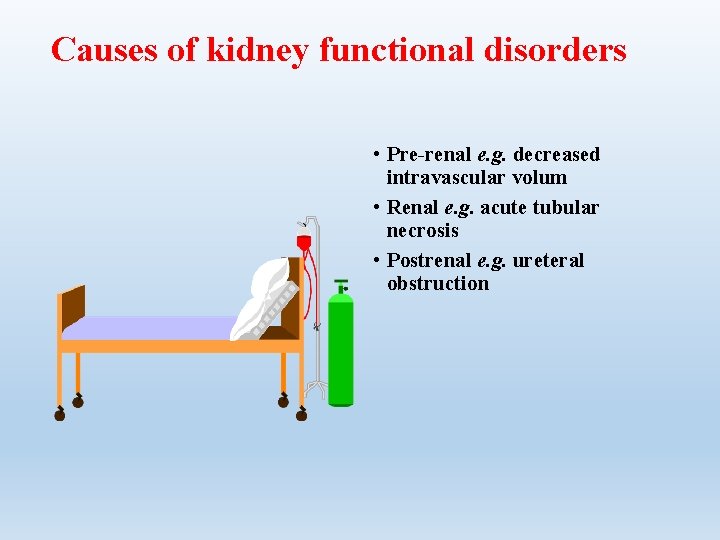
Causes of kidney functional disorders • Pre-renal e. g. decreased intravascular volum • Renal e. g. acute tubular necrosis • Postrenal e. g. ureteral obstruction
Why Test Renal Function? • To identify renal dysfunction. • To diagnose renal disease. • To monitor disease progress. • To monitor response to treatment. 10
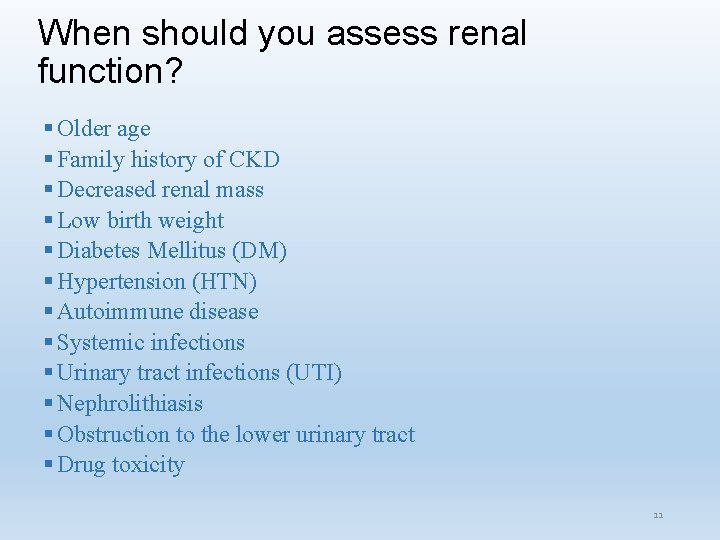
When should you assess renal function? § Older age § Family history of CKD § Decreased renal mass § Low birth weight § Diabetes Mellitus (DM) § Hypertension (HTN) § Autoimmune disease § Systemic infections § Urinary tract infections (UTI) § Nephrolithiasis § Obstruction to the lower urinary tract § Drug toxicity 11
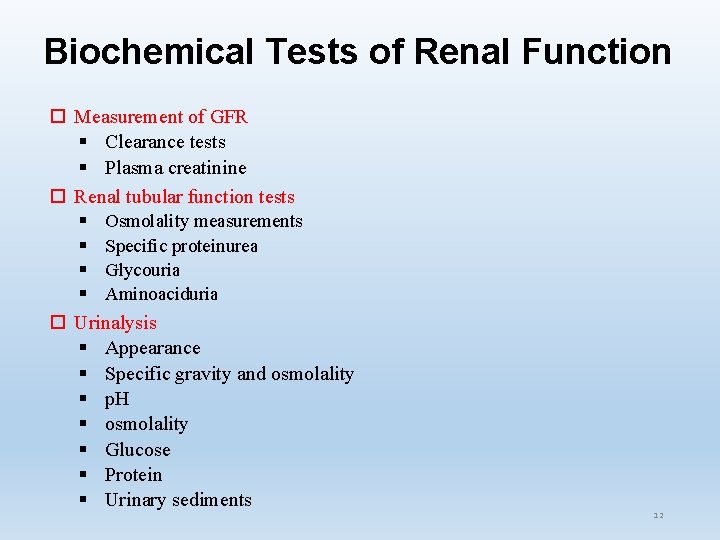
Biochemical Tests of Renal Function Measurement of GFR § Clearance tests § Plasma creatinine Renal tubular function tests § Osmolality measurements § Specific proteinurea § Glycouria § Aminoaciduria Urinalysis § Appearance § Specific gravity and osmolality § p. H § osmolality § Glucose § Protein § Urinary sediments 12
Biochemical Tests of Renal Function Measurement of GFR Clearance tests Plasma creatinine 13
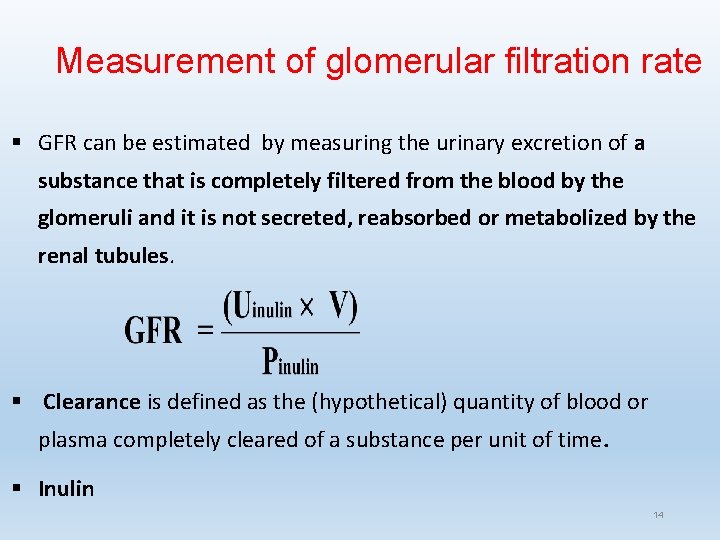
Measurement of glomerular filtration rate § GFR can be estimated by measuring the urinary excretion of a substance that is completely filtered from the blood by the glomeruli and it is not secreted, reabsorbed or metabolized by the renal tubules. § Clearance is defined as the (hypothetical) quantity of blood or plasma completely cleared of a substance per unit of time. § Inulin 14
Biochemical Tests of Renal Function Measurement of GFR �Clearance tests Plasma creatinine �Urea, uric acid and β 2 -microglobulin 15
• The normal value for GFR is 90 or above. • A GFR below 60 is a sign that the kidneys are not working properly. • A GFR below 15 indicates that a treatment for kidney failure, such as dialysis or a kidney transplant, will be needed. 16
Creatinine § 1 to 2% of muscle creatine spontaneously converts to creatinine daily and released into body fluids at a constant rate. § Endogenous creatinine produced is proportional to muscle mass, it is a function of total muscle mass the production varies with age and sex § Dietary fluctuations of creatinine intake cause only minor variation in daily creatinine excretion of the same person. § Creatinine released into body fluids at a constant rate and its plasma levels maintained within narrow limits Creatinine clearance may be measured as an indicator of GFR. 17
Creatinine clearance and clinical utility § The most frequently used clearance test is based on the measurement of creatinine. § Small quantity of creatinine is reabsorbed by the tubules and other quantities are actively secreted by the renal tubules So creatinine clearance is approximately 7% greater than inulin clearance. § The difference is not significant when GFR is normal but when the GFR is low (less 10 ml/min), tubular secretion makes the major contribution to creatinine excretion and the creatinine clearance significantly overestimates the GFR. 18
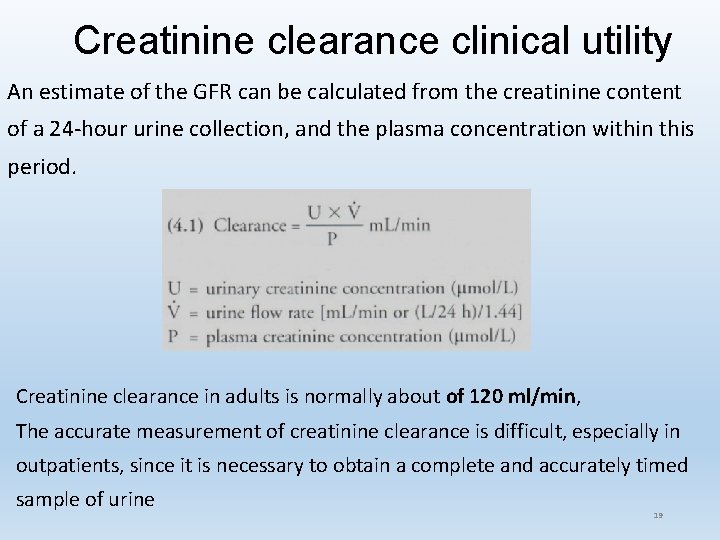
Creatinine clearance clinical utility An estimate of the GFR can be calculated from the creatinine content of a 24 -hour urine collection, and the plasma concentration within this period. Creatinine clearance in adults is normally about of 120 ml/min, The accurate measurement of creatinine clearance is difficult, especially in outpatients, since it is necessary to obtain a complete and accurately timed sample of urine 19
Use of Formulae to Predict Clearance • Formulae have been derived to predict Creatinine Clearance from Plasma creatinine. • Plasma creatinine derived from muscle mass which is related to body mass, age, sex. • Cockcroft & Gault Formula CC =K [(140 -Age) x weight(Kg))] / serum Creatinine (mg/d. L) k = 1 for males & 0. 85 for females 20
Plasma Urea is the major nitrogen-containing metabolic product of protein catabolism in humans, ü Its elimination in the urine represents the major route for nitrogen excretion. ü More than 90% of urea is excreted through the kidneys, with losses through the GIT and skin ü Urea is filtered freely by the glomeruli ü Urea production is increased by a high protein intake and it is decreased in patients with a low protein intake or in patients with liver disease. 21
Plasma Urea § Many renal diseases with various glomerular, tubular, interstitial or vascular damage can cause an increase in plasma urea concentration. § The reference interval for serum BUN of healthy adults is 5 -39 mg/dl. Plasma concentrations also tend to be slightly higher in males than females. High protein diet causes significant increases in plasma urea concentrations and urinary excretion. 22
§ Measurement of plasma creatinine provides a more accurate assessment than urea because there are many factors that affect urea level. § Nonrenal factors can affect the urea level (normal adults is level 5 -39 mg/dl) like: § Mild dehydration, § high protein diet, § increased protein catabolism, muscle wasting as in starvation, § reabsorption of blood proteins after a GIT haemorrhage, § treatment with cortisol or its synthetic analogous 23
Urinalysis • Appearance - blood, colour, turbidity. • Specific gravity - sticks measure ionic particles only, not glucose. • p. H - normally acidic, except after a meal. • Glucose - the presence of glucose in urine may indicate increased blood glucose, or tubular disorder. • Proteinuria - the presence of protein in the urine may be caused by glomerular leak, raised serum low-molecular weight proteins, Bence Jones' proteins, myoglobulin, or protein of renal origin. • Microscopy - urinary tract infection will show polymorphs with no casts; acute glomerulonephritis will show cells and casts; chronic glomerulonephritis shows little sediment. 24
Imaging Tests • Ultrasound • This test uses sound waves to get a picture of the kidney. It may be used to look for abnormalities in size or position of the kidneys or for obstructions such as stones or tumors. 25
• CT Scan • This imaging technique uses contrast dye to picture the kidneys. It may also be used to look for structural abnormalities and the presence of obstructions. 26
kidney Biopsy • A biopsy may be done occasionally for one of the following reasons: 1. to identify a specific disease process and determine whether it will respond to treatment 2. to evaluate the amount of damage that has occurred in the kidney 3. to find out why a kidney transplant may not be doing well A kidney biopsy is performed by using a thin needle with a sharp cutting edge to slice small pieces of kidney tissue for examination under a microscope. 27
Urine Tests • Some urine tests require only a couple of tablespoonfuls of urine. But some tests require collection of all urine produced for a full 24 hours. A 24 -hour urine test shows how much urine your kidneys produce in one day. The test also can give an accurate measurement of how much protein leaks from the kidney into the urine in one day. 28
MICROALBUMINURIA • This is a more sensitive dipstick test, which can detect a tiny amount of protein called albumin in the urine. • People who have an increased risk of developing kidney disease, such as those with diabetes or high blood pressure, should have this test if their standard dipstick test for proteinuria is negative. 29
Albuminuria-to-creatinine ratio (ACR). • Albuminuria occurs when there are higher amounts of a type of protein called albumin in the urine, It is a common marker of kidney damage. The ratio of albumin-to-creatinine is recommended as the best method to determine albuminuria. • All patients with CKD should be tested for albuminuria at least annually. • You should also get tested if you are at risk for kidney disease (have diabetes, high blood pressure, or family history of diabetes, high blood pressure or kidney failure). 30