
TESTING WRITING Assessment of Writing It is important
- Slides: 23
TESTING WRITING
Assessment of Writing It is important that learning experiences in the classroom be assessed in an authentic manner. The traditional grading of papers still has a legitimate place in the English language arts classroom but should not be the sole means of assessing writing. Rather, continuous assessment should mirror instruction and be interwoven with it. Evaluation is vital for a clear, reliable picture of how students are progressing and how well the methods of instruction address students' needs.
Writing assessment can take many forms. Where once only product was considered, the writing process must also be acknowledged in evaluation. In process assessment, teachers monitor the process students use as they write. In product assessment, teachers evaluate students' finished compositions. In both types of assessment, the goal is to help students become better writers.
Process Assessment Teachers watch students as they engage in writing in order to determine strengths, abilities, and needs. Teachers observe in order to learn about students' attitudes and interests in writing, the writing strategies that they use, and how students interact with classmates during writing. While observing, teachers may ask students questions such as: How is it going? What are you writing about? Where do you want this piece to go? This type of informal observation, although not graded as such, enables teachers to make informed instructional decisions and demonstrates to students that teachers are supportive of the writing process.
Conferencing is a central means of assessing the writing process. A conference is a meeting to discuss work in progress. As teachers listen to students talk about writing, they can learn how to help students work through the process. A conference can occur at various points of the writing process. Teachers' questions can lead students to discuss what they know, what they are doing, what they find confusing, or of what they are proud. Teachers should balance the amount of their talk with the students' talk and allow the students to take responsibility for discussing and thinking about their own writing.
The key to success in any conference lies in asking questions that teach, such as the following:
As students begin to write: n n n n n What will your topic be? How did you choose (or narrow) your topic? What pre-writing activities are you doing? How are you gathering ideas for writing? How might you organize your writing? How might you start writing your rough draft? What form might your writing take? Who might be your audience? What do you plan to do next?
As students are drafting: n n n How is your writing going? Are you having any problems? What do you plan to do next?
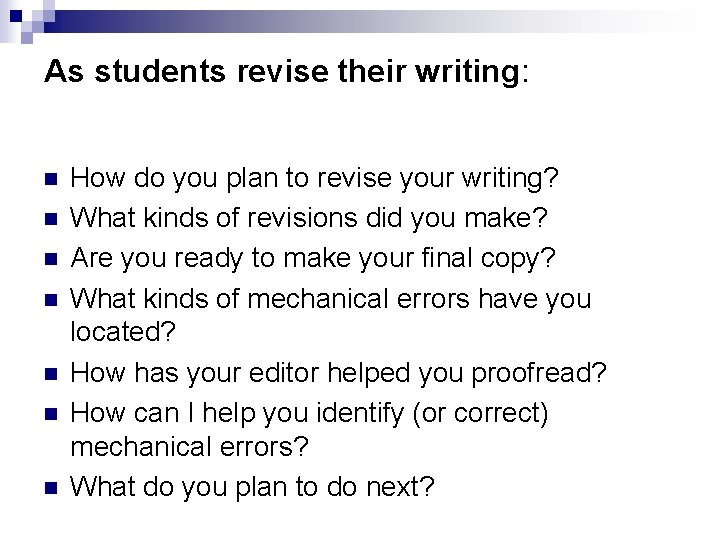
As students revise their writing: n n n n How do you plan to revise your writing? What kinds of revisions did you make? Are you ready to make your final copy? What kinds of mechanical errors have you located? How has your editor helped you proofread? How can I help you identify (or correct) mechanical errors? What do you plan to do next?
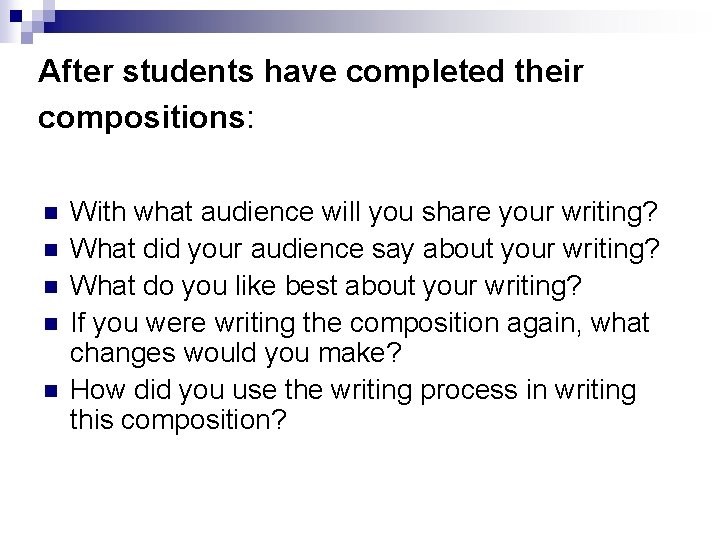
After students have completed their compositions: n n n With what audience will you share your writing? What did your audience say about your writing? What do you like best about your writing? If you were writing the composition again, what changes would you make? How did you use the writing process in writing this composition?
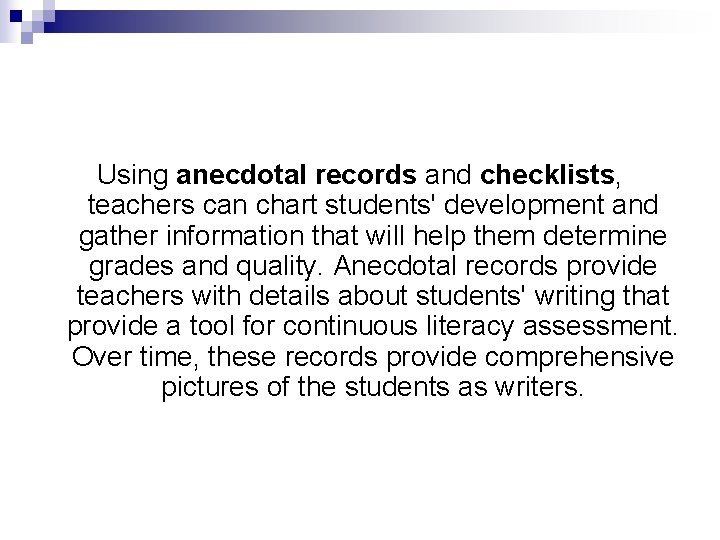
Using anecdotal records and checklists, teachers can chart students' development and gather information that will help them determine grades and quality. Anecdotal records provide teachers with details about students' writing that provide a tool for continuous literacy assessment. Over time, these records provide comprehensive pictures of the students as writers.
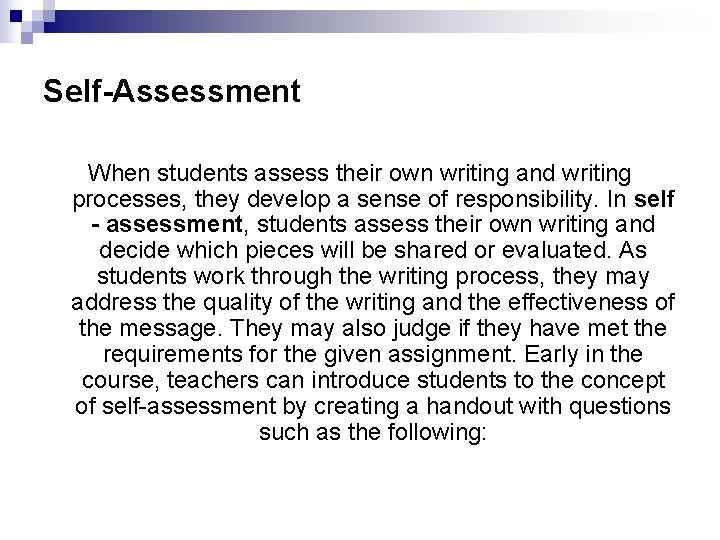
Self-Assessment When students assess their own writing and writing processes, they develop a sense of responsibility. In self - assessment, students assess their own writing and decide which pieces will be shared or evaluated. As students work through the writing process, they may address the quality of the writing and the effectiveness of the message. They may also judge if they have met the requirements for the given assignment. Early in the course, teachers can introduce students to the concept of self-assessment by creating a handout with questions such as the following:
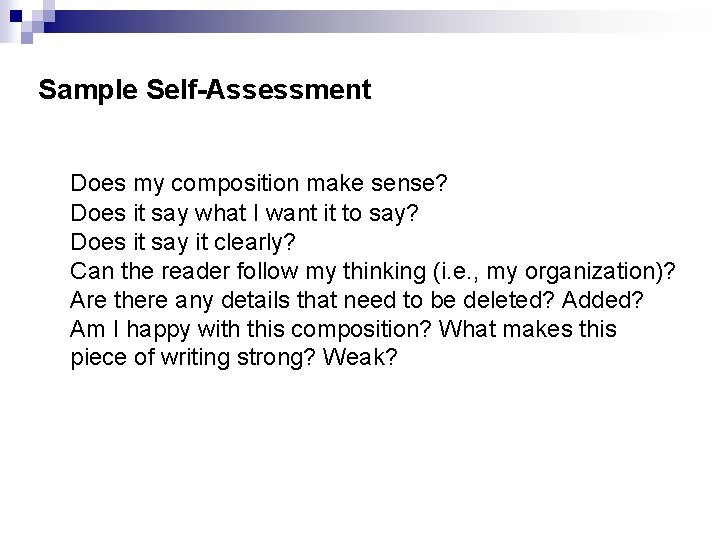
Sample Self-Assessment Does my composition make sense? Does it say what I want it to say? Does it say it clearly? Can the reader follow my thinking (i. e. , my organization)? Are there any details that need to be deleted? Added? Am I happy with this composition? What makes this piece of writing strong? Weak?
Product Assessment of the process students use when writing is of great importance in assisting students to improve their writing; however, the finished composition or product is also important as an indication of writing achievement.
Product assessment is often equated with a grade, yet this type of assessment attends only to the students' cognitive domain. "Teachers, raised and educated in the old tradition, do not easily let go of the belief that they must correct and grade each piece of writing that their students do" (Crowhurst, 1988, p. 8). This overriding obsession with correction, often narrowly focused on mechanics, actually undermines the more fundamental aspect of composing--content and clarity.
Intensively marked papers give too many details, overwhelming and demoralizing the students in addition to overloading the teacher. Researchers have found that constructive, encouraging, and frequent feedback, as well as responses that emphasize content and process rather than just conventions, lead to improved competency and positive attitudes to writing. Praising what students do well improves their writing more than mere correction of what they do badly. Intensive correction actually does more damage than moderate correction. Focusing students' attention on one or two areas for concentration and improvement is more helpful.
When students use the writing process, intensive correction is not as likely to be required because students usually write more carefully considered and crafted compositions. They have gone through several revisions. They often reflect a more thorough understanding of the assignment's nature. They require, therefore, a thoughtful response from teachers. Too often teachers revert to reacting and evaluating papers only in terms of mechanics.
If students are to grow as writers they deserve regular feedback. In addition to noting errors with mechanics, teachers can respond with appropriate comments. Comments such as the following can help students grow and can validate them as writers.
Holistic Scoring Teachers read the compositions for a general impression and, according to this impression, award a numerical score or letter grade. All aspects of the composition-content and conventions--affect the teacher's response, but none of them is specifically identified or directly addressed using a checklist. This approach is rapid and efficient in judging overall performance. It may, however, be inappropriate for judging how well students applied a specific criterion or developed a particular form. A sample holistic scoring guide follows, with scores ranging from 5 to 1.
Analytic Scoring In analytic scoring, teachers read compositions focusing on a pre-determined list of criteria. Compositions can be compared to a set standard and teachers can diagnose to determine needed instruction. Although this type of analysis is more time consuming than other measures, it does provide detailed feedback. Diederich's Scale (1974) is the most widely used analytic measure but it must be used cautiously in order to reflect the instructional focus. It is easy to adapt the scale for specific purposes.
Some Final Considerations Students need to know exactly what will be evaluated and how; teachers need to communicate their expectations or develop the expectations with the class. Consider the following:
n n Teachers should not feel that they must mark everything but they should provide some kind of feedback for most of the students' writing. Using the dossier/portfolio system, students should choose what they will submit for evaluation. Teachers set the minimum guidelines (e. g. , five public compositions/three informal/one novel study). Teachers should communicate their assessment guidelines as well as the methods (e. g, . holistic/analytic) very clearly at the beginning of the course to all the stakeholders--students, parents, school administration. Teachers should clearly communicate the mark allocation (e. g. , the percentage assigned to each of product and process). For some assignments, students may have the option to weight the process or product more heavily within a pre-determined range of marks. Teachers must balance the marks assigned to writing with the other language strands.
Growth in writing is slow and highly individualistic. Effective evaluation depends on teachers clearly understanding what students can do, assessing students' growth, and giving meaningful feedback and encouragement.