
Testing V A in verbal children 1 2
Testing V. A in verbal children 1. 2. 3. 4. 5. Allen picture card (Kay pictures). HOTV test (Sonsken- Silver test). Sheridan- Gardner test. Landolt rings (C). Familiar tumbling E test.
Allen picture card (Kay pictures). - Near test cards are easier for younger children. - Disadvantages: 1. Pictures are not constructed according to snellen form (each element in the target subtends 1 of visual angle) 2. Some pictures are not familiar to the child e. g. telephone. 3. Pictures are variably larger than the corresponding Snellen letter target. 4. Smallest one 20/30=6/9. Ø But most children respond to this test.
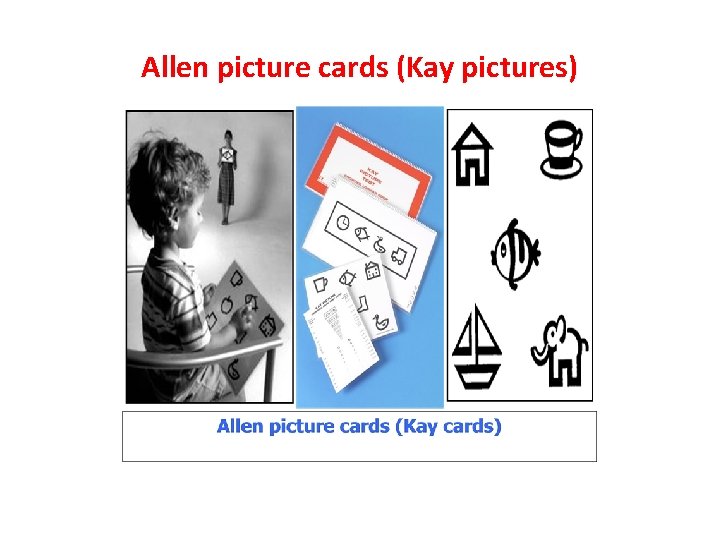
Allen picture cards (Kay pictures)
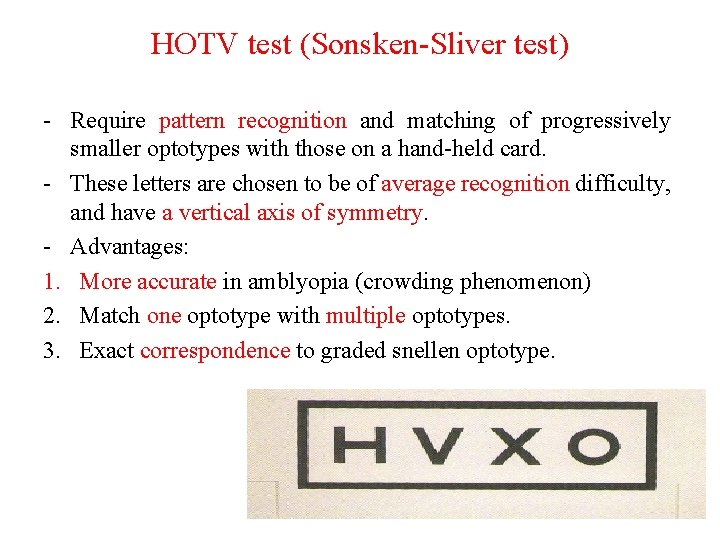
HOTV test (Sonsken-Sliver test) - Require pattern recognition and matching of progressively smaller optotypes with those on a hand-held card. - These letters are chosen to be of average recognition difficulty, and have a vertical axis of symmetry. - Advantages: 1. More accurate in amblyopia (crowding phenomenon) 2. Match one optotype with multiple optotypes. 3. Exact correspondence to graded snellen optotype.
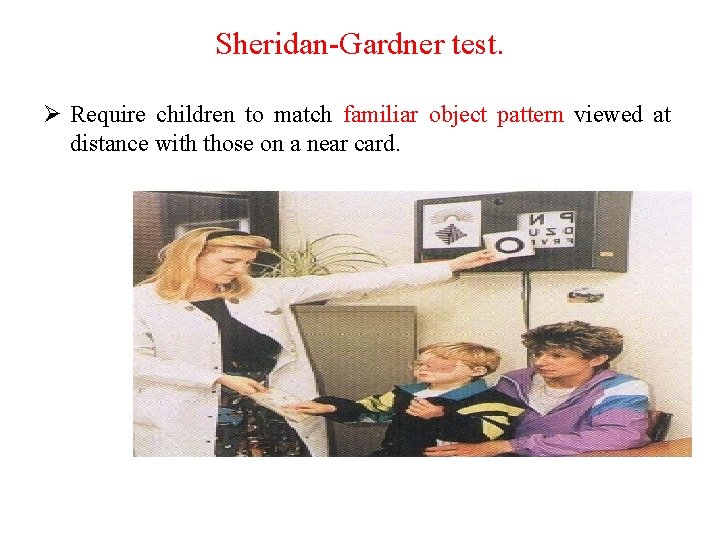
Sheridan-Gardner test. Ø Require children to match familiar object pattern viewed at distance with those on a near card.

Which is better? ? ? Ø The main deference between the Sheridan-Gardner test and the HOTV test is that there is no crowding phenomena in the Sheridan-Gardner test, because it show a single optotype in each card , so it is not accurate to test an amblyopic child with the Sheridan-Gardner. Ø Because the crowding phenomena is the hallmark to the presence of amblyopia , so it is very important to use these two tests in the correct way and on the suitable patients in the HOTV test.
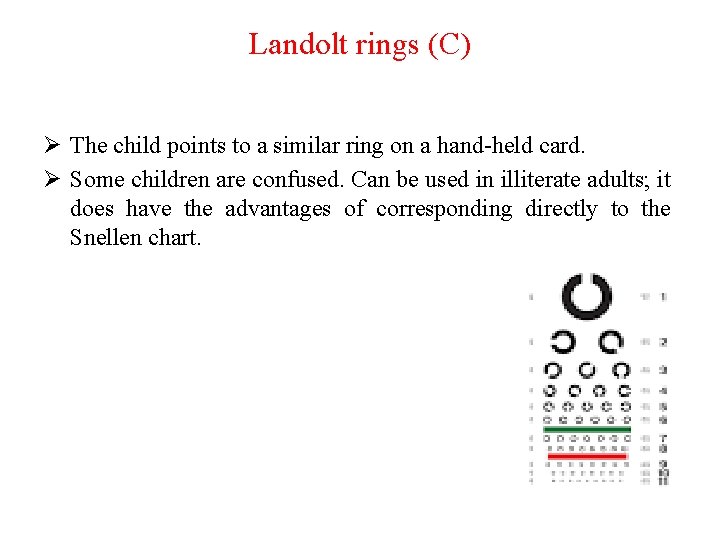
Landolt rings (C) Ø The child points to a similar ring on a hand-held card. Ø Some children are confused. Can be used in illiterate adults; it does have the advantages of corresponding directly to the Snellen chart.
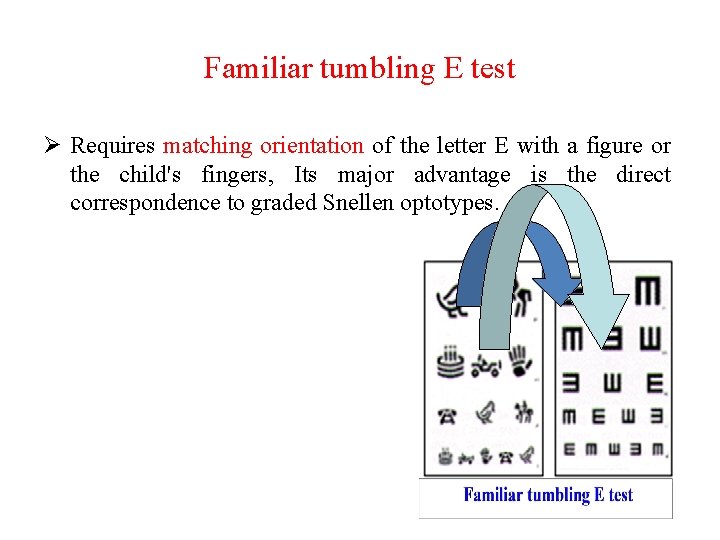
Familiar tumbling E test Ø Requires matching orientation of the letter E with a figure or the child's fingers, Its major advantage is the direct correspondence to graded Snellen optotypes.
Ø Important notes: - In some cases, the patient may have a latent nystagmus, which appears when the other eye is occluded. - The latent nystagmus reduces the V. A due to the inability to fixate the target. - In these cases when testing V. A, we must occlude the eye in a way that’s prevent the latent nystagmus to occur. Ø There are methods to perform that: 1. Using a +5. 00 D in front of the eye, it will reduce the vision in a marked limit and in the same time it will not produce nystagmus. Ø It is an important exception that the patient does not be hypermetropic.
2. By putting the occluder in front of the eye at a distance nearly 10 cm, in this way we occluded the eye and prevent the nystagmus. 3. By using the frosted lens, which present in some trial cases. Ø This lens permits some light to enter the eye but it also occlude the eye from seeing anything and so no nystagmus will occur.
- Slides: 10