
Testing the slow roll inflation paradigm with the
- Slides: 11
Testing the slow roll inflation paradigm with the Big Bang Observer Carlo Ungarelli School of Physics and Astronomy Astrophysics and Space Research Group In collaboration with A. Vecchio, P. Corasaniti (Columbia, NY), R. A. Mercer
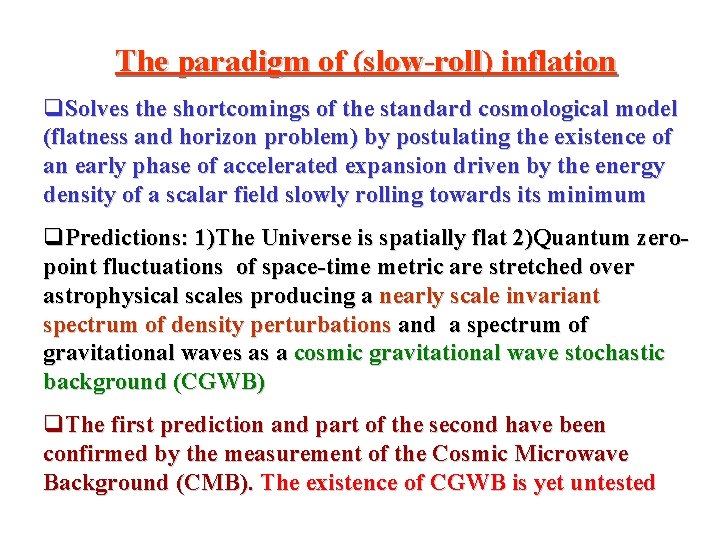
The paradigm of (slow-roll) inflation q. Solves the shortcomings of the standard cosmological model (flatness and horizon problem) by postulating the existence of an early phase of accelerated expansion driven by the energy density of a scalar field slowly rolling towards its minimum q. Predictions: 1)The Universe is spatially flat 2)Quantum zeropoint fluctuations of space-time metric are stretched over astrophysical scales producing a nearly scale invariant spectrum of density perturbations and a spectrum of gravitational waves as a cosmic gravitational wave stochastic background (CGWB) q. The first prediction and part of the second have been confirmed by the measurement of the Cosmic Microwave Background (CMB). The existence of CGWB is yet untested
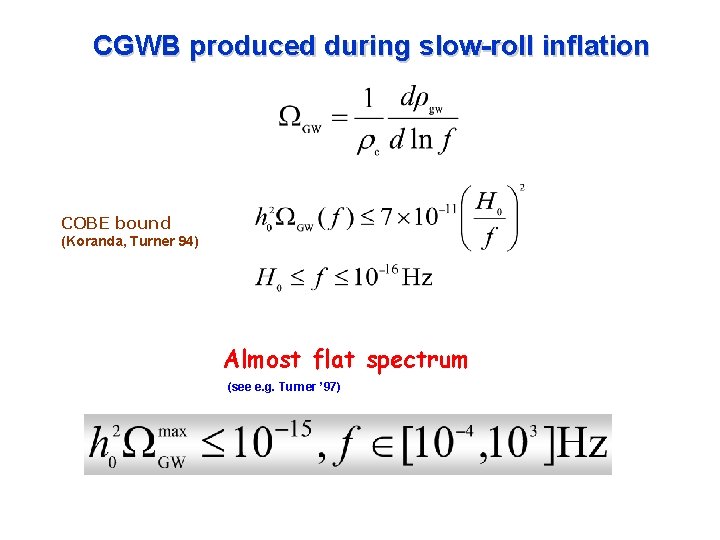
CGWB produced during slow-roll inflation COBE bound (Koranda, Turner 94) Almost flat spectrum (see e. g. Turner ’ 97)
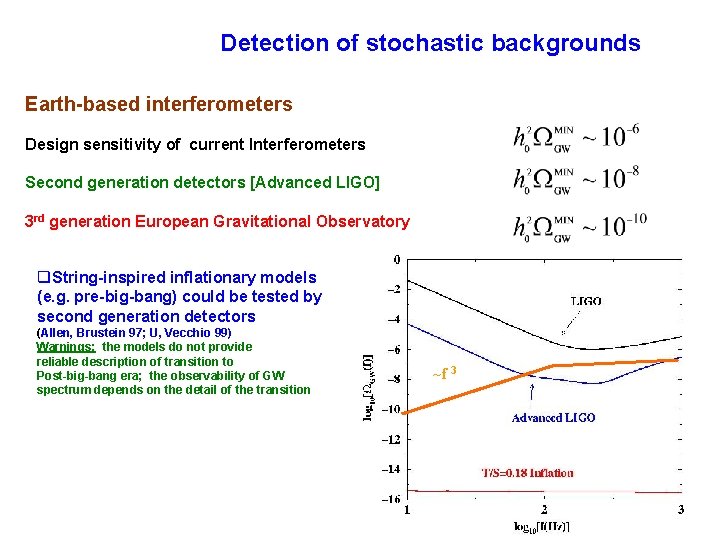
Detection of stochastic backgrounds Earth-based interferometers Design sensitivity of current Interferometers Second generation detectors [Advanced LIGO] 3 rd generation European Gravitational Observatory q. String-inspired inflationary models (e. g. pre-big-bang) could be tested by second generation detectors (Allen, Brustein 97; U, Vecchio 99) Warnings: the models do not provide reliable description of transition to Post-big-bang era; the observability of GW spectrum depends on the detail of the transition ~f 3
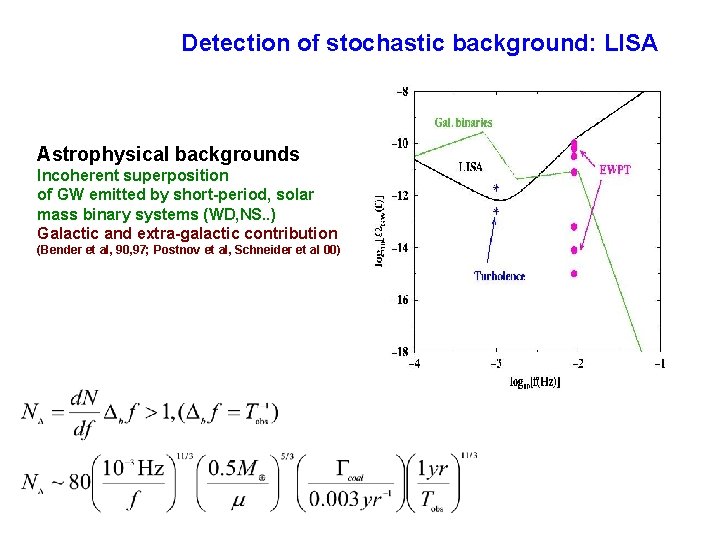
Detection of stochastic background: LISA Astrophysical backgrounds Incoherent superposition of GW emitted by short-period, solar mass binary systems (WD, NS. . ) Galactic and extra-galactic contribution (Bender et al, 90, 97; Postnov et al, Schneider et al 00)
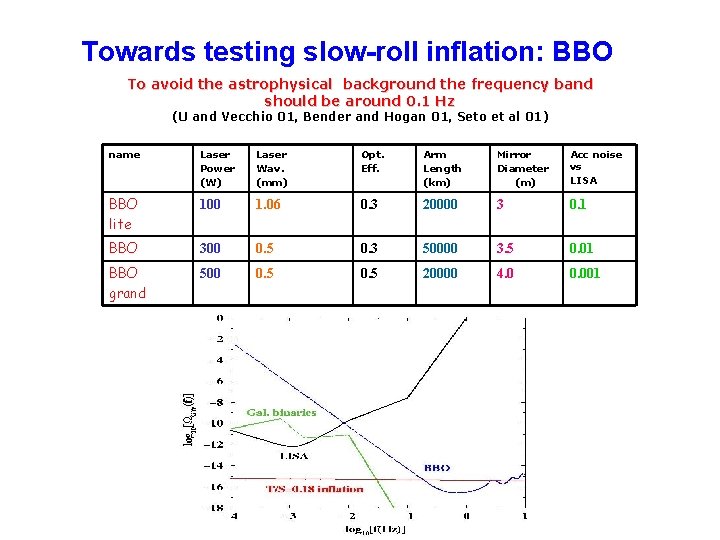
Towards testing slow-roll inflation: BBO To avoid the astrophysical background the frequency band should be around 0. 1 Hz (U and Vecchio 01, Bender and Hogan 01, Seto et al 01) name Laser Power (W) Laser Wav. (mm) Opt. Eff. Arm Length (km) Mirror Diameter (m) Acc noise vs LISA BBO lite 100 1. 06 0. 3 20000 3 0. 1 BBO 300 0. 5 0. 3 50000 3. 5 0. 01 BBO grand 500 0. 5 20000 4. 0 0. 001
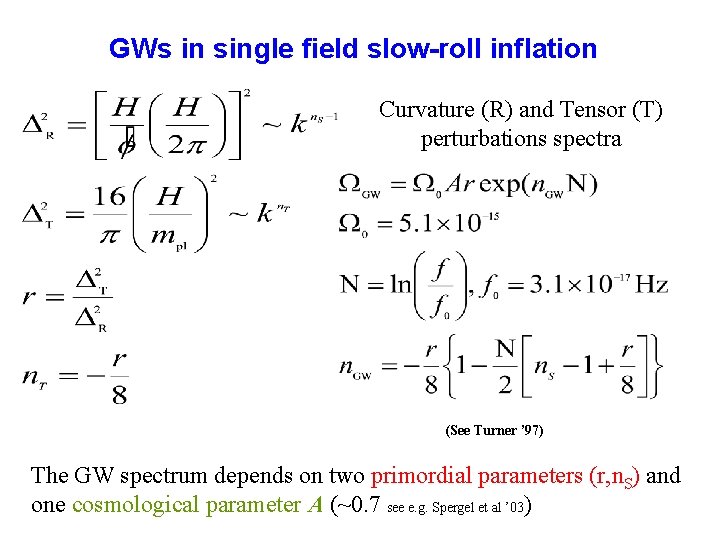
GWs in single field slow-roll inflation Curvature (R) and Tensor (T) perturbations spectra (See Turner ’ 97) The GW spectrum depends on two primordial parameters (r, n. S) and one cosmological parameter A (~0. 7 see e. g. Spergel et al ’ 03)
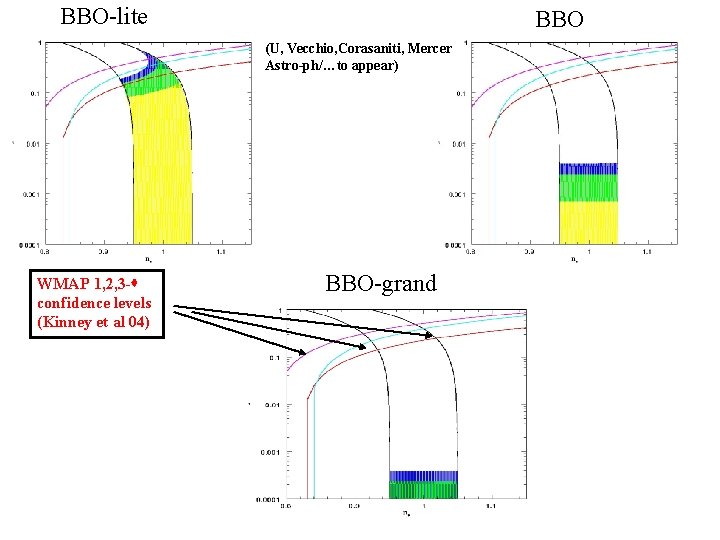
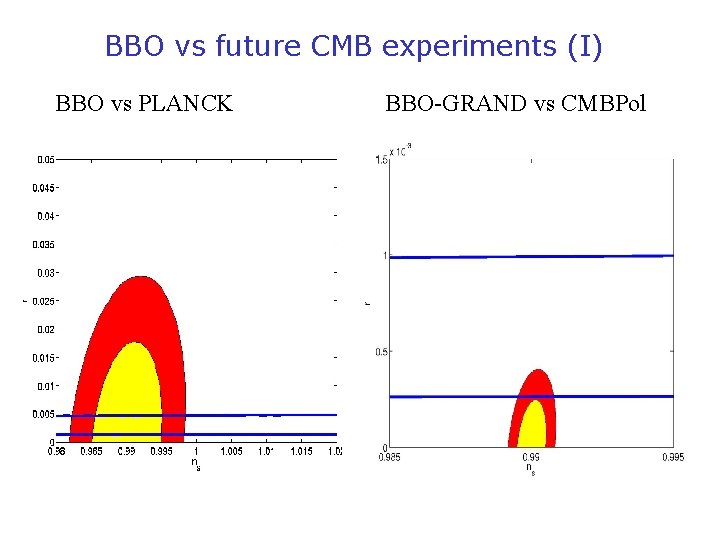
BBO-lite BBO (U, Vecchio, Corasaniti, Mercer Astro-ph/…to appear) WMAP 1, 2, 3 -s confidence levels (Kinney et al 04) BBO-grand
BBO vs future CMB experiments (I) BBO vs PLANCK BBO-GRAND vs CMBPol
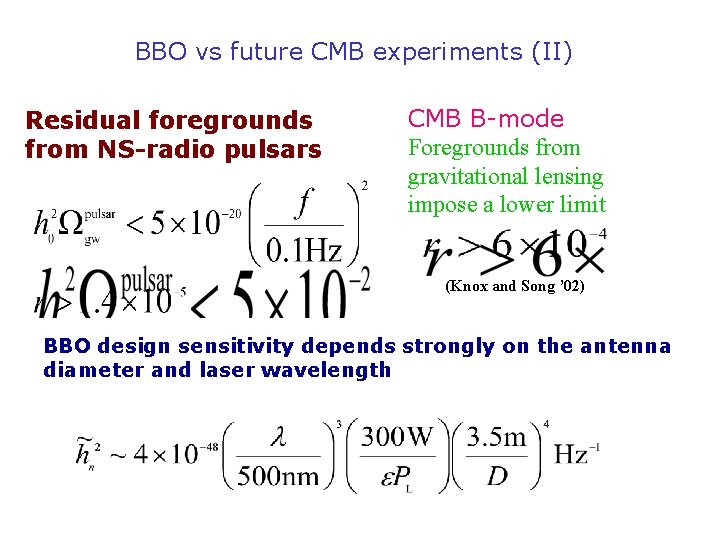
BBO vs future CMB experiments (II) Residual foregrounds from NS-radio pulsars CMB B-mode Foregrounds from gravitational lensing impose a lower limit (Knox and Song ’ 02) BBO design sensitivity depends strongly on the antenna diameter and laser wavelength
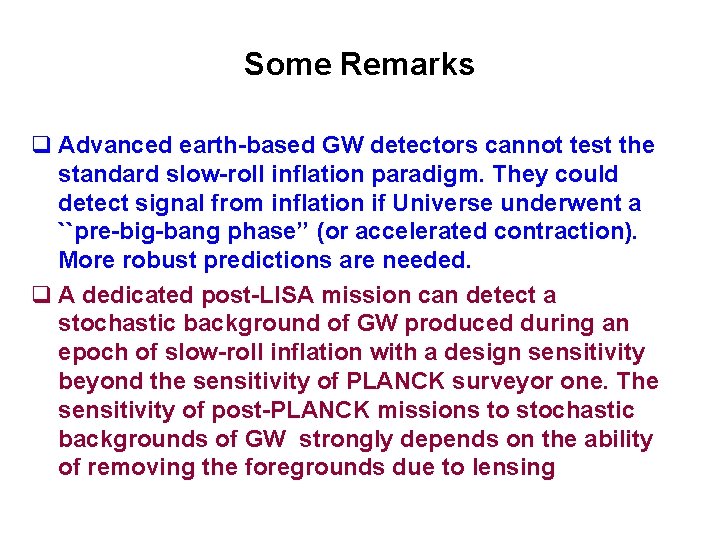
Some Remarks q Advanced earth-based GW detectors cannot test the standard slow-roll inflation paradigm. They could detect signal from inflation if Universe underwent a ``pre-big-bang phase’’ (or accelerated contraction). More robust predictions are needed. q A dedicated post-LISA mission can detect a stochastic background of GW produced during an epoch of slow-roll inflation with a design sensitivity beyond the sensitivity of PLANCK surveyor one. The sensitivity of post-PLANCK missions to stochastic backgrounds of GW strongly depends on the ability of removing the foregrounds due to lensing