
Testing the Performance of an Electron Retarding Potential
- Slides: 1
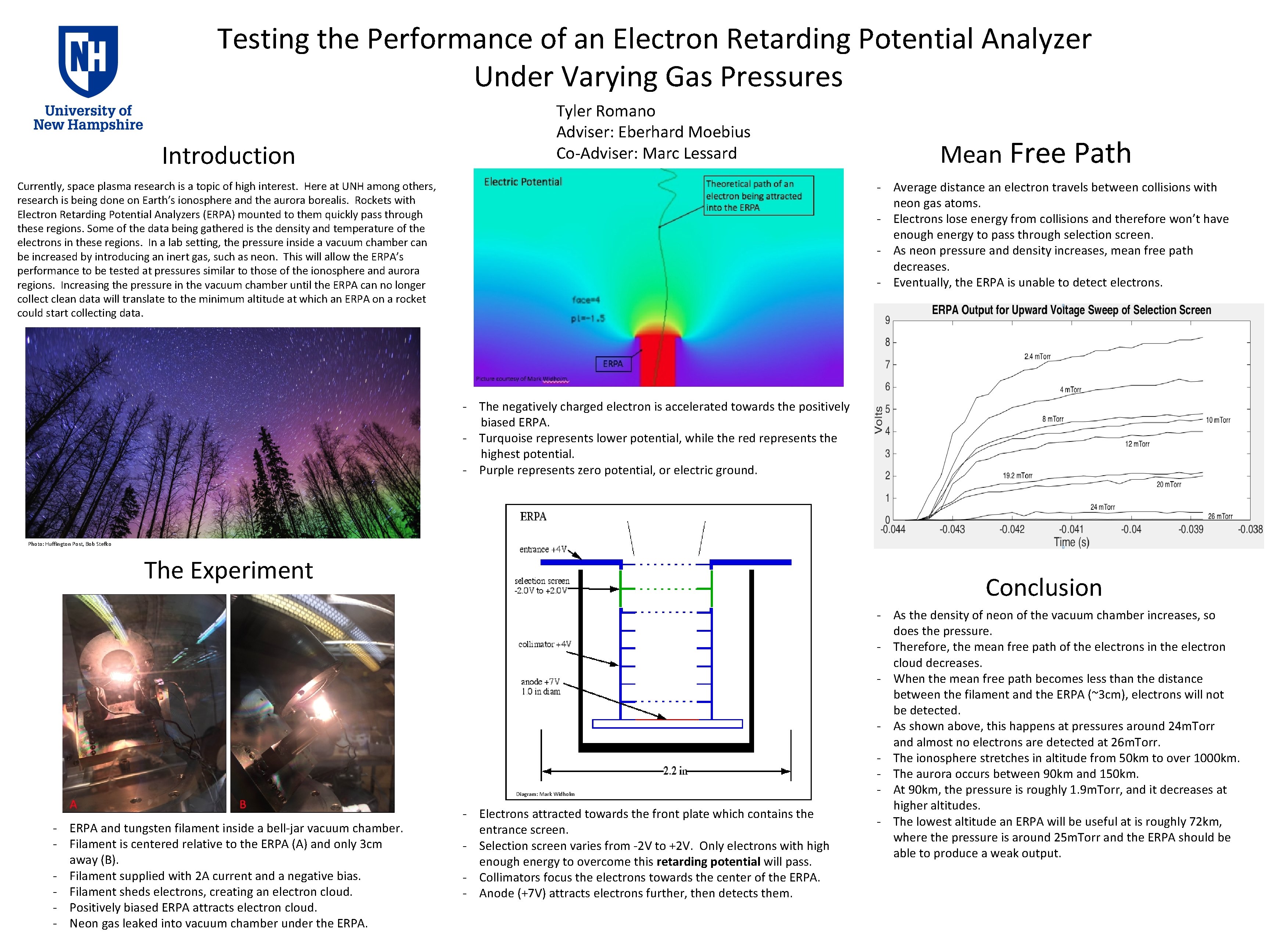
Testing the Performance of an Electron Retarding Potential Analyzer Under Varying Gas Pressures Introduction Tyler Romano Adviser: Eberhard Moebius Co-Adviser: Marc Lessard Mean Free Path - Average distance an electron travels between collisions with neon gas atoms. - Electrons lose energy from collisions and therefore won’t have enough energy to pass through selection screen. - As neon pressure and density increases, mean free path decreases. - Eventually, the ERPA is unable to detect electrons. Currently, space plasma research is a topic of high interest. Here at UNH among others, research is being done on Earth’s ionosphere and the aurora borealis. Rockets with Electron Retarding Potential Analyzers (ERPA) mounted to them quickly pass through these regions. Some of the data being gathered is the density and temperature of the electrons in these regions. In a lab setting, the pressure inside a vacuum chamber can be increased by introducing an inert gas, such as neon. This will allow the ERPA’s performance to be tested at pressures similar to those of the ionosphere and aurora regions. Increasing the pressure in the vacuum chamber until the ERPA can no longer collect clean data will translate to the minimum altitude at which an ERPA on a rocket could start collecting data. - The negatively charged electron is accelerated towards the positively biased ERPA. - Turquoise represents lower potential, while the red represents the highest potential. - Purple represents zero potential, or electric ground. Photo: Huffington Post, Bob Stefko The Experiment Conclusion Diagram: Mark Widholm - ERPA and tungsten filament inside a bell-jar vacuum chamber. - Filament is centered relative to the ERPA (A) and only 3 cm away (B). - Filament supplied with 2 A current and a negative bias. - Filament sheds electrons, creating an electron cloud. - Positively biased ERPA attracts electron cloud. - Neon gas leaked into vacuum chamber under the ERPA. - Electrons attracted towards the front plate which contains the entrance screen. - Selection screen varies from -2 V to +2 V. Only electrons with high enough energy to overcome this retarding potential will pass. - Collimators focus the electrons towards the center of the ERPA. - Anode (+7 V) attracts electrons further, then detects them. - As the density of neon of the vacuum chamber increases, so does the pressure. - Therefore, the mean free path of the electrons in the electron cloud decreases. - When the mean free path becomes less than the distance between the filament and the ERPA (~3 cm), electrons will not be detected. - As shown above, this happens at pressures around 24 m. Torr and almost no electrons are detected at 26 m. Torr. - The ionosphere stretches in altitude from 50 km to over 1000 km. - The aurora occurs between 90 km and 150 km. - At 90 km, the pressure is roughly 1. 9 m. Torr, and it decreases at higher altitudes. - The lowest altitude an ERPA will be useful at is roughly 72 km, where the pressure is around 25 m. Torr and the ERPA should be able to produce a weak output.