
Testing the Effectiveness of the Exercise Plus Program
- Slides: 27
Testing the Effectiveness of the Exercise Plus Program Barbara Resnick, Ph. D, CRNP Jay Magaziner, Ph. D, MPH Denise Orwig, Ph. D Sheryl Zimmerman, Ph. D, MSW William Hawkes, Ph. D Richard Hebel, Ph. D
Introduction • Hip fracture is a major public health problem with striking consequences for the older adult • By the year 2040, over 650, 000 hip fractures will occur annually in older adults, and 1833% of these older hip fracture patients will die within the first year of their fracture
Introduction • Recovery following a hip fracture has been shown to be greatly facilitated by participation in a rehabilitation program • Continued participation in a regular exercise program can improve functional recovery, muscle strength, and prevent future fractures.
Introduction • Despite the benefits of exercise, it is difficult to get older adults to initiate exercise activity, and helping them adhere to an exercise regime is even more challenging.
Introduction • This project is the 5 th in a series of Baltimore Hip Studies (BHS). • Over the past 15 years, Dr. Magaziner and an interdisciplinary team of investigators have enrolled and followed over 2, 000 hip fracture patients in nine Baltimore area hospitals.
Purpose • The rationale for developing this Baltimore Hip Study is to test the effectiveness of an intervention, The Exercise Plus Program, to motivate these individuals to initiate and adhere to a regular exercise program.
Purpose • The primary aims of this study are to implement a home delivered self-efficacy based intervention to strengthen efficacy expectations (self-efficacy and outcome expectations) related to exercise, and improve exercise behavior and overall activity of older adults who have sustained a hip fracture.
Primary Aims • Specifically the primary aims are to test the impact of the exercise trainer component alone, the motivational component alone, and the exercise plus program (combined trainer and motivational program) on exercise behavior, activity, and efficacy expectations at 2, 6, and 12 months following a hip fracture.
Secondary Aims • To test the impact of the exercise trainer component alone, the motivational component alone, and the exercise plus program (combined trainer and motivation intervention) on functional performance, muscle strength, overall health status, mood, pain, fear of falling, falls and fall related injuries at 2, 6, and 12 months following a hip fracture.
Theoretical Approach • The study intervention was developed using two different theoretical frameworks: – (1) a model of motivation referred to as the Wheel the Moves – (2) theory of self-efficacy
Theoretical Approach • In addition the transtheoretical model and stages of change will also be considered in this study. • Specifically Stages of Change for: – Exercise – Activity
Methods: Sample • Eligibility for this study includes – being female, age 65 or older – sustaining a non-pathological hip fracture within 48 hours prior to admission – being community-dwelling at the time of fracture – medical clearance to participate in the exercise program from the participant=s orthopedist.
Methods: Sample • Older adults will be excluded from the study if they have medical problems that put them at risk for exercise in the home.
Methods: Sample • To facilitate recruitment a process of meeting with the orthopedists and case managers on orthopedic and rehabilitation units was done at all 5 study hospitals.
Design: Randomization • The design is a 2 (exercise trainer yes/no) X 2 (motivation yes/no) factorial design
Design: Measurement • Baseline measures will be collected at the time of recruitment to the study and prior to randomization. • Follow up measures will be collected at 2, 6, and 12 months post hip fracture in the home setting).
Measures • • • Descriptive information will include Efficacy expectations Exercise behavior and activity Functional measures Psychosocial measures Performance measures
Intervention 1 • Group 1: Exercise Trainer Component – a home-based exercise regime given by an exercise trainer. – Maximal participation will entail performing five exercise sessions per week for 40 minutes duration each. – Two sessions will focus on flexibility and strength training; and three will be aerobic exercise.
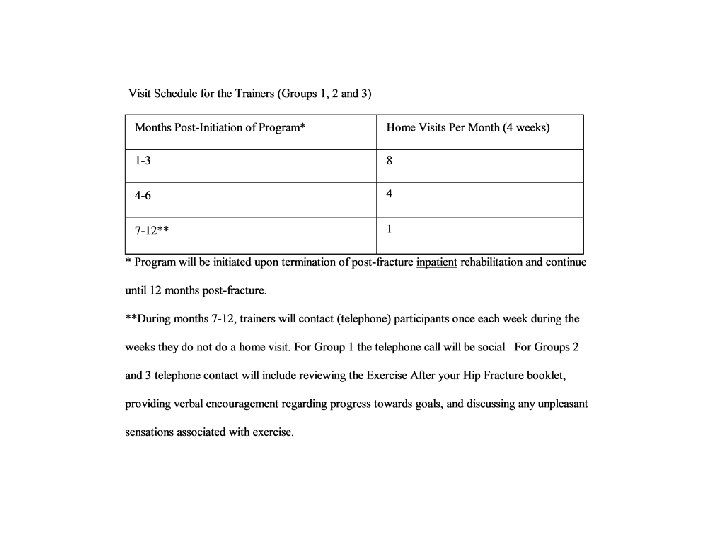
Intervention 2 • Group 2: Plus Component Intervention – an exercise trainer visits and engages in the following activities (Visits scheduled as per Intervention 1)
The Plus Component • (1) education and encouragement with exposure to an "Exercise After your Hip Fracture" booklet, identification of both short (weekly) and long term goals with an incentive gift given when weekly goals are achieved
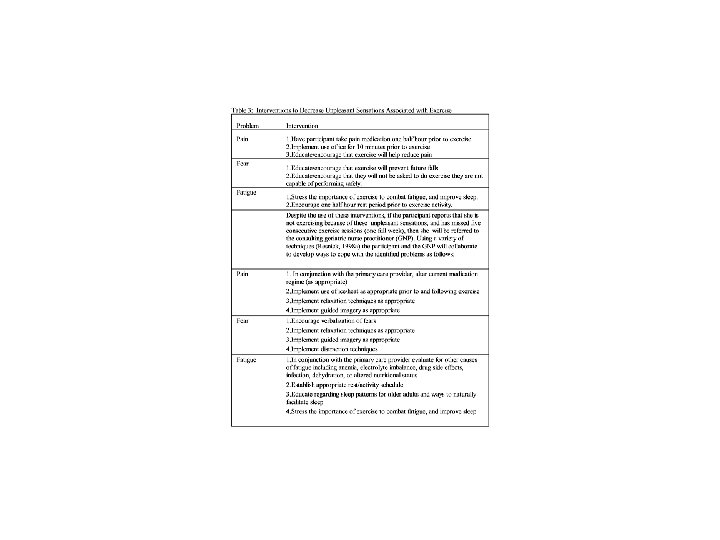
The Plus Component • (2) physiological feedback which involves asking the participants at each supervised exercise session if they experience pain, fear, or fatigue associated with exercise that makes them not want to exercise and implementing interventions to decrease those sensations
The Plus Component • (3) Cuing with self-modeling (a picture of the participant exercising) and visual/auditory aids including an exercise calendar marked off to remind the participant to do either aerobic or resistive exercise and when they will be visited by the, poster of exercises, audiotape of exercises.
Intervention 3 • Group 3: The Exercise Plus Program – Will be exposed to both the Exercise Trainer component and the Plus component (the Exercise Plus program) as described for Group 1 and Group 2. The combined components will be given by a single exercise trainer.
Intervention 4 • Group 4: Control Group • Will receive routine care
Data Analysis • Generalized estimating equations (GEE) will be used to perform repeated measures analyses with both binary and continuous outcome measures as dependent variables to test all hypotheses.