
Testing OOD Course Solange Karsenty 1 Observations about
Testing OOD Course Solange Karsenty 1
Observations about Testing • “Testing is the process of executing a program with the intention of finding errors. ” – Myers • “Testing can show the presence of bugs but never their absence. ” - Dijkstra 2
Good Testing Practices • A good test case is one that has a high probability of detecting an undiscovered defect, not one that shows that the program works correctly • It is impossible to test your own program • A necessary part of every test case is a description of the expected result 3
Good Testing Practices • Avoid non reproducible or on-the-fly testing • Write test cases for valid as well as invalid input conditions. • Thoroughly inspect the results of each test • As the number of detected defects in a piece of software increases, the probability of the existence of more undetected defects also increases 4
Good Testing Practices • Assign your best people to testing • Ensure that testability is a key objective in your software design • Never alter the program to make testing easier • Testing, like almost every other activity, must start with objectives 5
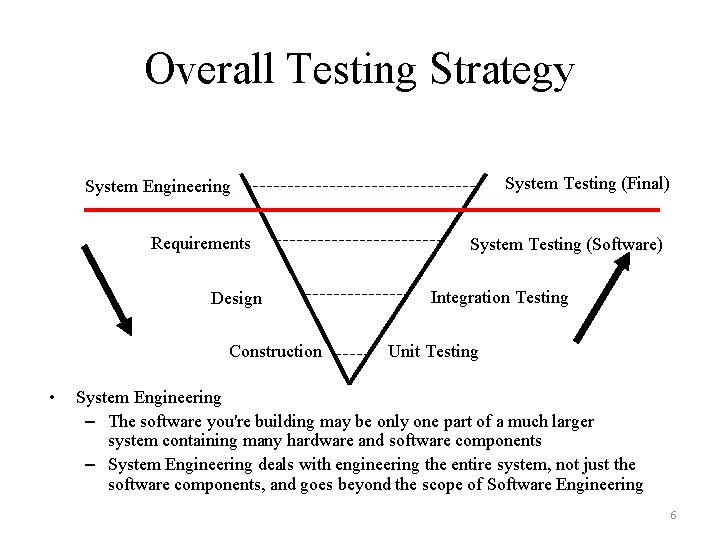
Overall Testing Strategy System Testing (Final) System Engineering Requirements Design Construction • System Testing (Software) Integration Testing Unit Testing System Engineering – The software you're building may be only one part of a much larger system containing many hardware and software components – System Engineering deals with engineering the entire system, not just the software components, and goes beyond the scope of Software Engineering 6
What is Unit Testing • Testing of individual software "units" (i. e. , classes, routines) • White box testing • Usually done by the engineer who wrote the unit 7
Unit Testing: Test-Driven Development • The traditional approach is to write unit test cases after the code is written • Test-Driven Development (TDD) is a relatively new approach that encourages writing unit test cases before the code is written – Writing test cases first forces you to think about the requirements and design before writing the code, which leads to a better design – Since your test cases will fail at first, they help you know when the code is done (i. e. , when the tests work, you're done) – Writing test cases before the code doesn't take any more effort than writing them after the code – Writing test cases first will help you detect and remove bugs sooner 8
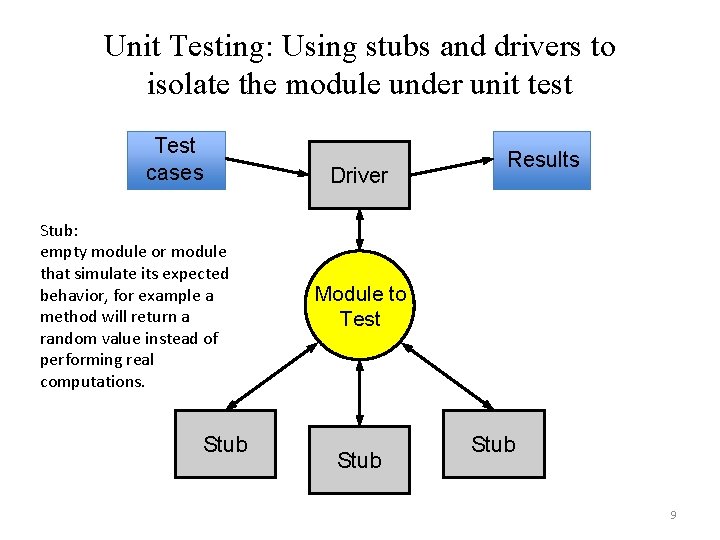
Unit Testing: Using stubs and drivers to isolate the module under unit test Test cases Stub: empty module or module that simulate its expected behavior, for example a method will return a random value instead of performing real computations. Stub Driver Results Module to Test Stub 9
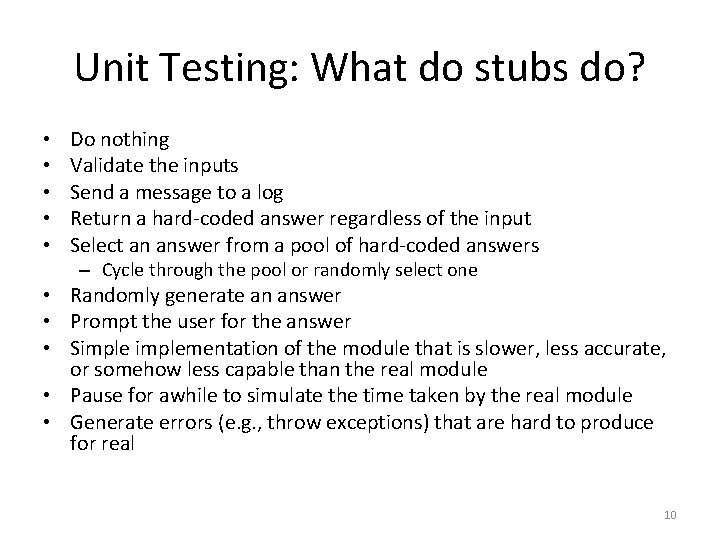
Unit Testing: What do stubs do? • • • Do nothing Validate the inputs Send a message to a log Return a hard-coded answer regardless of the input Select an answer from a pool of hard-coded answers – Cycle through the pool or randomly select one • Randomly generate an answer • Prompt the user for the answer • Simplementation of the module that is slower, less accurate, or somehow less capable than the real module • Pause for awhile to simulate the time taken by the real module • Generate errors (e. g. , throw exceptions) that are hard to produce for real 10
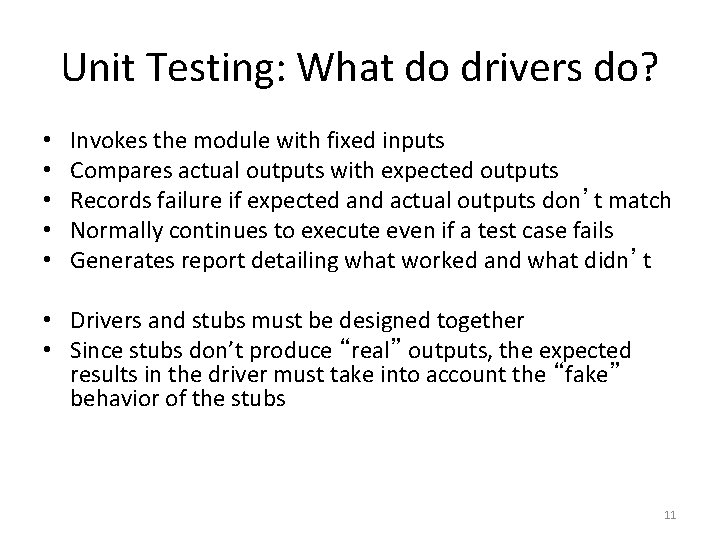
Unit Testing: What do drivers do? • • • Invokes the module with fixed inputs Compares actual outputs with expected outputs Records failure if expected and actual outputs don’t match Normally continues to execute even if a test case fails Generates report detailing what worked and what didn’t • Drivers and stubs must be designed together • Since stubs don’t produce “real” outputs, the expected results in the driver must take into account the “fake” behavior of the stubs 11
Integration Testing • Integration involves combining the individual software units into larger functional units • If the units work individually, why wouldn't they work when you put them together? – Basketball team? • Example: Interactions between units may be flawed – Mars Orbiter disaster : one module assuming English units and another assuming Metric units http: //edition. cnn. com/TECH/space/9909/30/mars. metric / 12
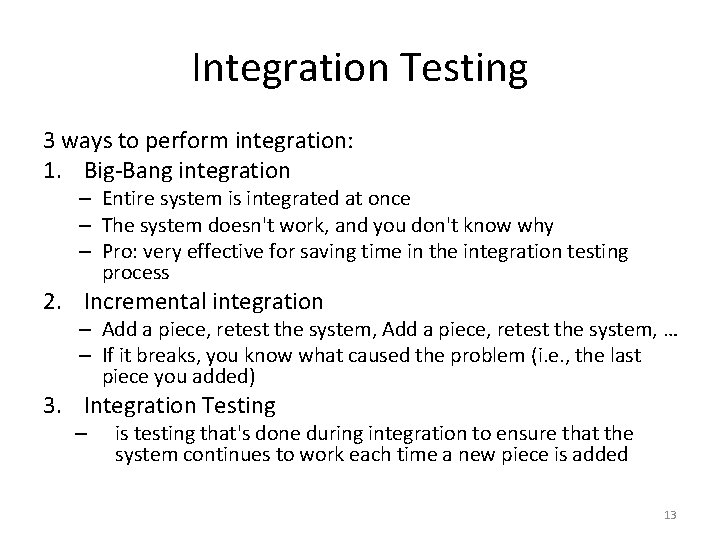
Integration Testing 3 ways to perform integration: 1. Big-Bang integration – Entire system is integrated at once – The system doesn't work, and you don't know why – Pro: very effective for saving time in the integration testing process 2. Incremental integration – Add a piece, retest the system, … – If it breaks, you know what caused the problem (i. e. , the last piece you added) 3. Integration Testing – is testing that's done during integration to ensure that the system continues to work each time a new piece is added 13
Modules integration • 2 ways to integrate – Top down – Bottom up 14
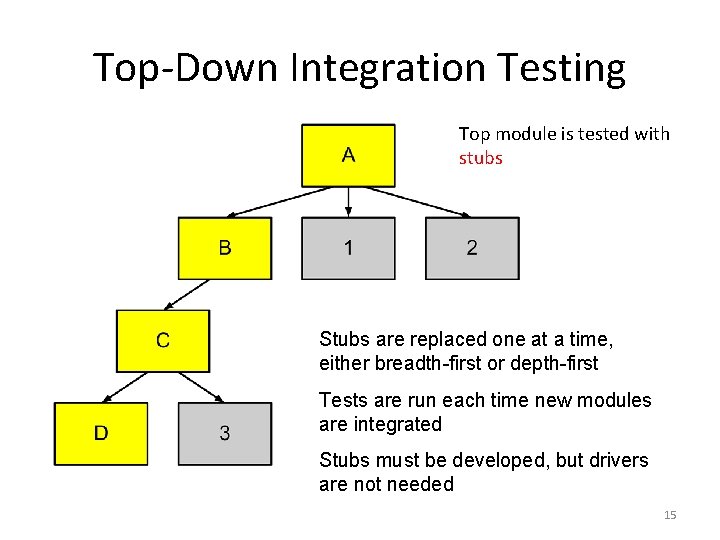
Top-Down Integration Testing Top module is tested with stubs Stubs are replaced one at a time, either breadth-first or depth-first Tests are run each time new modules are integrated Stubs must be developed, but drivers are not needed 15
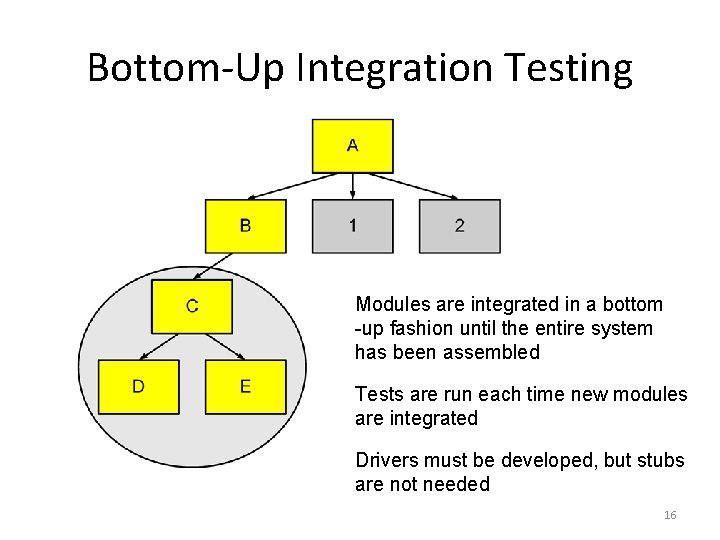
Bottom-Up Integration Testing Modules are integrated in a bottom -up fashion until the entire system has been assembled Tests are run each time new modules are integrated Drivers must be developed, but stubs are not needed 16
Sandwich Integration Testing • Combination of top-down and bottom-up integration • Integrate from the top and from the bottom as it makes sense, and meet somewhere in the middle 17
Continuous Integration • Some projects wait several weeks between integrations • Between integrations, engineers work on their pieces in relative isolation • Each integration produces a new "build" • The system may not build successfully between integrations • A better approach for many projects is "continuous integration" • A minimal working system is checked into source control • Engineers check in new code every time they finish a meaningful unit of work • Engineers must never break the build, and are responsible for adding new test cases to exercise the new code • The system is built and tests are run every night to ensure that all is well • The system is always integrated and build-able 18
Unit Testing or Integration Testing? • Sometimes people who claim to be doing unit testing are actually doing bottom-up integration testing • How do you tell the difference? – Unit testing uses stubs to isolate the module under test from its dependencies – Bottom-up integration testing does not (i. e. , modules call their “real” dependencies) 19
System Testing • Black box testing to ensure that the product meets all of the specified requirements • Performed by independent testing group – The testing organization should be separate from the development organization to avoid conflict of interest – The testing organization creates a “test plan” that details how the product will be tested • Development delivers periodic builds of the complete system • Acceptance test is run on new builds to verify that they're stable enough to test – If a build fails the acceptance test, it's rejected and no testing resources are expended on it – If a build passes the acceptance test, tests are run and bugs are entered into the bug tracking system 20
System Testing • Before shipping a product it's important to get feedback from real customers • Alpha Testing – – – • Product not yet feature-complete (some things are missing) Give the product to trusted, enthusiastic customers for evaluation Could be done at your place or theirs Lots of hand-holding by the developers Incentives to alpha testers could include influence on product features or early access to needed features Beta Testing – – – Product much closer to shipment than with alpha testing Product is feature-complete (debugging and tuning still in progress) Broader distribution to a less selective group of customers Less hand-holding Incentives could include cash, free software or customer support, early access to needed features 21
System Testing • When are we done testing? • "You're never done testing, the burden simply shifts from you to your customer. " • "You're done testing when you run out of time or you run out of money. " • You're done testing when: – All "show stopper" bugs have been fixed – The rate at which new bugs are being found falls below some acceptable threshold • If your testing is thorough, the rate at which you're finding new bugs is related to how many bugs still remain 22
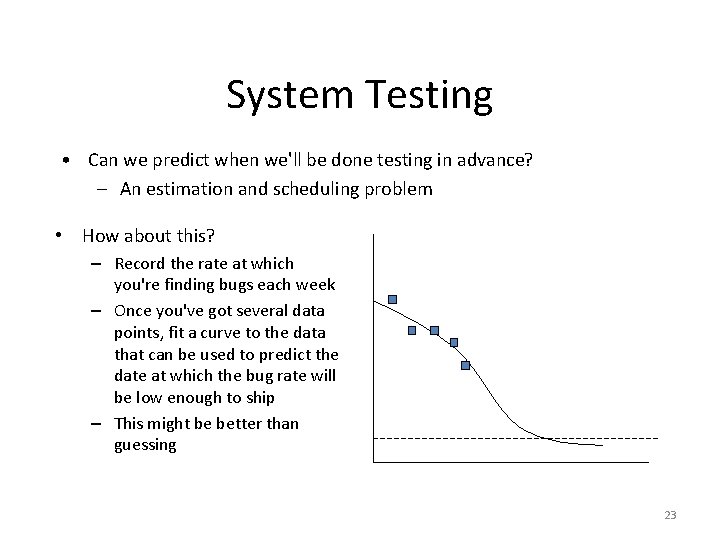
System Testing • Can we predict when we'll be done testing in advance? – An estimation and scheduling problem • How about this? – Record the rate at which you're finding bugs each week – Once you've got several data points, fit a curve to the data that can be used to predict the date at which the bug rate will be low enough to ship – This might be better than guessing 23
Regression Testing (I) • Any change to a software product, even a slight one, has the potential to cause bugs anywhere in the system • Basically, you have to assume that anything can break at any time • Regression testing is done on every build to ensure that new code (including bug fixes) did not break features that used to work • It's not feasible to re-run all prior tests on every build (especially manual tests) • The regression test suite is a subset of tests that covers all product areas and can feasibly be run on every build • The regression test suite will evolve (i. e. , grow larger) over time 24
Regression Testing (II) • In addition to having regression tests that cover all functional areas of the product, you should also have a regression test for every bug that has been fixed • Whenever a bug is discovered, if you don't already have one, design a test case that can be used later to verify that the bug has been fixed • After the bug is fixed, re-run the test case on each new build to ensure that the bug stays fixed • • Experience has shown that fixed bugs often get “unfixed” later Why? – Source control mistakes (i. e. , somebody unintentionally overwrites the bug fix in the code repository) – The bug fix was “fragile” (i. e. , it barely worked, and some later change pushes it over the edge) – The feature in which the bug was found is later redesigned and re-implemented. The original mistake is repeated, thus reintroducing the bug 25
Customer Acceptance Testing • After system testing is complete, the customer might perform a "customer acceptance test" before signing off on the product • The customer acceptance test is a suite of tests that will be run by the customer (or someone they hire) to ensure that the product meets requirements 26
References • Code Complete, Steve Mc. Connell • Software Engineering, Roger Pressman • Testing Computer Software, Cem Kaner, et. Al. 27
- Slides: 27