
Testing of realistic contaminant mixtures with the harpacticoid
- Slides: 1
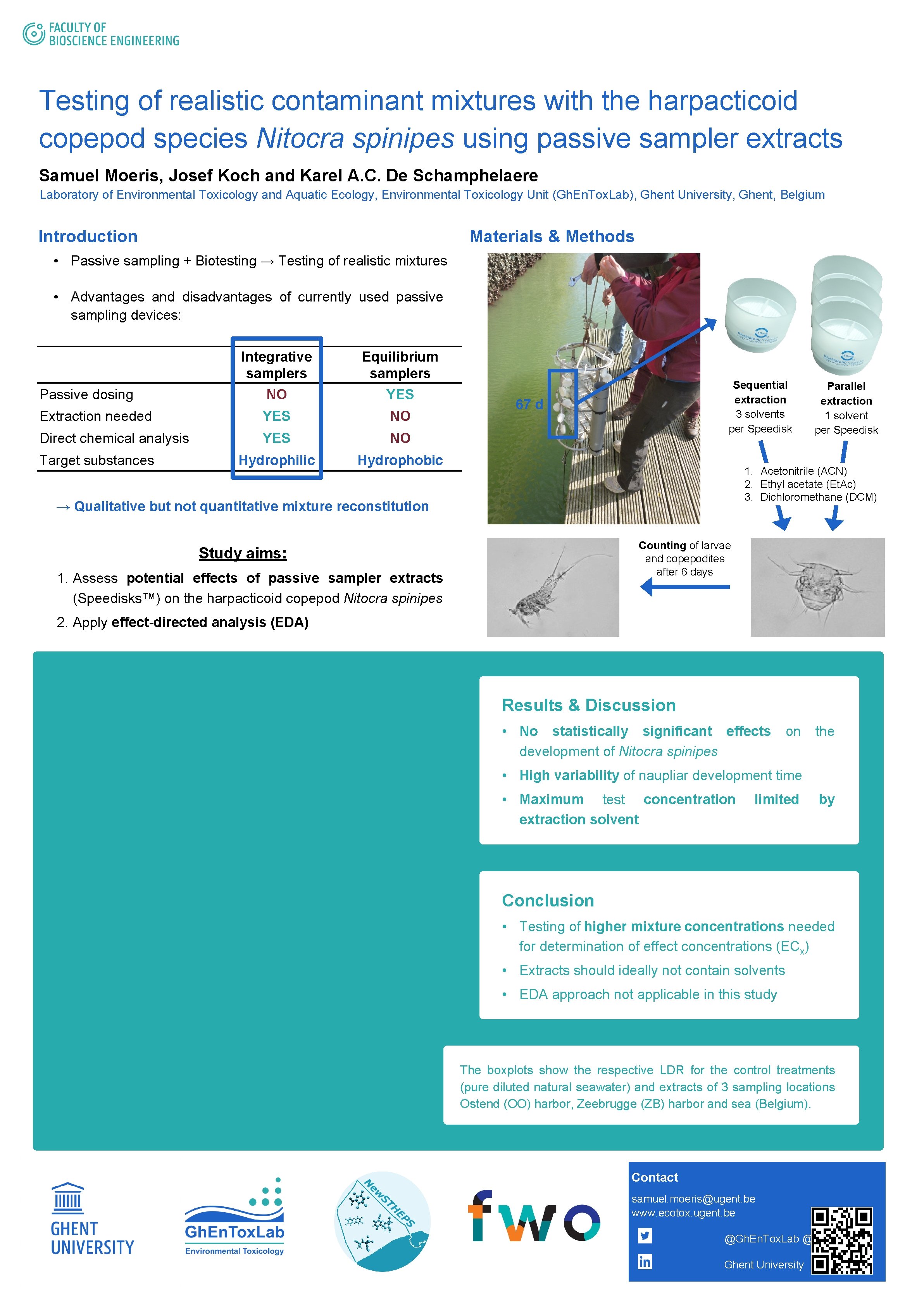
Testing of realistic contaminant mixtures with the harpacticoid copepod species Nitocra spinipes using passive sampler extracts Samuel Moeris, Josef Koch and Karel A. C. De Schamphelaere Laboratory of Environmental Toxicology and Aquatic Ecology, Environmental Toxicology Unit (Gh. En. Tox. Lab), Ghent University, Ghent, Belgium Materials & Methods Introduction • Passive sampling + Biotesting → Testing of realistic mixtures • Advantages and disadvantages of currently used passive sampling devices: Integrative samplers NO Equilibrium samplers YES Extraction needed YES NO Direct chemical analysis YES NO Hydrophilic Hydrophobic Passive dosing Target substances Sequential extraction 3 solvents per Speedisk 67 d Parallel extraction 1 solvent per Speedisk 1. Acetonitrile (ACN) 2. Ethyl acetate (Et. Ac) 3. Dichloromethane (DCM) → Qualitative but not quantitative mixture reconstitution Counting of larvae and copepodites after 6 days Study aims: 1. Assess potential effects of passive sampler extracts (Speedisks™) on the harpacticoid copepod Nitocra spinipes 2. Apply effect-directed analysis (EDA) Results & Discussion • No statistically significant effects development of Nitocra spinipes on the • High variability of naupliar development time • Maximum test concentration extraction solvent limited by Conclusion • Testing of higher mixture concentrations needed for determination of effect concentrations (ECx) • Extracts should ideally not contain solvents • EDA approach not applicable in this study The boxplots show the respective LDR for the control treatments (pure diluted natural seawater) and extracts of 3 sampling locations Ostend (OO) harbor, Zeebrugge (ZB) harbor and sea (Belgium). Contact samuel. moeris@ugent. be www. ecotox. ugent. be @Gh. En. Tox. Lab @ugent Ghent University