
Testing Intelligence Principal Types of Tests Personality Mental

- Slides: 24
Testing & Intelligence • Principal Types of Tests – Personality – Mental ability • Intelligence tests – potential for general mental ability • Aptitude – potential for specific types of mental abilities (verbal reasoning, numerical ability, abstract reasoning, space relations, etc. ) • Achievement – mastery and knowledge of various subjects
Testing & Intelligence • Standardization & Norms – Standardization: uniform procedures used in the administration and scoring of a test – Normalization (Test Norms) • Information about where a score ranks in relation to other scores on that test – Percentile scores: the percentage of people who score at or below the score one has obtained
Test-retest reliability
Content Validity • Does the content of the test measure how well a student has learned the material presented?
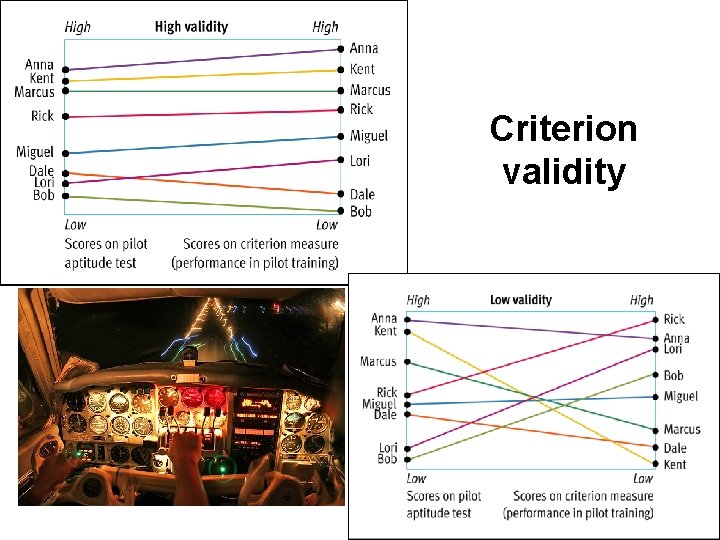
Criterion validity
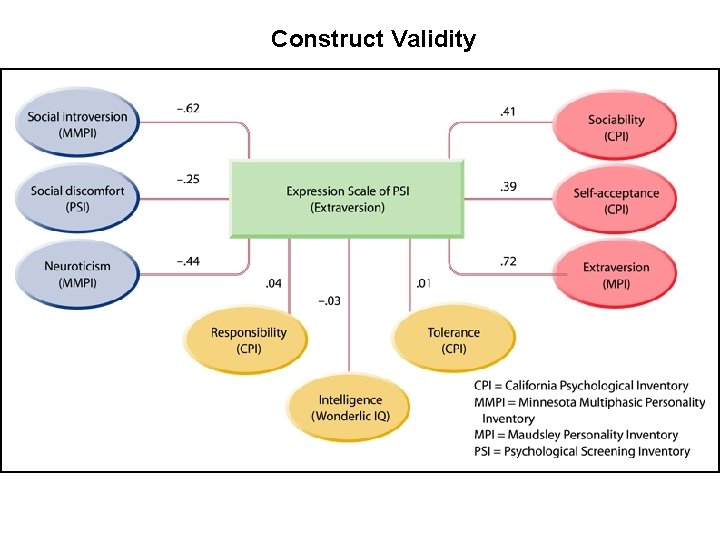
Construct Validity
History: defining & measuring intelligence n Sir Francis Galton (1822 -1911) genes & family lines n intelligence = biological capacity n Eugenics n reaction times & sensory acuity n n later research contradicted these measures
History: defining & measuring intelligence n Alfred Binet (1857 -1911) Binet-Simon Test France, 1905 n Looking to identify students in need of extra help, but not always applied that way n intelligence = collection of higherorder mental abilities loosely related to one another n intelligence is nurtured n mental age n
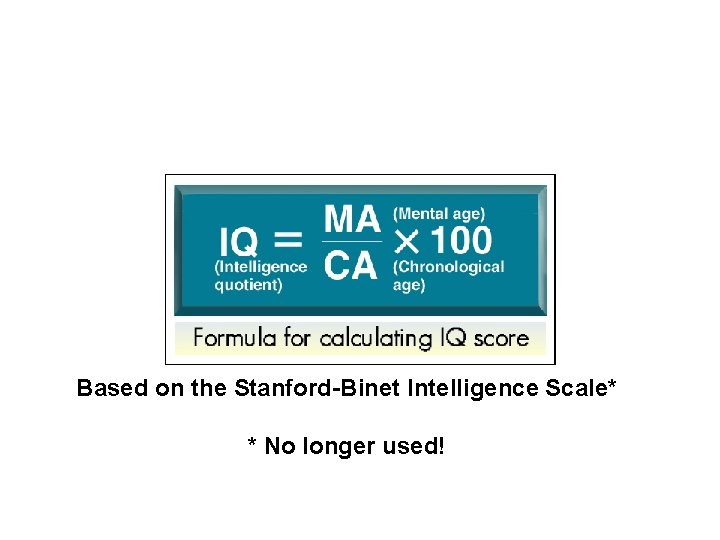
Lewis Terman (1916) n The Stanford-Binet Scale modification of the original Binet. Simon, after original came to US n intelligence quotient (IQ) = child’s mental age divided by child’s chronological age n used widely in the US, not as much as previously n
Based on the Stanford-Binet Intelligence Scale* * No longer used!
Modern intelligence tests n The Wechsler tests used more widely now than Stanford. Binet n Less reliance on verbal abilities n modeled after Binet’s, also made adult test n WISC-III for children n WAIS-III for adults n
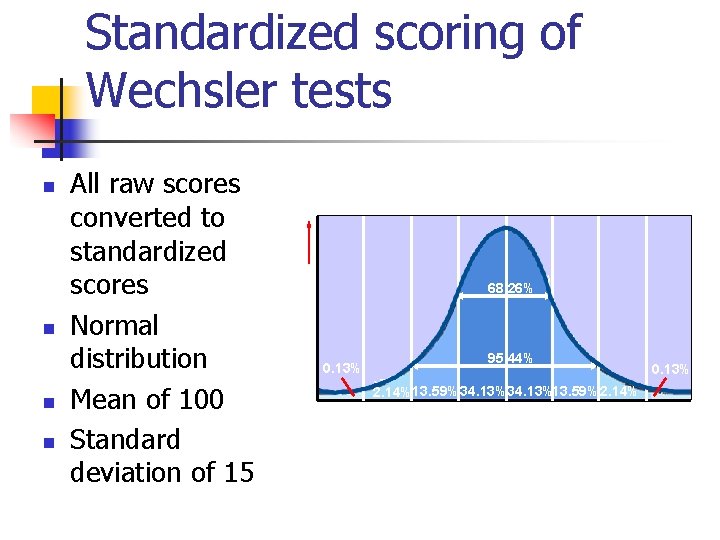
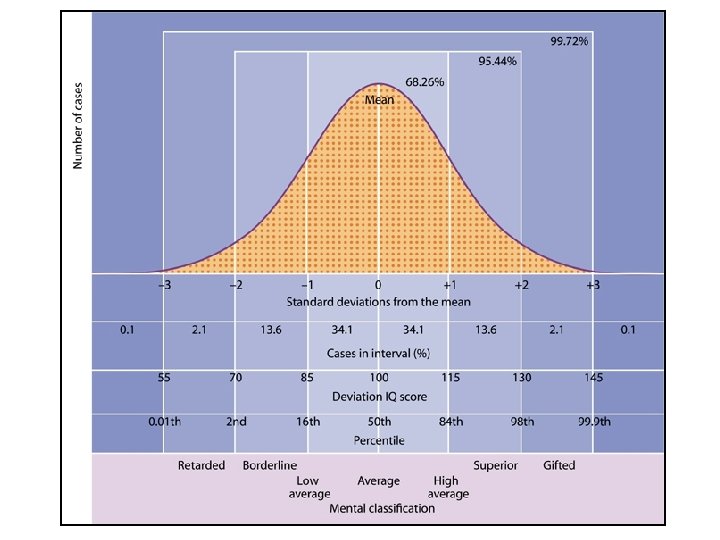
n n All raw scores converted to standardized scores Normal distribution Mean of 100 Standard deviation of 15 Number of score Standardized scoring of Wechsler tests 68. 26% 95. 44% 0. 13% 2. 14%13. 59%34. 13%13. 59%2. 14% 50 70 85 100 115 130 Wechsler IQ score 145
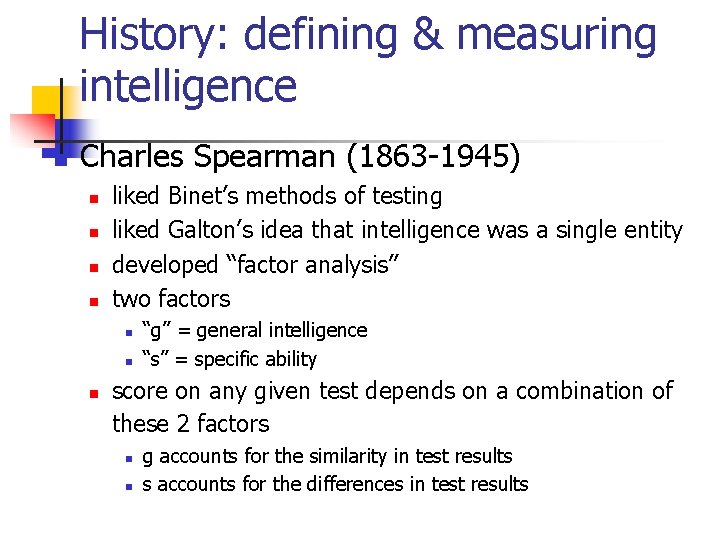
History: defining & measuring intelligence n Charles Spearman (1863 -1945) n n liked Binet’s methods of testing liked Galton’s idea that intelligence was a single entity developed “factor analysis” two factors n n n “g” = general intelligence “s” = specific ability score on any given test depends on a combination of these 2 factors n n g accounts for the similarity in test results s accounts for the differences in test results
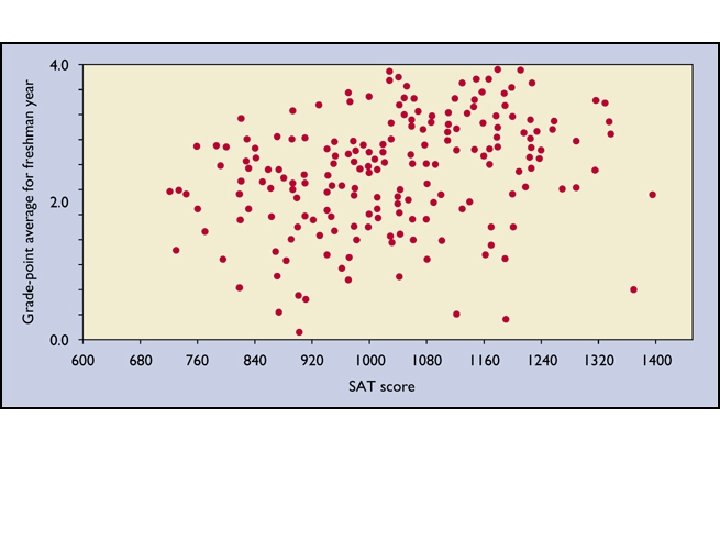
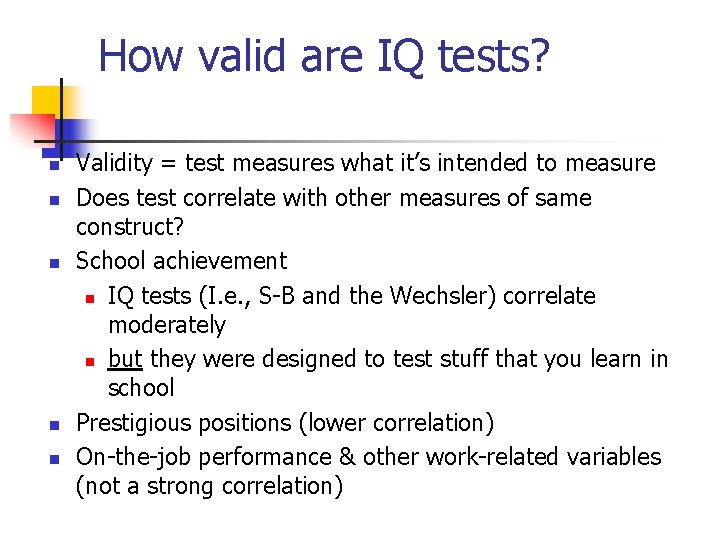
How valid are IQ tests? n n n Validity = test measures what it’s intended to measure Does test correlate with other measures of same construct? School achievement n IQ tests (I. e. , S-B and the Wechsler) correlate moderately n but they were designed to test stuff that you learn in school Prestigious positions (lower correlation) On-the-job performance & other work-related variables (not a strong correlation)
What do IQ tests measure about your mind? n Mental speed and span of working memory; Jensen (1982, 1987, 1992) n n n typically use a digit span test to measure this more recent studies found modest correlations (. 30) between reaction times and IQ scores Why is this important? n n mental quickness may expand capacity of working memory Inspection time may be a more important factor (. 40 s) correlation between inspection time scores and measures of fluid intelligence (Deary, 2000)
History: defining & measuring intelligence n Raymond Cattell (1963) & Horn (1985) student of Spearman’s n modified Spearman’s intelligence theory n thought that general intelligence was not one factor but two n
Cattell’s Fluid & Crystallized Intelligence n Fluid intelligence ability to perceive relationships without previous specific experience n Memory capacity, reasoning ability, and speed of information processing n
Cattell’s Fluid & Crystallized Intelligence n Crystallized intelligence n mental ability derived from previous experience word meanings n use of tools n cultural practices n
What do IQ tests measure about your mind? n n Cognitive processes in intelligent behavior Sternberg n n n studies more complex decision-making abilities states that the mind is made up of different components, each of which works on different problem solving tasks Triarchic theory – Contextual (behaviors considered intelligent), Experiential (the reciprocal relationship between experience and intelligence) & Componential (cognitive processes underlying all intelligent behavior)
Expanding the Concept n n n Gardner (1989) Eight intelligences (logicalmathematical, linguistic, musical, spatial, bodily-kinesthetic, interpersonal, intrapersonal, naturalist) Is this too broad to make the concept of intelligence meaningful?