
Testing gases Worksheet Combined Science Chemistry Key Stage
Testing gases Worksheet Combined Science - Chemistry - Key Stage 4 C 8 Chemical Analysis Mr Robbins
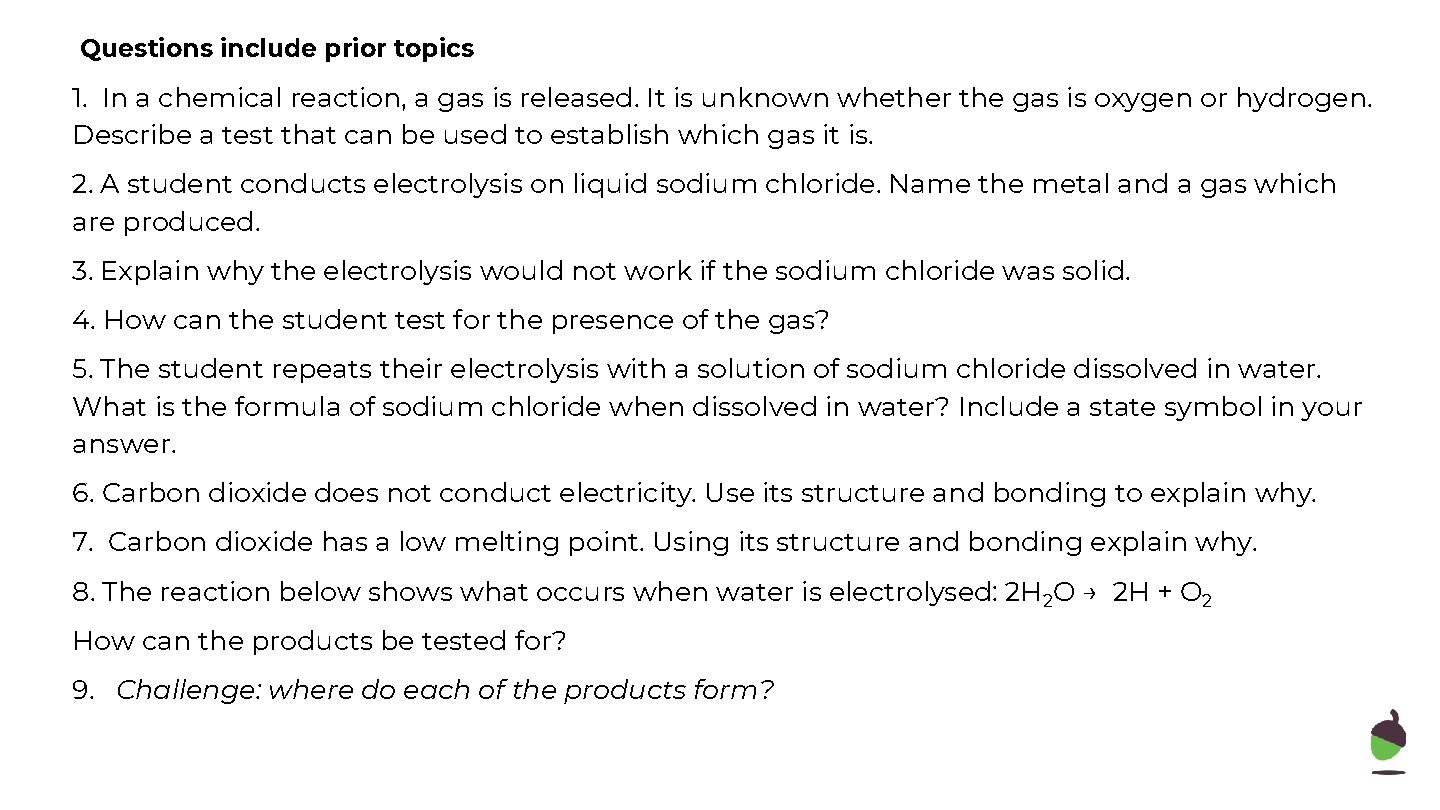
Questions include prior topics 1. In a chemical reaction, a gas is released. It is unknown whether the gas is oxygen or hydrogen. Describe a test that can be used to establish which gas it is. 2. A student conducts electrolysis on liquid sodium chloride. Name the metal and a gas which are produced. 3. Explain why the electrolysis would not work if the sodium chloride was solid. 4. How can the student test for the presence of the gas? 5. The student repeats their electrolysis with a solution of sodium chloride dissolved in water. What is the formula of sodium chloride when dissolved in water? Include a state symbol in your answer. 6. Carbon dioxide does not conduct electricity. Use its structure and bonding to explain why. 7. Carbon dioxide has a low melting point. Using its structure and bonding explain why. 8. The reaction below shows what occurs when water is electrolysed: 2 H 2 O → 2 H + O 2 How can the products be tested for? 9. Challenge: where do each of the products form?
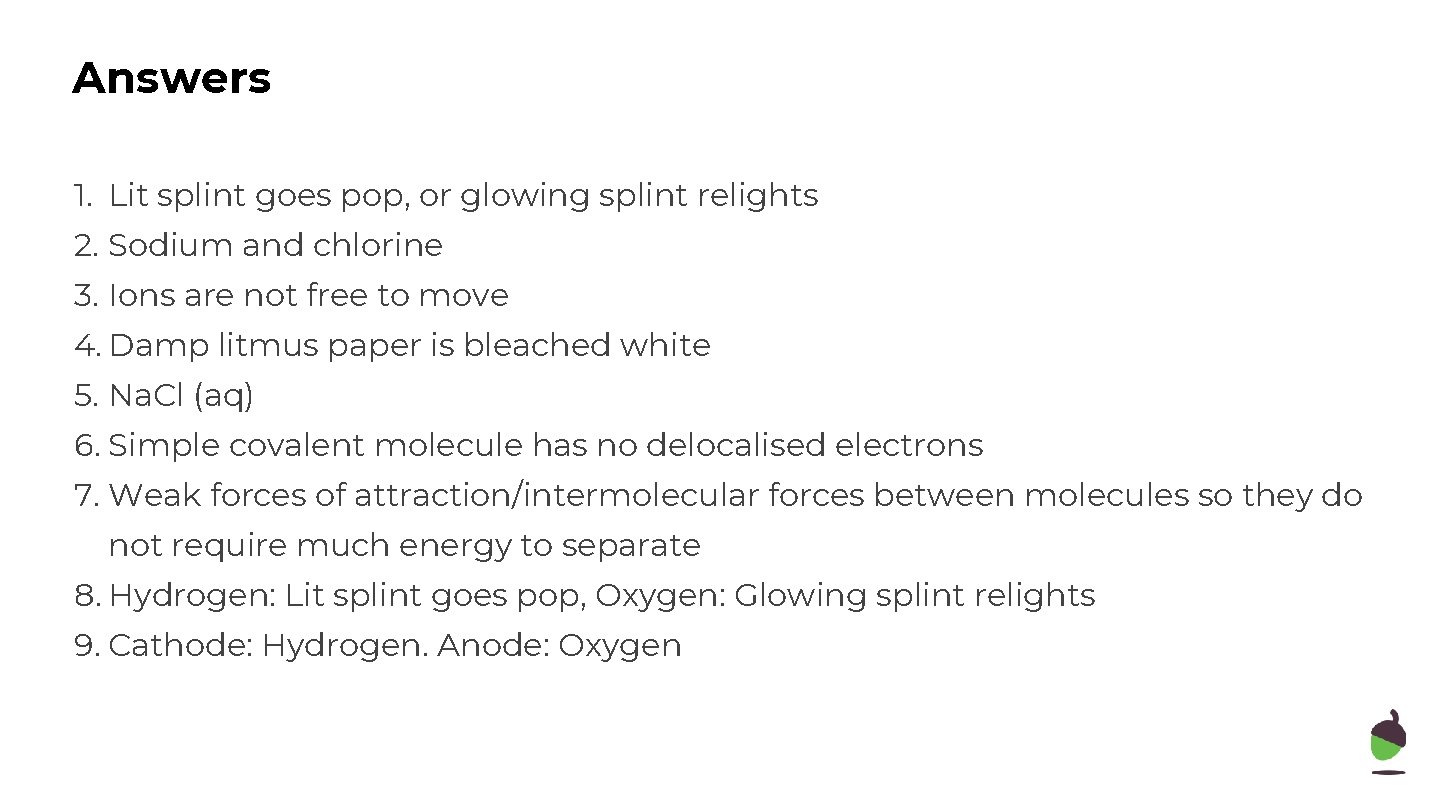
Answers 1. Lit splint goes pop, or glowing splint relights 2. Sodium and chlorine 3. Ions are not free to move 4. Damp litmus paper is bleached white 5. Na. Cl (aq) 6. Simple covalent molecule has no delocalised electrons 7. Weak forces of attraction/intermolecular forces between molecules so they do not require much energy to separate 8. Hydrogen: Lit splint goes pop, Oxygen: Glowing splint relights 9. Cathode: Hydrogen. Anode: Oxygen
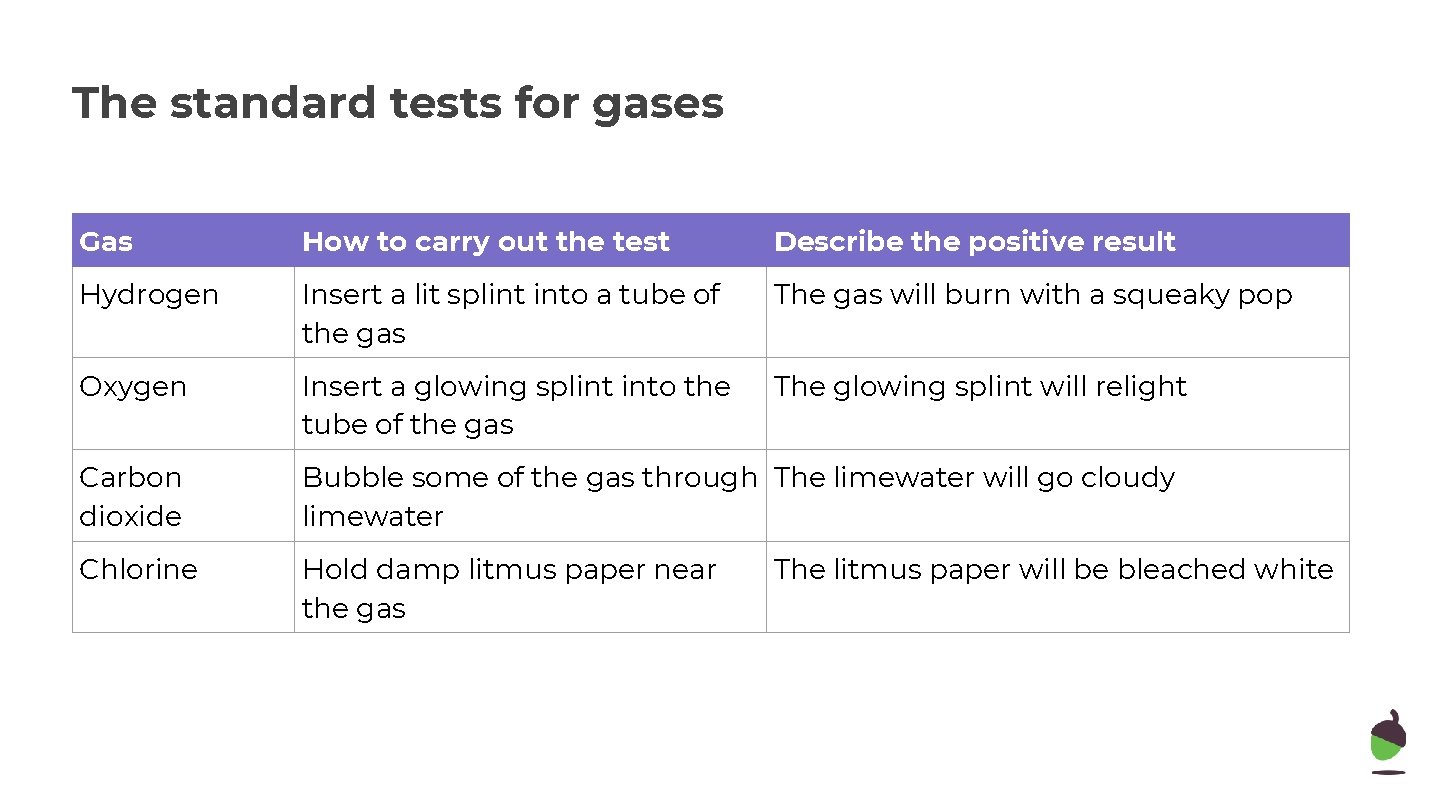
The standard tests for gases Gas How to carry out the test Describe the positive result Hydrogen Insert a lit splint into a tube of the gas The gas will burn with a squeaky pop Oxygen Insert a glowing splint into the tube of the gas The glowing splint will relight Carbon dioxide Bubble some of the gas through The limewater will go cloudy limewater Chlorine Hold damp litmus paper near the gas The litmus paper will be bleached white
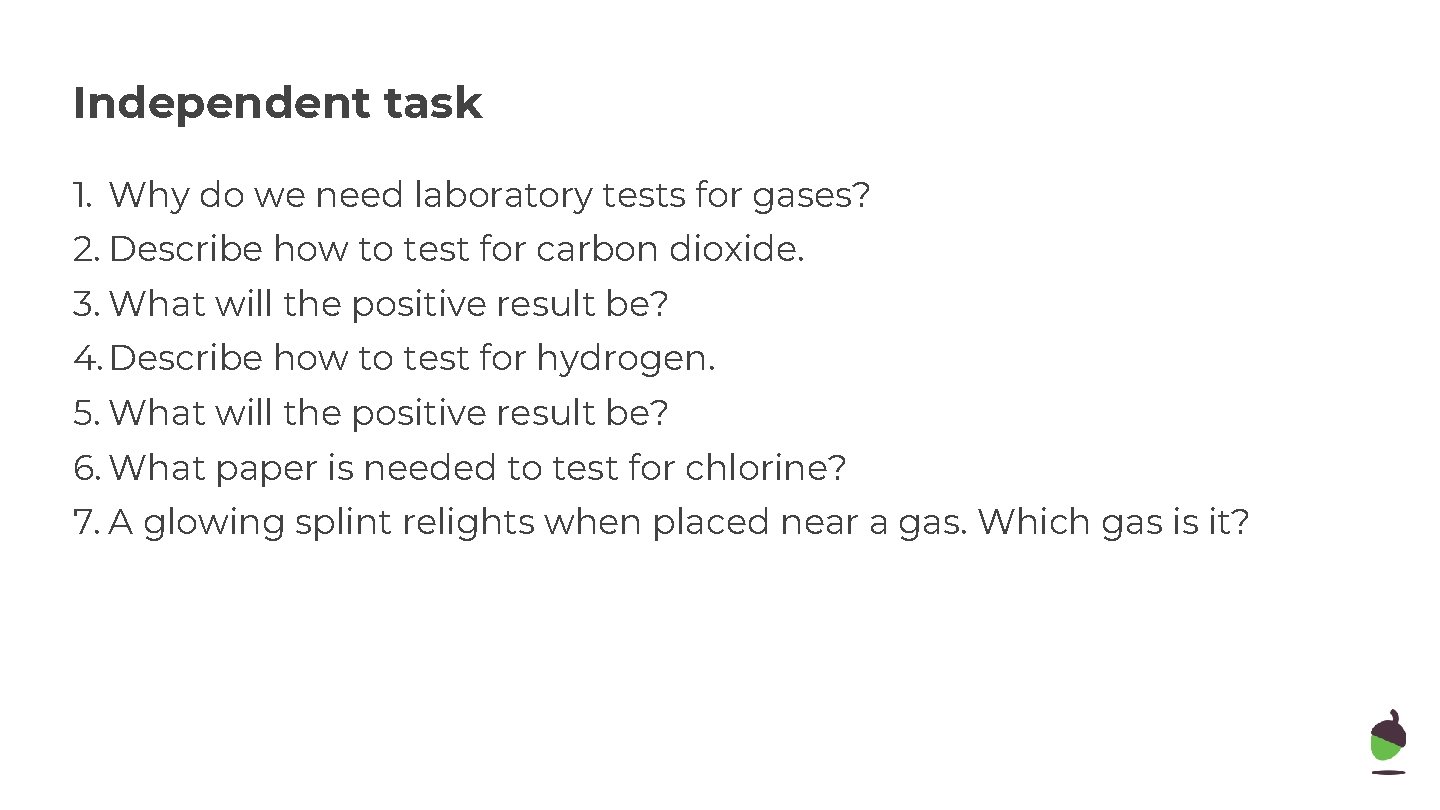
Independent task 1. Why do we need laboratory tests for gases? 2. Describe how to test for carbon dioxide. 3. What will the positive result be? 4. Describe how to test for hydrogen. 5. What will the positive result be? 6. What paper is needed to test for chlorine? 7. A glowing splint relights when placed near a gas. Which gas is it?
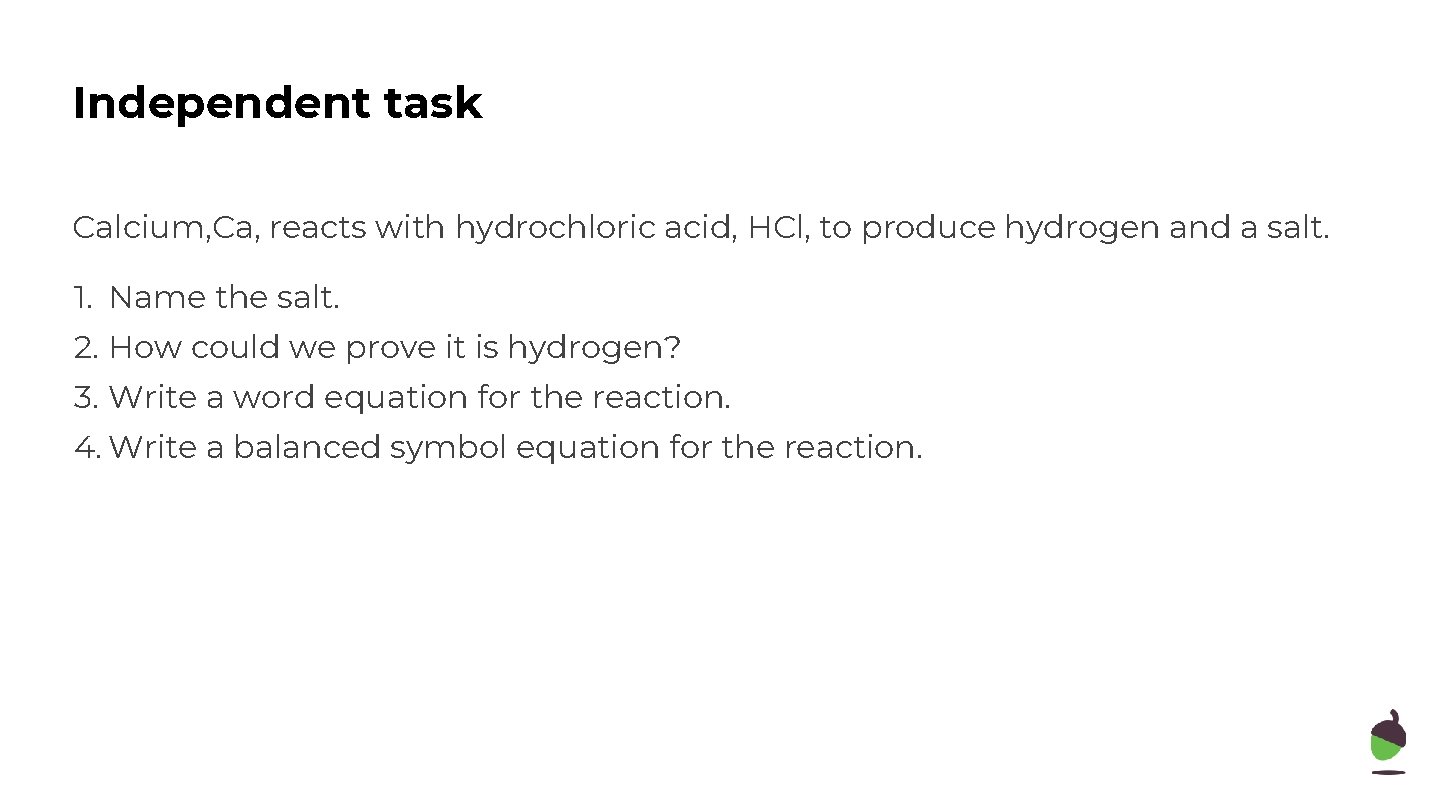
Independent task Calcium, Ca, reacts with hydrochloric acid, HCl, to produce hydrogen and a salt. 1. Name the salt. 2. How could we prove it is hydrogen? 3. Write a word equation for the reaction. 4. Write a balanced symbol equation for the reaction.
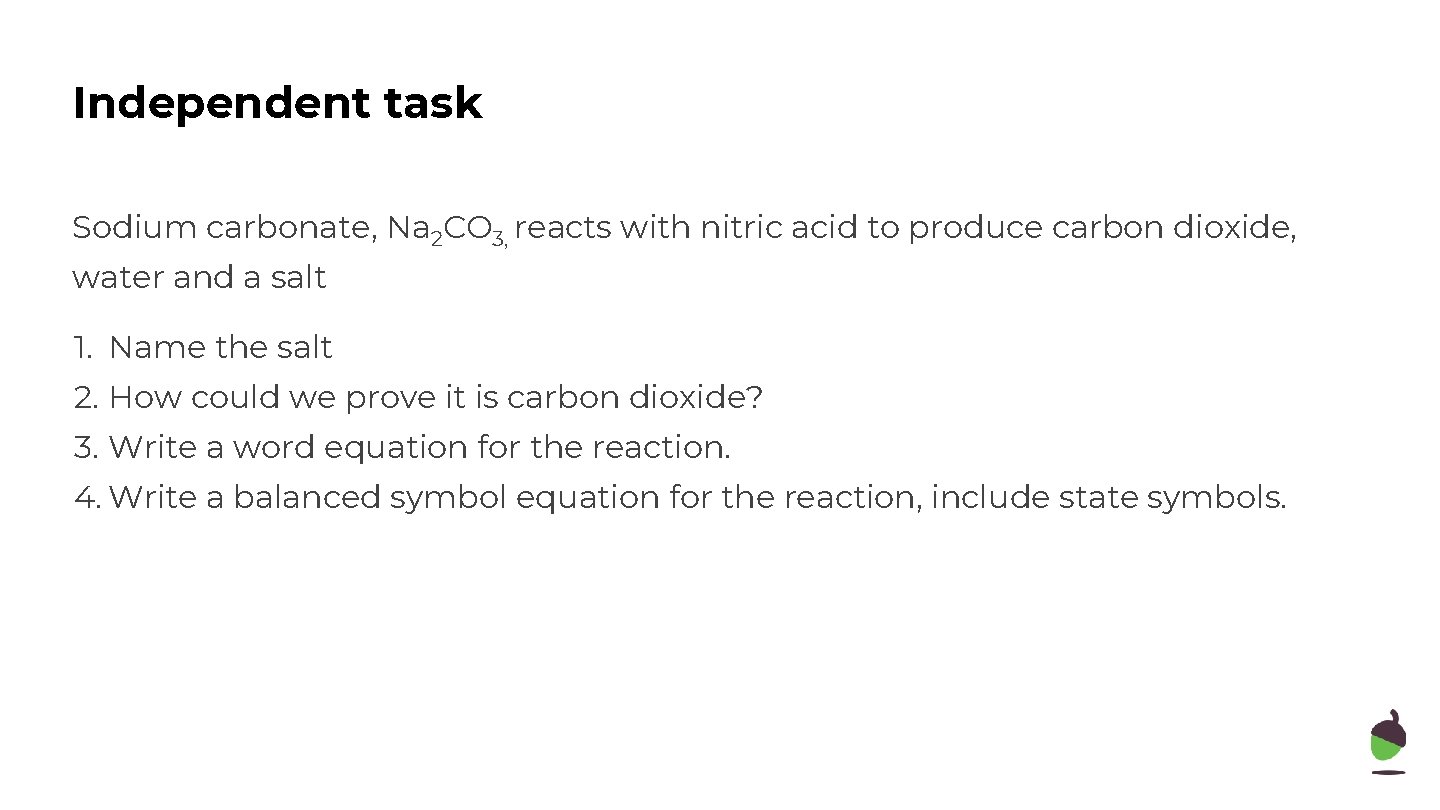
Independent task Sodium carbonate, Na 2 CO 3, reacts with nitric acid to produce carbon dioxide, water and a salt 1. Name the salt 2. How could we prove it is carbon dioxide? 3. Write a word equation for the reaction. 4. Write a balanced symbol equation for the reaction, include state symbols.
- Slides: 8