
Testing for Optical Brighteners in the Tidal Creeks
Testing for Optical Brighteners in the Tidal Creeks of New Hanover County EVS 595 Mary Tavares December 13 th 2007
Background n Three New Hanover County Tidal creeks 1. Futch Creek Bradley Creek Hewletts Creek 2. 3. n n n Optical brighteners Fecal coliform bacteria Combined testing – detection of human fecal contamination
Introduction n n Tidal Creek ecosystems are abundant along the SE NC coast -74 in 4 counties Located behind barrier islands and drain into the ICW or feed into larger estuaries or rivers Collective importance (materials transfer and other ecological processes) equal or exceed larger estuaries in certain geographic regions (Dame et al. 2000) Materials transfer, habitat Shellfishing, finfishing, real-estate
Development and Water Quality SE NC is undergoing an increase in tourism and population n Shellfishing areas closed to harvest n Fecal coliform bacteria- estimator of pathogenic bacteria n NCDWQ 200 CFU/100 m. L (human contact waters), 14 CFU/100 m. L (shellfishing)- no more than 10% samples exceeding 43 CFU/100 m. L n 2 sources: run-off or sewer and septic n
Source 1: runoff Strong relationship between percentage impervious surface and mean estuarine fecal coliform abundance ( Mallin et al. 2000 b) n >29% impervious surface= degraded n >10%= impaired n <10% acceptable n Changes in land use planning and development n
Source 2: Septic and Sewer leaks Bradley and Hewletts n 1215 septic systems n Point source n Easier to trace and eliminate n Increased measures to detect public health n Optical brighteners n
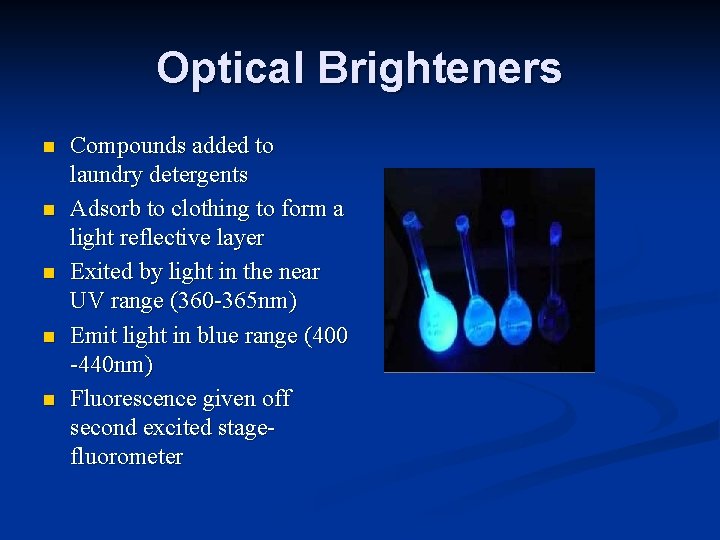
Optical Brighteners n n n Compounds added to laundry detergents Adsorb to clothing to form a light reflective layer Exited by light in the near UV range (360 -365 nm) Emit light in blue range (400 -440 nm) Fluorescence given off second excited stagefluorometer
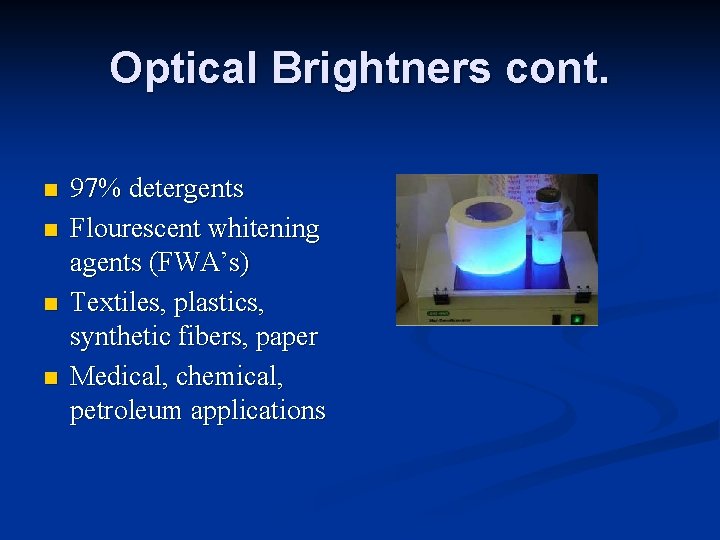
Optical Brightners cont. n n 97% detergents Flourescent whitening agents (FWA’s) Textiles, plastics, synthetic fibers, paper Medical, chemical, petroleum applications
Optical brighteners in waterways Household plumbing-combination of grey and waste water n WWTPs not a source due- UV light destroys both fecal coliform bacteria and OBs n Photo-decay and biodegradation rates of OB n Soaps and TP n
Likely sources for fecal coliform and optical brightener contamination Fecal Bacteria High Optical Brightener Probable Cause High Sewer pipe leak or failing septic system Other warm blooded mammal source or human waste from other source such as out-house High Low High Gray water in storm water system Low Background fluorescence or insignificant contamination
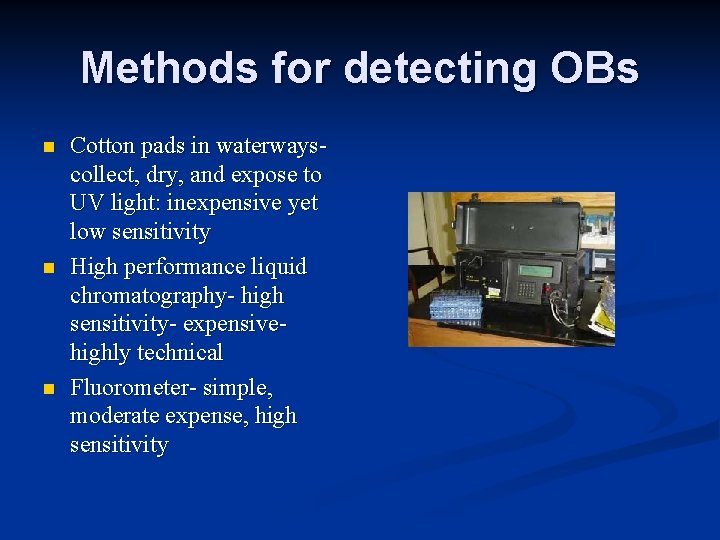
Methods for detecting OBs n n n Cotton pads in waterwayscollect, dry, and expose to UV light: inexpensive yet low sensitivity High performance liquid chromatography- high sensitivity- expensivehighly technical Fluorometer- simple, moderate expense, high sensitivity
Methods n n 1. 2. 3. Monthly sampling at high tide, boat or shore Temperature, salinity, dissolved oxygen, conductivity, p. H, turbidity Fecal coliform- membrane filtration method Fluorometry- kit added Lamp emitting near UV light 310 -390 nm 1 filter 300 -400 nm light range 436 nm filter to greater decrease background fluorescence
Statistical analyses Regression n Correlation n Scatter Plot n Significant relationship between optical brighteners and fecal coliform bacteria n Analyzed as whole and by creek n
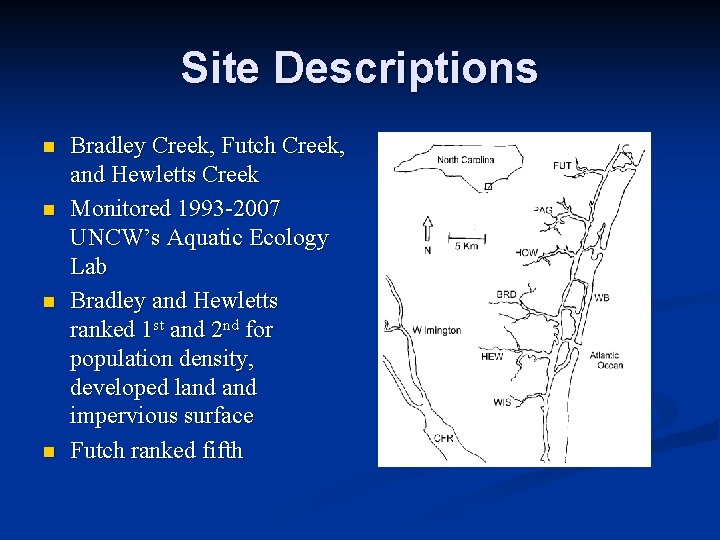
Site Descriptions n n Bradley Creek, Futch Creek, and Hewletts Creek Monitored 1993 -2007 UNCW’s Aquatic Ecology Lab Bradley and Hewletts ranked 1 st and 2 nd for population density, developed land impervious surface Futch ranked fifth
Rating system Dissolved oxygen, chlorophyll a, turbidity, fecal coliform bacteria n NC state standard <10%=Good n 10 -25%=Fair n > 25%= Poor n
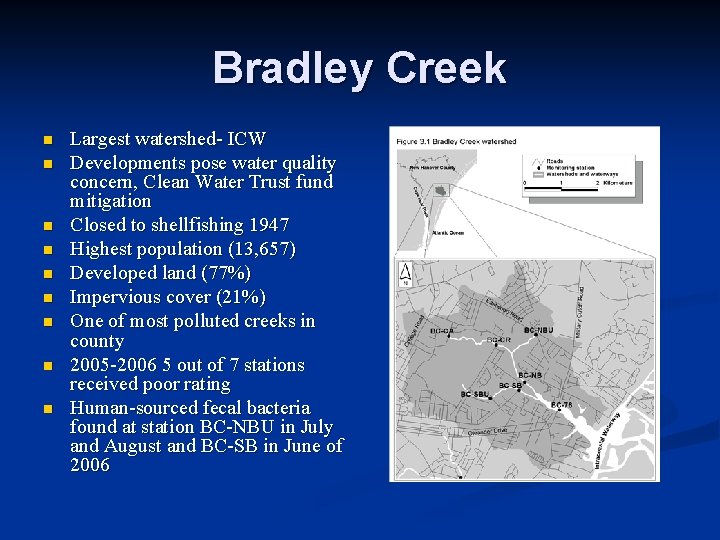
Bradley Creek n n n n n Largest watershed- ICW Developments pose water quality concern, Clean Water Trust fund mitigation Closed to shellfishing 1947 Highest population (13, 657) Developed land (77%) Impervious cover (21%) One of most polluted creeks in county 2005 -2006 5 out of 7 stations received poor rating Human-sourced fecal bacteria found at station BC-NBU in July and August and BC-SB in June of 2006
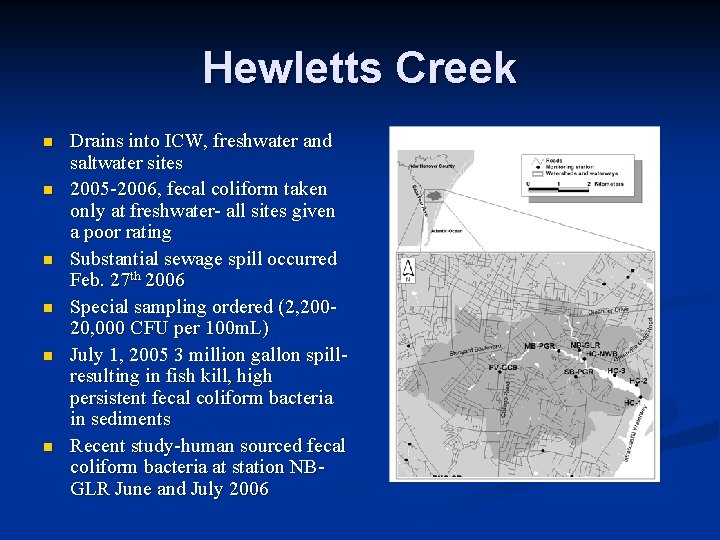
Hewletts Creek n n n Drains into ICW, freshwater and saltwater sites 2005 -2006, fecal coliform taken only at freshwater- all sites given a poor rating Substantial sewage spill occurred Feb. 27 th 2006 Special sampling ordered (2, 20020, 000 CFU per 100 m. L) July 1, 2005 3 million gallon spillresulting in fish kill, high persistent fecal coliform bacteria in sediments Recent study-human sourced fecal coliform bacteria at station NBGLR June and July 2006
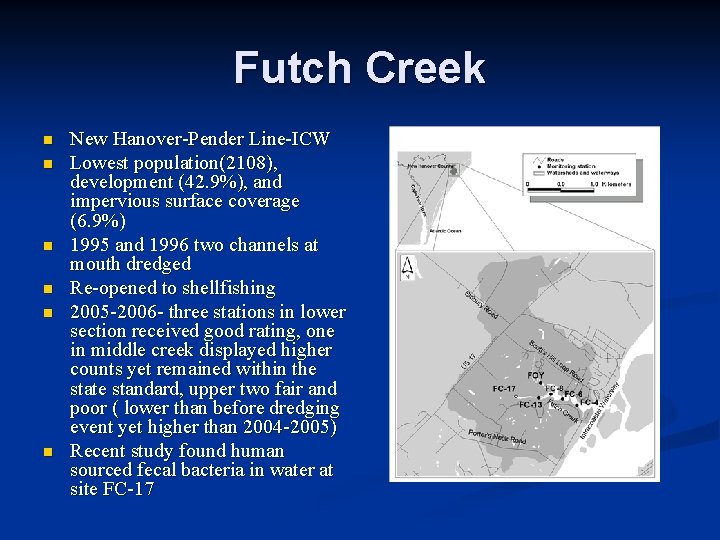
Futch Creek n n n New Hanover-Pender Line-ICW Lowest population(2108), development (42. 9%), and impervious surface coverage (6. 9%) 1995 and 1996 two channels at mouth dredged Re-opened to shellfishing 2005 -2006 - three stations in lower section received good rating, one in middle creek displayed higher counts yet remained within the state standard, upper two fair and poor ( lower than before dredging event yet higher than 2004 -2005) Recent study found human sourced fecal bacteria in water at site FC-17
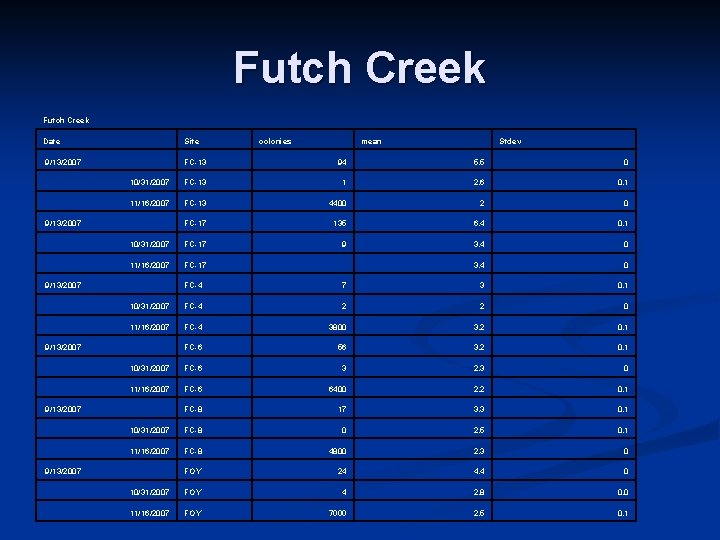
Futch Creek Date Site 9/13/2007 FC-13 94 5. 5 0 10/31/2007 FC-13 1 2. 6 0. 1 11/16/2007 FC-13 4400 2 0 FC-17 135 6. 4 0. 1 10/31/2007 FC-17 9 3. 4 0 11/16/2007 FC-17 3. 4 0 9/13/2007 colonies mean Stdev FC-4 7 3 0. 1 10/31/2007 FC-4 2 2 0 11/16/2007 FC-4 3800 3. 2 0. 1 FC-6 56 3. 2 0. 1 10/31/2007 FC-6 3 2. 3 0 11/16/2007 FC-6 6400 2. 2 0. 1 FC-8 17 3. 3 0. 1 10/31/2007 FC-8 0 2. 5 0. 1 11/16/2007 FC-8 4800 2. 3 0 FOY 24 4. 4 0 10/31/2007 FOY 4 2. 8 0. 0 11/16/2007 FOY 7000 2. 5 0. 1 9/13/2007
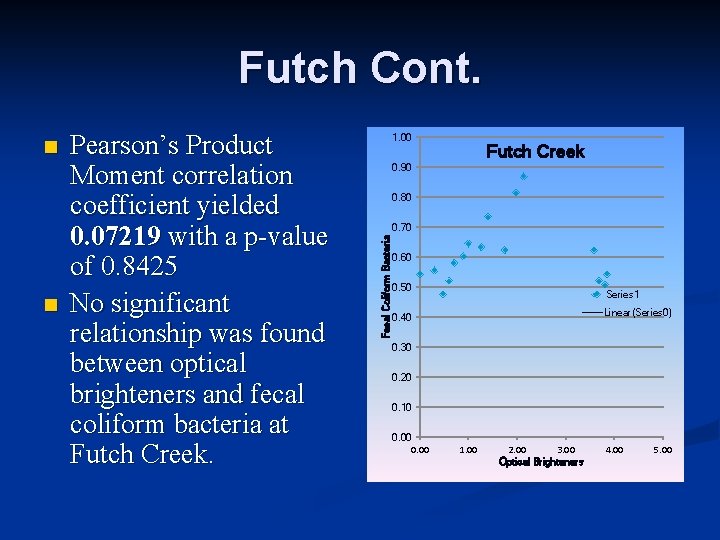
Futch Cont. n Pearson’s Product Moment correlation coefficient yielded 0. 07219 with a p-value of 0. 8425 No significant relationship was found between optical brighteners and fecal coliform bacteria at Futch Creek. 1. 00 Futch Creek 0. 90 0. 80 0. 70 Fecal Coliform Bacteria n R 2 = 0 0. 60 0. 50 Series 1 Linear(Series 0) 0. 40 0. 30 0. 20 0. 10 0. 00 1. 00 2. 00 3. 00 Optical Brighteners 4. 00 5. 00
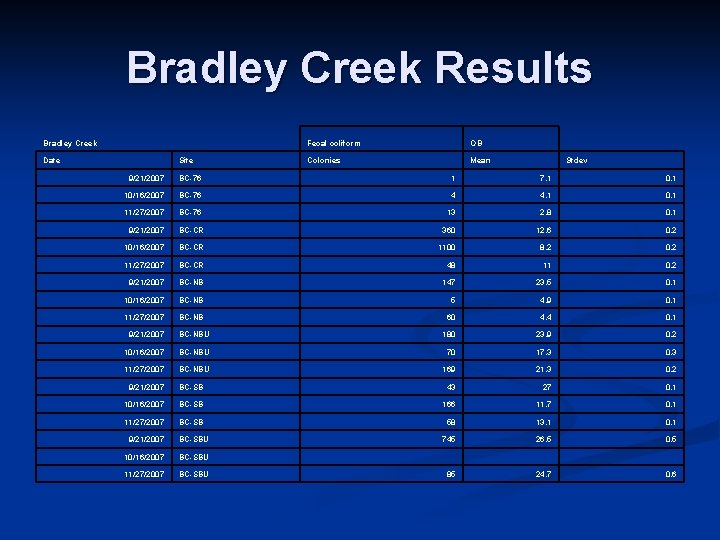
Bradley Creek Results Bradley Creek Date Site Fecal coliform OB Colonies Mean Stdev 9/21/2007 BC-76 1 7. 1 0. 1 10/16/2007 BC-76 4 4. 1 0. 1 11/27/2007 BC-76 13 2. 8 0. 1 9/21/2007 BC-CR 360 12. 6 0. 2 10/16/2007 BC-CR 1100 8. 2 0. 2 11/27/2007 BC-CR 48 11 0. 2 9/21/2007 BC-NB 147 23. 5 0. 1 10/16/2007 BC-NB 5 4. 9 0. 1 11/27/2007 BC-NB 60 4. 4 0. 1 9/21/2007 BC-NBU 180 23. 9 0. 2 10/16/2007 BC-NBU 70 17. 3 0. 3 11/27/2007 BC-NBU 169 21. 3 0. 2 9/21/2007 BC-SB 43 27 0. 1 10/16/2007 BC-SB 166 11. 7 0. 1 11/27/2007 BC-SB 58 13. 1 0. 1 745 26. 5 0. 5 9/21/2007 BC-SBU 10/16/2007 BC-SBU 11/27/2007 BC-SBU 85 24. 7 0. 6
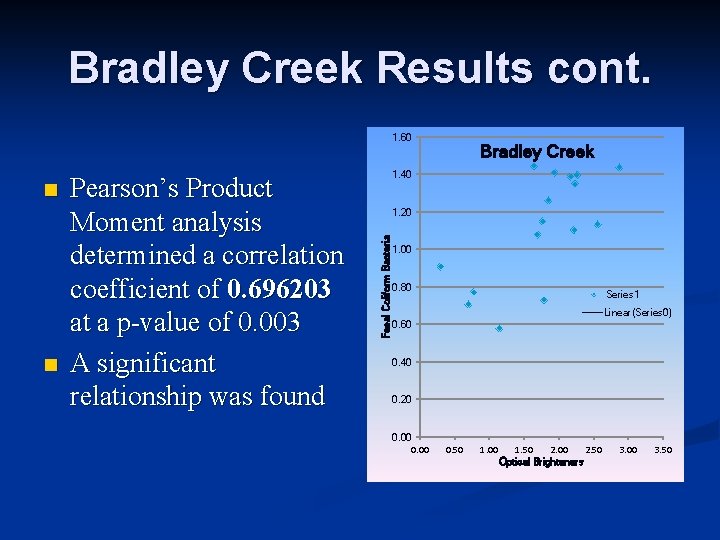
Bradley Creek Results cont. 1. 60 n Pearson’s Product Moment analysis determined a correlation coefficient of 0. 696203 at a p-value of 0. 003 A significant relationship was found 1. 40 1. 20 Fecal Coliform Bacteria n Bradley Creek R 2 1. 00 0. 80 Series 1 Linear(Series 0) 0. 60 0. 40 0. 20 0. 00 0. 50 1. 00 1. 50 2. 00 2. 50 Optical Brighteners 3. 00 3. 50

Hewletts Creek Results Hewletts Creek Date Site colonies mean Stdev 9/13/2007 HC-2 2 2. 3 0. 1 10/15/2007 HC-2 24 2. 9 0. 1 11/25/2007 HC-2 4 1. 8 0. 1 9/13/2007 HC-3 13 3. 2 0. 1 10/15/2007 HC-3 4 3. 5 0. 1 11/25/2007 HC-3 11 2. 2 0. 1 9/13/2007 MB-PGR 1115 25. 7 0. 5 10/15/2007 MB-PGR 940 25. 3 0. 2 11/25/2007 MB-PGR 145 20. 1 0. 2 9/13/2007 NB-GLR 375 12. 7 0. 1 10/15/2007 NB-GLR 45 7. 6 0. 1 11/25/2007 NB-GLR 427 7. 5 0. 1 9/13/2007 SB-PGR 105 9 0. 1 10/15/2007 SB-PGR 11 5. 8 0 11/25/2007 SB-PGR 169 6. 2 0. 1
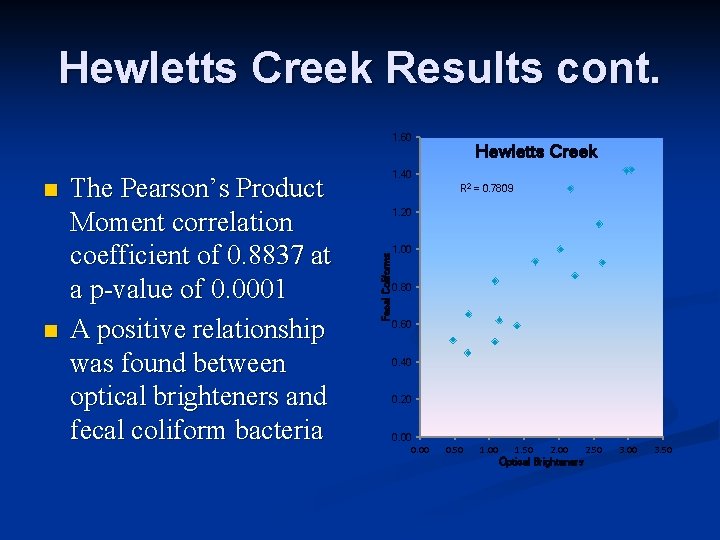
Hewletts Creek Results cont. 1. 60 n The Pearson’s Product Moment correlation coefficient of 0. 8837 at a p-value of 0. 0001 A positive relationship was found between optical brighteners and fecal coliform bacteria 1. 40 R 2 = 0. 7809 1. 20 Fecal Coliforms n Hewletts Creek 1. 00 0. 80 0. 60 0. 40 0. 20 0. 00 0. 50 1. 00 1. 50 2. 00 2. 50 Optical Brighteners 3. 00 3. 50
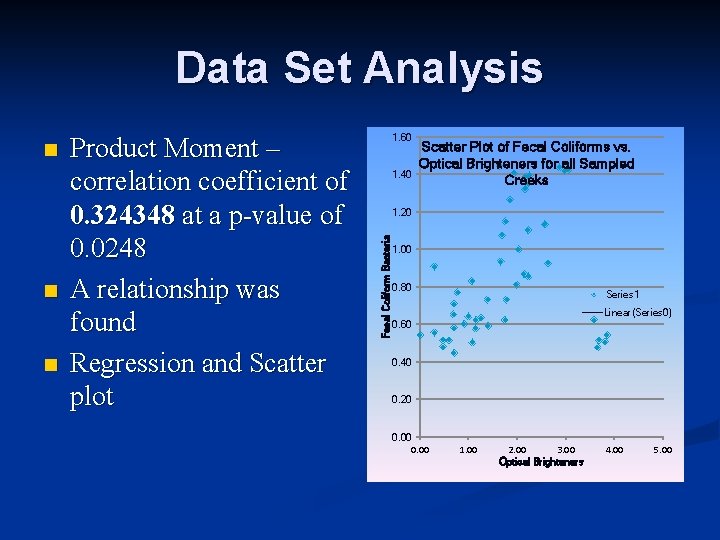
Data Set Analysis n n Product Moment – correlation coefficient of 0. 324348 at a p-value of 0. 0248 A relationship was found Regression and Scatter plot 1. 40 Scatter Plot of Fecal Coliforms vs. Optical Brighteners for all Sampled Creeks 1. 20 Fecal Coliform Bacteria n 1. 60 R 2 = 0. 1 1. 00 0. 80 Series 1 Linear(Series 0) 0. 60 0. 40 0. 20 0. 00 1. 00 2. 00 3. 00 Optical Brighteners 4. 00 5. 00
Discussion Positive results at Hewletts Creek and Bradley Creek indicate viable methodology for future studies n Past or present sources at Hewletts Creek? n Futch Creek- likely source of fecal coliform bacteria is wildlife not humans n Bradley Creek- fecal coliform bacteria possibly coming from run-off n
Discussion Cont. Fluorescence from other sources n Refinement of fluorometric methodology n Increased research during site selection n Sampling at low tide n Determine source of fecal bacteria through chemical, genotypic, or phenotypic methods n
The results of this preliminary experiment found an overall relationship between optical brightener values and fecal coliform bacteria counts. Therefore this project can be considered a viable resource when developing further experiments involving optical brighteners and fecal coliform bacteria contamination in waterways.
Acknowledgements I would like to thank Dr. Michael Mallin, research professor at UNC Wilmington’s Center for Marine Science, for oversight, guidance, and editorial comments. For methodology assistance, editorial comments, and support I thank Matthew Mc. Iver, Aquatic Ecology Lab manager. For advising and support I thank Dr. Jeffery M. Hill, Graduate Program Coordinator of Environmental Studies at UNCW. For field, laboratory and editorial assistance I thank Byron Toothman, Rena Spivey, Brad Rosov, Ned Durant and Kimberly Duernberger
References n n n n APHA. 1995. Standard Methods for the Examination of Water Quality and Wastewater, 19 th ed. American Public Health Association, Washington, D. C. Dadswell, J. V. 1993. Microbiological quality of coastal waters and its health effects. International Journal of Environmental Health Research 3: 32 -46. Dame, R. , Alber, M. , Allen, D. , Chalmers, A. , Gardner, C. , Gilman, B. , Kjerfve, B. , Lewitus, A. , Mallin, M. , Montague, C. , Pinkney, J. , Smith, N. , 2000. Estuaries of the South Atlantic Coast of North America: Their Geographical Signatures. Estuaries 23, 793 -819. Ford, T. E. , and R. R. Colwell. 1996. A global decline in microbiological safety of water: a call for action. American Academy of Microbiology, Washington, D. C. , USA. Hagedorn, C. , Saluta, M. , Hassal, A. , Dickerson, J. 2005 a. Fluorometric Detection of Optical Brighteners as an Indicator of Human Sources of Water Pollution. Part I: Description and Detection of Optical Brighteners. Crop and Soil Environmental News. Online periodical, available at: (http: //www. ext. vt. edu/ cgibin/webobjects/Docs. woa/wa/getnews? cat=tt-news-cses&issue=200511) (verified 25, October 2007). Hagedorn, C. , Saluta, M. , Hassal, A. , Dickerson, J. 2005 b. Fluorometric Detection of Optical Brighteners as an Indicator of Human Sources of Water Pollution. Part II: Development as a Source Tracking Methodology in Open Waters. Crop and Soil Environmental News. Online periodical, available at: (http: //www. ext. vt. edu/ cgibin/webobjects/Docs. woa/wa/getnews? cat=tt-news-cses&issue=200511) (verified 25, October 2007).
References cont. n n n n Hartel, P. G. , Mc. Donald, J. L. , Gentit, L. C. , Hemmings, S. N. , Rodgers, K. , Smith, K. A. , Belcher, C. N. , Kuntz, R. L. , Rivera-Torres, Y. , Otero, E. , Schrōder, E. C. 2007 a. Improving Fluorometry as a Source Tracking Method to Detect Human Fecal Contamination. Estuaries and Coasts 30, 1 -11. Hartel, P. G. , Hagedorn, C. , Mc. Donald, J. L. , Fisher, J. A. , Saluta, M. A. , Dickerson Jr. , J. W. , Gentit, L. C. , Smith, S. L. , Mantripragada, N. S. , Ritter, K. J. , Belcher, C. N. 2007 b. Exposing water samples to ultraviolet light improves fluorometry for detecting human fecal contamination. Water Research 41, 3629 -3642. Kramer, J. B. , Canonica, S. , Hoigne, L. , Kaschig, 1996. Degradation of fluorescent whitening agents in sunlit natural waters. Environ. Sci. Technol. 30, 2227 -2234. NCDEHNR. 1996. Water Quality Progress in North Carolina, 1994 -1995 305(b) Report No. 96 -03. North Carolina Department of Environment, Health, and Natural Resources, Division of Water Quality. Raleigh, N. C. Mallin, M. A. , L. B. Cahoon, J. J. Mancock, J. F. Merrit, M. H. Posey, R. K. Sizemore, W. D. Webster, and T. D. Alphin. 1998. A four-year environmental analysis of New Hanover county tidal creeks. CMSR Report Number 98 -01. University of North Carolina at Wilmington, North Carolina, USA. Mallin, M. A. , Esham, E. C. , Williams, K. E. , Nearhoof, J. E. , 1999. Tidal Stage Variability of Fecal Coliform and Chlorophyll a Concentrations in Coastal Creeks. Marine Pollution Bulletin 38, 414422. Mallin, M. A. , Burkholder, J. M. , Cahoon, L. B. , Posey, M. H. , 2000 a. The North and South Carolina coasts. Marine Pollution Bulletin 41: 56 -75.
References cont. n n n n Mallin, M. A. , K. E. Williams, E. C. Escham, R. P. Lowe. 2000 b. Effect of Human Development on Bacteriological Water Quality in Coastal Watersheds. Ecological Applications 10: 1047 -1056. Mallin, M. A. , L. B. Cahoon, R. P. Lowe, J. F. Merrit, R. K. Sizemore, K. E. Williams. 2000 c. Restoration of Shellfishing Waters in a Tidal Creek Following Limited Dredging. Journal of Coastal Research 16: 40 -47. Mallin, M. A. , Lewitus, A. J. , 2004. The Importance of Tidal Creek Ecosystems. Journal of Experimental Marine Biology and Ecology 298 (2004) 145 -149. Mallin, M. A. , D. C. Parsons, V. L. Johnson, M. R. Mc. Iver, H. A. Co. Van. 2004. Nutrient Limitation and Algal Blooms in Urbanizing Tidal Creeks. Journal of Experimental Marine Biology and Ecology 298 (2004) 211 -231. Mallin, M. A. , L. B. Cahoon, B. R. Toothman, D. C. Parsons, M. R. Mc. Iver, M. L. Ortwine, R. N. Harrington. 2007. Impacts of a Raw Sewage Spill on Water and Sediment Quality in an Urban Estuary. Marine Pollution Bulletin 54: 81 -88. Mallin, M. A. , L. B. Cahoon, T. D. Alphin, M. H. Posey, B. A. Rosov, D. C. Parsons, R. N. Harrington, J. F. Merritt. 2007. Environmental Quality of Wilmington and New Hanover County Watersheds. 2005 -2006. CMS Report 07 -01, Center for Marine Science, University of North Carolina at Wilmington, N. C. Rees, G. K. Pond, K. Johal, S. Pedley, and A. Rickards. 1998. Microbiological analysis of selected coastal bathing waters in the U. K. , Greece, Italy and Spain. Water Research 32: 2335 -2340.
- Slides: 32