
Testing Contact Tracing Oversight and insights for regulatory


- Slides: 9
Testing & Contact Tracing Oversight and insights for regulatory & supervisory organisations
Overview of Test and Trace in Ireland
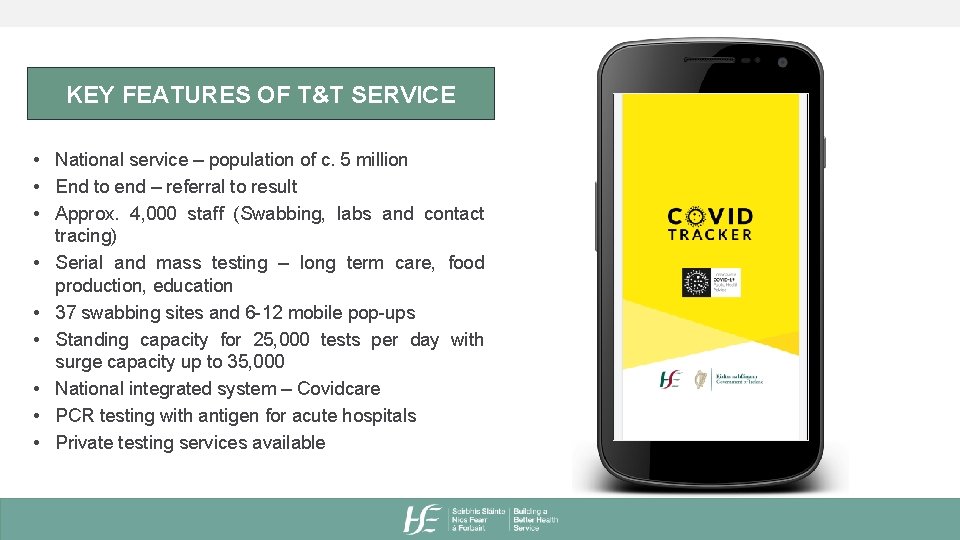
KEY FEATURES OF T&T SERVICE • National service – population of c. 5 million • End to end – referral to result • Approx. 4, 000 staff (Swabbing, labs and contact tracing) • Serial and mass testing – long term care, food production, education • 37 swabbing sites and 6 -12 mobile pop-ups • Standing capacity for 25, 000 tests per day with surge capacity up to 35, 000 • National integrated system – Covidcare • PCR testing with antigen for acute hospitals • Private testing services available
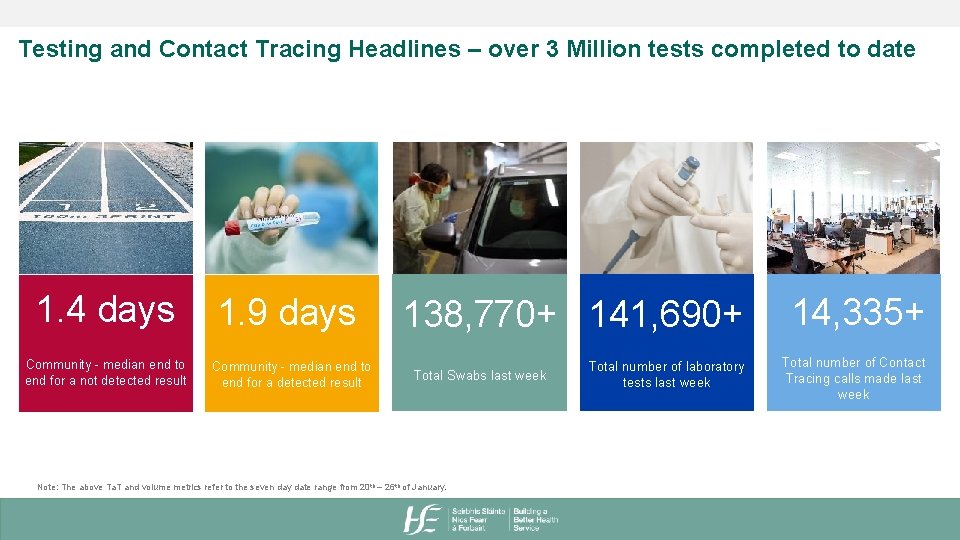
Testing and Contact Tracing Headlines – over 3 Million tests completed to date 1. 4 days Community - median end to end for a not detected result 1. 9 days Community - median end to end for a detected result 138, 770+ 141, 690+ 14, 335+ Total number of laboratory tests last week Total number of Contact Tracing calls made last week Total Swabs last week Note: The above Ta. T and volume metrics refer to the seven day date range from 20 th – 26 th of January.
Oversight of Monitoring and Oversight
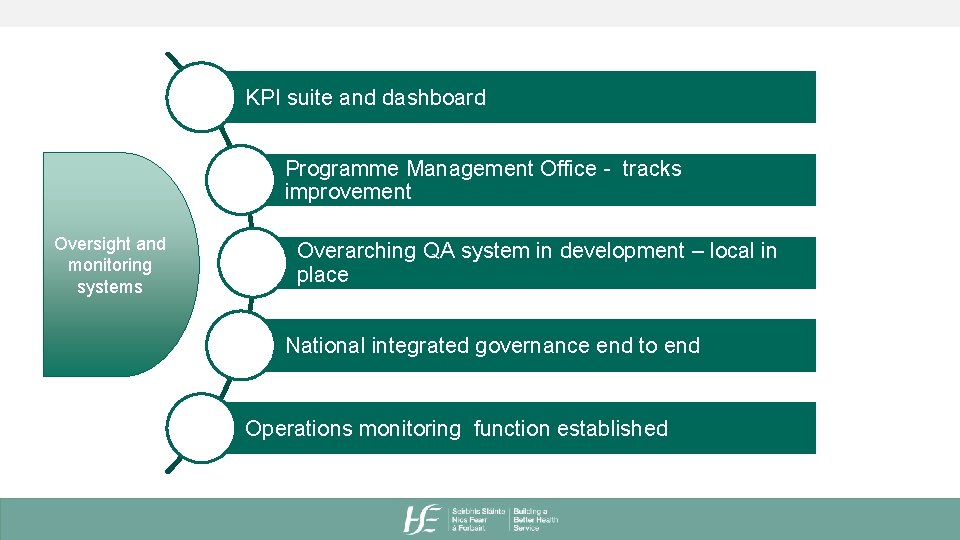
KPI suite and dashboard Programme Management Office - tracks improvement Oversight and monitoring systems Overarching QA system in development – local in place National integrated governance end to end Operations monitoring function established
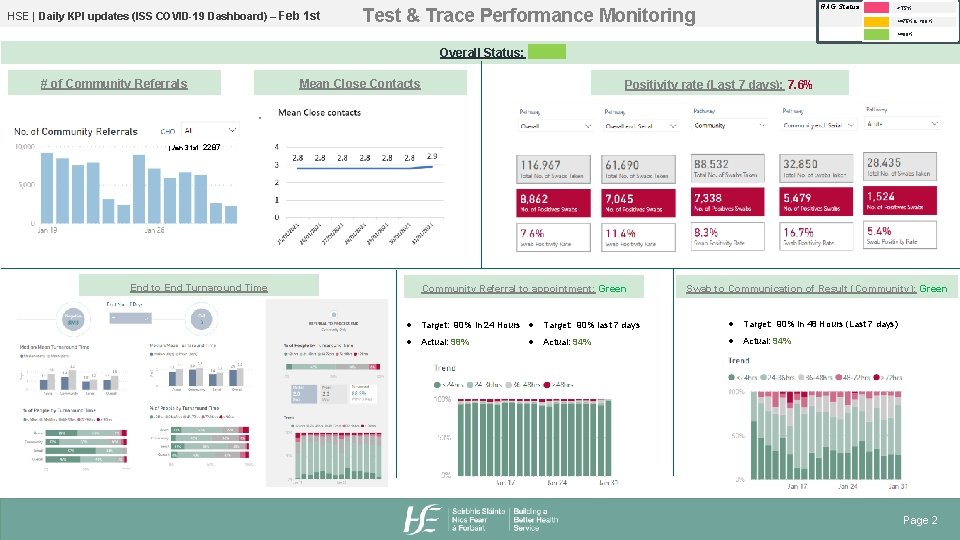
HSE | Daily KPI updates (ISS COVID-19 Dashboard) – Feb 1 st RAG Status Test & Trace Performance Monitoring < 75% >=75% & <90% >=90% Overall Status: # of Community Referrals Mean Close Contacts Positivity rate (Last 7 days): 7. 6% (Jan 31 st: 2287 End to End Turnaround Time Community Referral to appointment: Green Target: 90% in 24 Hours Actual: 98% Swab to Communication of Result (Community): Green Target: 90% last 7 days Target: 90% in 48 Hours (Last 7 days) Actual: 94% Page 2
Insights for regulators/inspectorates
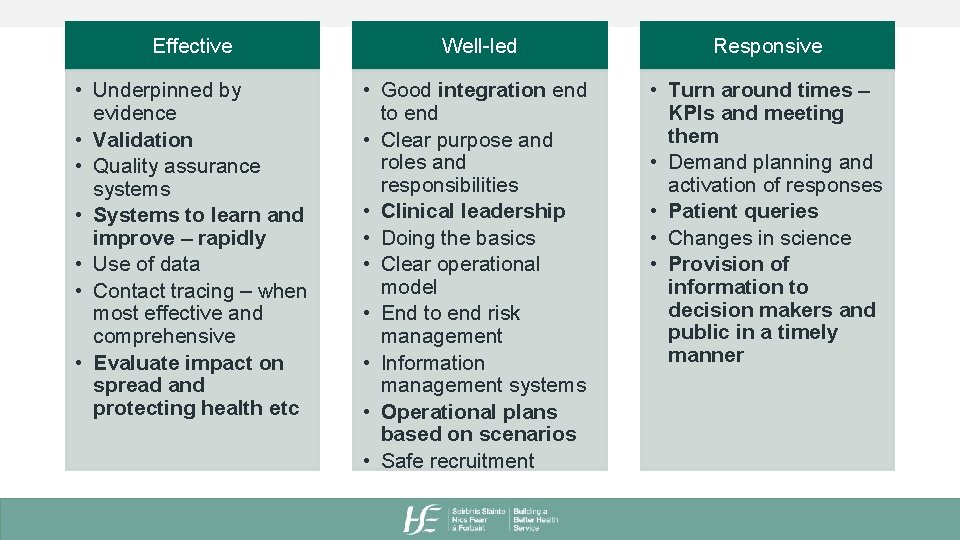
Effective Well-led Responsive • Underpinned by evidence • Validation • Quality assurance systems • Systems to learn and improve – rapidly • Use of data • Contact tracing – when most effective and comprehensive • Evaluate impact on spread and protecting health etc • Good integration end to end • Clear purpose and roles and responsibilities • Clinical leadership • Doing the basics • Clear operational model • End to end risk management • Information management systems • Operational plans based on scenarios • Safe recruitment • Turn around times – KPIs and meeting them • Demand planning and activation of responses • Patient queries • Changes in science • Provision of information to decision makers and public in a timely manner