
Testing Conformity Assessment for Energy Storage Systems Ken
- Slides: 25
Testing & Conformity Assessment for Energy Storage Systems Ken Boyce Principal Engineer Director Energy & Power Technologies UL LLC UL and the UL logo are trademarks of UL LLC © 2017
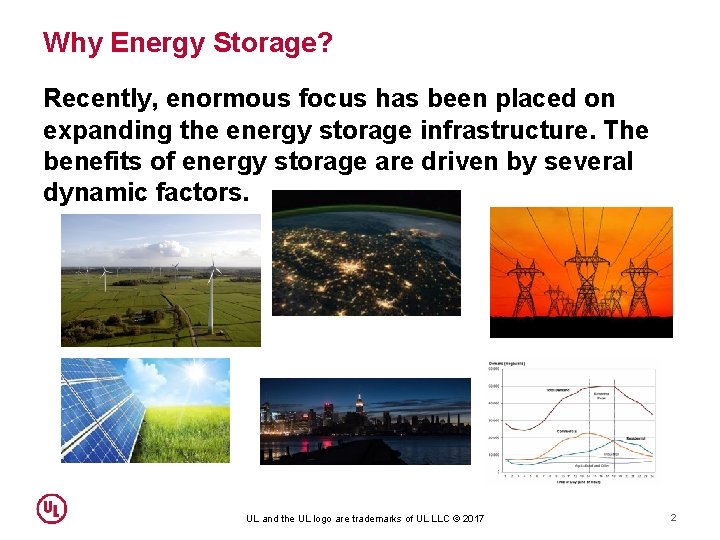
Why Energy Storage? Recently, enormous focus has been placed on expanding the energy storage infrastructure. The benefits of energy storage are driven by several dynamic factors. UL and the UL logo are trademarks of UL LLC © 2017 2
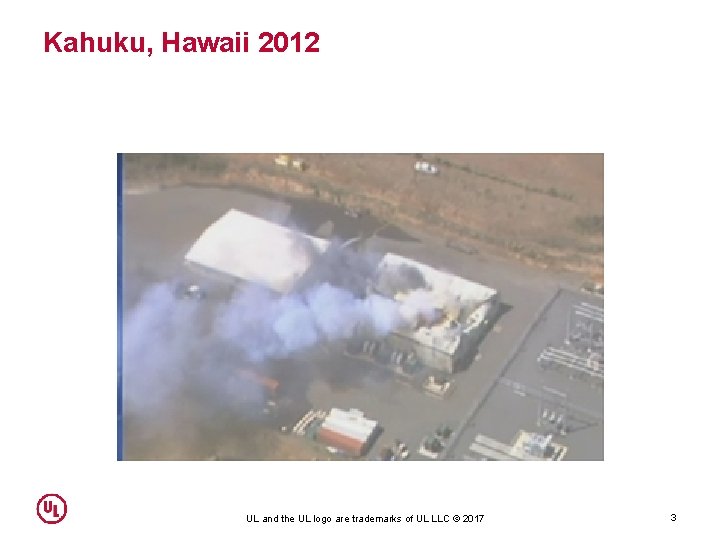
Kahuku, Hawaii 2012 UL and the UL logo are trademarks of UL LLC © 2017 3
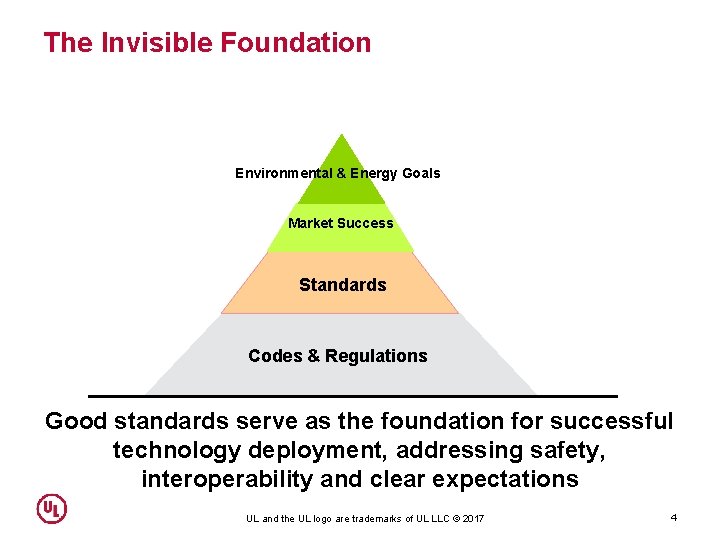
The Invisible Foundation Environmental & Energy Goals Market Success Standards Codes & Regulations Good standards serve as the foundation for successful technology deployment, addressing safety, interoperability and clear expectations UL and the UL logo are trademarks of UL LLC © 2017 4
Testing and conformity assessment of energy storage systems are critical for safety Safely managing high energy density under normal and abnormal conditions must be demonstrated Connections to the electric grid and buildings present dynamic and demanding conditions of use Integration into the infrastructure must be coordinated to minimize the risk of unintended consequences over the life of the energy storage system Some approaches used elsewhere may help the South African technical community find the best solutions UL and the UL logo are trademarks of UL LLC © 2017 5
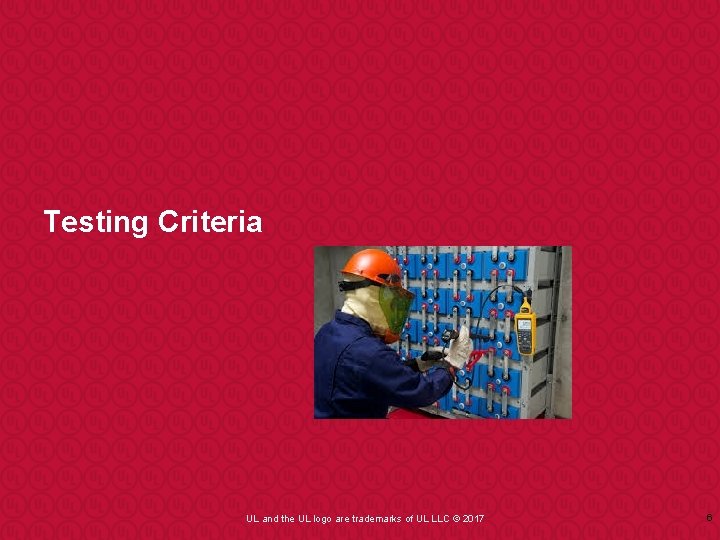
Testing Criteria UL and the UL logo are trademarks of UL LLC © 2017 6
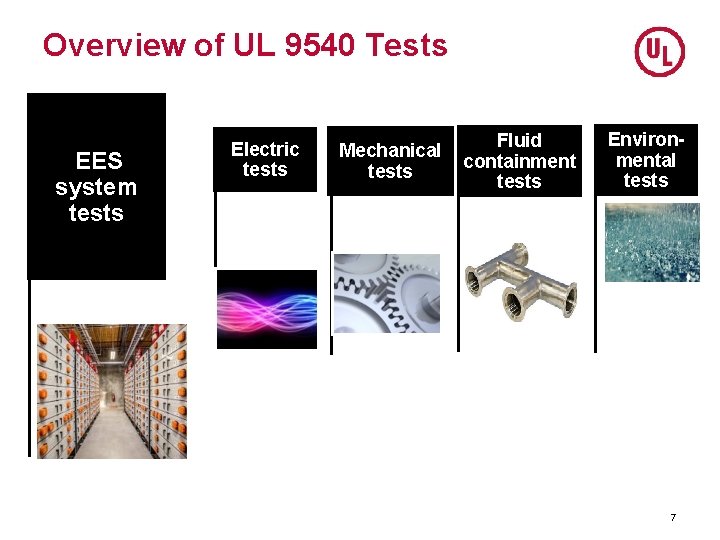
Overview of UL 9540 Tests EES system tests Electric tests Mechanical tests Fluid containment tests Environmental tests 7
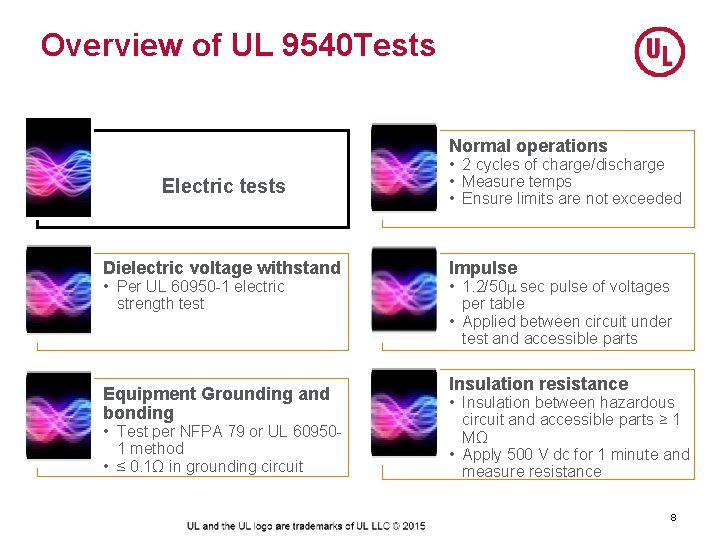
Overview of UL 9540 Tests Normal operations Electric tests Dielectric voltage withstand • Per UL 60950 -1 electric strength test Equipment Grounding and bonding • Test per NFPA 79 or UL 609501 method • ≤ 0. 1Ω in grounding circuit • 2 cycles of charge/discharge • Measure temps • Ensure limits are not exceeded Impulse • 1. 2/50 sec pulse of voltages per table • Applied between circuit under test and accessible parts Insulation resistance • Insulation between hazardous circuit and accessible parts ≥ 1 MΩ • Apply 500 V dc for 1 minute and measure resistance 8
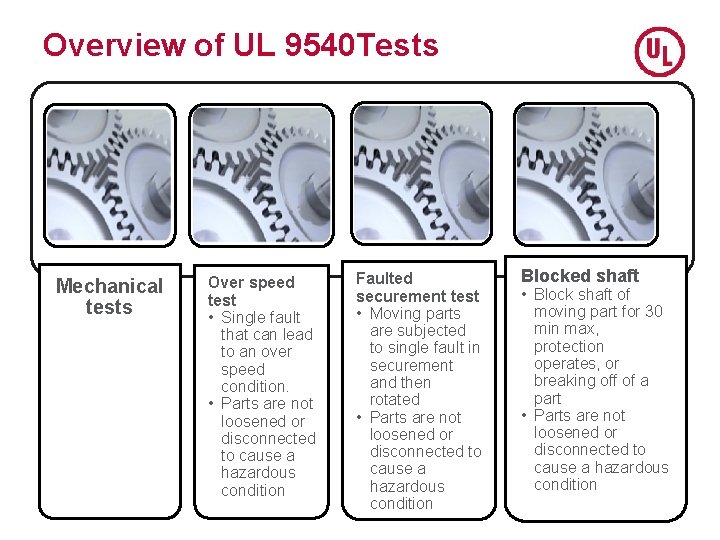
Overview of UL 9540 Tests Mechanical tests Over speed test • Single fault that can lead to an over speed condition. • Parts are not loosened or disconnected to cause a hazardous condition Faulted securement test • Moving parts are subjected to single fault in securement and then rotated • Parts are not loosened or disconnected to cause a hazardous condition Blocked shaft • Block shaft of moving part for 30 min max, protection operates, or breaking off of a part • Parts are not loosened or disconnected to cause a hazardous condition 9
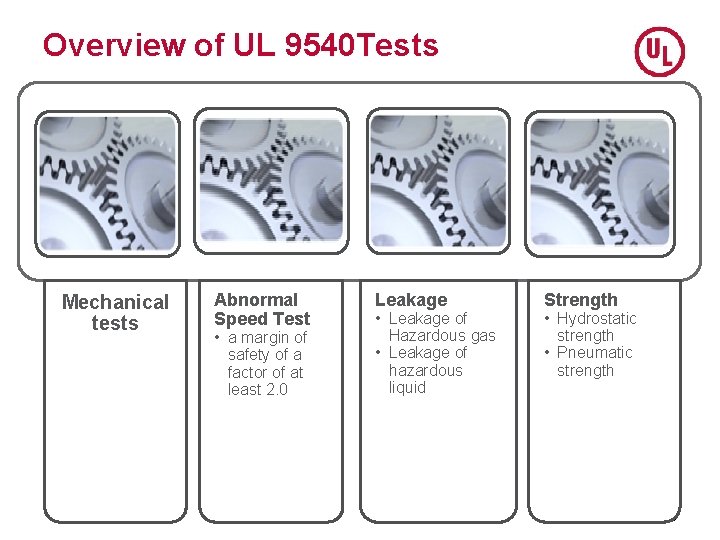
Overview of UL 9540 Tests Mechanical tests Abnormal Speed Test • a margin of safety of a factor of at least 2. 0 Leakage • Leakage of Hazardous gas • Leakage of hazardous liquid Strength • Hydrostatic strength • Pneumatic strength 10
Overview of UL 9540 Tests Environmental tests Outdoors installations subject to moisture exposure • IEC 60529, UL 50 E, CSA C 22. 2 No. 94. 2 per rating • Electrical Insulation tests after conditioning • Check for water in side on components, etc. Outdoor installation near marine environments • Salt Fog test of IEC 60068 -2 -52 for Severities 1 of 2. • Electrical Insulation tests after conditioning • Examination for signs of damage as a result of salt fog exposure Installation in seismic environments • Evaluated for ability to withstand seismic events per rating • examined for signs of explosion, fire, combustible concentrations (if applicable to technology), rupture of the enclosure, electrolyte leakage, electric shock and loss of protection controls that may lead 11
Testing Facilities Testing of energy storage systems presents some unique challenges Safety of personnel and the facility is critical when testing battery technologies, especially large format and especially in fault modes Expertise in BMS technology is imperative Grid connection testing requires significant testing equipment and expertise of the technicians 12
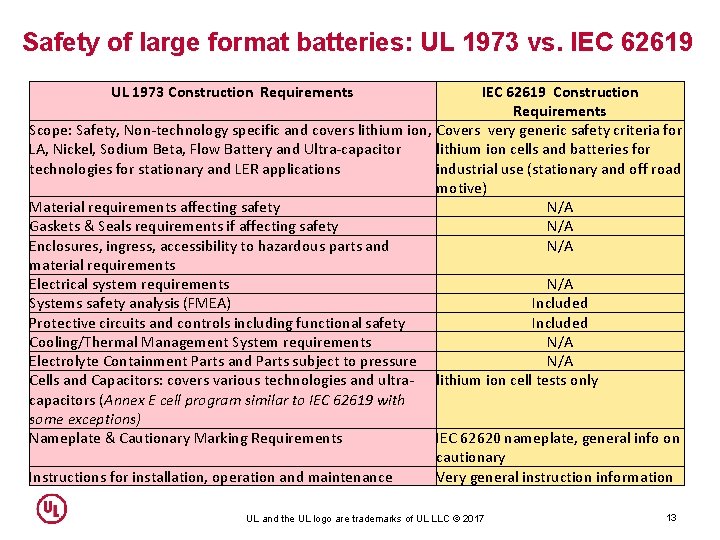
Safety of large format batteries: UL 1973 vs. IEC 62619 UL 1973 Construction Requirements IEC 62619 Construction Requirements Scope: Safety, Non-technology specific and covers lithium ion, Covers very generic safety criteria for LA, Nickel, Sodium Beta, Flow Battery and Ultra-capacitor lithium ion cells and batteries for technologies for stationary and LER applications industrial use (stationary and off road motive) Material requirements affecting safety N/A Gaskets & Seals requirements if affecting safety N/A Enclosures, ingress, accessibility to hazardous parts and N/A material requirements Electrical system requirements N/A Systems safety analysis (FMEA) Included Protective circuits and controls including functional safety Included Cooling/Thermal Management System requirements N/A Electrolyte Containment Parts and Parts subject to pressure N/A Cells and Capacitors: covers various technologies and ultra- lithium ion cell tests only capacitors (Annex E cell program similar to IEC 62619 with some exceptions) Nameplate & Cautionary Marking Requirements IEC 62620 nameplate, general info on cautionary Instructions for installation, operation and maintenance Very general instruction information UL and the UL logo are trademarks of UL LLC © 2017 13
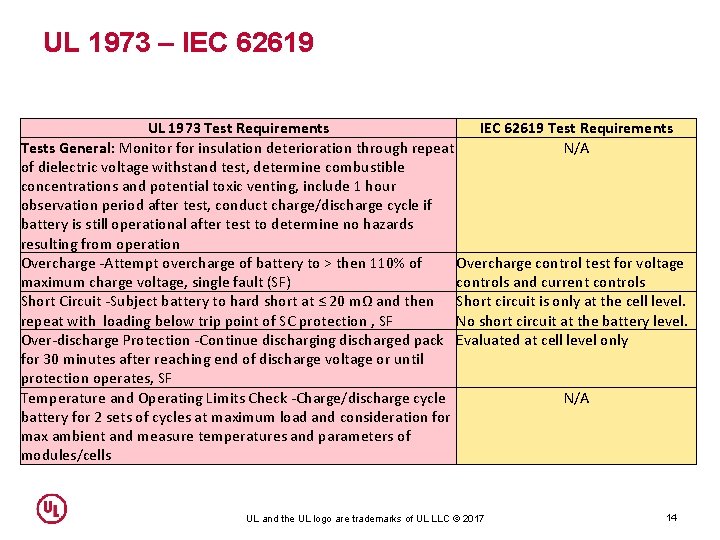
UL 1973 – IEC 62619 UL 1973 Test Requirements IEC 62619 Test Requirements Tests General: Monitor for insulation deterioration through repeat N/A of dielectric voltage withstand test, determine combustible concentrations and potential toxic venting, include 1 hour observation period after test, conduct charge/discharge cycle if battery is still operational after test to determine no hazards resulting from operation Overcharge -Attempt overcharge of battery to > then 110% of Overcharge control test for voltage maximum charge voltage, single fault (SF) controls and current controls Short Circuit -Subject battery to hard short at ≤ 20 mΩ and then Short circuit is only at the cell level. repeat with loading below trip point of SC protection , SF No short circuit at the battery level. Over-discharge Protection -Continue discharging discharged pack Evaluated at cell level only for 30 minutes after reaching end of discharge voltage or until protection operates, SF Temperature and Operating Limits Check -Charge/discharge cycle N/A battery for 2 sets of cycles at maximum load and consideration for max ambient and measure temperatures and parameters of modules/cells UL and the UL logo are trademarks of UL LLC © 2017 14
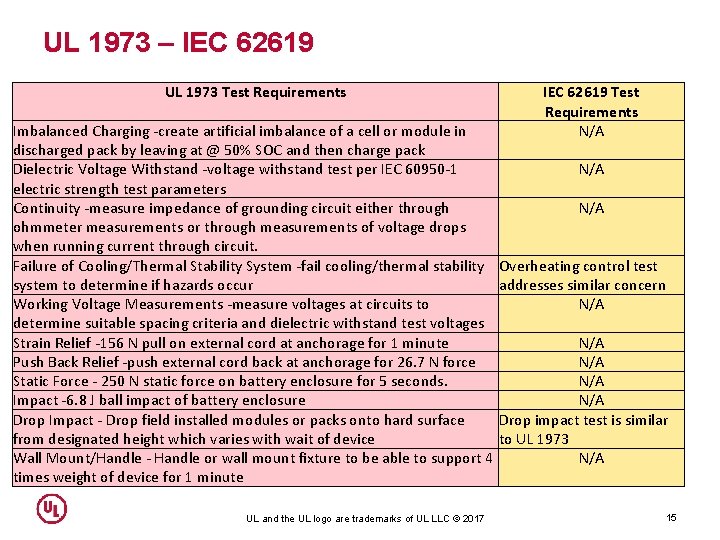
UL 1973 – IEC 62619 UL 1973 Test Requirements Imbalanced Charging -create artificial imbalance of a cell or module in discharged pack by leaving at @ 50% SOC and then charge pack Dielectric Voltage Withstand -voltage withstand test per IEC 60950 -1 electric strength test parameters Continuity -measure impedance of grounding circuit either through ohmmeter measurements or through measurements of voltage drops when running current through circuit. Failure of Cooling/Thermal Stability System -fail cooling/thermal stability system to determine if hazards occur Working Voltage Measurements -measure voltages at circuits to determine suitable spacing criteria and dielectric withstand test voltages Strain Relief -156 N pull on external cord at anchorage for 1 minute Push Back Relief -push external cord back at anchorage for 26. 7 N force Static Force - 250 N static force on battery enclosure for 5 seconds. Impact -6. 8 J ball impact of battery enclosure Drop Impact - Drop field installed modules or packs onto hard surface from designated height which varies with wait of device Wall Mount/Handle - Handle or wall mount fixture to be able to support 4 times weight of device for 1 minute UL and the UL logo are trademarks of UL LLC © 2017 IEC 62619 Test Requirements N/A N/A Overheating control test addresses similar concern N/A N/A N/A Drop impact test is similar to UL 1973 N/A 15
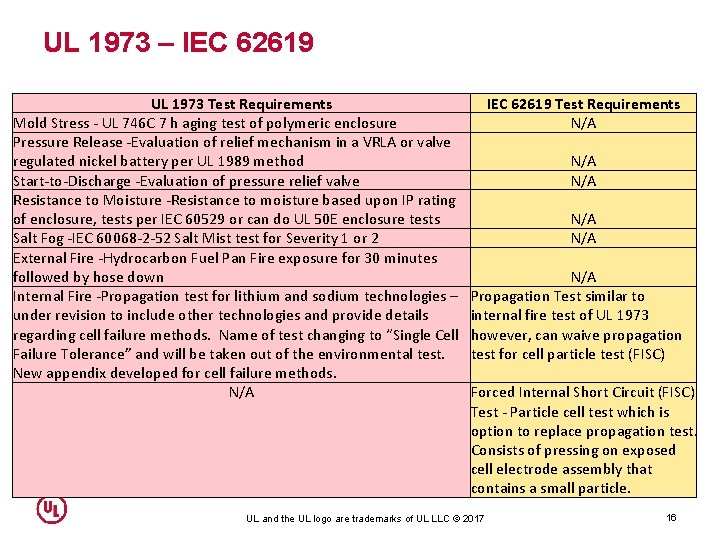
UL 1973 – IEC 62619 UL 1973 Test Requirements Mold Stress - UL 746 C 7 h aging test of polymeric enclosure Pressure Release -Evaluation of relief mechanism in a VRLA or valve regulated nickel battery per UL 1989 method Start-to-Discharge -Evaluation of pressure relief valve Resistance to Moisture -Resistance to moisture based upon IP rating of enclosure, tests per IEC 60529 or can do UL 50 E enclosure tests Salt Fog -IEC 60068 -2 -52 Salt Mist test for Severity 1 or 2 External Fire -Hydrocarbon Fuel Pan Fire exposure for 30 minutes followed by hose down Internal Fire -Propagation test for lithium and sodium technologies – under revision to include other technologies and provide details regarding cell failure methods. Name of test changing to “Single Cell Failure Tolerance” and will be taken out of the environmental test. New appendix developed for cell failure methods. N/A IEC 62619 Test Requirements N/A N/A N/A Propagation Test similar to internal fire test of UL 1973 however, can waive propagation test for cell particle test (FISC) Forced Internal Short Circuit (FISC) Test - Particle cell test which is option to replace propagation test. Consists of pressing on exposed cell electrode assembly that contains a small particle. UL and the UL logo are trademarks of UL LLC © 2017 16
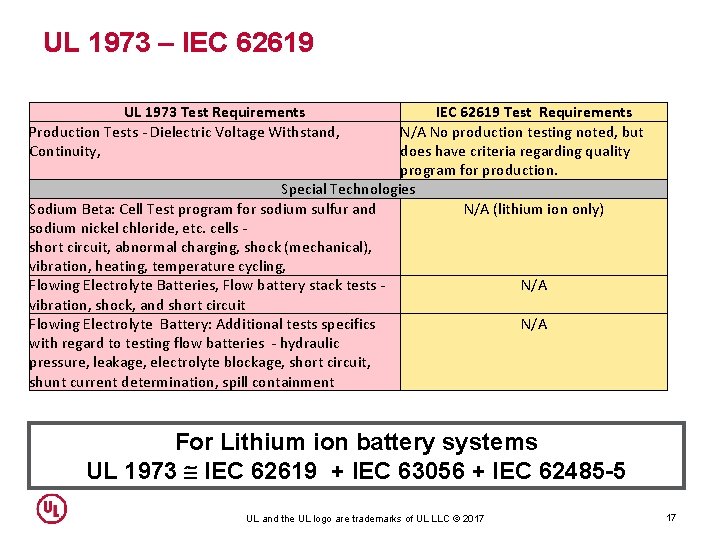
UL 1973 – IEC 62619 UL 1973 Test Requirements Production Tests - Dielectric Voltage Withstand, Continuity, IEC 62619 Test Requirements N/A No production testing noted, but does have criteria regarding quality program for production. Special Technologies Sodium Beta: Cell Test program for sodium sulfur and N/A (lithium ion only) sodium nickel chloride, etc. cells short circuit, abnormal charging, shock (mechanical), vibration, heating, temperature cycling, Flowing Electrolyte Batteries, Flow battery stack tests N/A vibration, shock, and short circuit Flowing Electrolyte Battery: Additional tests specifics N/A with regard to testing flow batteries - hydraulic pressure, leakage, electrolyte blockage, short circuit, shunt current determination, spill containment For Lithium ion battery systems UL 1973 IEC 62619 + IEC 63056 + IEC 62485 -5 UL and the UL logo are trademarks of UL LLC © 2017 17
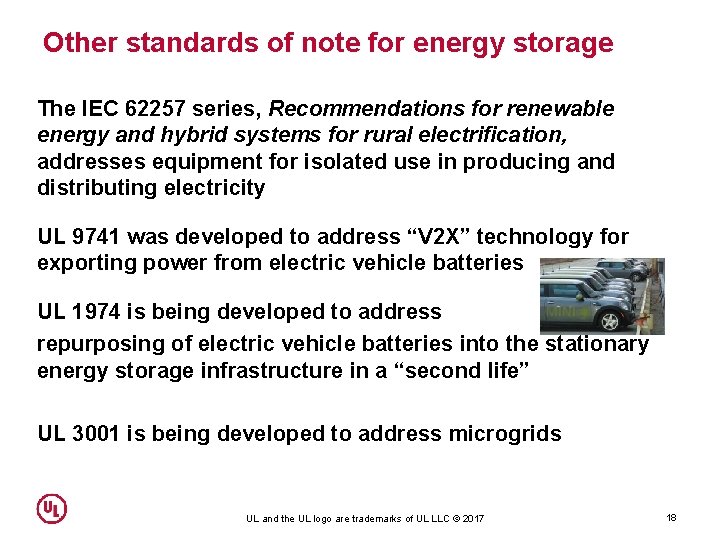
Other standards of note for energy storage The IEC 62257 series, Recommendations for renewable energy and hybrid systems for rural electrification, addresses equipment for isolated use in producing and distributing electricity UL 9741 was developed to address “V 2 X” technology for exporting power from electric vehicle batteries UL 1974 is being developed to address repurposing of electric vehicle batteries into the stationary energy storage infrastructure in a “second life” UL 3001 is being developed to address microgrids UL and the UL logo are trademarks of UL LLC © 2017 18
Conformity Assessment UL and the UL logo are trademarks of UL LLC © 2017 19
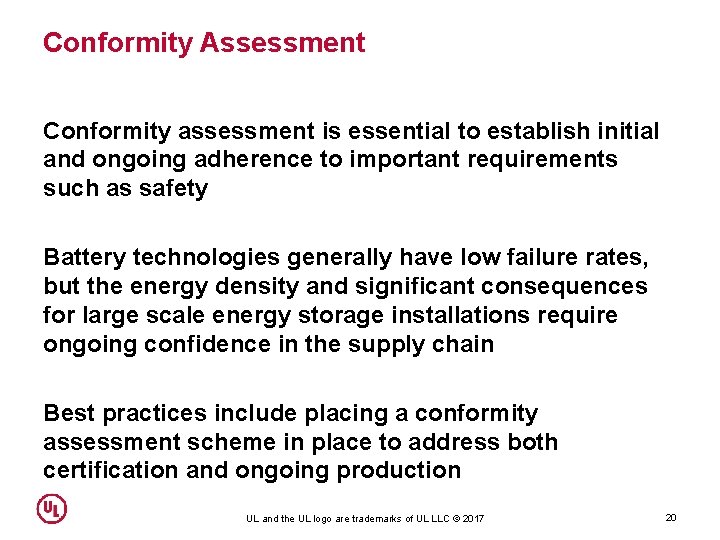
Conformity Assessment Conformity assessment is essential to establish initial and ongoing adherence to important requirements such as safety Battery technologies generally have low failure rates, but the energy density and significant consequences for large scale energy storage installations require ongoing confidence in the supply chain Best practices include placing a conformity assessment scheme in place to address both certification and ongoing production UL and the UL logo are trademarks of UL LLC © 2017 20
Interface with Codes and Regulations Coordinating testing and certification to product standards with an overarching codes and regulatory structure promotes optimal integration This establishes clear rules for how certified products and systems need to be imported, sited, installed, commissioned and operated These requirements can address electrical aspects, how to integrate into a building with respect to fire safety and structural integrity, grid compatibility, and the like UL and the UL logo are trademarks of UL LLC © 2017 21
Code developments NFPA 70, the National Electrical Code, added new requirements in the 2017 Edition to address energy storage systems and DC microgrids, requiring certification NFPA 855 is being developed to address building and fire safety considerations for integrating energy storage systems The International Fire Code (IFC) was revised to include rules for installing energy storage systems into buildings, identifying limits, certification, fire suppression and setbacks Grid codes continue to evolve, but the evolution to “smart inverters” with advanced technology will offer better grid management for the future UL and the UL logo are trademarks of UL LLC © 2017 22
Other efforts related to energy storage UL is leading work to with interested parties to continue refinement of methods to assess the risk of fire starting within and propagating UL is working with leaders in industry and the fire service to assess the risk of an external fire engaging an energy storage system Work continues in the broader fire community to address the best methods for fire suppression involving energy storage technologies UL and the UL logo are trademarks of UL LLC © 2017 23
Summary Energy storage has brought may benefits to the global energy infrastructure There are standards and codes that may serve as a model to help South Africa develop the optimal approach for its people and country Work continues on finding the best way to address the needs of all stakeholders – consumers, owners, manufacturers, utilities, government, insurers, first responders and others – for energy storage 24
Thank you Ngiyabonga Dankie Ken Boyce Kenneth. p. boyce@ul. com UL and the UL logo are trademarks of UL LLC © 2014