
Testability DOB PDR Marlon Barbero Tomasz Hemperek Bonn
Testability DOB & PDR Marlon Barbero / Tomasz Hemperek, Bonn University FE-I 4 Review, CERN Nov. 3 rd - 4 th 2009
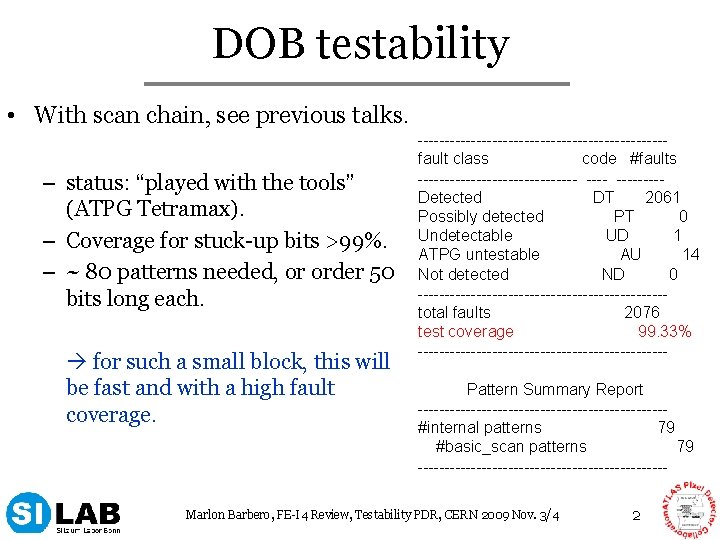
DOB testability • With scan chain, see previous talks. – status: “played with the tools” (ATPG Tetramax). – Coverage for stuck-up bits >99%. – ~ 80 patterns needed, or order 50 bits long each. for such a small block, this will be fast and with a high fault coverage. ----------------------- fault class code #faults --------------- Detected DT 2061 Possibly detected PT 0 Undetectable UD 1 ATPG untestable AU 14 Not detected ND 0 ----------------------- total faults 2076 test coverage 99. 33% ----------------------- Pattern Summary Report ----------------------- #internal patterns 79 #basic_scan patterns 79 ------------------------ Marlon Barbero, FE-I 4 Review, Testability PDR, CERN 2009 Nov. 3/4 2
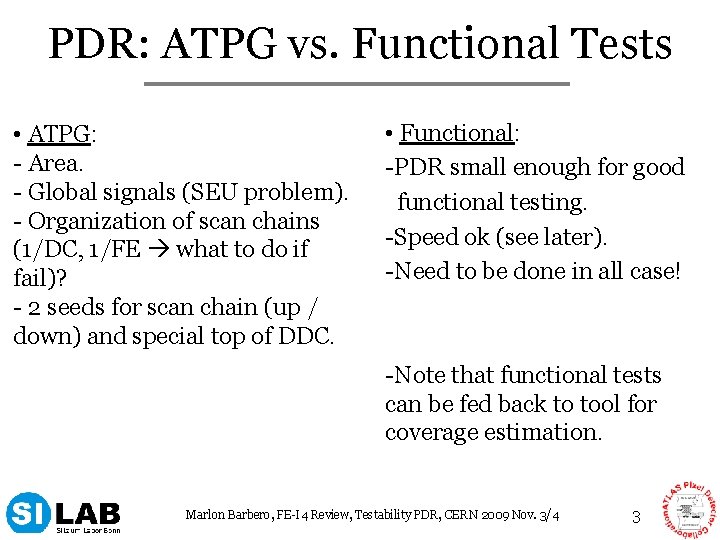
PDR: ATPG vs. Functional Tests • ATPG: - Area. - Global signals (SEU problem). - Organization of scan chains (1/DC, 1/FE what to do if fail)? - 2 seeds for scan chain (up / down) and special top of DDC. • Functional: -PDR small enough for good functional testing. -Speed ok (see later). -Need to be done in all case! -Note that functional tests can be fed back to tool for coverage estimation. Marlon Barbero, FE-I 4 Review, Testability PDR, CERN 2009 Nov. 3/4 3
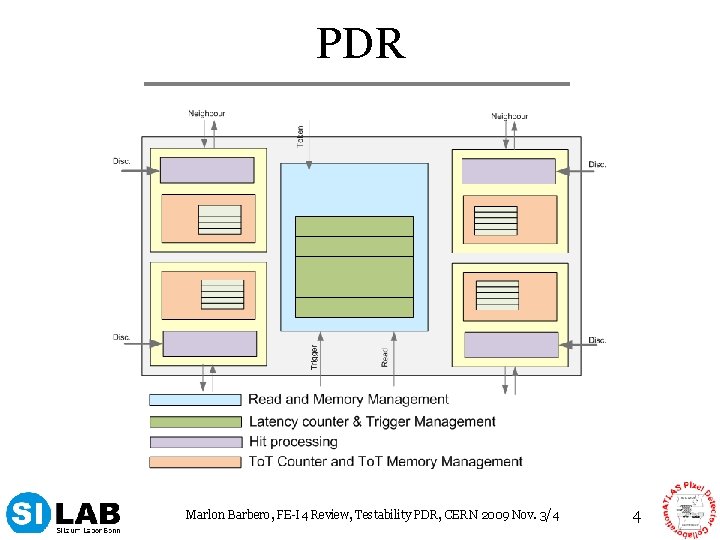
PDR Marlon Barbero, FE-I 4 Review, Testability PDR, CERN 2009 Nov. 3/4 4
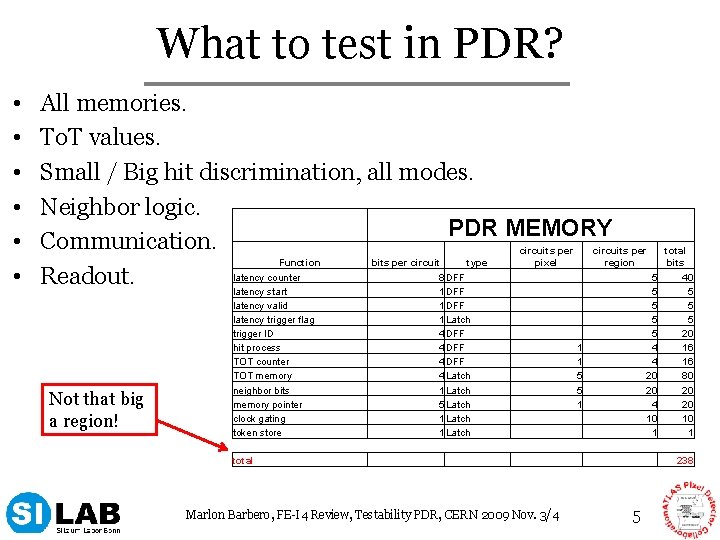
What to test in PDR? • • • All memories. To. T values. Small / Big hit discrimination, all modes. Neighbor logic. PDR MEMORY Communication. circuits per Function bits per circuit type pixel region latency counter 8 DFF 5 Readout. latency start 1 DFF 5 Not that big a region! latency valid latency trigger flag trigger ID hit process TOT counter TOT memory neighbor bits memory pointer clock gating token store total 1 DFF 1 Latch 4 DFF 4 Latch 1 Latch 5 Latch 1 Latch 5 5 5 4 4 20 20 4 10 1 1 1 5 5 1 Marlon Barbero, FE-I 4 Review, Testability PDR, CERN 2009 Nov. 3/4 total bits 40 5 5 5 20 16 16 80 20 20 10 1 238 5
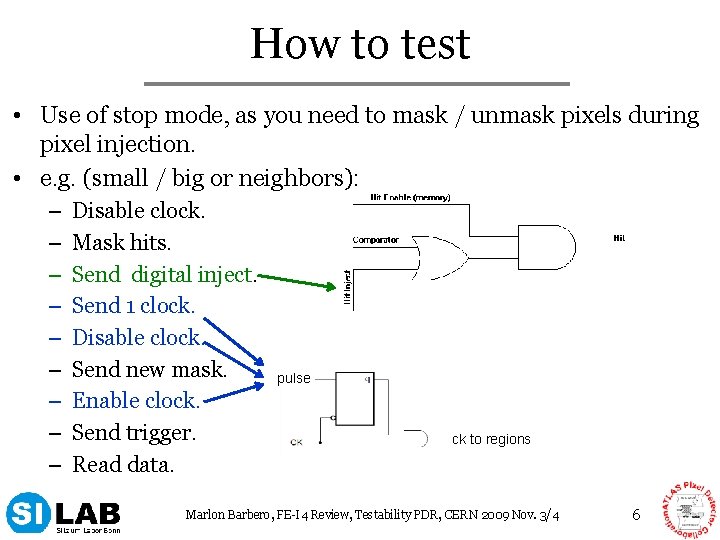
How to test • Use of stop mode, as you need to mask / unmask pixels during pixel injection. • e. g. (small / big or neighbors): – – – – – Disable clock. Mask hits. Send digital inject. Send 1 clock. Disable clock. Send new mask. Enable clock. Send trigger. Read data. pulse ck to regions Marlon Barbero, FE-I 4 Review, Testability PDR, CERN 2009 Nov. 3/4 6
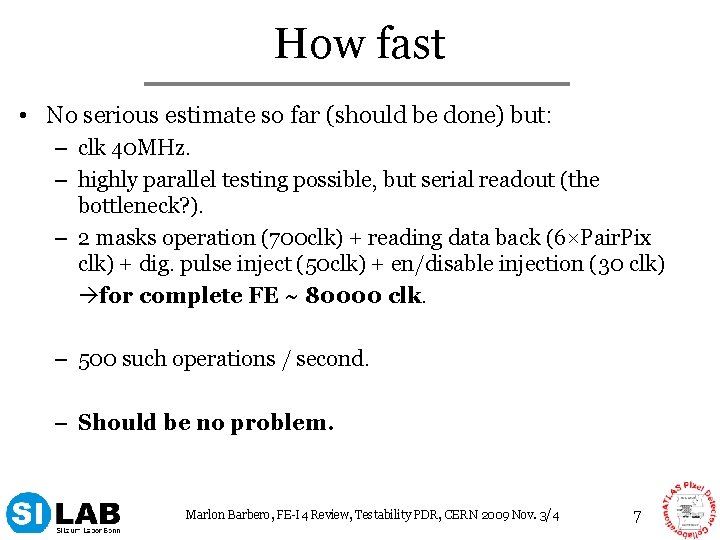
How fast • No serious estimate so far (should be done) but: – clk 40 MHz. – highly parallel testing possible, but serial readout (the bottleneck? ). – 2 masks operation (700 clk) + reading data back (6×Pair. Pix clk) + dig. pulse inject (50 clk) + en/disable injection (30 clk) for complete FE ~ 80000 clk. – 500 such operations / second. – Should be no problem. Marlon Barbero, FE-I 4 Review, Testability PDR, CERN 2009 Nov. 3/4 7
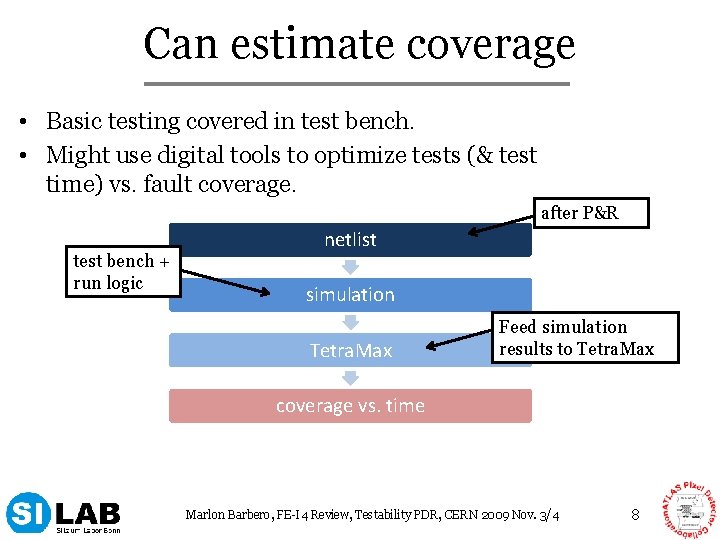
Can estimate coverage • Basic testing covered in test bench. • Might use digital tools to optimize tests (& test time) vs. fault coverage. after P&R test bench + run logic netlist simulation Tetra. Max Feed simulation results to Tetra. Max coverage vs. time Marlon Barbero, FE-I 4 Review, Testability PDR, CERN 2009 Nov. 3/4 8
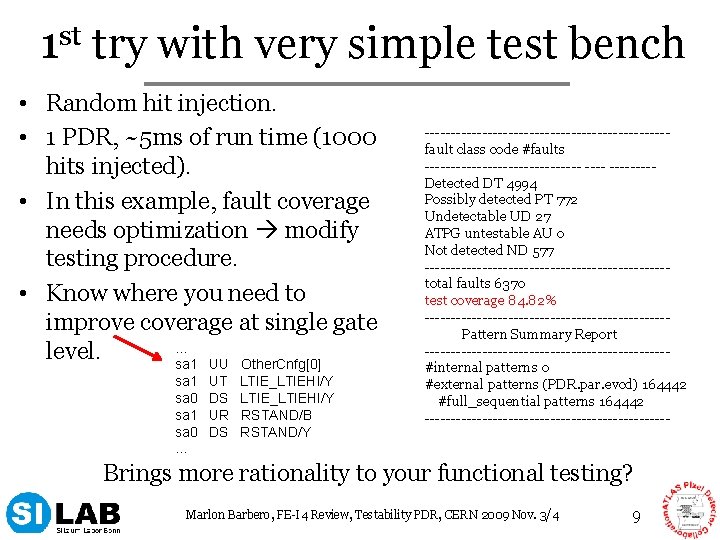
1 st try with very simple test bench • Random hit injection. • 1 PDR, ~5 ms of run time (1000 hits injected). • In this example, fault coverage needs optimization modify testing procedure. • Know where you need to improve coverage at single gate … level. sa 1 UU Other. Cnfg[0] sa 1 UT LTIE_LTIEHI/Y sa 0 DS LTIE_LTIEHI/Y sa 1 UR RSTAND/B sa 0 DS RSTAND/Y … ------------------------ fault class code #faults --------------- Detected DT 4994 Possibly detected PT 772 Undetectable UD 27 ATPG untestable AU 0 Not detected ND 577 ------------------------ total faults 6370 test coverage 84. 82% ------------------------ Pattern Summary Report ------------------------ #internal patterns 0 #external patterns (PDR. par. evcd) 164442 #full_sequential patterns 164442 ------------------------ Brings more rationality to your functional testing? Marlon Barbero, FE-I 4 Review, Testability PDR, CERN 2009 Nov. 3/4 9
Backup • BACKUP Marlon Barbero, FE-I 4 Review, Testability PDR, CERN 2009 Nov. 3/4 10
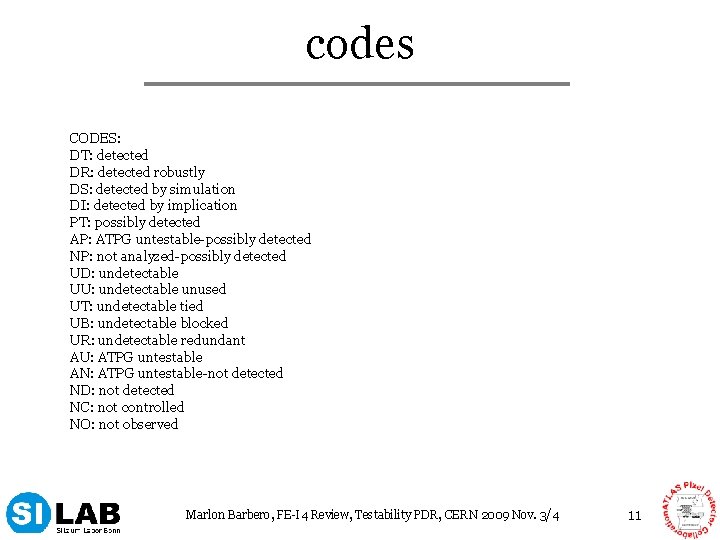
codes CODES: DT: detected DR: detected robustly DS: detected by simulation DI: detected by implication PT: possibly detected AP: ATPG untestable-possibly detected NP: not analyzed-possibly detected UD: undetectable UU: undetectable unused UT: undetectable tied UB: undetectable blocked UR: undetectable redundant AU: ATPG untestable AN: ATPG untestable-not detected ND: not detected NC: not controlled NO: not observed Marlon Barbero, FE-I 4 Review, Testability PDR, CERN 2009 Nov. 3/4 11
- Slides: 11