
Test Theory Classical Modern How we get scores


- Slides: 44
Test Theory – Classical & Modern (How we get scores for our tests) Gavin T L Brown, Ph. D Seminar at EARLI SIG 1 Summer School, August 2018, Helsinki, Finland
Overview • Philosophic and practical issues � Difficulty, discrimination, & chance ◦ Classical Test (True Score) Theory ◦ Item Response Theory (Rasch, 2 PL, and 3 PL)
Assumptions in Measurement � If something exists we can measure it � If we can’t measure it, we may have failed in our ingenuity and ability to measure—it doesn’t mean the thing doesn’t exist � We have an unfortunate tendency to treat as valuable only the things we can measure ◦ We tend to treat as value-less anything we can’t measure even if it does have value
Assumptions in Measurement � All measures have some error ◦ The length of a certain platinum bar in Paris is a metre ◦ It is supposed to be 1/10, 000 th of the distance from equator to pole ◦ but it is short by 0. 2 mm according to satellite surveys � Less error in measures of physical phenomena and more in social phenomena
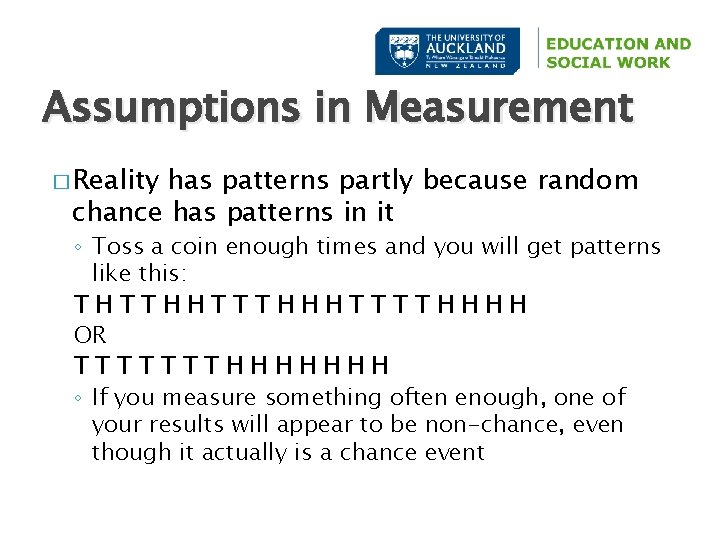
Assumptions in Measurement � Reality has patterns partly because random chance has patterns in it ◦ Toss a coin enough times and you will get patterns like this: THTTHHTTTHHHTTTTHHHH OR TTTTTTTHHHHHHH ◦ If you measure something often enough, one of your results will appear to be non-chance, even though it actually is a chance event
Assumptions in Measurement � Chance plays a significant part in the results we generate ◦ Sometimes the result we get could occur by chance anyway; just because something happens doesn’t mean it would not have occurred anyway ◦ If it is relatively unlikely to occur by chance then we say it is “Statistically significant” �So we create tables of how often things occur by chance as a reference point ◦ We can estimate the probability (p) of something happening by chance and use this to determine whether our result is real or a chance artefact
Measuring Human mental properties � Problem of measuring stuff ‘in-the-head’ ◦ Our mental actions are difficulty to observe directly � How do we know how much xxx you have? ◦ Measure xxx with a recognised tool � Measuring Tools for Social Science ◦ Answers to Questions (paper or oral) ◦ Self-reports ◦ Observational Check Lists � What have? scale properties do tools like these
Test Scores � Answers are marked as right =1, wrong=0 ◦ Categorical/Nominal labelling of each response � Tests use the sum of all answers marked as right to indicate total score ◦ 1, 0, 1, 1, 1, 0, 0, 0, 1, 0=5/10: A continuous, numeric scale � What other factors might be at work and how do we account for them? ◦ Difficulty of items, quality of items, probability of getting an item right despite low knowledge, varying ability of people
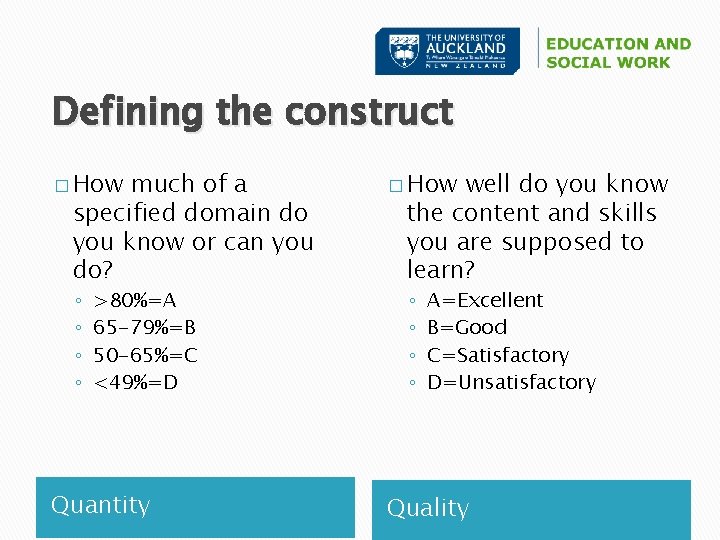
Defining the construct � How much of a specified domain do you know or can you do? ◦ ◦ >80%=A 65 -79%=B 50 -65%=C <49%=D Quantity � How well do you know the content and skills you are supposed to learn? ◦ ◦ A=Excellent B=Good C=Satisfactory D=Unsatisfactory Quality
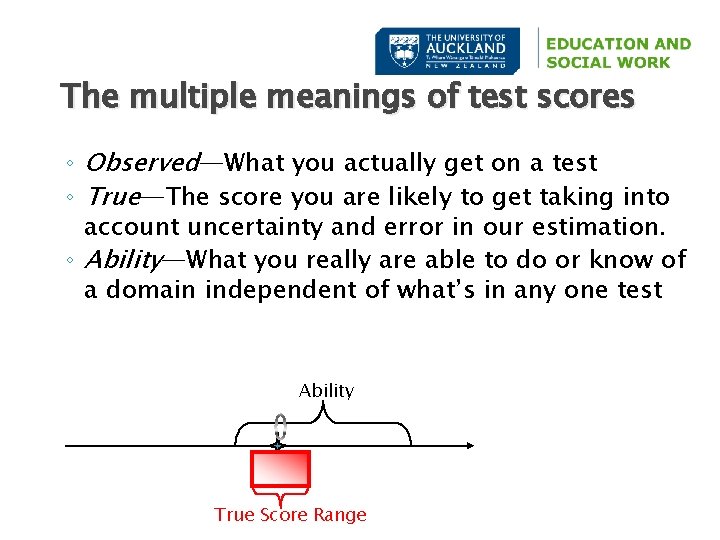
The multiple meanings of test scores ◦ Observed—What you actually get on a test ◦ True—The score you are likely to get taking into account uncertainty and error in our estimation. ◦ Ability—What you really are able to do or know of a domain independent of what’s in any one test Ability True Score Range
How Tests & Scores Relate � Ability is relatively constant or invariant; only changes gradually with learning & teaching (test independent) � True Score varies depending on difficulty of items selected in test (test dependent) � Observed scores vary dependent on quality of items and their accuracy in measuring the construct (test dependent) � What we know about items depends on the sample of examinees they are tested on
Two Major Models � Classical Test Theory � Item (CTT) ◦ Served test industry well for most of 20 th century ◦ Relatively weak theoretical assumptions – easy to meet ◦ Easy to apply – hand calculated statistics, but ◦ Major limitations ◦ Focus at TEST level Response Theory (IRT) ◦ ‘Modern’ test theory ◦ Strong theoretical assumptions … but may not always be met! ◦ Requires computers to apply ◦ Focus at ITEM level
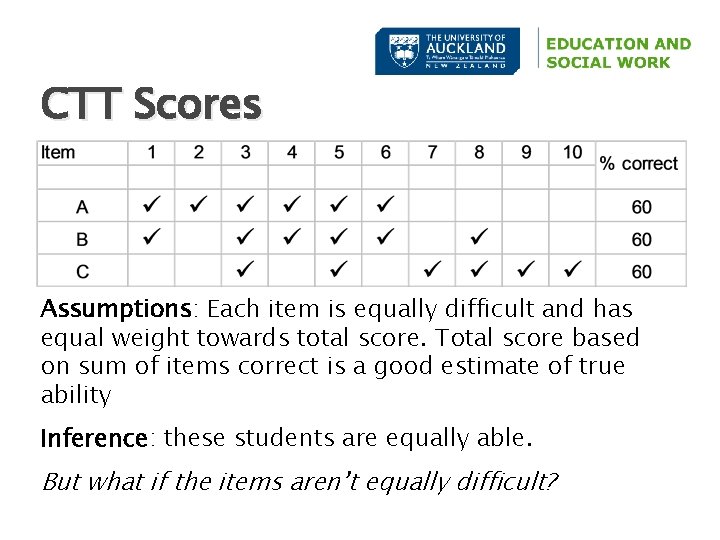
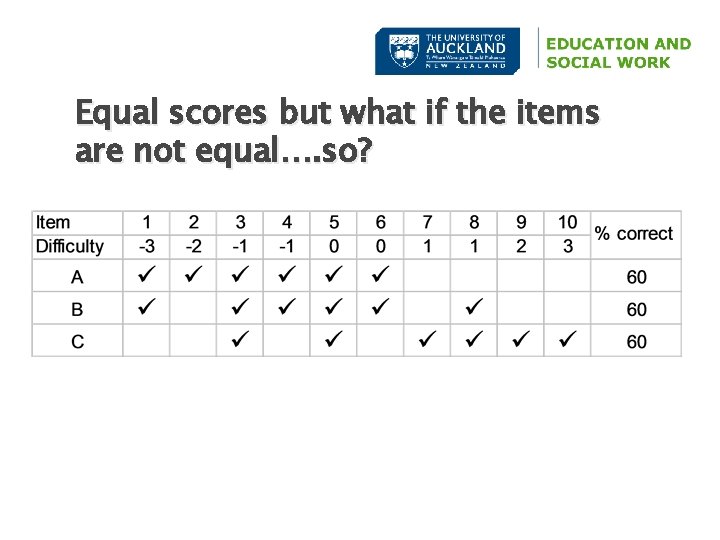
Test Scores: The problem � Students A, B and C all sit the same test � Test has ten items � All items are dichotomous (score 0 or 1) � All three students score 6 out of 10 � What can we say about the ability of these three students?
CTT Scores Assumptions: Each item is equally difficult and has equal weight towards total score. Total score based on sum of items correct is a good estimate of true ability Inference: these students are equally able. But what if the items aren’t equally difficult?
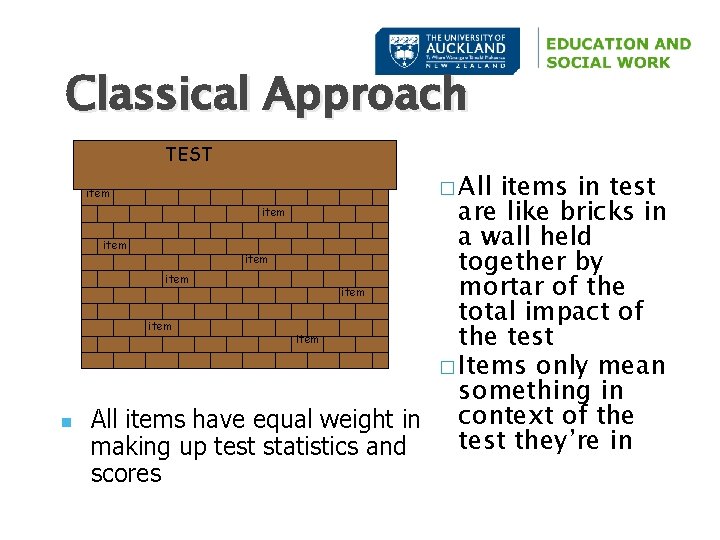
Classical Approach TEST items in test item are like bricks in a wall held item together by item mortar of the item total impact of item the test � Items only mean something in All items have equal weight in context of the test they’re in making up test statistics and scores item n � All
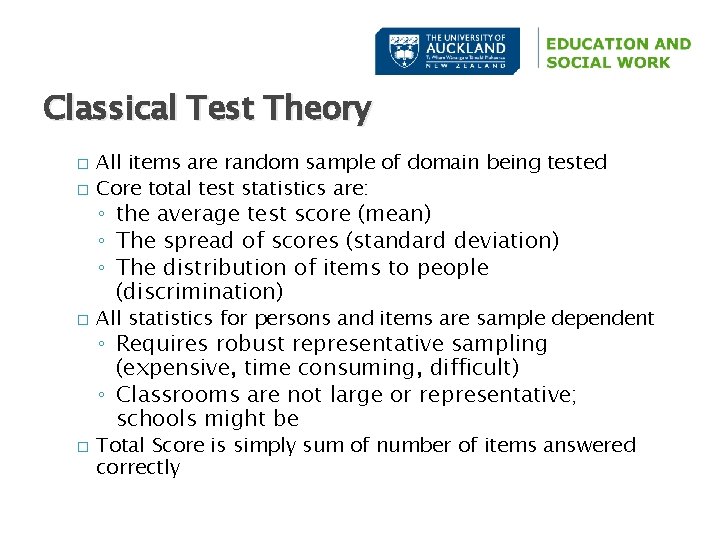
Classical Test Theory � � All items are random sample of domain being tested Core total test statistics are: ◦ the average test score (mean) ◦ The spread of scores (standard deviation) ◦ The distribution of items to people (discrimination) � All statistics for persons and items are sample dependent ◦ Requires robust representative sampling (expensive, time consuming, difficult) ◦ Classrooms are not large or representative; schools might be � Total Score is simply sum of number of items answered correctly
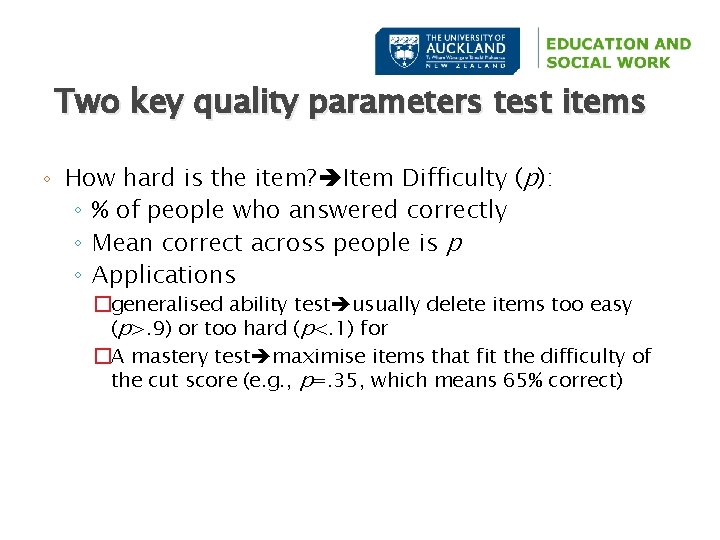
Two key quality parameters test items ◦ How hard is the item? Item Difficulty (p): ◦ % of people who answered correctly ◦ Mean correct across people is p ◦ Applications �generalised ability test usually delete items too easy (p>. 9) or too hard (p<. 1) for �A mastery test maximise items that fit the difficulty of the cut score (e. g. , p=. 35, which means 65% correct)
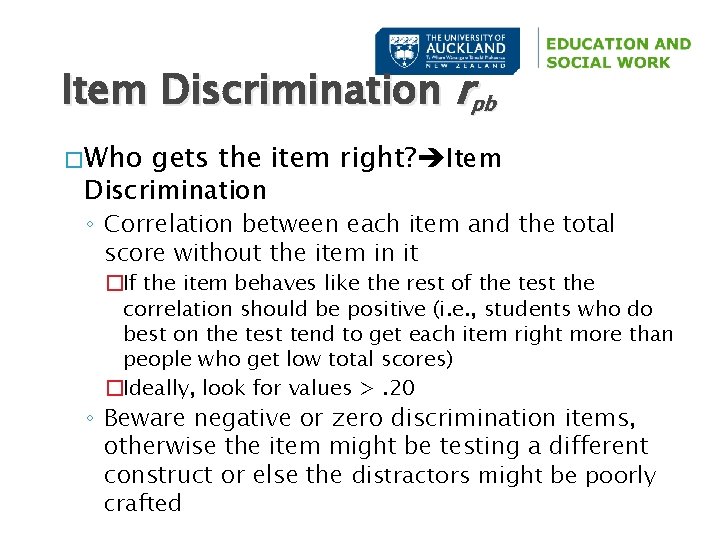
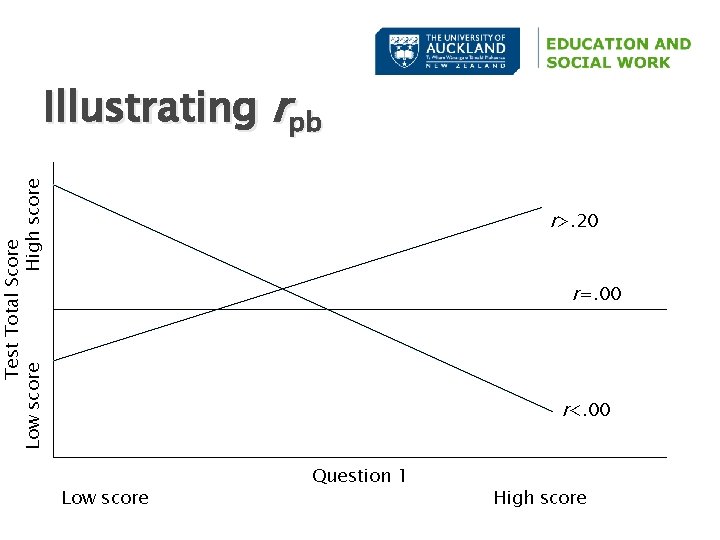
Item Discrimination rpb � Who gets the item right? Item Discrimination ◦ Correlation between each item and the total score without the item in it �If the item behaves like the rest of the test the correlation should be positive (i. e. , students who do best on the test tend to get each item right more than people who get low total scores) �Ideally, look for values >. 20 ◦ Beware negative or zero discrimination items, otherwise the item might be testing a different construct or else the distractors might be poorly crafted
Test Total Score Low score High score Illustrating rpb r>. 20 r=. 00 r<. 00 Low score Question 1 High score
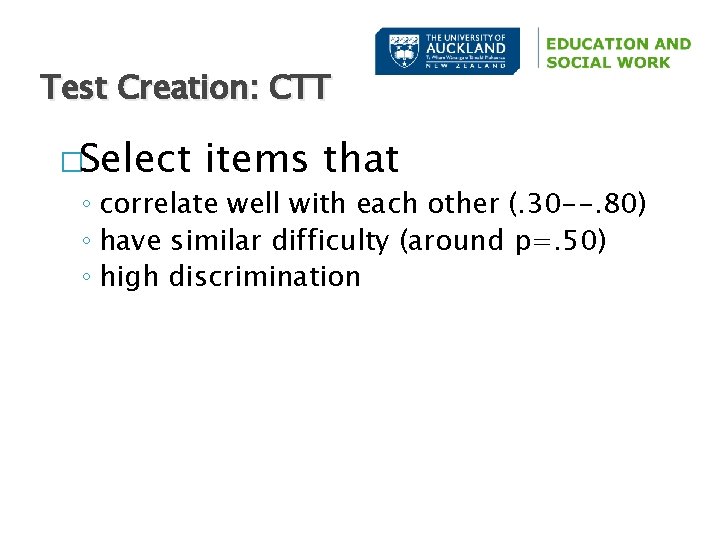
Test Creation: CTT �Select items that ◦ correlate well with each other (. 30 --. 80) ◦ have similar difficulty (around p=. 50) ◦ high discrimination
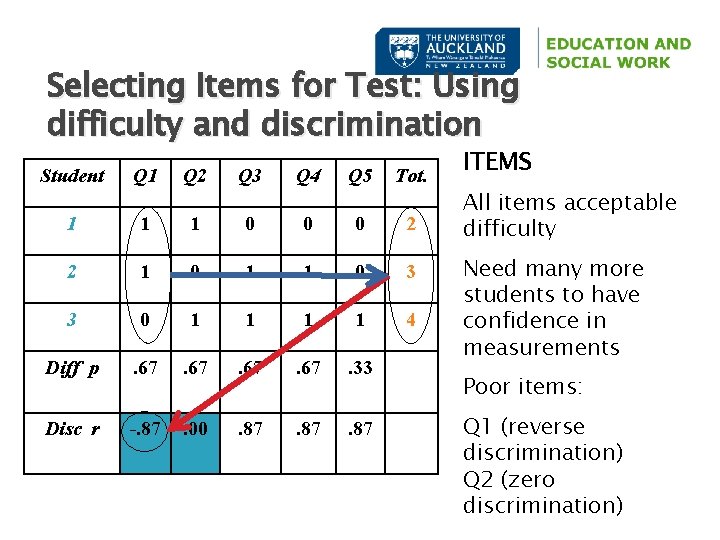
Selecting Items for Test: Using difficulty and discrimination Student Q 1 Q 2 Q 3 Q 4 Q 5 Tot. 1 1 1 0 0 0 2 2 1 0 1 1 0 3 3 0 1 1 4 Diff p . 67 . 33 Disc r -. 87 . 00 . 87 ITEMS All items acceptable difficulty Need many more students to have confidence in measurements Poor items: Q 1 (reverse discrimination) Q 2 (zero discrimination)
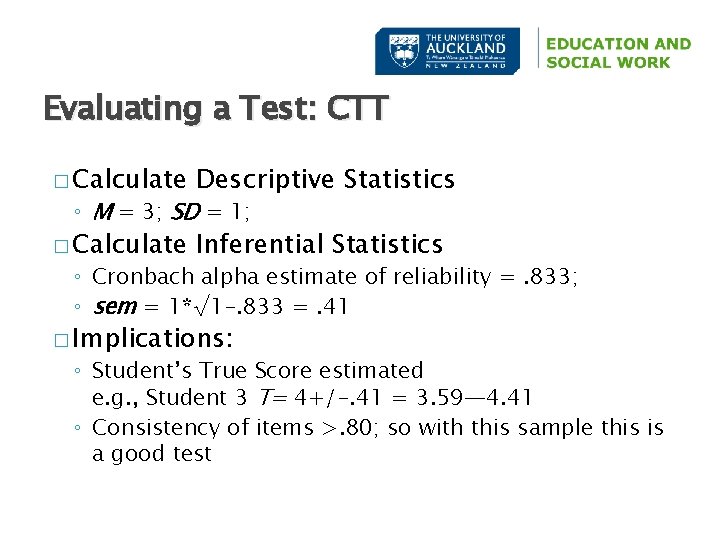
Evaluating a Test: CTT � Calculate Descriptive Statistics � Calculate Inferential Statistics ◦ M = 3; SD = 1; ◦ Cronbach alpha estimate of reliability =. 833; ◦ sem = 1*√ 1 -. 833 =. 41 � Implications: ◦ Student’s True Score estimated e. g. , Student 3 T= 4+/-. 41 = 3. 59— 4. 41 ◦ Consistency of items >. 80; so with this sample this is a good test
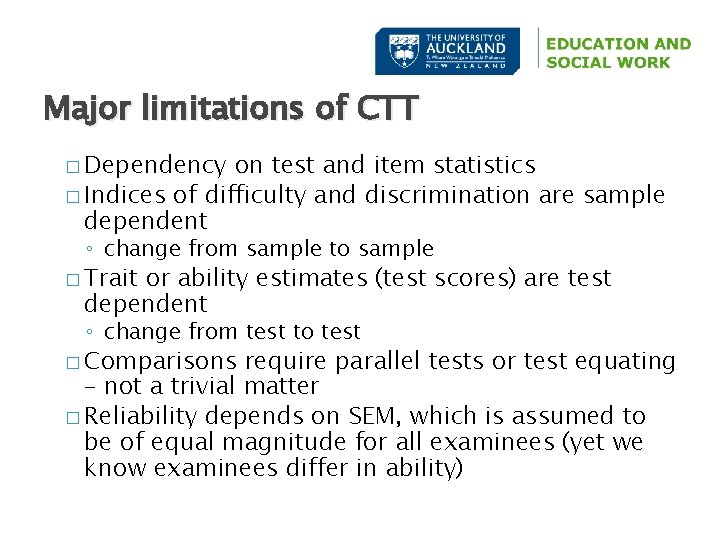
Major limitations of CTT � Dependency on test and item statistics � Indices of difficulty and discrimination are sample dependent ◦ change from sample to sample � Trait or ability estimates (test scores) are test dependent ◦ change from test to test � Comparisons require parallel tests or test equating – not a trivial matter � Reliability depends on SEM, which is assumed to be of equal magnitude for all examinees (yet we know examinees differ in ability)
Summary of CTT � All statistics for persons, items, and tests are sample dependent ◦ Requires robust representative sampling (expensive, time consuming, difficult) � Items have equal weight towards total score � Easy statistics to obtain & interpret for TESTS only � Has major limitations, however
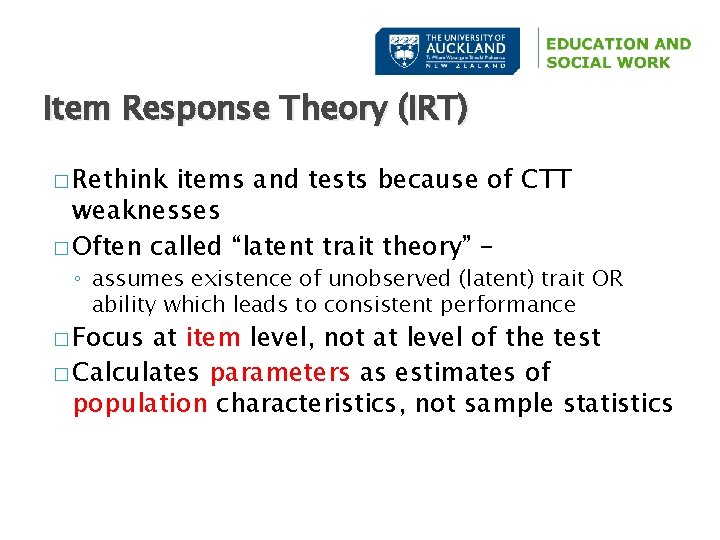
Item Response Theory (IRT) � Rethink items and tests because of CTT weaknesses � Often called “latent trait theory” – ◦ assumes existence of unobserved (latent) trait OR ability which leads to consistent performance � Focus at item level, not at level of the test � Calculates parameters as estimates of population characteristics, not sample statistics
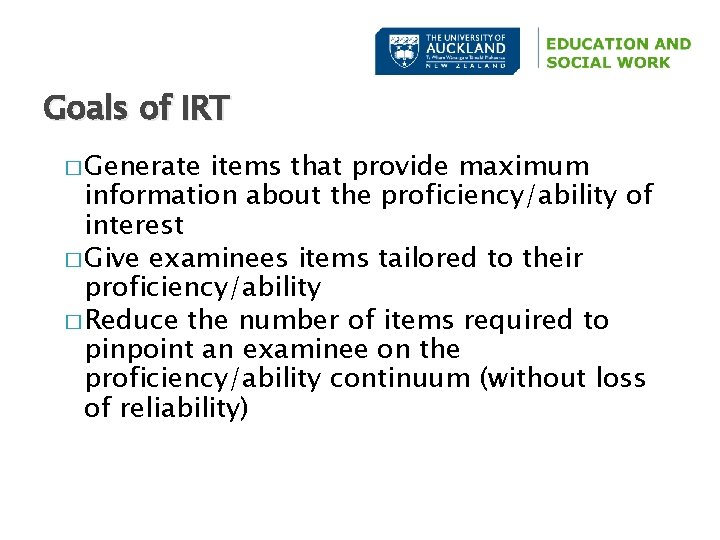
Goals of IRT � Generate items that provide maximum information about the proficiency/ability of interest � Give examinees items tailored to their proficiency/ability � Reduce the number of items required to pinpoint an examinee on the proficiency/ability continuum (without loss of reliability)
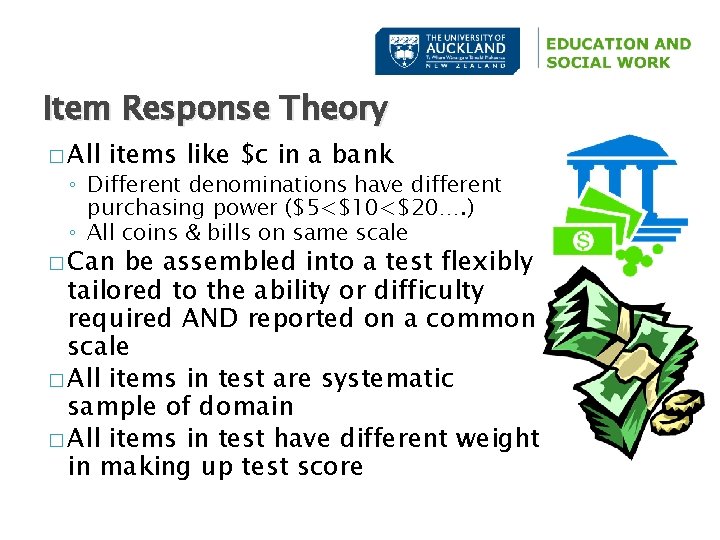
Item Response Theory � All items like $c in a bank ◦ Different denominations have different purchasing power ($5<$10<$20…. ) ◦ All coins & bills on same scale � Can be assembled into a test flexibly tailored to the ability or difficulty required AND reported on a common scale � All items in test are systematic sample of domain � All items in test have different weight in making up test score
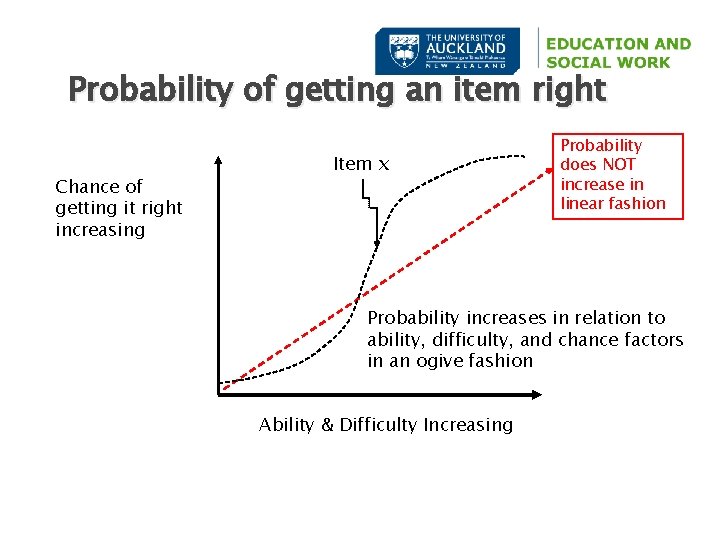
IRT Assumptions � Probability of getting an item correct is a function of ability—Pi(θ) ◦ as ability increases the chance of getting item correct increases � People and items can be located on one scale � Item statistics are invariant across groups of examinees � S-shaped curves (ogive) plot relationship of parameters � More than one model for accounting for error components
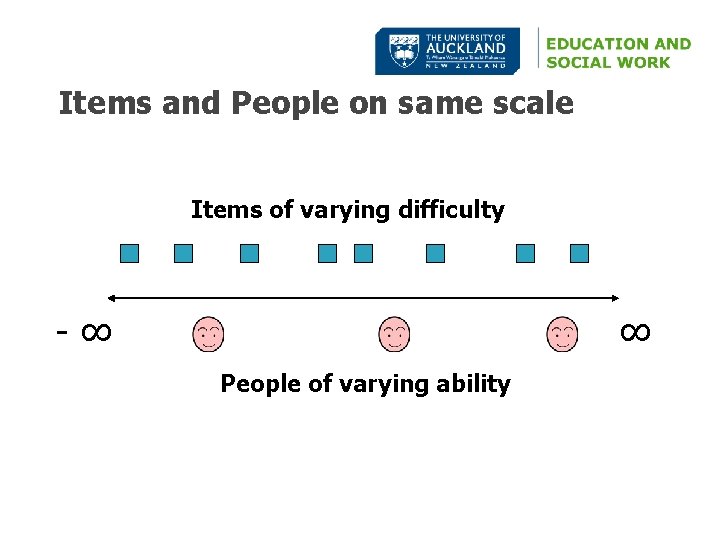
Items and People on same scale Items of varying difficulty -∞ ∞ People of varying ability
Ogive �A term used to describe a round tapering shape
Probability of getting an item right Chance of getting it right increasing Item x Probability does NOT increase in linear fashion Probability increases in relation to ability, difficulty, and chance factors in an ogive fashion Ability & Difficulty Increasing
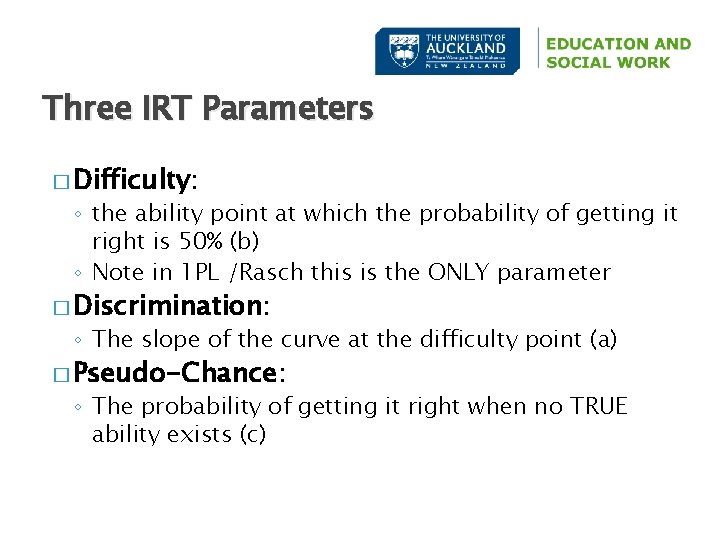
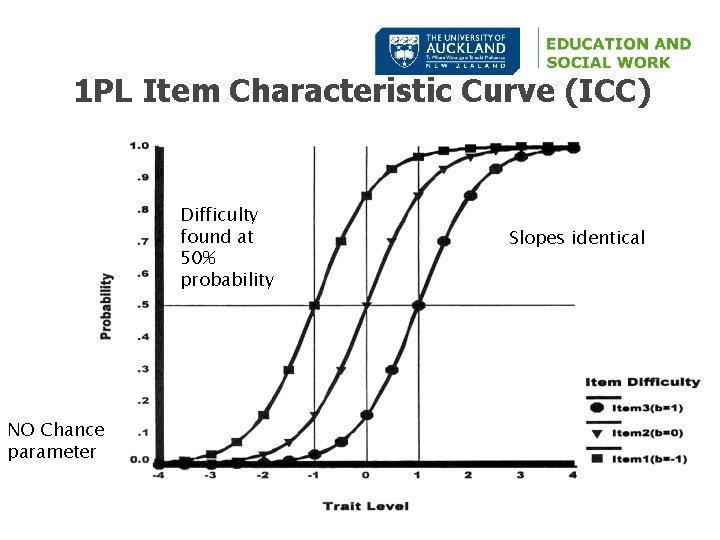
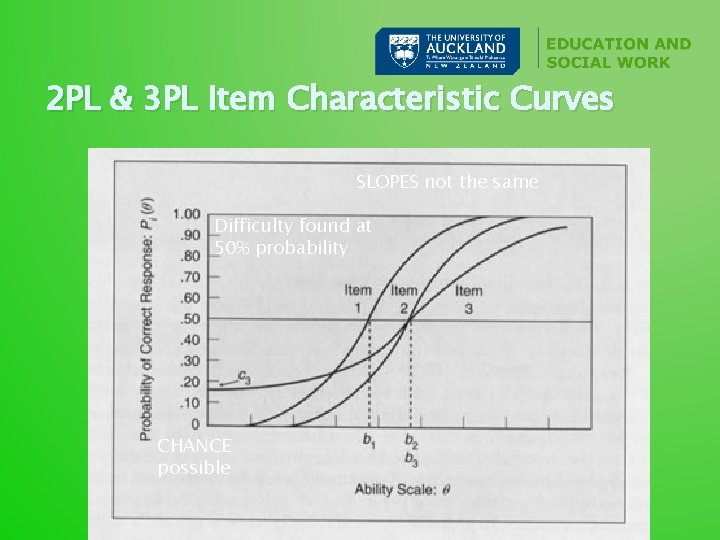
Three IRT Parameters � Difficulty: ◦ the ability point at which the probability of getting it right is 50% (b) ◦ Note in 1 PL /Rasch this is the ONLY parameter � Discrimination: ◦ The slope of the curve at the difficulty point (a) � Pseudo-Chance: ◦ The probability of getting it right when no TRUE ability exists (c)
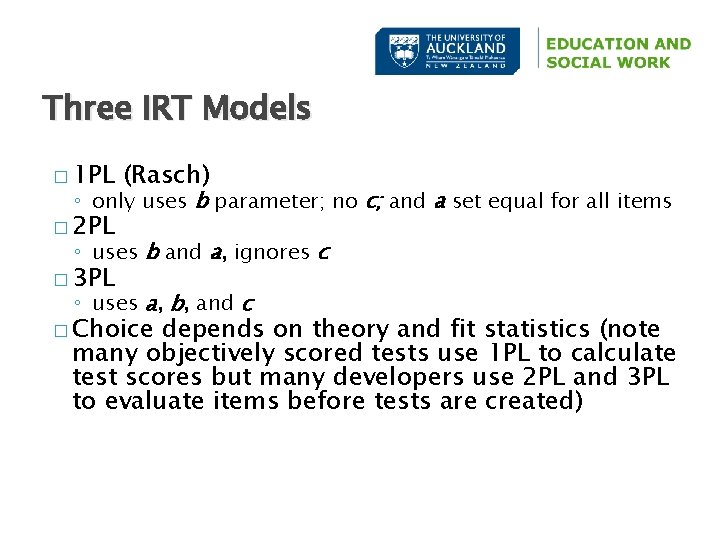
Three IRT Models � 1 PL (Rasch) ◦ only uses b parameter; no c; and a set equal for all items � 2 PL ◦ uses b and a, ignores c � 3 PL ◦ uses a, b, and c � Choice depends on theory and fit statistics (note many objectively scored tests use 1 PL to calculate test scores but many developers use 2 PL and 3 PL to evaluate items before tests are created)
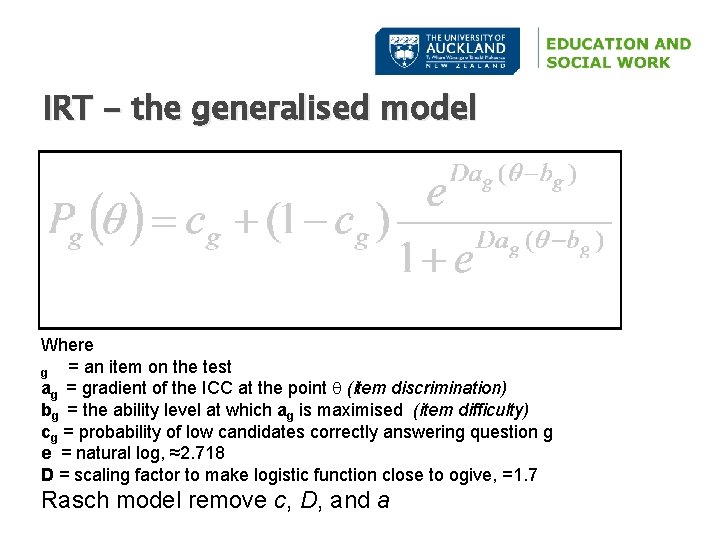
IRT - the generalised model Where = an item on the test g ag = gradient of the ICC at the point (item discrimination) bg = the ability level at which ag is maximised (item difficulty) cg = probability of low candidates correctly answering question g e = natural log, ≈2. 718 D = scaling factor to make logistic function close to ogive, =1. 7 Rasch model remove c, D, and a
Estimating a Score � IRT creates estimate of ability based on how hard the items were that the student got right ◦ Creates estimate of where the student has a 50% chance of getting items correct � Note more items answered correctly at the same difficulty point only increases accuracy of estimate, not the estimate of ability
1 PL Item Characteristic Curve (ICC) Difficulty found at 50% probability NO Chance parameter Slopes identical
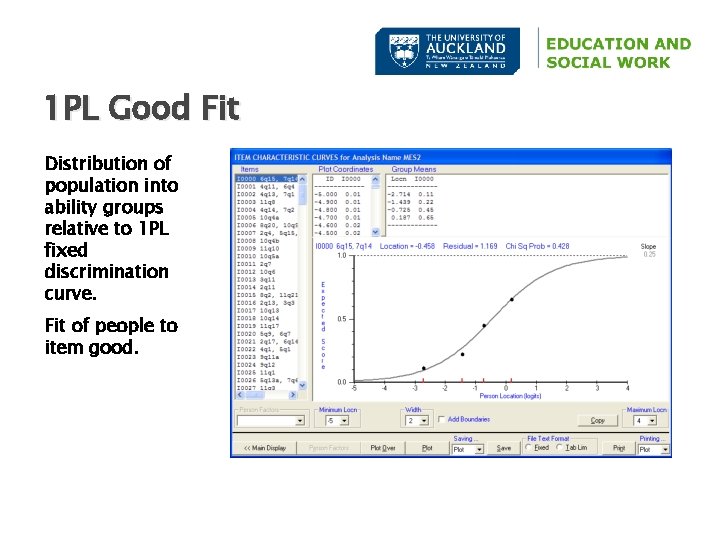
1 PL Good Fit Distribution of population into ability groups relative to 1 PL fixed discrimination curve. Fit of people to item good.
2 PL & 3 PL Item Characteristic Curves SLOPES not the same Difficulty found at 50% probability CHANCE possible
Key Properties of IRT � Probabilistic - determines the probability that an examinee with ability correctly answers the item � Identifies how well data fits the model � Identifies which items to reject before score calculation � Estimates item parameters and person ability on same scale � Sample independent
Equal scores but what if the items are not equal…. so?
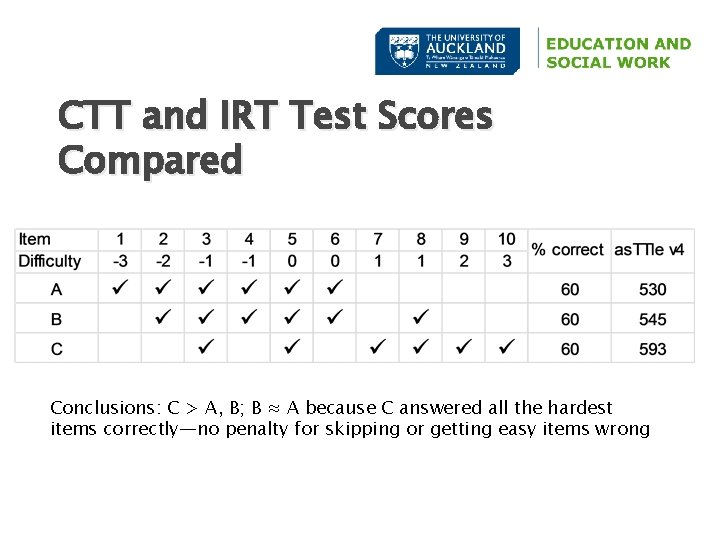
CTT and IRT Test Scores Compared Conclusions: C > A, B; B ≈ A because C answered all the hardest items correctly—no penalty for skipping or getting easy items wrong
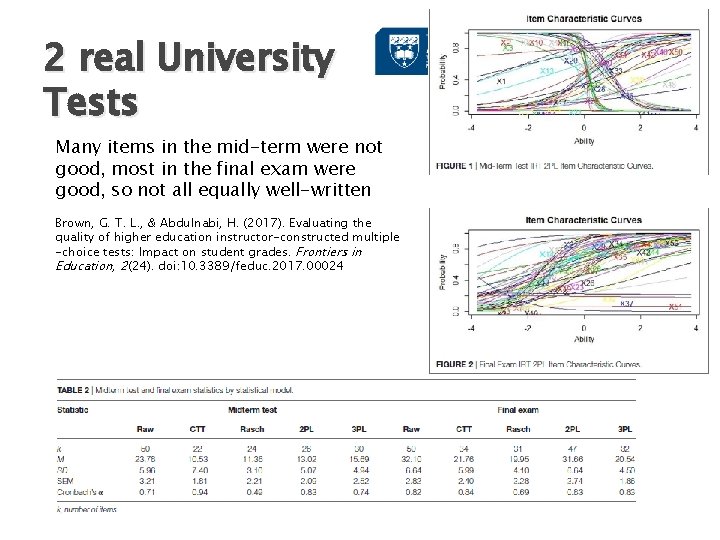
2 real University Tests Many items in the mid-term were not good, most in the final exam were good, so not all equally well-written Brown, G. T. L. , & Abdulnabi, H. (2017). Evaluating the quality of higher education instructor-constructed multiple -choice tests: Impact on student grades. Frontiers in Education, 2(24). doi: 10. 3389/feduc. 2017. 00024
Tutorial � Install R; R Studio � Install packages ◦ (if you haven’t got them already) ◦ psych, ltm � Download data file ◦ https: //figshare. com/s/84263075944322 e 54036 � Open “Analysing a test with packages in R” tutorial document ◦ https: //figshare. com/s/aa 594 e 1913 d 00 fe 02852 � Let’s go….
Extra readings � � Baker, F. B. (2001). The Basics of Item Response Theory (2 nd ed. ). College Park, MD: ERIC Clearinghouse on Assessment and Evaluation, University of Maryland. Available: https: //eric. ed. gov/? id=ED 458219 Embretson, S. E. , & Reise, S. P. (2000). Item Response Theory for Psychologists. Mahwah, NJ: LEA. Hambleton, R. K. , & Jones, R. W. (1993). Comparison of classical test theory and item response theory and their applications to test development. Educational Measurement: Issues & Practice, 12(3), 38 -47. Hambleton, R. K. , Swaminathan, H. , & Rogers, H. J. (1991). Fundamentals of item response theory. Newbury Park, CA: Sage.