
Test Techniques Analyze the situation Model the test
- Slides: 12
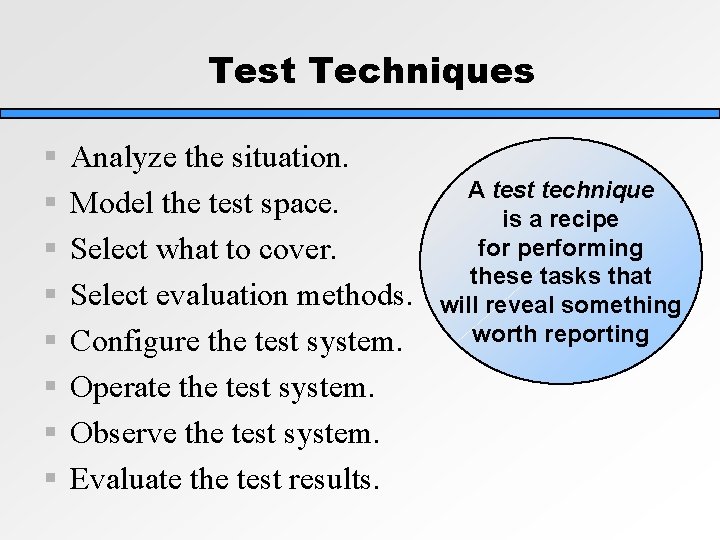
Test Techniques § § § § Analyze the situation. Model the test space. Select what to cover. Select evaluation methods. Configure the test system. Operate the test system. Observe the test system. Evaluate the test results. A test technique is a recipe for performing these tasks that will reveal something worth reporting
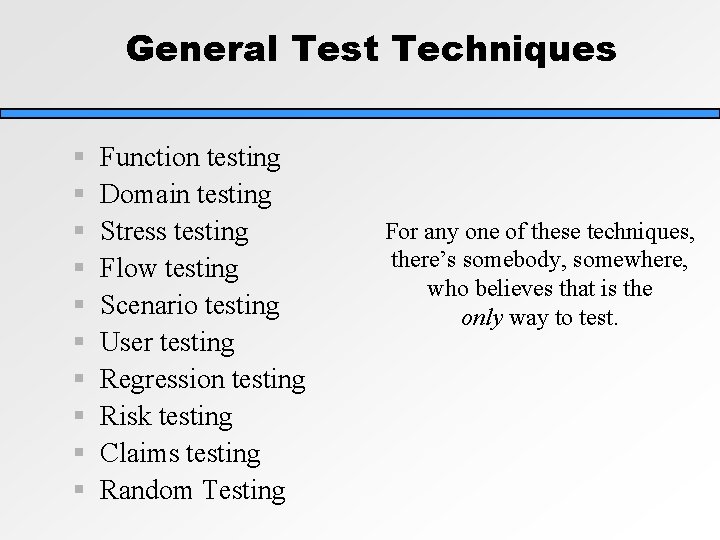
General Test Techniques § § § § § Function testing Domain testing Stress testing Flow testing Scenario testing User testing Regression testing Risk testing Claims testing Random Testing For any one of these techniques, there’s somebody, somewhere, who believes that is the only way to test.
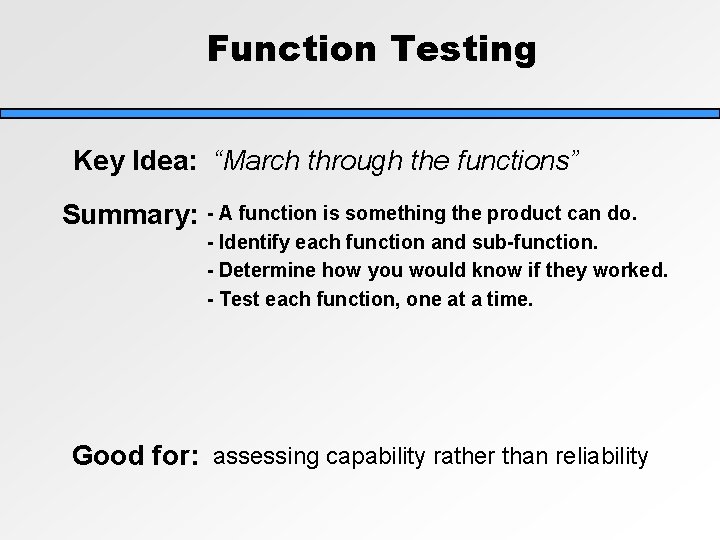
Function Testing Key Idea: “March through the functions” Summary: - A function is something the product can do. - Identify each function and sub-function. - Determine how you would know if they worked. - Test each function, one at a time. Good for: assessing capability rather than reliability
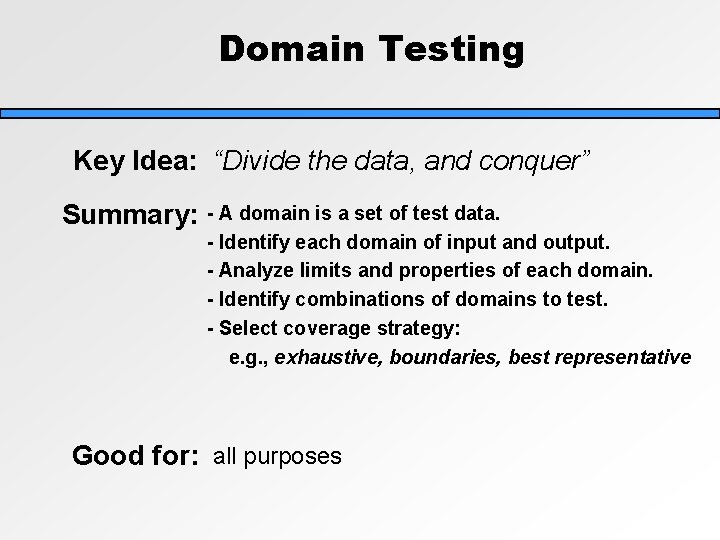
Domain Testing Key Idea: “Divide the data, and conquer” Summary: - A domain is a set of test data. - Identify each domain of input and output. - Analyze limits and properties of each domain. - Identify combinations of domains to test. - Select coverage strategy: e. g. , exhaustive, boundaries, best representative Good for: all purposes
Stress Testing Key Idea: “Overwhelm the product” Summary: - Select test items and functions to stress. - Identify data and platform elements that relate to them. - Select or generate challenging data and platform configurations to test with: e. g. , large or complex data structures, high loads, long test runs, many test cases Good for: performance, reliability, and efficiency assessment
Flow Testing Key Idea: “Do one thing after another” Summary: - Define test procedures or high level cases that incorporate many events and states. - The events may be in series, parallel, or some combination thereof. - Don’t reset the system between events. Good for: finding problems fast (however, bug analysis is more difficult)
Scenario Testing Key Idea: “Test to a compelling story” Summary: - Design tests that involve meaningful and complex interactions with the product. - A good scenario test is a plausible story of how someone who matters might do something that matters with the product. - Incorporate multiple elements of the product, and data that is realistically complex. Good for: Finding problems that seem important
User Testing Key Idea: “Involve the users” Summary: - Identify categories of users. - Understand favored and disfavored users. -Find these users and have them do testing or help you design tests. -User testing is powerful when you involve a variety of users. Good for: all purposes
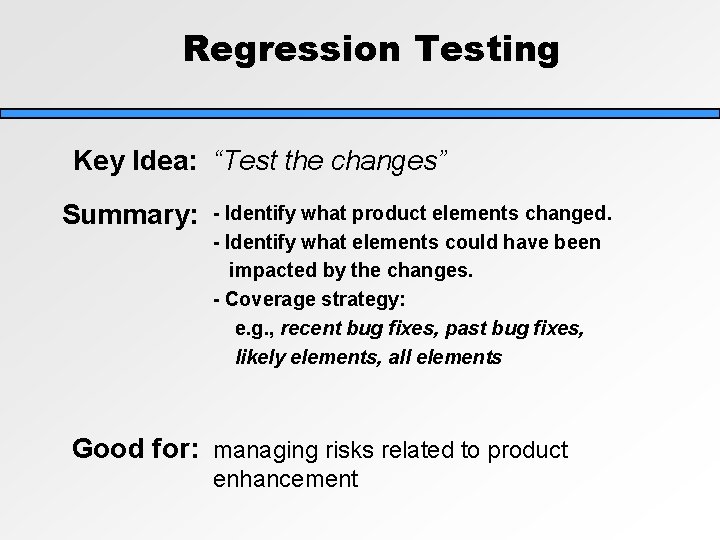
Regression Testing Key Idea: “Test the changes” Summary: - Identify what product elements changed. - Identify what elements could have been impacted by the changes. - Coverage strategy: e. g. , recent bug fixes, past bug fixes, likely elements, all elements Good for: managing risks related to product enhancement
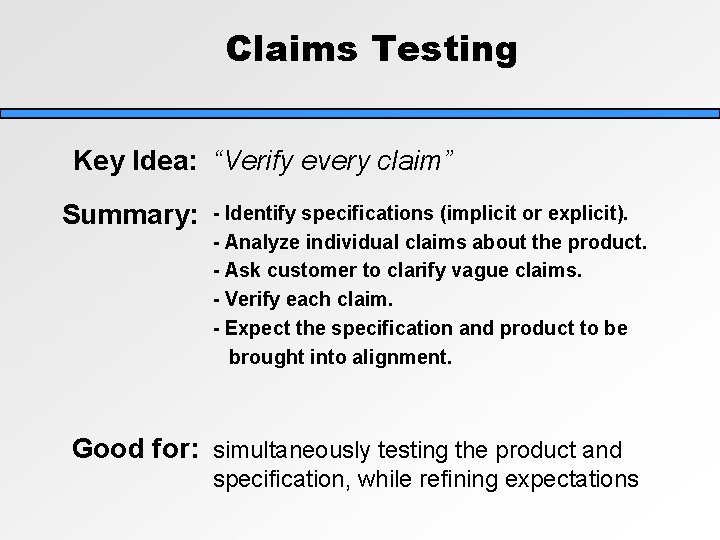
Claims Testing Key Idea: “Verify every claim” Summary: - Identify specifications (implicit or explicit). - Analyze individual claims about the product. - Ask customer to clarify vague claims. - Verify each claim. - Expect the specification and product to be brought into alignment. Good for: simultaneously testing the product and specification, while refining expectations
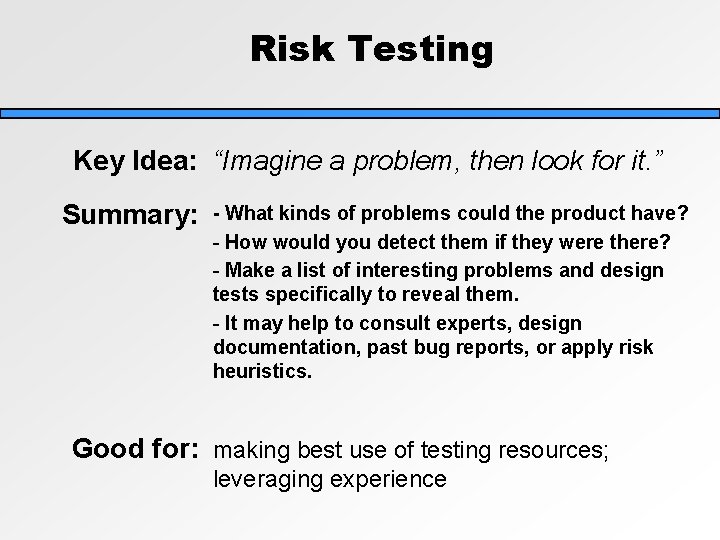
Risk Testing Key Idea: “Imagine a problem, then look for it. ” Summary: - What kinds of problems could the product have? - How would you detect them if they were there? - Make a list of interesting problems and design tests specifically to reveal them. - It may help to consult experts, design documentation, past bug reports, or apply risk heuristics. Good for: making best use of testing resources; leveraging experience
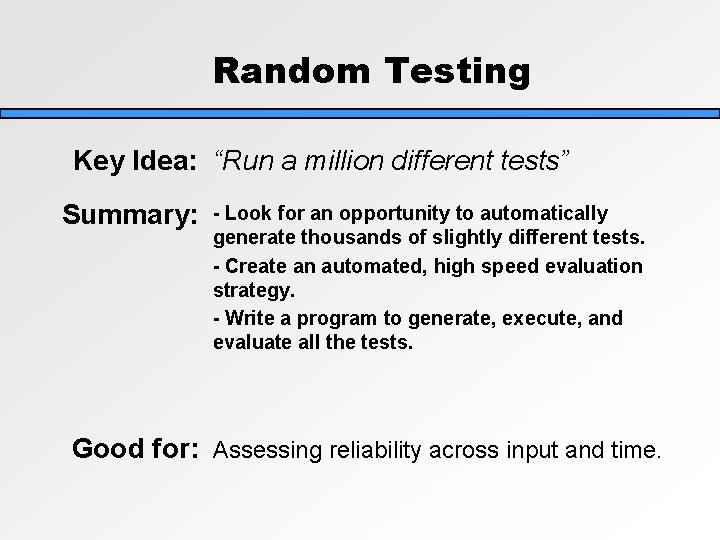
Random Testing Key Idea: “Run a million different tests” Summary: - Look for an opportunity to automatically generate thousands of slightly different tests. - Create an automated, high speed evaluation strategy. - Write a program to generate, execute, and evaluate all the tests. Good for: Assessing reliability across input and time.